

What if filing for bankruptcy in Chicago wasn't a permanent exit from the housing market, but actually the most strategic way to reset your path to homeownership? Many residents feel like they've been handed a life sentence of high rent and financial exile, but the reality of getting a mortgage after bankruptcy in Cook County is far more optimistic than you might think. With median home prices hitting $387,000 as of April 2026, the urgency to stop paying a landlord and start building your own equity is higher than ever.
It's completely normal to feel overwhelmed by the conflicting rules for FHA and Conventional loans or to worry that your credit is beyond repair. You likely want a stable future without the constant fear of being priced out of your neighborhood. This guide will show you exactly how to navigate the 2026 regulatory landscape to secure a home in as little as 24 months. We'll break down the specific waiting periods for different loan types, explain how the new $50,000 Illinois homestead exemption protects you, and provide a clear roadmap to rebuild your credit score from the ground up.
Key Takeaways
- Learn why filing for bankruptcy isn't a 10-year ban on homeownership and how it can actually position you as a better loan candidate by wiping the slate clean.
- Discover the exact waiting periods for FHA, VA, and conventional loans to find your fastest route for getting a mortgage after bankruptcy in Cook County.
- Understand how the specific type of filing you choose, whether it's Chapter 7 or Chapter 13, changes your eligibility timeline and lender requirements.
- Follow a 12-month roadmap for credit rehabilitation that focuses on smart strategies like secured cards to boost your score before you apply.
- Find out how having a legal team that handles both bankruptcy and real estate closings helps you avoid technical errors that could stall your home purchase.
Can You Really Buy a House After Bankruptcy in Cook County?
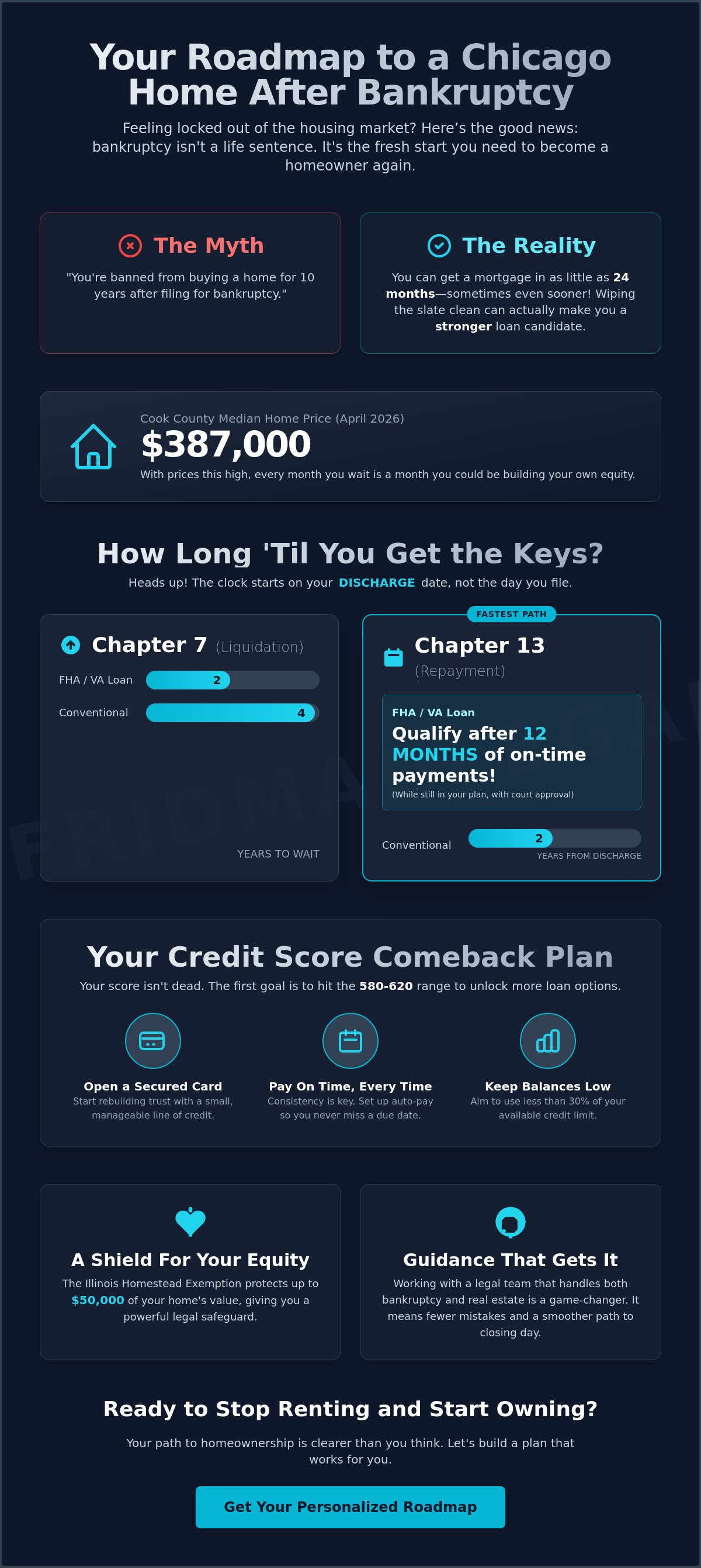
There's a persistent rumor that filing for bankruptcy means you're banned from the housing market for a decade. In Chicago, that simply isn't true. While a bankruptcy stays on your credit report, it doesn't stop you from getting a mortgage after bankruptcy in Cook County. In fact, for many people, it's the only realistic way to clear out the "noise" of old debt so they can actually qualify for a loan. Lenders don't just look at your past; they look at your current ability to pay, and a discharge often makes you a more attractive candidate by lowering your debt to income ratio.
As we move through 2026, the Cook County real estate market remains incredibly competitive. Median home prices have climbed to $387,000, and rent prices aren't showing signs of slowing down. Waiting ten years isn't just frustrating; it's financially impossible for most families. The good news is that lenders have specific rules that allow you to buy much sooner than you'd expect. By understanding these timelines, you can stop feeling like a financial exile and start planning your move back into a home of your own.
The "Fresh Start" Philosophy in Chicago
The legal framework established by the U.S. Bankruptcy Code isn't designed to punish you forever. Instead, it's built on the idea that the economy works better when people aren't buried under unpayable debt. Local lenders in the Chicago area understand this philosophy well. They'd often rather see a borrower who has legally discharged their debts than one who is barely treading water with massive credit card balances. A "Fresh Start" is essentially a legal and financial tool that allows you to regain your purchasing power by trading a temporary credit hit for long term solvency.
Why Your Credit Score Isn’t "Dead"
Many people expect their credit score to drop to zero and stay there. That's a myth. While there's an initial dip, removing delinquent accounts and late payments can actually give your score a small, immediate bump. It sounds counterintuitive, but getting a mortgage after bankruptcy in Cook County starts with accepting that your score is a living number, not a static judgment. You don't need a perfect 800 score to buy a home in Berwyn, Skokie, or downtown Chicago. Your first realistic target is usually between 580 and 620. This range opens the door to FHA and even some conventional products. The path to homeownership isn't about waiting for the bankruptcy to vanish; it's about what you do in the months immediately following your discharge.
Understanding the Waiting Periods: From Discharge to Closing Day
Wait times aren't just arbitrary hurdles. They're what lenders call seasoning periods. It's their way of making sure you've actually changed your financial habits before they hand over hundreds of thousands of dollars. One thing people often get wrong is when the clock actually starts ticking. For most, it's the discharge date, which is when the court officially closes your case, not the day you first sat in your lawyer's office to file the paperwork. Getting a mortgage after bankruptcy in Cook County requires you to be precise about these dates, as a mistake of even a few days can lead to an automatic denial from an automated underwriting system.
Lenders use these years to mitigate risk. They want to see that you can manage new credit without falling back into old patterns. It's helpful to view this time as a preparation phase rather than a punishment. While these timelines are the industry standard, they're only the minimum requirements. You'll still need to meet income and credit score benchmarks to cross the finish line. If you're unsure where you stand in this timeline, it's a good idea to speak with a professional who can review your specific discharge papers and help you plan your next move.
FHA and VA Loans: The Fastest Paths
If you're looking for the quickest way back into a home, FHA and VA loans are usually the answer. For a Chapter 7 filing, the standard FHA loan waiting period is just two years. It's even more flexible for Chapter 13. If you've been in a repayment plan for at least 12 months and made every payment on time, you might be able to get a mortgage while your case is still active, provided you get court approval. This is a huge advantage for families in Chicago who are tired of rising rents and want to lock in a mortgage rate, which sits around 5.6% for FHA loans as of June 2026.
Conventional and USDA Loans
Conventional loans through Fannie Mae or Freddie Mac are a bit more conservative. You're typically looking at a four year wait after a Chapter 7 discharge. However, if you can prove your bankruptcy was caused by extenuating circumstances, like a sudden medical crisis or a job loss beyond your control, that wait could drop to two years. USDA loans, which are great for parts of Cook County that still qualify as rural, usually require a three year wait. Since getting a mortgage after bankruptcy in Cook County often depends on the specific loan product, knowing these differences helps you target the right lender from the start.
Chapter 7 vs. Chapter 13: Two Different Paths to a Mortgage
Choosing between Chapter 7 and Chapter 13 is a strategic decision that fundamentally changes how you'll approach getting a mortgage after bankruptcy in Cook County. Lenders view these two paths through very different lenses. Chapter 7 is a liquidation, a relatively quick way to wipe out qualifying debt so you can focus on the future without the weight of past mistakes. Chapter 13 is a reorganization, showing a long term commitment to paying back a portion of what you owe over several years. While many people carry a deep fear that bankruptcy is a permanent "scarlet letter" on their record, most modern lenders see it as a responsible way to handle a financial crisis. That Discharge Order isn't a badge of failure; it's the legal key that unlocks your ability to borrow again.
The distinction between these two filings matters because it dictates your level of "risk" in the eyes of an underwriter. A Chapter 7 discharge says you've cleared the deck and have more cash flow available for a mortgage payment. A Chapter 13 filing, even if not yet finished, proves you've been under the court's microscope and have maintained a strict budget. If you're weighing which option is right for your homeownership goals, it's helpful to explore the specifics of each filing type to see which timeline fits your family's needs.
The Chapter 7 Timeline
The Chapter 7 process is a sprint, typically wrapping up in four to six months. It's the most common route for those who want a total reset. However, keep in mind that the mandatory seasoning periods for FHA or conventional loans only begin once that final discharge is official. If you're planning to buy a home in a couple of years, start a "mortgage folder" today. Put your discharge papers and all your bankruptcy schedules in it. Your future loan officer will need these to prove that the old debts appearing on your credit report were actually legally cleared and shouldn't be counted against your current debt-to-income ratio.
Buying a Home While Still in Chapter 13
Buying a house while you're still in the middle of a Chapter 13 plan is a massive advantage that many Chicagoans overlook. You don't necessarily have to wait for the final discharge if you've been making your plan payments on time for at least a year. You'll need to work with your attorney to get "Court Permission" to take on the new debt. The Chapter 13 Trustee in Cook County will want to see that your new mortgage is sustainable and doesn't interfere with your court-ordered repayment plan. It's a more involved process, but it allows you to enter the market years earlier than those who wait for a total discharge. Your consistent track record of on-time plan payments is the strongest proof you can offer a lender that you're a safe bet for a new loan.
Practical Steps to Rebuild Your Credit in Cook County
Rebuilding your credit isn't a passive waiting game. It's a proactive 12 month roadmap that begins the day your discharge papers are signed. Many people assume that simply staying away from debt will fix their score, but lenders want to see that you can handle credit responsibly now, not just that you're avoiding it. If you're serious about getting a mortgage after bankruptcy in Cook County, you need to show a consistent pattern of on time payments and low balances. This isn't about rushing back into a spending spree; it's about strategically using small tools to prove your financial stability.
Cook County has a unique lending environment with many local institutions that are more flexible than national banks. You'll find that several credit unions in the Chicago area offer specific products designed for people in the recovery phase. These "starter" loans can be the bridge you need to reach that 580 or 620 score target required for most FHA or VA loan programs. By focusing on local resources and staying disciplined, you can often see significant score improvements within the first year after your case closes.
Monitoring Your Post-Bankruptcy Report
The first step in your recovery is ensuring your credit report actually reflects the court's decision. It's surprisingly common for creditors to fail to update their records, leaving discharged debts showing as "past due" instead of having a zero balance. This is a major red flag for mortgage underwriters. You should pull your reports from all three major bureaus immediately after discharge and again every four months. If you find errors, you've got to dispute them formally. Getting a mortgage after bankruptcy in Cook County is much harder if you're still fighting ghosts of old debt that should have been wiped clean.
Establishing New, Positive Trade Lines
Once your report is accurate, you need to add positive data. A secured credit card is usually the most effective tool for this. You provide a small deposit, which becomes your credit limit, and use the card for minor, recurring expenses. The key is the "30% rule." If your limit is $300, never let your balance exceed $90. High utilization looks like desperation to a lender, even if you pay it off every month. Be wary of predatory lenders in Chicago who promise "easy approval" but charge astronomical fees. These can set you back years. If you're still in the planning stages of your filing, contacting a legal professional can help ensure your bankruptcy is structured to make this rebuilding process as smooth as possible.
How Professional Legal Guidance Bridges the Gap
Navigating the mortgage market after a bankruptcy isn't just about waiting out the clock. It's about how you present your history to an underwriter. Many people try to handle the post-discharge phase on their own, only to find that technical errors in their initial filing or missing documentation cause a denial at the closing table. A law firm that understands the intersection of debt relief and property law provides a distinct advantage when you're getting a mortgage after bankruptcy in Cook County. We don't just see you as a case number; we're your long term partners in financial recovery. We understand the local lending climate and the specific hurdles Chicago area buyers face.
Technical errors are the most common reason for delays. If a debt wasn't properly scheduled or a lien wasn't correctly stripped during your case, a title company might flag it years later when you're trying to buy. These issues are much harder to fix after the fact. By seeking professional guidance early, you ensure your legal foundation is solid. This proactive approach gives you the confidence to start the home buying process knowing there aren't any hidden traps waiting to derail your progress. We recommend a consultation before you even start browsing listings so we can verify your eligibility timeline together.
The Benefit of Dual Expertise
Fridman Legal offers a unique perspective because our team handles both Chapter 7 bankruptcy and residential real estate closings. This dual expertise means we know exactly what local lenders in Chicago look for in a borrower's history. We can help you articulate the circumstances of your filing to a skeptical loan officer and ensure that all your discharge paperwork is in perfect order. Having a professional who can confirm a clean title and verify that all legal requirements were met during your case is often the difference between a smooth closing and a last minute disaster. We bridge the gap between your past financial struggles and your future home.
Take the First Step Toward Your New Home
Your journey to owning a home again starts long before you visit an open house. It begins with a comprehensive bankruptcy strategy that keeps your future goals in mind. We invite you to reach out for a personalized evaluation of your situation. Whether you're just starting to consider your options or you've already received your discharge, we can help you map out the next steps. Let 2026 be the year you stop worrying about your credit history and start building your future. Getting a mortgage after bankruptcy in Cook County is a realistic, achievable goal when you have a dedicated legal team in your corner.
Secure Your Future in the Chicago Market
The journey toward getting a mortgage after bankruptcy in Cook County is defined by strategy rather than just time. By understanding the specific seasoning periods for FHA or conventional loans and actively rebuilding your credit through local resources, you can move from discharge to closing day much faster than you might expect. You don't have to navigate these complex federal rules and local market trends alone. Having a clear roadmap is the difference between a successful purchase and years of unnecessary rent payments.
Fridman Legal brings nearly 20 years of local legal experience to your side. We offer flat-fee bankruptcy services and possess specialized knowledge in both debt relief and real estate closings, ensuring your path to a new home is legally sound. You can Talk to a Cook County Bankruptcy Expert Today to begin your personalized evaluation. It's time to leave the stress of debt behind and start building equity for your family. Your new home in Chicago is closer than you think.
Frequently Asked Questions
Can I get a mortgage if my bankruptcy hasn’t been discharged yet?
Yes, but this is generally only possible if you are in an active Chapter 13 repayment plan. You must have made every plan payment on time for at least 12 months and obtain written permission from the bankruptcy court or trustee. For Chapter 7 cases, you must wait until the court officially issues your discharge order before you can move forward with a new mortgage application.
How much of a down payment will I need for a post-bankruptcy mortgage in Chicago?
You'll likely need a minimum of 3.5% for an FHA loan if your credit score is 580 or higher. If your score falls between 500 and 579, lenders typically require a 10% down payment to offset the risk. Conventional loans often start with a 3% to 5% requirement, though having a larger down payment can sometimes help you secure approval if your credit score is still in the rebuilding phase.
Will I have to pay a higher interest rate because of my bankruptcy?
You might pay a slightly higher rate in the beginning, but it's not a permanent penalty. Lenders base your rate on your current credit score at the time of application, not just your past filing. As you work on getting a mortgage after bankruptcy in Cook County and boost your score, you'll eventually qualify for rates closer to the 2026 market averages, which currently range from 6.25% to 6.75% for 30-year fixed loans.
Do I need to tell my real estate agent about my past bankruptcy?
It's best to be transparent with your agent from your very first meeting. They need to understand your specific timeline and financing constraints so they can show you homes that fit your reality. An experienced Chicago agent can also connect you with local lenders who specialize in post-bankruptcy financing, which can save you from unnecessary denials and wasted time.
What is the "extenuating circumstances" rule for shortening waiting periods?
This rule allows you to bypass standard waiting periods if you can prove your financial collapse was caused by a one-time, uncontrollable event. Examples include a sudden job loss due to a factory closure or a massive, unexpected medical crisis. If you can document these events, the four-year wait for a conventional loan can often be reduced to just two years, allowing you to buy much sooner.
Can I use a co-signer to get a mortgage sooner after filing?
A co-signer can help you qualify for a better interest rate or a higher loan amount, but they can't help you skip the mandatory waiting periods. Even with a co-signer who has a perfect 800 credit score, you still have to meet the seasoning requirements for your specific loan type. The lender's clock always starts with your discharge or dismissal date, regardless of who else is on the loan.
What documents from my bankruptcy case will the mortgage lender ask for?
Lenders will require a full copy of your bankruptcy petition, all schedules, and the final discharge order. They need these documents to verify exactly which debts were wiped out and to ensure no undisclosed liabilities are lingering. Keeping a complete digital file of your case paperwork is essential for getting a mortgage after bankruptcy in Cook County without running into administrative delays at the last minute.
Is it better to wait longer to get a better interest rate?
Waiting even six extra months to rebuild your credit can sometimes save you tens of thousands of dollars over the life of your loan. If waiting a bit longer moves your credit score into a higher tier, your monthly savings will be significant. However, with Cook County home prices rising, you'll need to balance the benefit of a lower rate against the risk of being priced out of your preferred neighborhood.

Article by
O. Allan Fridman
O. Allan Fridman has been practicing law since 2001. His practice is unique in that he does not view himself as a litigation attorney or transactional attorney. Rather, he views each area of law as a tool to pursue the best results for his clients. By practicing in both areas of law, he is able to take a 360-degree view of law. This enables the firm to catch potential drawbacks that are readily identifiable.
By practicing in litigation and transactional law and taking a holistic approach in dealing with our clients, he doesn’t put clients in box — rather, as we are all individuals, so too are the legal services we may require.
Whether it is bankruptcy or litigation or transactional, each client brings challenges and does not fit in any one box. Often times, bankruptcy clients end up not filing bankruptcy because we can achieve a better result through litigation or through an out-of-court resolution with the lender, or through a real estate sale. On the other end of the spectrum, a litigation client with multiple issues and lawsuit may fare better in a bankruptcy.
Since 2001, Allan has practiced in states and federal court, and he is a member of the trial bar of the Northern District of Illinois and admitted in the Northern District of Indiana.
We are a debt relief agency. We help people file for bankruptcy relief under the Bankruptcy Code
The materials on this site are for informational purposes only and do not constitute legal advice. Viewing this site or contacting us does not create an attorney–client relationship, and you should not act or refrain from acting based on any information here without seeking professional legal counsel.


