

Navigate the complexities of Illinois bankruptcy law with a professional roadmap designed to protect your assets and secure your financial future. For professionals and homeowners in Northbrook and the surrounding Chicago suburbs, overwhelming debt can threaten not only financial stability but also a carefully built reputation. Constant creditor communications, the risk of wage garnishment, and the fear of losing a home are significant burdens. The common misconception is that bankruptcy is a last resort for the destitute; the reality is that Chapter 7 bankruptcy, when approached strategically, is a powerful legal tool for preserving assets while systematically eliminating unsecured debt.
In Illinois, Chapter 7 is not an admission of failure but a sophisticated financial instrument that, when executed with localized legal expertise, preserves high-value suburban assets while erasing debt. This guide provides a clear framework for understanding the process, from eligibility to discharge, specifically for residents of Cook and Lake Counties.
Defining Chapter 7 Bankruptcy in Illinois: The Fresh Start Framework
Chapter 7 bankruptcy is a federal court process, governed by the U.S. Bankruptcy Code, designed to liquidate a debtor's non-exempt assets to satisfy creditors and provide a discharge of unsecured debts. For individuals and families in Northbrook and the surrounding suburbs, it serves as a primary and highly effective tool for eliminating overwhelming credit card balances, medical bills, and personal loans. The core principle of this process is the "Fresh Start," a legal philosophy that aims to provide immediate relief from creditor actions and a clear path toward financial recovery. For many filers, Chapter 7 is preferable to a Chapter 13 repayment plan, particularly for those without significant, consistent disposable income to fund a multi-year plan.
The Power of the Automatic Stay in Cook County
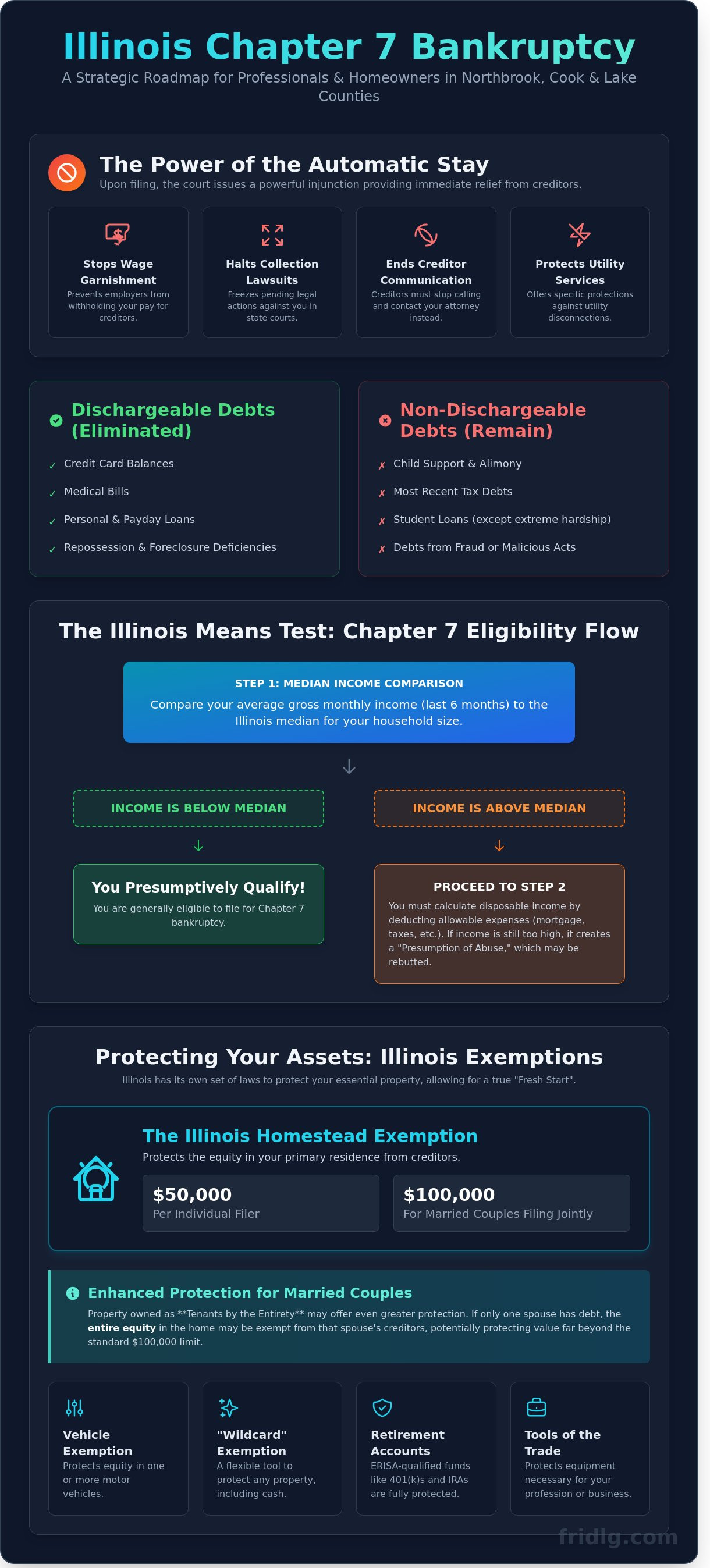
Upon filing a Chapter 7 petition, the court issues a powerful injunction known as the Automatic Stay. This legal mechanism provides immediate and comprehensive protection from creditors. In Cook County, the stay immediately halts all collection activities, including wage garnishments processed through Illinois employers and collection lawsuits pending in state courts. It also offers specific protections against utility shut-offs for Northbrook residents, providing critical breathing room. Once you have retained legal counsel and the petition is filed, the automatic stay legally prevents creditors from contacting you directly; all communications must be routed through your attorney.
Debts That Can and Cannot Be Discharged
A central objective of a Chapter 7 filing is the discharge—or legal elimination—of qualifying debts. A successful discharge releases you from personal liability for these obligations.
- Dischargeable Debts: The most common types of debt eliminated in Chapter 7 include credit card debt, medical bills, personal loans, and balances from repossession or foreclosure (deficiency balances).
- Non-Dischargeable Debts: Certain obligations are excluded from discharge by federal law. These typically include domestic support obligations like child support and alimony, most recent tax debts, and, under current guidelines, student loans except in cases of extreme hardship.
- Strategic Analysis: Many professionals in high-cost suburbs like Northbrook possess a mixed debt portfolio. A strategic analysis by experienced counsel is essential to determine how a Chapter 7 filing will impact your overall financial picture and to confirm it is the most advantageous course of action.
The Illinois Means Test: Navigating Eligibility in 2026
Eligibility for Chapter 7 bankruptcy is primarily determined by the Means Test, a two-part calculation designed to assess whether a filer has sufficient disposable income to repay a meaningful portion of their debts. It is a common misconception among Northbrook professionals that a high salary automatically disqualifies them from Chapter 7 relief. The test is more nuanced, accounting for specific expenses and household size.
The Means Test compares your average gross monthly income over the six months prior to filing against the median income for a household of the same size in Illinois. If your income is below the median, you presumptively qualify. If it is above, you must proceed to the second part of the test, which involves calculating your disposable income after accounting for a range of standardized and actual expenses.
Step One: The Median Income Comparison
The first step is a direct comparison of your household's income to the Illinois median income figures, which are published by the U.S. Trustee and based on IRS data. This calculation uses a six-month "lookback" period, which can be a critical factor for business owners or commissioned professionals in Northbrook with fluctuating income. It is important to note that for individuals whose debts are primarily non-consumer (i.e., business-related), the Means Test may not apply at all, opening a more direct path to Chapter 7 relief.
Step Two: Deductible Expenses and Disposable Income
If your income exceeds the state median, you are not disqualified. Instead, you must complete a detailed calculation of allowable expenses. This analysis accounts for high cost-of-living factors specific to the Chicago metropolitan area, including mortgage or rent payments, property taxes for Cook or Lake County homeowners, vehicle ownership costs, and necessary insurance premiums. The goal is to demonstrate that after these expenses are paid, you lack the disposable income required to fund a Chapter 13 plan. If the calculation still shows sufficient income, it creates a "Presumption of Abuse," which can be rebutted by documenting special circumstances that justify your need for Chapter 7 relief.
Protecting Your Assets: Illinois Bankruptcy Exemptions
A primary concern for anyone considering bankruptcy is the protection of their property. Illinois has "opted out" of the federal exemption scheme, meaning filers must use the state-specific statutes to protect their assets. These laws are designed to allow filers to retain essential property, ensuring the "fresh start" is meaningful.
- The Homestead Exemption: Protects a significant amount of equity in your primary residence.
- The "Wildcard" Exemption: A flexible tool used to protect any property, including cash or assets not covered by other exemptions.
- Vehicle Exemptions: Allows for the protection of equity in one or more vehicles, essential for commuters in the Cook County area.
- Retirement Accounts: Most ERISA-qualified retirement funds, such as 401(k)s and IRAs, are fully protected.
The Illinois Homestead Exemption for Homeowners
For homeowners in Northbrook and throughout Illinois, the homestead exemption is the most critical asset protection tool.
- Current Exemption Limits: Under current Illinois law, an individual can protect $50,000 of equity in their primary residence. Married couples filing jointly can protect a total of $100,000 of equity.
- Strategic Considerations: The high property values in suburbs like Northbrook make a precise equity calculation essential. This analysis is central to determining whether Chapter 7 is the appropriate strategy or if a Chapter 13 filing would be necessary to protect a home with equity exceeding the exemption limits. When properly applied, the homestead exemption prevents the Chapter 7 Trustee from seizing and selling your primary residence.
Personal Property and the Wildcard Provision
Illinois law provides specific exemptions for various types of personal property. Professionals and contractors based in Northbrook can protect their "tools of the trade" up to a certain value. Furthermore, the Illinois "wildcard" statute is a powerful and flexible provision that allows a filer to protect up to $4,000 in any property of their choosing. This is often strategically applied to protect bank account funds, valuable personal items, or equity in an asset that exceeds another exemption limit.
The Filing Process: From Northbrook to the Dirksen Courthouse
The Chapter 7 bankruptcy process is a structured administrative and legal procedure that unfolds over several months. With experienced guidance, it is a manageable and predictable path to debt relief.
- Pre-Filing Credit Counseling: You must complete a credit counseling course from an approved Illinois provider before your petition can be filed.
- Petition and Schedules: Your attorney drafts and files the comprehensive bankruptcy petition with the U.S. Bankruptcy Court for the Northern District of Illinois. This includes detailed schedules of your assets, debts, income, and expenses.
- Trustee Appointment: The court appoints a Chapter 7 Trustee to oversee your case and review your financial disclosures.
- 341 Meeting of Creditors: You must attend a brief hearing, typically held via video conference or at the Dirksen Federal Courthouse in downtown Chicago, where the Trustee may ask questions under oath.
- Financial Management Course: Before receiving a discharge, you must complete a second mandatory course on financial management.
- Discharge: Approximately 60-90 days after the 341 meeting, the court issues the discharge order, officially eliminating your qualifying debts.
Preparing the Petition and Schedules
The accuracy and completeness of your bankruptcy petition are paramount. Full and honest disclosure of all assets, debts, and financial transactions is required by law; any attempt to conceal assets can lead to a denial of discharge and other serious legal penalties. The preparation phase involves gathering key documents, including recent tax returns, pay stubs, bank statements, and, if applicable, a Northbrook real estate appraisal. Fridman Legal streamlines this document collection process, providing busy clients with a secure and efficient system to ensure all information is compiled correctly.
The Meeting of Creditors (341 Meeting)
The 341 Meeting is a standard, required step in the bankruptcy process, but it is often a source of anxiety for filers. In reality, this meeting is typically a brief, straightforward proceeding lasting about ten minutes. You will be questioned under oath by the Trustee regarding the information in your petition, confirming your assets and debts in Cook County. Creditors have the right to appear and ask questions, but they rarely do so in standard consumer bankruptcy cases. With thorough preparation from your attorney, Northbrook residents can navigate this hearing smoothly and confidently.
Strategic Debt Relief: The Fridman Legal Advantage in Northbrook
Navigating the bankruptcy courts of the Northern District of Illinois requires more than just filling out forms; it demands strategic insight and localized experience. With nearly twenty years dedicated to this practice area, Fridman Legal offers a boutique approach that prioritizes sophisticated asset protection for suburban homeowners and professionals. We provide transparent, flat-fee structures that eliminate financial uncertainty for clients already in distress. Our firm's deep expertise in bankruptcy law is integrated with a strong background in real estate and civil litigation, providing a comprehensive perspective on your financial challenges.
Personalized Representation by O. Allan Fridman
Clients of Fridman Legal receive direct, personalized counsel from the principal attorney, O. Allan Fridman. Unlike high-volume "bankruptcy mills" where cases are often managed by paralegals, our firm ensures that every client benefits from the attention of an experienced lawyer. We develop customized filing strategies tailored to individuals with complex asset portfolios, leveraging local expertise in Cook and Lake County court dynamics and Trustee preferences to achieve optimal outcomes.
Next Steps: Your Path to Financial Stability
The typical Chapter 7 bankruptcy case proceeds from filing to discharge in approximately four to six months. Following the discharge, you can immediately begin implementing strategies to rebuild your credit and secure a stable financial future. To understand how this strategic process can be applied to your specific situation, the next step is a confidential, no-obligation consultation.
Secure Your Fresh Start with a Northbrook Bankruptcy Expert
Frequently Asked Questions
Is Chapter 7 bankruptcy better than debt settlement in Illinois? For individuals with overwhelming debt, Chapter 7 is often superior as it provides a complete and legally binding discharge of qualifying debts. Debt settlement is an informal negotiation process that can have uncertain tax consequences and offers no legal protection from lawsuits or garnishments if negotiations fail.
Can I keep my car if I file Chapter 7 in Northbrook? Yes, in most cases. Illinois exemptions protect a certain amount of equity in your vehicle. If you have a car loan, you can typically "reaffirm" the debt—agreeing to continue making payments—and keep the car.
How much does it cost to file Chapter 7 bankruptcy in Illinois? The cost includes a court filing fee (currently $338) and attorney's fees. Fridman Legal offers flat-fee structures for most Chapter 7 cases, providing clarity and predictability. The total cost varies based on the complexity of the case.
What happens to my credit score after a Chapter 7 discharge in 2026? Your credit score will likely decrease initially. However, because your debt-to-income ratio improves dramatically after discharge, many filers see their credit scores begin to recover within 6-12 months and are often able to qualify for new credit, such as a car loan or mortgage, within a few years.
Will my employer in Northbrook find out if I file for bankruptcy? Generally, no. Bankruptcy filings are public records, but it is highly unlikely your employer would search for them. They are not automatically notified unless they are also a creditor or if a wage garnishment needs to be stopped.
Can I file for Chapter 7 if I own a business in Cook County? Yes, but the implications vary. If you operate as a sole proprietor, your business assets and debts are treated as your personal assets and debts. If your business is a corporation or LLC, the situation is more complex. A consultation is necessary to determine the best strategy for protecting your business interests.
How often can I file for Chapter 7 bankruptcy in Illinois? You can receive a discharge in a Chapter 7 bankruptcy once every eight years, measured from the filing date of the previous Chapter 7 case.
What is the difference between Chapter 7 and Chapter 13 for Chicago residents? Chapter 7 is a liquidation bankruptcy that erases most unsecured debt in a few months without a repayment plan. Chapter 13 is a reorganization that involves a 3-to-5-year repayment plan. It is typically used by individuals who do not pass the Means Test or who need to catch up on mortgage or car payments to prevent foreclosure or repossession.

Article by
O. Allan Fridman
O. Allan Fridman has been practicing law since 2001. His practice is unique in that he does not view himself as a litigation attorney or transactional attorney. Rather, he views each area of law as a tool to pursue the best results for his clients. By practicing in both areas of law, he is able to take a 360-degree view of law. This enables the firm to catch potential drawbacks that are readily identifiable.
By practicing in litigation and transactional law and taking a holistic approach in dealing with our clients, he doesn’t put clients in box — rather, as we are all individuals, so too are the legal services we may require.
Whether it is bankruptcy or litigation or transactional, each client brings challenges and does not fit in any one box. Often times, bankruptcy clients end up not filing bankruptcy because we can achieve a better result through litigation or through an out-of-court resolution with the lender, or through a real estate sale. On the other end of the spectrum, a litigation client with multiple issues and lawsuit may fare better in a bankruptcy.
Since 2001, Allan has practiced in states and federal court, and he is a member of the trial bar of the Northern District of Illinois and admitted in the Northern District of Indiana.
We are a debt relief agency. We help people file for bankruptcy relief under the Bankruptcy Code
The materials on this site are for informational purposes only and do not constitute legal advice. Viewing this site or contacting us does not create an attorney–client relationship, and you should not act or refrain from acting based on any information here without seeking professional legal counsel.