

Did you know Illinois currently ranks 6th in the nation for bankruptcy filings, with nearly 19,000 residents seeking relief this year? It's a staggering figure that shows you're certainly not alone in navigating these financial hurdles. When you begin looking for bankruptcy attorneys in Chicago Suburbs, you aren't just looking for a legal service; you're looking for a way to protect your family's stability and your peace of mind.
It's understandable to feel a sense of dread regarding wage garnishment or the complex choice between Chapter 7 and Chapter 13. You want to ensure your suburban home stays yours, especially with the stress of a changing economy. This article will show you how to leverage the new 2026 Illinois exemptions, such as the $50,000 homestead protection, to secure your assets. We'll walk through the essential steps of the local court process and help you identify a legal partner who provides the precise, strategic guidance necessary for a fresh start.
Key Takeaways
- Understand how the specific court nuances in Cook and Lake Counties can change the way your case is handled compared to a city filing.
- Compare Chapter 7 and Chapter 13 strategies to see which path best protects your home equity and fits your family's long-term goals.
- Learn what to look for when vetting bankruptcy attorneys in Chicago Suburbs to ensure you have a partner who truly knows the local 341 Meeting of Creditors process.
- Get the facts that debunk common myths about losing your property, showing you how new Illinois exemptions keep more assets in your hands.
- Discover how a flat-fee model for legal services can provide the financial clarity you need to move forward without worrying about hidden costs.
Searching for Bankruptcy Attorneys in the Chicago Suburbs? Here is Why Local Knowledge Matters
Dealing with debt feels like a constant weight, especially when you're trying to maintain a stable life in the Chicago suburbs. It’s easy to view financial struggles as a personal shortcoming; however, it's more accurate to see them as a hurdle that requires a strategic, professional solution. Many families are currently finding themselves in this exact position. Recent data shows that filings in the Northern District of Illinois have seen a notable uptick, reflecting the broader economic pressures hitting our communities. When you start looking for bankruptcy attorneys in Chicago Suburbs, you aren't just seeking a signature on a form. You're looking for someone who understands that your Northbrook home or your business in Lake County represents years of dedication and hard work.
Bankruptcy isn't a sign of failure; it's a structured legal reset designed to provide a viable path forward. The framework provided by U.S. bankruptcy law exists specifically to help individuals and businesses manage unfeasible debt loads while protecting essential assets. A local attorney understands suburban property values and local market trends in a way a downtown-only firm simply cannot. They know that the 2026 Illinois homestead exemption of $50,000 for an individual carries specific weight in a suburban neighborhood context. Having a partner who is physically present in the community means your legal strategy is built on the reality of your local environment.
The Difference Between "Big City" Firms and Suburban Boutiques
Large downtown firms often operate like high-volume mills where personal attention is a luxury. You might meet a senior partner once, only to have your case handled by a rotating door of assistants. In contrast, suburban boutique firms prioritize direct, consistent communication with the person actually handling your file. This personal touch is vital because local attorneys interact with the specific trustees in the suburban divisions of the Northern District of Illinois every day. They understand the procedural nuances and individual preferences of these officials, which can significantly smooth your path through the system.
When Should You Start Looking for Legal Help?
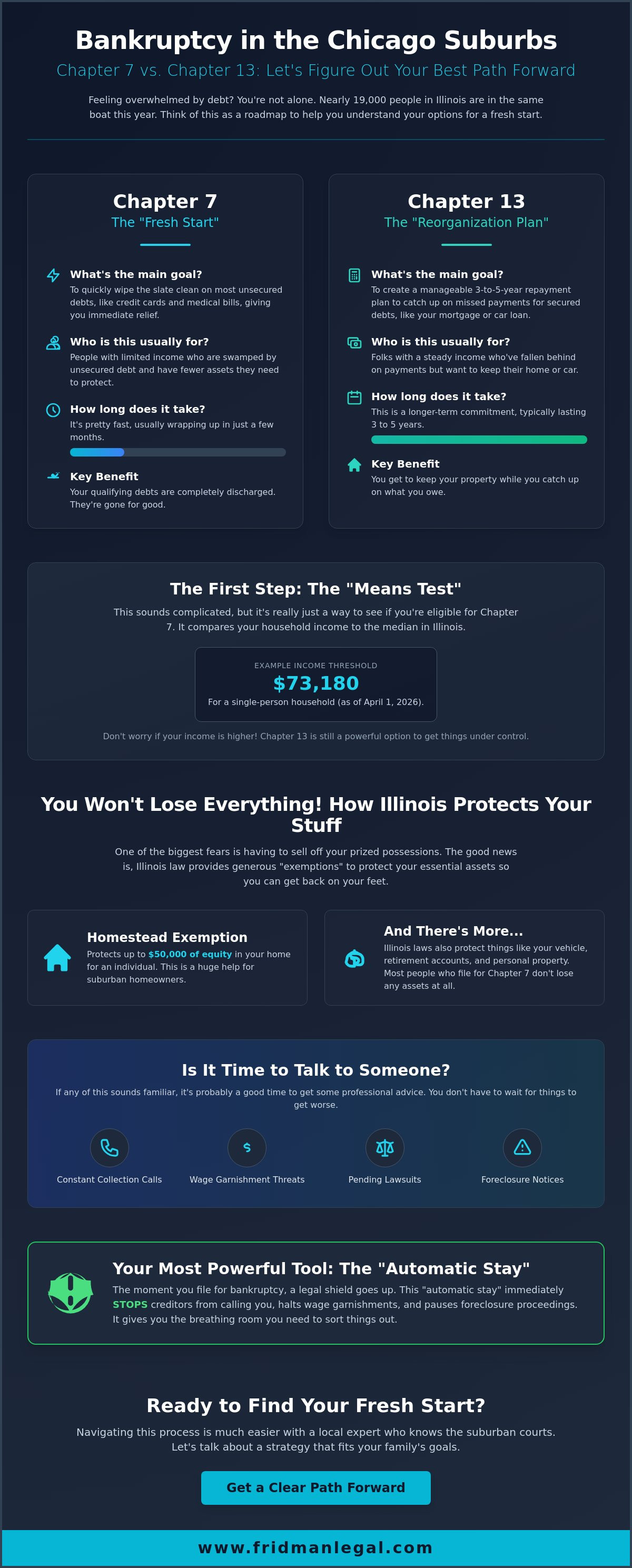
You don't have to wait until a process server is at your door to seek professional advice. If you're facing constant collection calls, pending lawsuits, or the threat of a wage garnishment, it's time to act. One of the most powerful tools available is the "automatic stay." This is essentially a legal shield that clicks into place the moment you file. It stops creditors from calling, halts garnishments, and pauses foreclosure proceedings immediately. Starting the conversation early through a dedicated bankruptcy resource ensures you keep the widest range of options on the table and protects your assets before they are further compromised.
Chapter 7 vs. Chapter 13: Which Path Fits Your Suburban Life?
Deciding which chapter of the bankruptcy code to file under is a significant choice. It really comes down to your current income and what you’re trying to save. Most people start by asking, "Which one fits me?" If you're overwhelmed by credit card debt and don't have a lot of extra income, you might be a candidate for Chapter 7. If you've fallen behind on your mortgage in Northbrook or Glenview but have a steady paycheck now, Chapter 13 is likely the better tool. Both paths offer a way out, but they function very differently.
The first step is often the "Means Test." This isn't as scary as it sounds; it's just a way to see if your household income falls below the Illinois median. For example, for cases filed on or after April 1, 2026, the threshold for a single-person household is $73,180. Experienced bankruptcy attorneys in Chicago Suburbs use this data to determine your eligibility right away. If you're over that limit, Chapter 13 remains a powerful option. Understanding these basics is a core part of Navigating the Local Court System and ensuring you choose the right strategy for your specific financial landscape.
Chapter 7: The "Fresh Start" for Unsecured Debt
Chapter 7 is designed to wipe the slate clean. It targets "unsecured" debt, which includes things like medical bills and high-interest credit cards. One of the biggest fears families have is that they'll lose everything they own. In reality, thanks to the 2026 Illinois exemptions, most suburban residents keep their cars, clothes, and household goods. The process is also relatively quick. Most cases wrap up in about three to four months from start to finish. If you want a deep dive into this specific option, check out this Chapter 7 Bankruptcy in Northbrook guide.
Chapter 13: Protecting Your Home and Assets
Think of Chapter 13 as a "catch-up plan" rather than a liquidation. It’s ideal for homeowners who want to stop a foreclosure and pay back their mortgage arrears over time. You’ll work with your attorney to create a repayment structure that lasts between three and five years. It’s a bit of a marathon compared to Chapter 7, but it offers protections that the "fresh start" model doesn't. It allows you to keep non-exempt property while paying off a portion of your debt through a court-approved plan. If you're unsure which path is right for your family, reaching out to Fridman Legal can help clarify your next steps and protect your suburban lifestyle.
Navigating the Local Court System in Cook and Lake Counties
When you take the step to file, your case enters the Northern District of Illinois. For residents in the Northbrook area or surrounding villages, this usually means dealing with the court system in either Cook or Lake County. While many people picture the Dirksen Federal Building in downtown Chicago, suburban cases are often handled with a specific local focus. The Bankruptcy Trustee assigned to your case isn't a faceless entity designed to take your things; they're a court-appointed official whose job is to ensure your paperwork is accurate and that the law is followed. Having bankruptcy attorneys in Chicago Suburbs who have worked with these specific trustees before can take a lot of the mystery out of the process.
Before your first meeting with a legal professional, it helps to be prepared. Gathering your documents early keeps the process moving and reduces the back-and-forth. Most local attorneys will ask you to bring a few essentials to your initial consultation:
- Your tax returns from the last two years
- Proof of income, like pay stubs, from the last six months
- A valid photo ID and your Social Security card
- A comprehensive list of your debts, including credit cards, medical bills, and personal loans
Being organized from the start allows your attorney to give you an accurate assessment of your situation. If you're ready to see how these details apply to your specific case, you can connect with our team to get started.
What Happens at the 341 Meeting of Creditors?
The "Meeting of Creditors," also known as the 341 meeting, sounds much more intimidating than it actually is. In reality, creditors rarely show up to these meetings. It’s typically a short, ten-minute conversation where the Trustee asks a few standard questions to verify your identity and the accuracy of your filing. You won't be alone; your attorney sits right next to you to ensure everything goes smoothly. Most clients walk out of this meeting surprised by how routine and professional the entire experience felt.
Understanding Local Exemptions: Keeping Your Car and Home
Exemptions are the legal rules that define what you get to keep. The goal of Filing for Bankruptcy in Illinois isn't to leave you with nothing; it's to give you a stable foundation for a reset. As of January 1, 2026, Illinois law significantly increased these protections. For example, the homestead exemption now protects $50,000 in equity for a single individual, and $100,000 for married couples. If you commute to work, the motor vehicle exemption allows you to protect $3,600 in equity in your car. These updated figures mean that for the vast majority of suburban families, their most important assets remain completely safe throughout the process.
Common Myths About Filing for Bankruptcy in Illinois
Many people hesitate to seek help because of long-standing rumors about what happens after you file. In many suburban circles, there's a specific fear of social stigma or the idea that your financial life is permanently over. It's time to pull back the curtain on these misconceptions. While it's true that bankruptcy is a public record, it's highly unlikely your neighbors are spending their weekends scouring federal court databases. Most people are far too busy with their own lives to notice or care about your private financial restructuring.
Another common fear is the belief that your credit score will never recover. Ironically, the opposite is often true. If you spend years barely making minimum payments on high-interest cards, your debt-to-income ratio stays high and your score remains stagnant. A bankruptcy discharge clears that hurdle. Many people find their credit scores begin to climb within months of their case closing because they finally have a manageable debt load and a clean slate. For a deeper look at these strategies, you might find this guide on being a Strategic Bankruptcy Lawyer in Chicago helpful for understanding how to navigate the 2026 landscape.
Working with experienced bankruptcy attorneys in Chicago Suburbs allows you to see the process as a tool for recovery rather than a mark of shame. It's about moving toward a stable future where you can actually participate in the economy again without the constant threat of collection calls.
Will I Ever Be Able to Buy a House or Car Again?
The short answer is yes. You won't be barred from the housing or auto markets forever. In fact, many car dealerships are willing to work with individuals shortly after a Chapter 7 discharge because they know you have no other competing debts. For a home, you can often qualify for an FHA loan just two years after a Chapter 7 discharge, or even sooner during a Chapter 13 plan, provided you've made on-time payments to the trustee. Rebuilding starts with small, secured credit cards and consistent, disciplined habits.
Can I File Bankruptcy Without My Spouse?
You aren't required to file a joint petition just because you're married. In Illinois, if the majority of the debt is in your name only, you can file individually. This can be a smart move if your spouse has excellent credit and you want to protect their standing. However, if you have significant joint debts, filing alone might leave your spouse on the hook for the full balance. Consulting with bankruptcy attorneys in Chicago Suburbs can help you determine if a solo or joint filing is the more efficient path for your household. If you're weighing these options, you can schedule a time to talk with our team to see which strategy fits your specific situation best.
Why Suburban Families and Businesses Choose Fridman Legal
O. Allan Fridman understands that suburban life comes with its own set of financial complexities. As a neighbor and a dedicated advocate, he has spent years helping families and small businesses find their footing in Lake and Cook Counties. When you're searching for bankruptcy attorneys in Chicago Suburbs, you'll find that many large firms treat cases like a numbers game. At Fridman Legal, the approach is fundamentally different. It’s built on professional integrity and a deep understanding of how local real estate and business interests intersect with debt relief.
One of the biggest sources of anxiety when hiring a lawyer is the fear of mounting hourly costs. To address this, the firm utilizes a flat-fee model for bankruptcy services. This transparency allows you to focus on your financial recovery instead of worrying about an unexpected bill every time you have a question. Because the firm also handles residential and commercial real estate transactions and civil litigation, you get a more comprehensive view of your situation. Whether you're dealing with a complex construction law issue or a straightforward credit card reset, the advice is always grounded in broad legal expertise.
Personalized Strategy Over "One-Size-Fits-All" Forms
Every financial situation in the Northbrook area is unique. A boilerplate approach often misses the nuances that can save a family home or protect a small business owner’s assets. When you work with this firm, you aren't handed off to a paralegal or a junior associate. You speak directly with the principal attorney to develop a custom-tailored plan. This level of direct communication is rare in the industry but essential for achieving the best possible outcome under the 2026 regulations. Your strategy is built around your specific goals, not just a standard set of forms.
Ready to Stop the Stress? Let’s Talk
The goal of any filing is long-term stability. It’s about more than just clearing a balance; it’s about reclaiming your future. If you're tired of the collection calls and the sleepless nights, take a breath and reach out. There is no pressure to make a decision immediately. The first step is simply understanding your rights and seeing which path offers the clearest exit from debt. You can visit the Fridman Legal Contact Page to start a conversation that could change your financial trajectory. Finding the right bankruptcy attorneys in Chicago Suburbs is the first step toward a genuine fresh start.
Your Path to Financial Stability Starts Here
Taking the time to understand your legal options is the first step toward reclaiming your financial independence. We've explored how local court nuances in Cook and Lake Counties affect your case; we've also looked at the strategic differences between Chapter 7 and Chapter 13. With the 2026 Illinois exemptions now in effect, protecting your home and vehicle is more achievable than ever. When you're ready to move forward, working with bankruptcy attorneys in Chicago Suburbs who understand the local landscape ensures your transition is handled with the precision it deserves.
At Fridman Legal, we prioritize transparency and direct communication. With nearly 20 years of local experience in both bankruptcy and real estate law, O. Allan Fridman provides the strategic guidance you need without the impersonal feel of a large downtown firm. You'll benefit from clear, flat-fee pricing and direct access to your attorney throughout the entire process. There's no reason to let debt dictate your future any longer. You have the support needed to make a genuine fresh start. Schedule a free, confidential consultation with Fridman Legal today and begin building a more secure tomorrow.
Frequently Asked Questions
How much does it cost to file for bankruptcy in the Chicago suburbs?
The federal court sets standard filing fees for everyone; as of 2026, it costs $338 to file for Chapter 7 and $313 for Chapter 13. Beyond these court costs, you'll also have legal fees for your representation. Many bankruptcy attorneys in Chicago Suburbs use a flat-fee model so you know exactly what the total investment will be before you even start the paperwork.
Can I keep my house if I file for Chapter 7 in Illinois?
Yes, you can usually keep your home as long as your equity doesn't exceed the state's homestead exemption. Thanks to a law change effective January 1, 2026, individuals can now protect up to $50,000 in equity, and married couples can protect up to $100,000. This is a significant jump from previous years and makes it much easier for suburban homeowners to seek relief without losing their primary residence.
How long does the bankruptcy process take in Cook County?
A typical Chapter 7 case moves relatively quickly, usually wrapping up in about three to four months. Chapter 13 is a longer commitment because it involves a repayment plan that lasts between three and five years. The exact timing depends on the current docket speed in the Northern District of Illinois and how organized your financial records are when you first file.
Will filing for bankruptcy stop my wage garnishment immediately?
Filing for bankruptcy triggers a legal tool called the "automatic stay," which stops most collection actions, including wage garnishments, the moment your case is filed. The court notifies your creditors and your employer to halt the deductions right away. This provides immediate breathing room and prevents further loss of your take-home pay while you work through the legal process.
Do I have to go to court if I file for bankruptcy?
Most people only have to attend one formal meeting known as the 341 Meeting of Creditors. You don't usually go into a traditional courtroom; instead, you meet with a Trustee to verify your identity and review your financial documents. While these often take place at satellite locations or virtually, your attorney stays with you to ensure every question is handled correctly.
What is the difference between a bankruptcy lawyer and a debt settlement company?
A bankruptcy lawyer provides a federal court discharge that legally wipes out your debt and offers protection through the automatic stay. Debt settlement companies are private businesses that simply try to negotiate lower payments with your creditors. Unlike bankruptcy, debt settlement doesn't stop lawsuits or garnishments, and creditors aren't legally required to participate in their programs.
Can I file for bankruptcy more than once in Illinois?
You can file for bankruptcy multiple times, but federal law requires you to wait a specific number of years between cases to receive another discharge. For example, you must wait eight years between two Chapter 7 filings. The timing is different if you're switching between Chapter 7 and Chapter 13, so it's vital to have your previous filing dates ready when you speak with your legal counsel.
Will my employer find out if I file for bankruptcy?
The court doesn't send a notice to your employer as a standard practice. However, if your employer is a creditor or if the court needs to stop a wage garnishment, they'll be notified so they can update their payroll records. While bankruptcy filings are public record, most employers don't spend time searching court databases unless there's a specific professional reason to do so.

Article by
O. Allan Fridman
O. Allan Fridman has been practicing law since 2001. His practice is unique in that he does not view himself as a litigation attorney or transactional attorney. Rather, he views each area of law as a tool to pursue the best results for his clients. By practicing in both areas of law, he is able to take a 360-degree view of law. This enables the firm to catch potential drawbacks that are readily identifiable.
By practicing in litigation and transactional law and taking a holistic approach in dealing with our clients, he doesn’t put clients in box — rather, as we are all individuals, so too are the legal services we may require.
Whether it is bankruptcy or litigation or transactional, each client brings challenges and does not fit in any one box. Often times, bankruptcy clients end up not filing bankruptcy because we can achieve a better result through litigation or through an out-of-court resolution with the lender, or through a real estate sale. On the other end of the spectrum, a litigation client with multiple issues and lawsuit may fare better in a bankruptcy.
Since 2001, Allan has practiced in states and federal court, and he is a member of the trial bar of the Northern District of Illinois and admitted in the Northern District of Indiana.
We are a debt relief agency. We help people file for bankruptcy relief under the Bankruptcy Code
The materials on this site are for informational purposes only and do not constitute legal advice. Viewing this site or contacting us does not create an attorney–client relationship, and you should not act or refrain from acting based on any information here without seeking professional legal counsel.