

Winning a lawsuit in a Cook County courtroom often feels like a loss once you see the legal fees and the damage done to your professional reputation. You've likely felt the weight of a pending dispute, worrying about how public exposure or a backlog in the courts might stall your company's growth. Knowing how to handle business disputes without going to court is no longer just a luxury; it's a necessary survival skill for any modern Illinois business owner who wants to protect their bottom line.
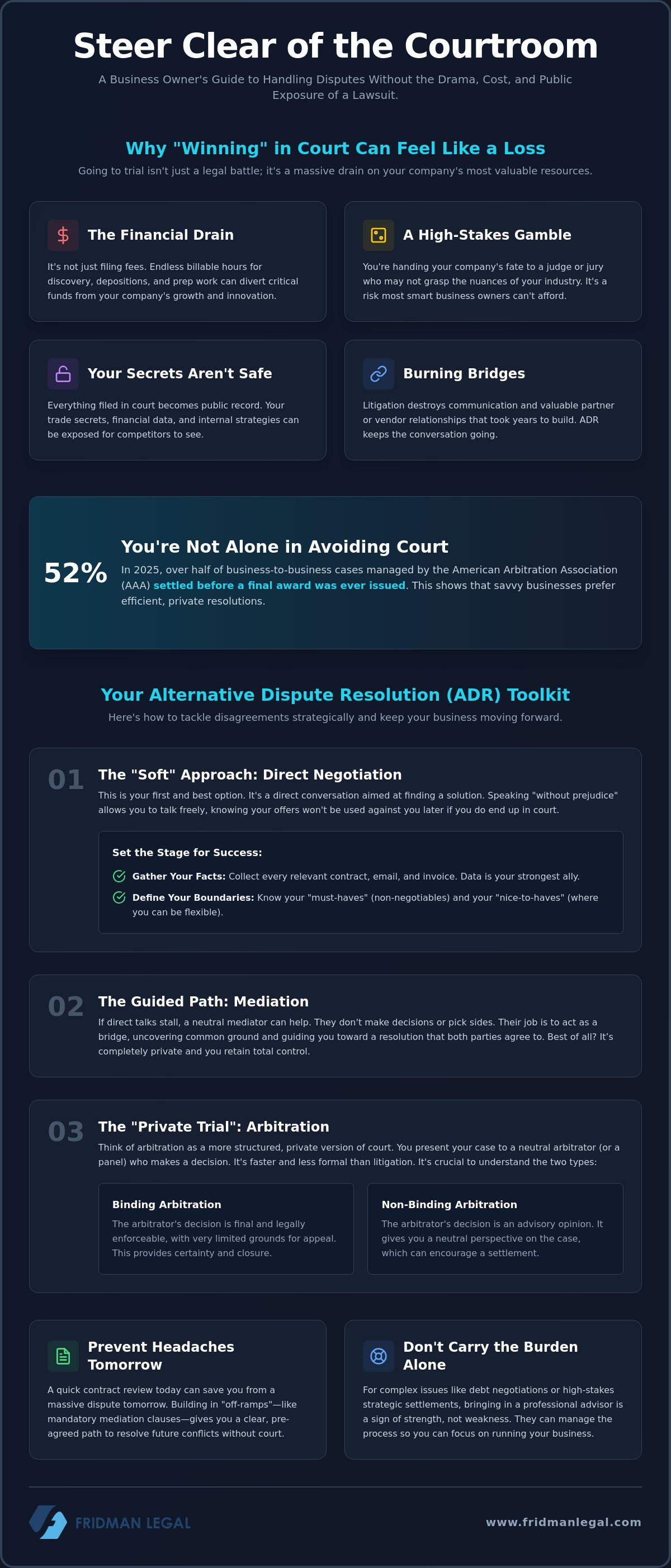
The good news is that a trial isn't your only option. This guide shows you how to resolve conflicts by using strategic resolution methods that keep your private matters out of the public record. We'll explore why 52% of business-to-business cases administered by the AAA settled before an award was even issued in 2025 and how you can use mediation or debt negotiation to reach a fast, confidential agreement. You'll learn how to bypass the high costs of traditional litigation while preserving the vendor and partner relationships that keep your business running smoothly.
Key Takeaways
- You'll see exactly how keeping your disagreements private protects your brand's reputation and saves you from the endless delays of the public court system.
- We'll break down the most effective methods for how to handle business disputes without going to court, focusing on mediation techniques that prioritize your time and budget.
- Learn the difference between binding and non-binding arbitration so you can choose the right "private trial" setup for your specific situation.
- Discover how a quick contract review today can prevent a massive headache tomorrow by building in "off-ramps" for future conflicts.
- Understand when it's time to bring in a professional to manage debt negotiations or strategic settlements so you don't have to carry the burden alone.
Why Avoiding the Courtroom is Usually Your Best Business Move
When you're facing a conflict with a partner or a vendor, your first instinct might be to file a complaint and let a judge sort it out. But before you take that step, it's vital to look at what you're actually risking. Litigation isn't just a legal battle; it's a massive drain on your company's most valuable resources. If you're wondering how to handle business disputes without going to court, you're already thinking like a strategist rather than a combatant. Choosing a path that avoids the courtroom isn't about being soft; it's about being efficient.
Think about the unpredictability factor. In a courtroom, you're handing over the fate of your company to a judge or a jury who might not understand the nuances of your specific industry. It's a gamble that most smart business owners simply can't afford to take. Beyond the verdict, court cases tend to burn bridges. Once the formal litigation process starts, direct communication usually breaks down. Opting for Alternative Dispute Resolution (ADR) allows you to keep the conversation going, which is often the only way to save a valuable vendor or partner relationship that took years to build.
The Real Cost of a Lawsuit in 2026
The financial impact of a trial goes far beyond the initial filing fees. You have to account for the endless billable hours spent on discovery, depositions, and prep work. This financial strain can become so intense that it forces some companies to seek out a debt settlement lawyer in Northbrook just to manage the fallout of the legal spend. It's a simple equation: every dollar you pour into a trial is a dollar you've effectively taken away from your company's growth and innovation. Plus, the hit to employee morale when key staff are pulled away for testimony can stall your operations for months.
Privacy and Your Competitive Advantage
Privacy is perhaps the most underrated benefit of staying out of court. Everything filed in a Cook County court becomes a matter of public record. This means your sensitive financial data, trade secrets, and internal disagreements are potentially visible to anyone with an internet connection. Your competitors love it when you go to court because they can essentially read your internal playbooks if they're entered as evidence. Mediation settlements, on the other hand, stay private. You can resolve the issue, sign the paperwork, and move on without your industry ever knowing the details of the conflict.
The "Soft" Approach: Negotiation and Mediation
When a disagreement arises, your first instinct shouldn't be to call the court clerk. Instead, think of the dispute as a business problem that requires a strategic solution. Learning how to handle business disputes without going to court often starts with the most direct path: a conversation. Direct negotiation is the art of the "without prejudice" discussion. This legal term essentially means you can speak freely to find a resolution without worrying that your concessions will be used against you if the case eventually ends up in front of a judge. It's a low-risk way to test the waters and see if a deal is possible.
If direct talk hits a wall, mediation is the logical next step. A mediator isn't there to tell you who's right or wrong. Unlike a judge, they have no power to impose a decision. This is actually your biggest advantage. Because the mediator is a neutral professional, they can uncover the underlying interests that both sides are often too proud or too angry to admit. They act as a bridge, helping you find a "yes" that satisfies your business needs without the scorched-earth tactics of a trial.
Setting the Stage for a Successful Negotiation
You can't walk into a negotiation and "wing it." Success requires preparation. Start by gathering every relevant email, contract, and invoice so you have the facts on your side. Before you pick up the phone, define your boundaries clearly:
- Must-haves: The core terms you need to keep your business viable.
- Nice-to-haves: Areas where you can afford to be flexible to reach a deal.
When you invite the other party to talk, frame it as a pursuit of efficiency. You aren't reaching out because you're afraid of court; you're reaching out because you value your time and resources more than a protracted legal battle.
How Mediation Actually Works in Illinois
In Illinois, mediation is a voluntary process where you retain total control over the final agreement. A typical day involves both parties starting in one room before moving to separate "caucus" rooms. The mediator then shuttles back and forth, delivering offers and clarifying points of friction. It's a structured environment that removes the emotional heat from the situation. You don't have to agree to anything that doesn't serve your interests, but the process often reveals creative solutions that a court simply couldn't order. If the complexity of the case feels overwhelming, having a civil litigation lawyer by your side during these sessions ensures your rights are protected while you focus on the business deal.
The "Structured" Alternatives: Arbitration and Collaborative Law
Sometimes a simple conversation or a guided mediation session doesn't quite get you to the finish line. When the parties involved need a definitive ruling but still want to avoid the public spectacle of a trial, structured alternatives provide a middle ground. These methods are designed for business owners who want the finality of a court order without the delays inherent in the Illinois judicial system. If you're weighing how to handle business disputes without going to court, understanding the mechanics of arbitration and collaborative law is essential for your long-term strategy.
Arbitration is effectively a private trial. Instead of a judge, you present your case to a neutral third party, often an expert in your specific industry. This process is generally faster and more flexible than a traditional lawsuit. According to 2025 data from the American Arbitration Association, the median time to an award for business-to-business claims over $1 million was 18.7 months. While that might sound long, it's often significantly quicker than navigating the current backlog in Cook County. Before you begin, you must determine if the process is binding or non-binding. Binding arbitration means the decision is final and enforceable by law, with very limited options for appeal. Non-binding arbitration functions more like a high-stakes dress rehearsal, giving both sides a clear look at how a neutral party views the evidence.
Is Arbitration Right for Your Dispute?
Arbitration is frequently the default resolution path in commercial real estate transactions and complex construction contracts. It's particularly useful when the dispute involves technical details that a generalist judge might struggle to grasp. You'll often find these requirements already baked into your existing contracts. It's a trade-off: you give up your right to a jury trial in exchange for a streamlined process and a decision-maker who actually understands the nuances of your business model.
The Collaborative Law Revolution
Collaborative law is a newer, team-based approach that's gaining traction in Northbrook and the wider Chicago business community. In this scenario, both parties and their lawyers sign a formal agreement to resolve the issue without litigation. What makes this unique is the "withdrawal" clause. If either side decides to walk away and head to court, both sets of lawyers must resign from the case. This creates a powerful financial and strategic incentive for everyone to stay at the table and find a workable solution. It's an excellent choice for partner disputes where you're trying to figure out a "business divorce" while keeping the company's operations intact.
Proactive Prevention: How to Avoid Future Court Dates
Most business owners only think about legal strategy once a process server is at the door. That's a reactive approach that often leads to high costs and unnecessary stress. The most effective strategy for how to handle business disputes without going to court actually begins months or years before a conflict ever exists. It's about building a structural framework that forces a resolution through dialogue before anyone has the chance to file a formal lawsuit. You should view your contracts and internal protocols as an insurance policy designed to protect your professional relationships from the volatility of the legal system.
By shifting your focus toward prevention, you're not just avoiding legal fees; you're protecting your company's focus. When a dispute is handled through pre-planned protocols, it doesn't become the "all-consuming" event that a lawsuit often is. You can keep your team focused on growth while the dispute follows a predictable, private path toward a resolution.
Bulletproofing Your Contracts
Every vendor agreement, partnership contract, or service level agreement should include a mandatory, multi-step dispute resolution clause. This language requires parties to engage in direct negotiation and then mediation before they are legally permitted to step into a courtroom. A well-written contract is your best defense against a courtroom. When reviewing documents for businesses in the Northbrook area, we look for "litigation traps" such as vague indemnity clauses or poorly defined performance milestones. These are the sparks that typically start the fires of litigation. By tightening this language, you remove the ambiguity that competitors or disgruntled partners might try to exploit later.
The Early Neutral Evaluation (ENE) Strategy
If a dispute does start to simmer, the Early Neutral Evaluation (ENE) strategy can be a game-changer. ENE involves bringing in an experienced legal professional very early in the process to provide an objective assessment of the case's merits. It acts as a necessary reality check for both sides. This process can save months of pointless arguing because it forces everyone to look at the facts through the eyes of a neutral party. Once both sides understand the likely outcome of a trial, the evaluation serves as a natural springboard for a settlement that satisfies everyone's bottom line.
The logic of proactive prevention also extends to how you manage internal partner disagreements. Many of the most damaging business battles are essentially succession disputes that could have been avoided with the same foresight used in estate planning in Northbrook. Just as you work to secure your family's financial legacy, you must secure your business's future by establishing clear protocols for decision-making and conflict escalation. If you're ready to move from a reactive stance to a proactive one, you can reach out for a strategic contract review to ensure your company is protected.
When to Call in a Professional Advisor
Attempting to settle a conflict on your own might seem like a prudent way to save on costs, but in the high-stakes environment of mediation and arbitration, "doing it yourself" often backfires. Without a professional advocate, you might lack the legal leverage needed to push for a settlement that truly protects your interests. Knowing how to handle business disputes without going to court isn't just about avoiding a judge; it's about having a strategist who can identify the subtle pressure points in a contract. A skilled advisor provides the objective distance necessary to see a path forward when internal emotions or partner frustrations are running high.
If a dispute is left to fester, the financial fallout can be devastating. We've seen cases where unresolved litigation or a complete breakdown in negotiations drains a company's cash reserves so thoroughly that a strategic Chapter 11 bankruptcy filing becomes the only tool left to restructure and save the business. At Fridman Legal, we focus on preventing that outcome by balancing aggressive advocacy with a focus on efficient, out-of-court resolutions that keep your operations intact.
Finding the Right Strategic Partner
You don't need a lawyer who's "sue-happy" and looks for every opportunity to file a motion. You need a partner who understands the Northbrook and Chicago business landscape and treats litigation as a last resort. The goal is to find personalized, results-driven legal solutions that prioritize your company's growth over billable hours. With nearly twenty years of experience, our firm approaches each conflict with the goal of reaching a settlement that preserves your professional relationships while securing your long-term financial integrity.
Your Next Steps to Resolution
Taking the first step toward a resolution is simpler than most business owners realize. When you're ready to move forward, start by organizing your "dispute folder." This should include your core contracts, a clear timeline of events, and any key correspondence that defines the disagreement. Having these facts ready allows your advisor to provide a clear, objective assessment of your options right from the start. If you're ready to resolve your conflict and get back to focusing on your company, contact Fridman Legal today to discuss your strategy and explore your options for an efficient resolution.
Protecting Your Business Future Through Strategic Resolution
Choosing a path of resolution over litigation isn't just about saving money on legal fees; it's about maintaining the focus you need to run your company. You've seen how tools like mediation and arbitration offer a private, faster alternative to the public court system. By reviewing your contracts now and understanding how to handle business disputes without going to court, you're building a structural defense that prioritizes long-term stability over short-term conflict. Every dispute is ultimately a business decision, and the best decisions are made outside the heat of a courtroom.
With nearly 20 years of Illinois legal experience, our firm provides a personalized, results-driven approach to civil litigation and debt negotiation. We focus on securing your business's financial integrity while resolving complex disagreements efficiently. If you're ready to find a strategic "off-ramp" for your current conflict, it's time to talk to a Northbrook business dispute expert at Fridman Legal. You don't have to navigate these challenges alone, and a faster, more private resolution is well within your reach.
Frequently Asked Questions
What is the cheapest way to resolve a business dispute?
Direct negotiation is the most cost-effective method because it eliminates third-party fees and court costs. It's the simplest way to find common ground through a structured conversation. If that doesn't work, mediation is usually the next best step for how to handle business disputes without going to court without draining your company's cash flow on endless billable hours.
Is mediation legally binding in Illinois?
The mediation process itself isn't binding, but the final settlement agreement is. Once both parties sign a written agreement in Illinois, it becomes a legally enforceable contract. This means if one side fails to follow the terms, you can seek a court order to enforce the specific deal you reached during the session. It provides a solid legal resolution without a trial.
Can I still go to court if mediation fails?
Yes, you can still proceed to trial if you don't reach a resolution. Mediation is a voluntary and confidential process designed to explore settlement options. If you can't find a "yes" that works for your business, your right to a day in court remains intact. It's a low-risk way to attempt a resolution before committing to the public litigation process.
Do I need a lawyer for arbitration?
You aren't legally required to have a lawyer, but it's strongly advised. Arbitration is much more formal than mediation and usually results in a final, binding decision. An experienced advocate ensures your evidence is properly presented and protects you from making procedural mistakes that could lead to a permanent, unfavorable ruling for your company that you cannot easily appeal.
How long does alternative dispute resolution usually take?
The timeline depends on the complexity of the case. For context, the median time to an award for business-to-business claims over $1 million was 18.7 months in 2025. However, many smaller disputes resolve in a single day of mediation. It's almost always faster than waiting for a trial date in the heavily backlogged Cook County judicial system, where delays are common.
What happens if the other party refuses to negotiate?
If the other party won't talk, you should check your existing contracts for mandatory ADR clauses. These clauses can legally force them to attend mediation or arbitration before filing a suit. If no such clause exists, filing a formal complaint is often the only way to prove you're serious, which frequently triggers a last-minute settlement discussion before the trial begins.
Is arbitration faster than a standard lawsuit in Cook County?
Arbitration is almost always faster because it bypasses the public court backlog. In Cook County, getting a trial date can take years. Arbitration allows you to choose your own arbitrator and set a schedule that fits your specific business needs. It's a more streamlined way for how to handle business disputes without going to court while still receiving a definitive ruling.
What is the difference between mediation and arbitration?
The main difference is who makes the final decision. In mediation, a neutral professional helps you and the other party reach your own agreement; you stay in total control of the outcome. In arbitration, the neutral party acts like a judge, hears the evidence from both sides, and then issues a final decision that is usually binding and very difficult to appeal.

Article by
O. Allan Fridman
O. Allan Fridman has been practicing law since 2001. His practice is unique in that he does not view himself as a litigation attorney or transactional attorney. Rather, he views each area of law as a tool to pursue the best results for his clients. By practicing in both areas of law, he is able to take a 360-degree view of law. This enables the firm to catch potential drawbacks that are readily identifiable.
By practicing in litigation and transactional law and taking a holistic approach in dealing with our clients, he doesn’t put clients in box — rather, as we are all individuals, so too are the legal services we may require.
Whether it is bankruptcy or litigation or transactional, each client brings challenges and does not fit in any one box. Often times, bankruptcy clients end up not filing bankruptcy because we can achieve a better result through litigation or through an out-of-court resolution with the lender, or through a real estate sale. On the other end of the spectrum, a litigation client with multiple issues and lawsuit may fare better in a bankruptcy.
Since 2001, Allan has practiced in states and federal court, and he is a member of the trial bar of the Northern District of Illinois and admitted in the Northern District of Indiana.
We are a debt relief agency. We help people file for bankruptcy relief under the Bankruptcy Code
The materials on this site are for informational purposes only and do not constitute legal advice. Viewing this site or contacting us does not create an attorney–client relationship, and you should not act or refrain from acting based on any information here without seeking professional legal counsel.