

What if the "permanent" weight of your student debt isn't actually permanent? If you're asking "can I file bankruptcy on student loans in Illinois" in 2026, you've likely been told for years that it's an impossible dream. It's exhausting to face those crushing monthly payments every single month while feeling like the legal system offers no exit. You're not alone in that anxiety, and the complex web of federal and private loan rules only adds to the confusion.
The good news is that the path to debt relief is more open than it used to be. This guide will show you that discharging student loans is a specific, navigable process for those who understand the updated criteria. We'll break down the three prongs of the Brunner Test and explain how the latest federal guidelines are helping borrowers find relief. By the end, you'll know exactly how to evaluate your situation and the first steps to take right here in Northbrook to regain your financial peace of mind.
Key Takeaways
- You'll learn that student loans don't just vanish automatically in bankruptcy; they require a specific legal action called an adversary proceeding to be fully discharged.
- We'll help you understand the Brunner Test, which is the primary yardstick Illinois courts use when you're wondering can I file bankruptcy on student loans in Illinois.
- Discover how the 2026 federal guidelines and the new Attestation Form have simplified the process of proving financial hardship for those with federal loans.
- Learn the critical differences between discharging federal versus private debt and why your specific loan mix changes your overall legal strategy.
- Get a clear roadmap of the steps involved, from the initial filing in Northbrook to the final court decision on your student debt.
The Reality of Student Loan Discharge in Illinois Bankruptcy Courts
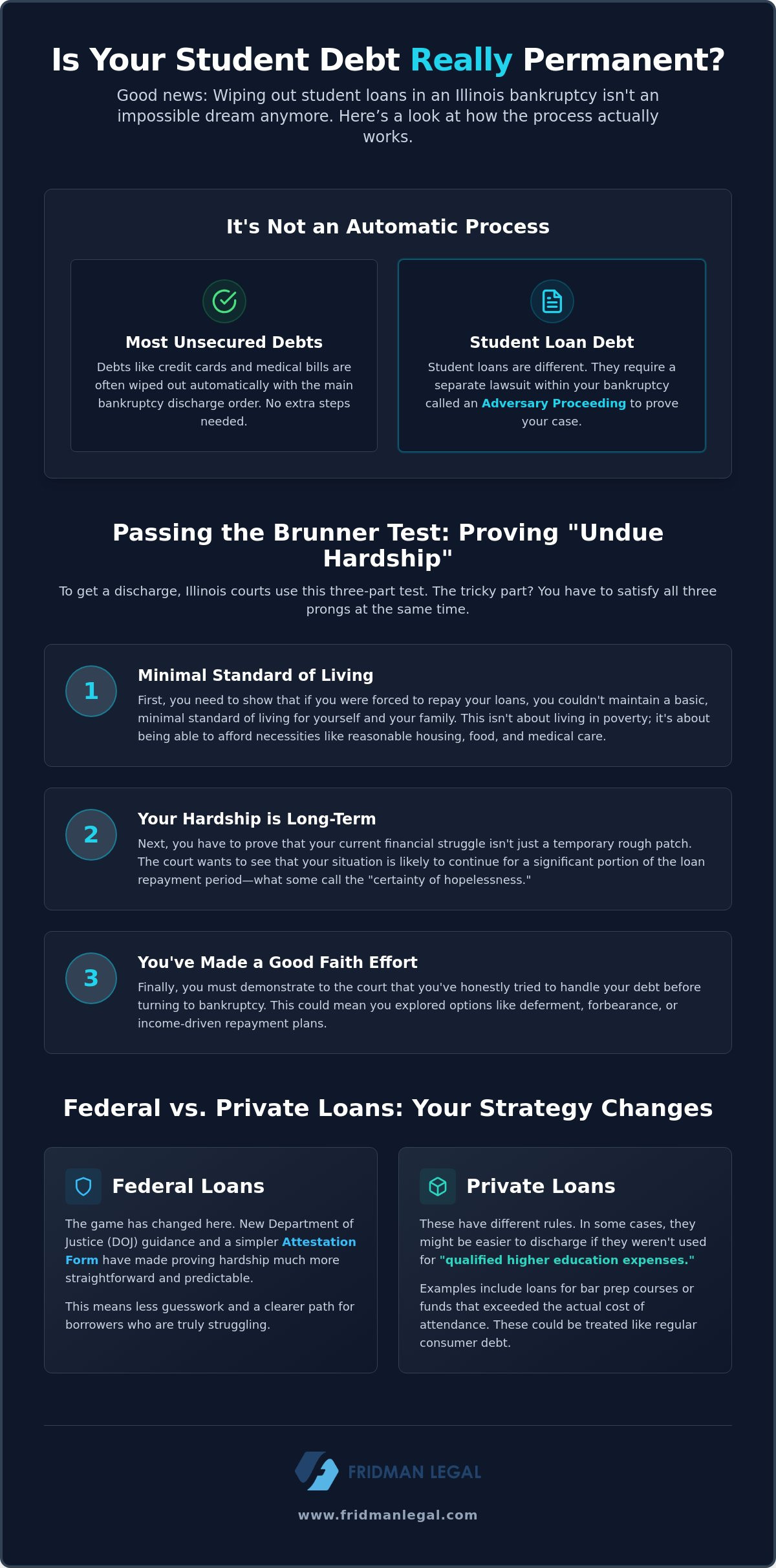
If you’ve spent any time searching for an answer to "can I file bankruptcy on student loans in Illinois," you’ve likely run into a wall of outdated information. Many people still believe that student debt is "untouchable" in court. The short answer is yes, you can discharge these loans, but it isn't an automatic process. When you file for Chapter 7 or Chapter 13 bankruptcy, most unsecured debts like credit cards or medical bills are wiped out by the court's discharge order without much fuss. Student loans are different. They require a "lawsuit within a lawsuit" known as an adversary proceeding.
This extra step is where many people give up before they even start. In the past, the narrative was that you had to be in a truly dire, permanent state of poverty to even stand a chance. However, the "impossible" narrative is a relic of the past. By 2026, the legal landscape has shifted significantly. Under U.S. bankruptcy law, the path to relief exists for those who are willing to navigate the specific procedural requirements. The shift we've seen through 2026 is largely due to a more standardized approach from the Department of Justice, which has made the process more predictable for residents across Cook County.
Federal vs. Private Loans: Does the Type Matter?
The type of loan you carry significantly dictates your legal strategy. Private student loans are often governed by different standards than federal ones. For instance, if a private loan was used for something other than "qualified higher education expenses," it might be treated like any other consumer debt. This includes loans for bar exam prep courses or loans that exceeded the actual cost of attendance. Federal loans, however, come with specific statutory protections. They generally require a more rigorous showing of hardship, though the new 2026 federal guidelines have made this process much more transparent and less of a "guessing game" for borrowers who are struggling to make ends meet.
Why Illinois is a Unique Environment for Debtors
Filing in the Northern District of Illinois means your case will be heard by judges who are intimately familiar with the Seventh Circuit’s interpretation of the law. Illinois courts are known for their precision. They don't just look at your balance; they look at your life. Having a local attorney in Northbrook is vital because they understand the specific documentation these local judges expect to see. The "impossible" narrative is outdated because we now have a clearer roadmap for what constitutes a successful claim in our local court system. When you're asking "can I file bankruptcy on student loans in Illinois," the answer often depends on how well you can present your specific financial story to a judge who has seen it all before.
Understanding the "Undue Hardship" Standard and the Brunner Test
Winning an adversary proceeding isn't a matter of luck or a judge’s mood. It comes down to a specific legal framework called the Brunner Test. This is the three-part yardstick Illinois courts use to determine if your debt meets the undue hardship standard required for a discharge. If you're asking "can I file bankruptcy on student loans in Illinois," you need to know that you must satisfy all three parts of this test simultaneously. It is a high bar, but it is a predictable one when you have the right documentation in place.
The first part of the test focuses on your current financial state. You have to prove that based on your current income and expenses, you cannot maintain a minimal standard of living for yourself and your dependents if you are forced to repay the loans. The second part is often called the "certainty of hopelessness." You must show that your current financial situation is likely to persist for a significant portion of the loan repayment period. Finally, you have to prove "good faith," showing the court that you actually tried to repay the debt before seeking bankruptcy, perhaps by looking into deferment or consolidated payment plans.
What "Minimal Standard of Living" Actually Means
A common misconception is that you must be living in absolute poverty to pass this first prong. In reality, Illinois courts look at whether you can afford basic necessities. This includes reasonable housing, nutritious food, utilities, and necessary medical care. When we build a case, we look closely at your monthly budget. People often forget to include irregular but essential expenses like car repairs, rising Chicago insurance premiums, or out-of-pocket healthcare costs. If paying your student loans means you can't keep the lights on or buy groceries, you are likely meeting this part of the test.
Proving Your Financial Situation is Permanent
The court needs to see that you aren't just in a temporary rut. They look for "additional circumstances" that suggest your income won't suddenly spike next year. This might include a chronic medical condition, the age of the debtor, or a lack of usable job skills in a shifting economy. By 2026, with over 234,000 Illinois borrowers already in default, courts are becoming more aware of how stagnant wages and high living costs create a cycle of debt that is nearly impossible to break. If your industry has moved on or your earning potential has peaked, these are powerful facts to present. If you're feeling overwhelmed by these requirements, a quick review of your bankruptcy options can help clarify where you stand.
The New DOJ Guidance: A Potential Game Changer for Federal Loans
If you're still wondering "can I file bankruptcy on student loans in Illinois," the landscape has changed for the better. The New DOJ Guidance, which remains a cornerstone of student debt relief in 2026, has shifted the power balance. In the past, the government fought nearly every discharge request with aggressive litigation. Now, they’ve introduced a streamlined process that focuses on objective data rather than legal combat. This change means that for many federal borrowers, the path to a discharge is no longer a blind gamble.
Central to this shift is the Attestation Form. This document allows you to lay out your financial reality, from your income to your essential expenses, in a standardized way. Instead of a high-stakes trial where every grocery receipt is scrutinized in open court, the Department of Justice uses this form to determine if you meet the hardship requirements. If the data shows you can't realistically pay, the government is now much more likely to "stipulate" to the discharge. This means they agree with your claim, effectively removing the biggest obstacle to your financial recovery and avoiding a full trial.
The Role of the Department of Education in Your Case
The Department of Education acts as the first filter in this new environment. They review your history and current earnings before the bankruptcy hearing even begins. We've seen a clear move away from fighting every case toward settling valid hardship claims. This shift is a practical response to the reality of the $63.4 billion in student debt held by Illinois residents. For many, 2026 is the best time to revisit these options because the government is finally acknowledging that some debts simply cannot be repaid without causing extreme hardship.
Is Your Loan Eligible for the Streamlined Process?
Not every loan qualifies for this specific streamlined path. Direct Loans are the primary candidates for this process. If you have older FFELP loans, you might need to consolidate them into the Direct Loan program first to take advantage of these rules. The process typically takes several months from the time you file your adversary proceeding to when a decision is reached. It’s a technical journey, but using Fridman Legal’s bankruptcy services ensures your attestation form is accurate and your loan types are correctly identified from the very start of your case.
The Adversary Proceeding: Steps to Discharging Your Loans
If you're asking "can I file bankruptcy on student loans in Illinois," you've already taken the hardest step: looking for a way out. The journey begins with filing your main bankruptcy petition, usually under Chapter 7 or Chapter 13. While this filing stops collections on most debts, it doesn't touch your student loans just yet. To deal with those, we have to initiate what’s called an adversary proceeding. Think of this as a separate lawsuit filed inside your bankruptcy case. It's the specific legal mechanism where we ask the judge to declare that your student debt is dischargeable because of undue hardship.
Initiating this process involves filing a formal complaint against your loan servicers. It sounds intimidating, but it's a structured procedural path. Once the complaint is filed, the court sets a schedule for the case. You aren't just a number in a pile anymore; you're a plaintiff in a legal action. This stage shifts the conversation from "if" you can pay to "why" the current debt load is unsustainable under the law.
What Happens During the Discovery Phase?
This is where the real work happens. During the discovery phase, we gather the evidence needed to prove your case. It isn't just about showing you're broke; it's about proving that your situation fits the legal standards we discussed earlier. You'll need to be organized and thorough. We'll typically need to prepare:
- Federal and state tax returns from the last several years to show income trends.
- Recent pay stubs or proof of all current income sources.
- Detailed medical records if a health issue or disability is part of your hardship claim.
- A comprehensive breakdown of every monthly living expense, from housing to rising utility costs.
Your attorney uses this data to build a "hardship narrative." We don't just hand over a stack of papers; we tell the story of your financial life to show the court that repayment is truly impossible.
Settling with the Government
Most cases don't actually end in a dramatic courtroom trial. Instead, the goal is often a "stipulated judgment." This happens when the government's attorneys review your evidence and agree that you've met the criteria for relief. Sometimes this results in a total discharge where the debt is wiped out completely. Other times, it might be a partial discharge, where the balance or interest rate is reduced to something you can actually afford. Having a Northbrook lawyer who knows how to talk to these government representatives can make all the difference in these negotiations. If you're ready to start this process, it's time to speak with a professional who can handle the heavy lifting for you.
Navigating Debt Relief in Northbrook: How Fridman Legal Can Help
When you're searching for an answer to "can I file bankruptcy on student loans in Illinois," the last thing you need is a cookie-cutter response from a high-volume "bankruptcy mill." These firms often overlook the nuances of student debt because they prioritize speed over strategy. At Fridman Legal, we take a different path. Student loan discharge cases are complex and require a high level of precision. O. Allan Fridman personally evaluates your specific loan portfolio to determine which debts are eligible for discharge and which might require a different negotiation strategy. This personalized approach ensures that your adversary proceeding is built on a solid foundation of facts and local court knowledge.
One of the biggest hurdles for people in Northbrook is the fear of unknown legal costs. We address this by offering flat-fee structures for standard bankruptcy filings. This transparency allows you to plan your financial recovery without worrying about an unpredictable hourly bill. By the time we file your case, you'll have a clear understanding of the process and the costs involved, letting you focus on the goal of a debt-free future. We handle the heavy lifting of the adversary proceeding paperwork so you don't have to navigate the federal court system alone.
Chapter 7 vs. Chapter 13 for Student Debt
Choosing between filing types is a strategic decision that depends on your income and your specific goals. If you qualify, Chapter 7 Bankruptcy in Northbrook can provide a total wipeout of qualifying unsecured debts, including student loans if we can prove undue hardship. On the other hand, Chapter 13 is often used to stop aggressive collections and consolidate your payments into a manageable five-year plan. Even if a full student loan discharge isn't possible, Chapter 13 can significantly lower your monthly obligations, giving you the breathing room you need to stay afloat while you work toward long-term relief.
Your Local Ally in Cook County Bankruptcy Courts
There's no substitute for nearly twenty years of experience in the Illinois legal system. We understand the specific tendencies of the Cook County courts and how local judges interpret the Brunner Test in 2026. This local expertise is vital when you're asking "can I file bankruptcy on student loans in Illinois," as it allows us to anticipate challenges before they arise. To get started, you'll want to gather your most recent tax returns, a complete list of your loan servicers, and your current monthly budget. Taking that first step is often the hardest part, but you don't have to carry this weight alone. We invite you to schedule a confidential consultation to discuss your options and begin the process of reclaiming your financial independence.
Take the Next Step Toward Financial Freedom
The landscape of student debt has shifted dramatically in 2026. While the question "can I file bankruptcy on student loans in Illinois" used to be met with a flat "no," the current reality is much more nuanced. Success now depends on your ability to navigate the Brunner Test and utilize the latest DOJ guidelines through a properly filed adversary proceeding. You don't have to decipher these complex federal rules on your own. It's a technical journey, but it's one that finally has a clear roadmap for those who are struggling.
With nearly 20 years of Illinois bankruptcy expertise, O. Allan Fridman provides the personalized attention your case deserves. From our convenient Northbrook office, we serve the entire Chicago suburban area with a focus on results-driven debt relief. We'll evaluate your specific loan portfolio and determine the most effective path forward for your unique situation. Don't let crushing debt dictate your future any longer. You've seen that relief is possible; now it's time to put a professional strategy in place.
Schedule a Consultation with Fridman Legal to Discuss Your Student Debt and start building the stable financial life you deserve. You've carried this weight long enough, and we're here to help you set it down for good.
Frequently Asked Questions
Can I file bankruptcy on student loans in Illinois without a lawyer?
You can technically file on your own, but it's highly discouraged due to the technical nature of the adversary proceeding. Successfully proving you meet the requirements when asking can I file bankruptcy on student loans in Illinois involves complex litigation that most people find overwhelming without professional help. The court expects the same level of legal precision from you as they would from an attorney, especially when filling out the 2026 DOJ attestation forms.
What happens if the court denies my student loan discharge request?
If your request is denied, you'll still be responsible for the debt, but you might still have options within your bankruptcy case. For example, in a Chapter 13 filing, your student loan payments could be restructured or managed as part of your overall five-year repayment plan. This doesn't wipe the debt away, but it can provide temporary relief from aggressive collection efforts while you handle other financial priorities.
Will filing for student loan bankruptcy hurt my future financial aid eligibility?
No, filing for bankruptcy won't prevent you from getting federal student aid in the future. Federal law is clear that schools can't deny you aid or loans just because you've sought bankruptcy protection. You can still fill out the FAFSA and qualify for grants or loans to further your education, even if your previous student loans were discharged in court.
Is the "undue hardship" standard different in Illinois than in other states?
The standard itself is national, but the way it's applied depends on the local circuit court's interpretation. Illinois falls under the Seventh Circuit, which strictly adheres to the Brunner Test. This means that while the core rules are the same as in many other states, the specific evidence and "narrative of hopelessness" required by Chicago judges can vary from what you might see in other parts of the country.
How much does it cost to file an adversary proceeding for student loans?
The court fee to file a complaint for an adversary proceeding is $350 as of 2026. This fee is separate from the standard filing fees for a Chapter 7 or Chapter 13 bankruptcy. It's important to remember that this is just the court's administrative cost; attorney fees for the litigation involved in a discharge case are typically handled through a separate agreement.
Can I discharge both federal and private student loans at the same time?
Yes, you can address both types of loans in the same adversary proceeding. However, the legal approach for each might be different. Federal loans often follow the streamlined DOJ process we discussed earlier, while private loans may require a more traditional litigation strategy to prove they aren't "qualified education loans" under the bankruptcy code.
How long does the entire student loan bankruptcy process take in Chicago?
The process usually lasts anywhere from six to eighteen months. The timeline depends on how quickly we can gather your financial records during the discovery phase and whether the loan servicer decides to settle early. Cases that involve the new 2026 federal attestation process can sometimes move faster if the government agrees to a stipulated judgment quickly.
Will my student loan cosigner still be liable if I file for bankruptcy?
Yes, a cosigner usually stays on the hook for the debt even if your personal liability is wiped out. Bankruptcy only protects the person who actually files the case. If you have a private loan with a parent or spouse as a cosigner, the lender can still go after them for the full balance unless they also seek their own legal debt relief.

Article by
O. Allan Fridman
O. Allan Fridman has been practicing law since 2001. His practice is unique in that he does not view himself as a litigation attorney or transactional attorney. Rather, he views each area of law as a tool to pursue the best results for his clients. By practicing in both areas of law, he is able to take a 360-degree view of law. This enables the firm to catch potential drawbacks that are readily identifiable.
By practicing in litigation and transactional law and taking a holistic approach in dealing with our clients, he doesn’t put clients in box — rather, as we are all individuals, so too are the legal services we may require.
Whether it is bankruptcy or litigation or transactional, each client brings challenges and does not fit in any one box. Often times, bankruptcy clients end up not filing bankruptcy because we can achieve a better result through litigation or through an out-of-court resolution with the lender, or through a real estate sale. On the other end of the spectrum, a litigation client with multiple issues and lawsuit may fare better in a bankruptcy.
Since 2001, Allan has practiced in states and federal court, and he is a member of the trial bar of the Northern District of Illinois and admitted in the Northern District of Indiana.
We are a debt relief agency. We help people file for bankruptcy relief under the Bankruptcy Code
The materials on this site are for informational purposes only and do not constitute legal advice. Viewing this site or contacting us does not create an attorney–client relationship, and you should not act or refrain from acting based on any information here without seeking professional legal counsel.