

What if the biggest risk to your firm’s 2026 expansion isn't a shift in the Chicago market, but the person sitting across the boardroom table? While 98% of local business leaders feel confident about growth this year, that optimism disappears quickly when a partnership turns toxic. It's exhausting to watch a successful venture stall because of constant infighting or a fundamental disagreement on strategy. You're likely worried about high Cook County legal fees or, worse, a judge freezing your assets and liquidating everything you've built. We believe professional integrity and your brand's reputation are your most valuable assets, and a public courtroom is often the worst place to protect them.
By choosing mediation for business partners Chicago, you can break through these deadlocks in a confidential, controlled environment. It's about finding a strategic resolution that prioritizes the health of the company over the "scorched earth" tactics of traditional litigation. You'll discover how to reach a clear exit strategy or a renewed working agreement while ensuring your daily operations don't skip a beat. We'll walk through the process of protecting your sanity, your staff, and the professional legacy you've worked so hard to establish.
Key Takeaways
- Learn why keeping things private is the best way to protect your brand's reputation in the high-stakes Chicago market.
- Find out how mediation for business partners Chicago gives you a way out of 50/50 deadlocks without risking a court-ordered liquidation of your assets.
- See why creative settlements usually beat the win-lose outcome of a public trial, saving you time and heavy legal fees in the process.
- Get a simple checklist of the financial documents and mindset you'll need to turn a partnership conflict into a workable solution.
- See how a background in debt negotiation and civil litigation helps create more pragmatic, sustainable business agreements for your company.
When the Handshake Fails: Why Chicago Business Partners Turn to Mediation
The "Chicago handshake" is a legendary part of our local business culture. It represents trust, shared vision, and a commitment to building something substantial. But when that trust erodes, the fallout can be devastating for a company's bottom line. Mediation for business partners Chicago is a voluntary, confidential path designed to stop the bleeding before the damage becomes permanent. It isn't a legal surrender. Instead, it's a strategic business decision to keep control of your company's future away from a public courtroom.
At its core, understanding what mediation is helps reframe the conflict. It's a structured negotiation facilitated by a neutral third party who doesn't take sides. In the high-stakes environment of 2026, where Chicago business leaders are aggressively pursuing growth and AI adoption, internal friction is more than just a distraction. It's a liability. The hidden costs of these disputes are often more expensive than the disagreement itself. You'll see your best employees leave for competitors, your clients sense the instability, and your growth will flatline while you're busy arguing over the books.
The Most Common Partnership Friction Points in 2026
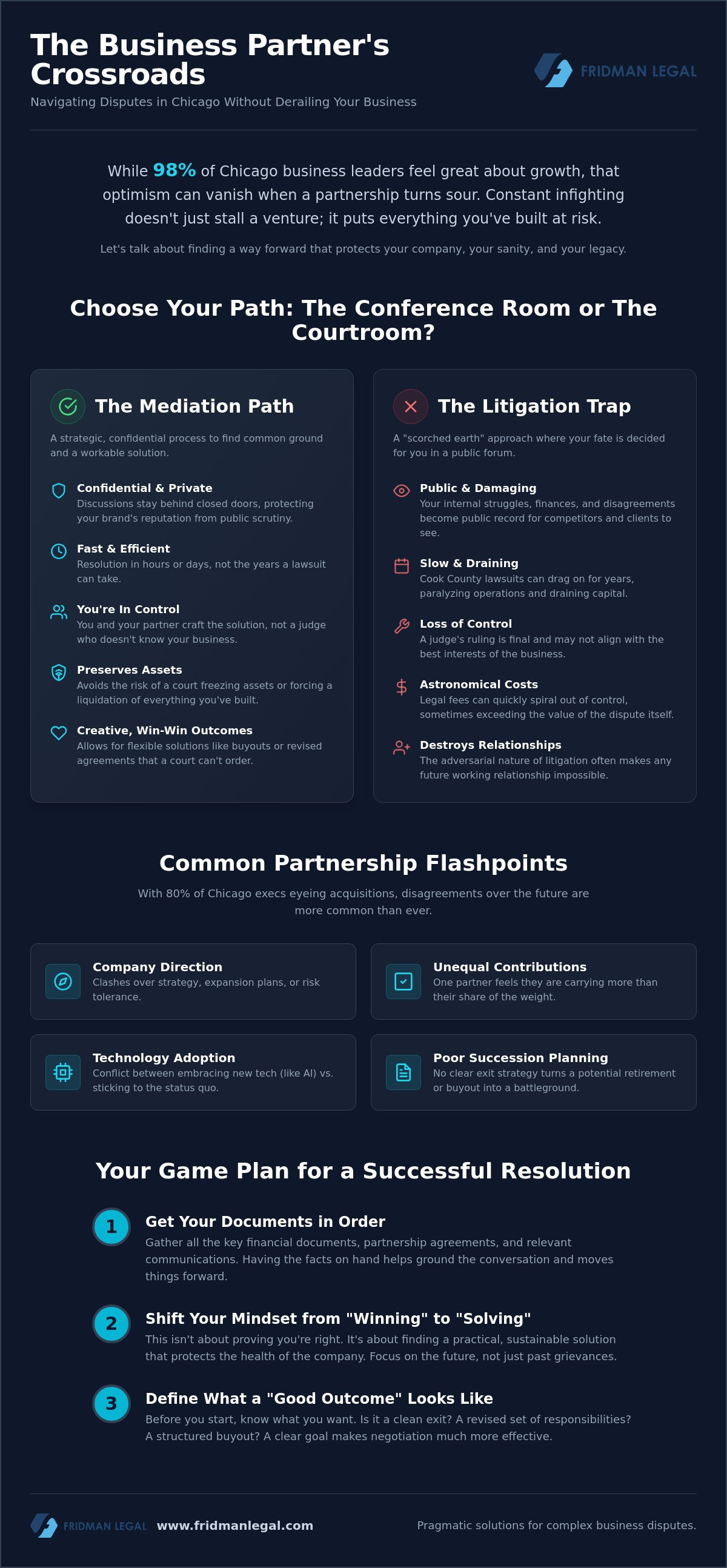
With 80% of Chicago executives planning acquisitions this year, many disputes stem from disagreements over company direction or rapid expansion. We often see tension when one partner wants to pivot toward new technology while the other prefers the status quo. Unequal contributions are another major trigger; it's hard to maintain a professional bond when one partner feels they're carrying the weight of a "silent" partner who isn't so silent. Finally, a lack of clear succession planning often turns a successful exit strategy into a bitter battleground.
Why Traditional Litigation in Cook County Can Be a Trap
Choosing to litigate a partnership dispute in Cook County often feels like taking a sledgehammer to a glass house. Court filings are public record. This means your competitors, clients, and even your bank can read the details of your internal infighting, which can instantly tarnish your brand's reputation. The Chicago court system is also notoriously slow. A typical business lawsuit can drag on for years, during which time your assets might be frozen or your operations paralyzed. By the time a judge makes a ruling, the legal fees can easily exceed the actual value of the dispute. Mediation for business partners Chicago allows you to bypass this "scorched earth" approach, keeping your private business matters exactly where they belong: behind closed doors.
Mediation vs. Litigation: Choosing the Right Path for Your Business
Choosing between the courtroom and the conference room is rarely just about who is right. It's about survival. Litigation is a blunt instrument; it's a binary process where one person wins and the other loses. In a partnership, a "win" in court often feels like a loss in business because the process itself is so destructive. Mediation for business partners Chicago offers a different trajectory. It's a key part of Alternative Dispute Resolution (ADR), a framework that prioritizes efficiency and practical outcomes over legal posturing.
The most significant advantage of mediation is its absolute confidentiality. Courtrooms are public stages. When you litigate, your company's internal struggles, financial records, and strategic failures become part of the public record. In mediation, what's discussed stays behind closed doors. This privacy is essential for maintaining your brand's reputation and your relationship with lenders. It also allows you to speak candidly about the real issues without worrying that your words will be used against you in a future trial. If you're looking for a way to resolve friction while keeping your company's dignity intact, a strategic legal perspective can help you weigh these options.
The Cost-Benefit Analysis: Time and Money
Litigation in Chicago can easily consume years of your life and a massive portion of your company's liquid capital. Mediation, by contrast, is often measured in hours or days. This speed is critical for preventing a total collapse that might otherwise lead to a Chapter 11 bankruptcy filing. Generally, the costs of the mediator's time are shared equally between the partners, which keeps both parties invested in reaching a conclusion. By resolving the dispute early, you're not just saving on legal fees; you're saving the business itself from the stagnation that occurs during a protracted legal battle.
Control Over the Outcome
When you go to court, you hand the keys of your business to a judge who must follow rigid statutes. They don't know your industry, your clients, or your long-term vision. They might order a dissolution that neither of you actually wants. Mediation for business partners Chicago keeps the pen in your hands. You and your partner decide the terms of the settlement. This flexibility allows for creative solutions, like restructuring equity or redefining roles, that a court simply cannot grant. In the modern business world, being "right" in court is useless if the company is dead by the time the verdict arrives.
Navigating the 50/50 Deadlock: Strategic Solutions for Equal Partners
It’s a classic Chicago story. Two founders launch a venture with equal equity and a shared vision. For years, the 50/50 split feels like the ultimate sign of trust. But when a fundamental disagreement arises, that same structure becomes a trap. Without a tie-breaking vote, your company hits a deadlock. Operations stall, growth stops, and your staff begins to worry about their futures. In these moments, mediation for business partners Chicago is often the only way to avoid a court-ordered "judicial dissolution," which effectively ends the business by force.
Illinois law doesn’t have a magic wand for deadlocks. If partners can’t resolve their differences, a judge might decide the only solution is to sell off the assets and close the doors. This is why having a neutral professional involved is so critical. A skilled mediator doesn’t just listen; they act as a catalyst for movement. Their presence helps parties come to an agreement by stripping away the ego and focusing on the objective health of the entity. They help you look at your Operating Agreement not as a weapon, but as a roadmap for a resolution.
When the Operating Agreement is Silent
Many local startups launch with "bare-bones" documents that were downloaded from the internet and never updated. These agreements often lack a clear mechanism for breaking an impasse. Mediation allows you to "write the missing chapter" of your partnership agreement in real-time. You can negotiate new terms that define how future disputes will be handled. Of course, if one partner has already violated their fiduciary duties, you may eventually need civil litigation representation to protect your interests. However, mediation is the most efficient way to fix a flawed governance structure before it sinks the ship.
The "Texas Shootout" and Other Creative Buyout Structures
If you’ve decided that the partnership can't continue, mediation is the best place to structure a fair exit. One popular method is the "Texas Shootout." In this scenario, one partner names a price for their half of the business. The other partner then has the choice to either buy out the first partner at that price or sell their own share for the same amount. It’s a remarkably fair way to value a company without spending thousands on forensic audits. A mediator helps facilitate these creative buyouts, ensuring the remaining partner isn't left bankrupt and the departing partner receives a fair settlement. It's about finding a path that respects the work you've both put in while allowing the company to survive.
The 'Mediation Playbook': How to Prepare for a Successful Resolution
If you treat mediation like a battle, you've already lost before you've even walked into the room. Success in mediation for business partners Chicago requires a fundamental shift from a "war" mindset to one focused on objective problem-solving. It isn't about proving your partner is a villain or airing grievances from three years ago. Instead, it's about figuring out how the business survives the current friction. You need to identify your BATNA, which is your Best Alternative to a Negotiated Agreement. In simple terms, this is your backup plan. If your best alternative is a messy court case that risks liquidating the firm, you'll be much more motivated to find middle ground during the session.
You can't negotiate what you haven't measured. Before the first session, you must gather every scrap of financial data. This includes profit and loss statements, tax returns, and any real estate valuations for your Chicago office or warehouse. A mediator who understands our local landscape will ask for these immediately. They know that in our market, property values and specific tax implications can make or break a buyout deal. Having "the books" ready shows you're serious about a professional resolution rather than an emotional stalemate.
Setting Your Goals: What Do You Actually Want?
Before you sit down, ask yourself if you want to be right or if you want to be out. These are very different goals. Being "right" is expensive and often yields no practical benefit in the long run. Being "restructured" or "bought out" gives you a clear path forward. You must have a firm walk-away number in mind before you start. This is the absolute minimum you'll accept to leave or the maximum you'll pay to take full control. Don't forget to factor in the tax consequences of a split; a settlement looks very different after the IRS and state authorities take their portion.
The Role of Your Attorney During Mediation
A mediator is neutral, which means they aren't there to protect your specific interests or offer you individual legal advice. This is why you still need a bankruptcy lawyer in Chicago or a seasoned business litigator in your corner. They act as your coach and legal safeguard throughout the process. Once the mediation ends, you'll likely have a "Memorandum of Understanding." This is just a draft. Your attorney needs to review it to ensure it's legally binding and doesn't leave you vulnerable to future breaches of contract. If you're ready to protect your interests, consulting with an experienced legal team can provide the clarity you need to move forward.
Moving Forward: How Fridman Legal Resolves Complex Business Disputes
Allan Fridman's approach is built on professional integrity and a refusal to let a business die just because its leaders are at odds. With nearly twenty years of experience navigating the Illinois legal system, he provides a steady hand in the middle of a crisis. His background in both litigation and debt settlement is a massive advantage during mediation for business partners Chicago. He knows how to untangle complex financial obligations that often get knotted up when a partnership sours. He's seen how failed negotiations can lead to the very Chapter 7 or Chapter 11 filings he helps businesses avoid.
We've found that many business owners in the city and suburbs appreciate our Northbrook location. It offers a discreet, professional environment away from the noise of the Loop, yet we remain deeply connected to the Chicago business climate. This local presence means we understand the specific pressures Cook County businesses face in 2026. Whether it's shifting tax burdens or the rapid adoption of AI technology, we ensure your settlement is grounded in current market realities. We don't just look at the law; we look at the strategic future of your firm.
A Holistic View of Your Business Health
A partnership dispute is rarely just about who gets which office. It's often a three-dimensional problem involving business law, commercial real estate, and corporate debt. We take a holistic view of your company’s health to ensure that a resolution today doesn't create a solvency crisis tomorrow. For example, if you're restructuring an Illinois LLC, we look at how that change affects your existing commercial real estate transactions and loan covenants. Our goal is to prevent a partnership exit from triggering a default or a foreclosure on your property assets. We focus on the precision of the new agreement to make sure every operative detail is covered.
Contact Us to Start the Conversation
Taking the first step toward a resolution shouldn't feel like a high-pressure sales pitch. It's about getting the information you need to make an informed decision for your company's future. You've invested too much time and capital into your firm to let a deadlock destroy your legacy. Whether you need a new working agreement or a clean break, we're here to provide the strategic guidance that protects your sanity and your brand. Most partnership conflicts have a professional solution, provided you have the right expert in your corner to navigate the regulatory environment. Please visit our contact page to schedule a confidential consultation and begin the process of moving your business forward.
Securing Your Company’s Future Beyond the Conflict
Navigating a partnership dispute doesn't have to mean the end of your business or your peace of mind. Choosing mediation for business partners Chicago allows you to keep control of the outcome while protecting your brand's reputation from the public record. By focusing on creative buyouts or restructured operating agreements, you're making a strategic decision to prioritize your firm's solvency over the high costs of a public trial. Whether you're facing a 50/50 deadlock or planning a complex exit, the right preparation and a problem solving mindset are your most powerful tools.
With nearly 20 years of Illinois legal experience and a specialized focus on high stakes business and debt matters, O. Allan Fridman provides the Northbrook and Chicago local expertise needed to resolve these hurdles. We take a holistic view of your company's health, ensuring that your settlement is sustainable and legally sound. Don't let a temporary disagreement lead to permanent damage. Talk to O. Allan Fridman about your business dispute today and start the journey toward a clearer, more stable path forward. You've built a legacy worth protecting, and the right resolution is closer than you think.
Frequently Asked Questions
Is business mediation legally binding in Illinois?
A mediation session itself isn't a trial, but the resulting written agreement is a legally binding contract in Illinois. Once both partners sign the settlement or "Memorandum of Understanding," it can be enforced in court just like any other business contract. This provides a level of certainty that's essential for long-term stability. It’s why having an attorney review the final document is a critical step in the process.
How much does business partnership mediation cost in Chicago?
The total investment for mediation for business partners Chicago depends on the complexity of the dispute and the mediator’s hourly rate. Most partners choose to split these costs equally to ensure both sides stay committed to a fair outcome. While fees vary across the city, the total cost is almost always a fraction of what you’d pay for a multi-year litigation battle in the Cook County court system.
What happens if my partner refuses to participate in mediation?
Mediation is a voluntary process, so you can't force a partner to sit down if they aren't willing to negotiate. If one side refuses to participate, your options usually shift toward traditional litigation or triggered clauses in your Operating Agreement. However, many partners change their minds once they realize that the alternative is an expensive, public courtroom battle that could potentially lead to the business being liquidated by a judge.
Can a mediator give us legal advice or tell us who is right?
A mediator's role is to facilitate a conversation, not to act as a judge or give you individual legal advice. They're neutral third parties who help you find common ground, but they won't tell you who is "right" or "wrong." This is exactly why you need your own attorney involved. Your lawyer protects your specific interests while the mediator focuses on helping both parties reach a workable, mutual agreement.
How long does the mediation process typically take for a business dispute?
Most business partnership disputes in Chicago can be resolved in one or two full-day sessions. This is a massive advantage compared to the local court system, where business cases often drag on for eighteen months or longer. Because mediation moves at the speed of the participants, you can often reach a resolution and get back to normal operations in a matter of weeks rather than years.
Can mediation help if we are already facing a lawsuit in Cook County?
You can absolutely turn to mediation even if a lawsuit has already been filed in Cook County. In fact, many judges encourage or even mandate court-annexed mediation to help clear the docket. Moving a pending case into a mediation room can put an immediate stop to mounting legal fees. It gives you a final chance to settle the matter privately before a public verdict is reached.
Do we need to have a written partnership agreement to go to mediation?
You don't need a formal written partnership agreement to start the mediation process. While having one provides a helpful framework, many disputes actually arise because no such document exists. Mediation is a great tool for "handshake" partners to finally put their roles, responsibilities, and exit strategies into a formal, written contract. It's about fixing the foundation so the business can grow without future deadlocks.
Will our employees or clients find out about the mediation?
Confidentiality is one of the primary reasons business owners choose mediation over court. Under the Illinois Uniform Mediation Act, the discussions held during your sessions are privileged and private. Your employees, clients, and competitors won't have access to the details of your disagreement. This allows you to resolve internal friction without damaging your brand’s reputation or creating unnecessary anxiety within your workforce or client base.

Article by
O. Allan Fridman
O. Allan Fridman has been practicing law since 2001. His practice is unique in that he does not view himself as a litigation attorney or transactional attorney. Rather, he views each area of law as a tool to pursue the best results for his clients. By practicing in both areas of law, he is able to take a 360-degree view of law. This enables the firm to catch potential drawbacks that are readily identifiable.
By practicing in litigation and transactional law and taking a holistic approach in dealing with our clients, he doesn’t put clients in box — rather, as we are all individuals, so too are the legal services we may require.
Whether it is bankruptcy or litigation or transactional, each client brings challenges and does not fit in any one box. Often times, bankruptcy clients end up not filing bankruptcy because we can achieve a better result through litigation or through an out-of-court resolution with the lender, or through a real estate sale. On the other end of the spectrum, a litigation client with multiple issues and lawsuit may fare better in a bankruptcy.
Since 2001, Allan has practiced in states and federal court, and he is a member of the trial bar of the Northern District of Illinois and admitted in the Northern District of Indiana.
We are a debt relief agency. We help people file for bankruptcy relief under the Bankruptcy Code
The materials on this site are for informational purposes only and do not constitute legal advice. Viewing this site or contacting us does not create an attorney–client relationship, and you should not act or refrain from acting based on any information here without seeking professional legal counsel.