

What if the most aggressive creditor actions could be halted within minutes of a single legal action, transforming a defensive struggle into a calculated strategic recovery? For many directors in Northbrook and Chicago, a chapter 11 bankruptcy filing isn't a sign of failure but a sophisticated tool for corporate preservation. You likely understand that the complexity of the federal courts in Illinois can feel overwhelming when your business control is at stake. It's a sentiment shared by many who face the pressure of maintaining operations while managing mounting liabilities.
This 2026 guide provides the precise legal framework necessary to navigate these high-stakes environments and secure long-term financial stability. Professional integrity demands a proactive approach; data from the Administrative Office of the U.S. Courts indicated a 15% rise in business reorganizations within the Northern District during 2024. You'll learn how to utilize the automatic stay to block creditor interference and implement a reorganization plan that restores solvency. We'll outline the exact steps to maintain operational authority while restructuring your obligations under current federal guidelines.
Key Takeaways
- Distinguish between reorganization and liquidation to evaluate if a chapter 11 bankruptcy filing is the appropriate instrument for your entity’s recovery.
- Gain clarity on the procedural requirements within the Northern District of Illinois and the immediate protections afforded by the automatic stay.
- Explore the streamlined benefits of Subchapter V, designed to significantly reduce the financial and administrative burdens on Northbrook-based small businesses.
- Understand the strategic management of adversary proceedings and the critical role creditor committees play in complex, large-scale reorganizations.
- Recognize the value of expert legal guidance in harmonizing formal bankruptcy proceedings with debt settlement options for sustainable financial health.
Understanding Chapter 11 Reorganization for Northbrook Businesses
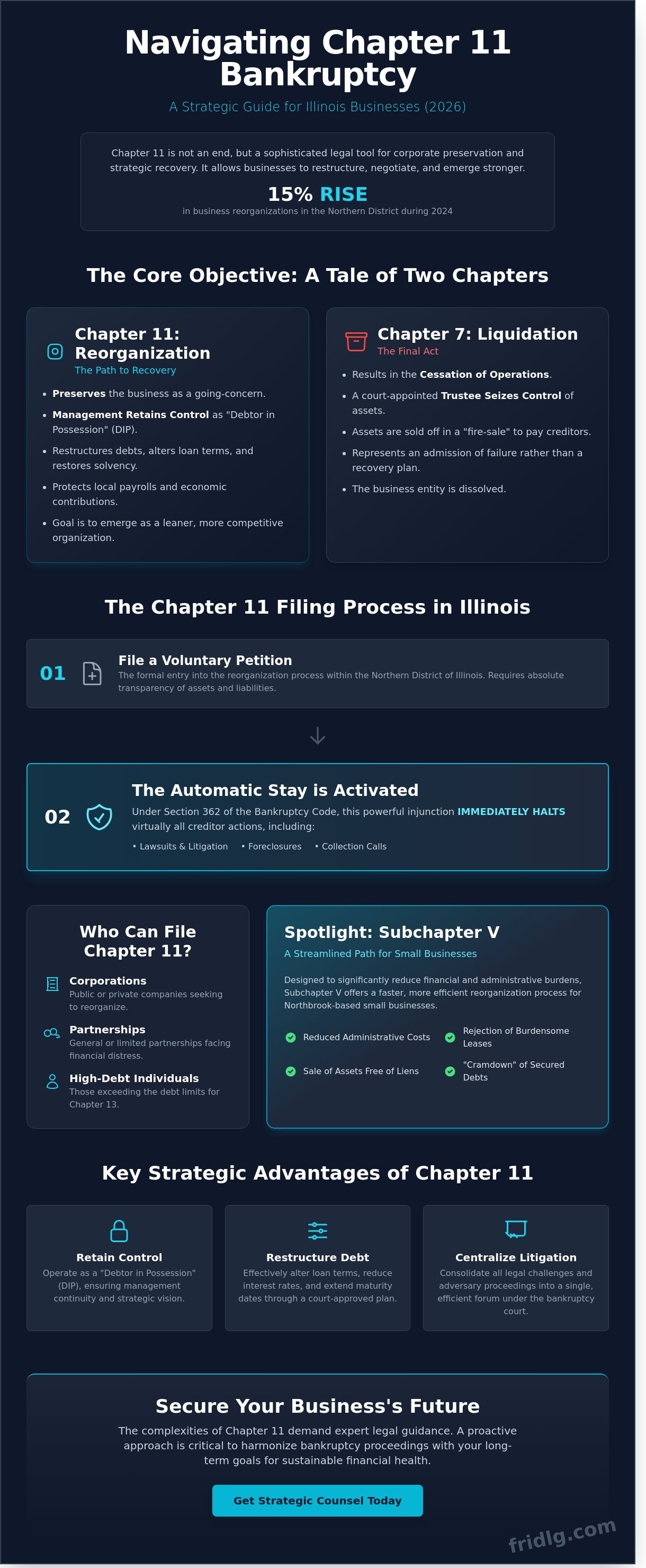
Chapter 11 serves as the primary legal framework for business rehabilitation within the United States. Unlike the finality associated with liquidation, a Chapter 11 of the United States Bankruptcy Code filing facilitates the restructuring of financial obligations while the business continues its daily activities. This process prioritizes the preservation of the enterprise's going-concern value. It's a sophisticated tool designed for entities that possess a viable core model but suffer from temporary insolvency or unsustainable debt structures.
A defining characteristic of this process is the "Debtor in Possession" (DIP) status. Under this designation, current management retains control of the company assets and operations. The court doesn't appoint a trustee to seize control as it does in Chapter 7. This continuity ensures that Northbrook executives maintain their strategic vision while operating under the protection of the bankruptcy court. It fosters a stable environment for negotiating with creditors. The primary objective is to emerge from the process as a leaner, more competitive organization.
The Core Objective: Reorganization vs. Liquidation
Reorganization functions as a calculated path toward long-term operational viability rather than an admission of failure. The primary mechanism involves a court-approved plan that can effectively alter loan terms, reduce interest rates, and extend maturity dates. For a business in the Chicago suburbs, this preservation of operations protects local payrolls and maintains the economic health of the Northbrook corridor. It prevents the fire-sale of assets that characterizes Chapter 7 liquidation, ensuring that the business remains an active participant in the regional market.
Who is Eligible to File Chapter 11 in Illinois?
Eligibility extends to corporations, partnerships, and high-debt individuals who exceed the statutory limits for Chapter 13. In 2026, many individual entrepreneurs choose Chapter 11 because their secured or unsecured debt surpasses the current thresholds set by federal law. This flexibility is particularly beneficial for Northbrook real estate holding companies and construction firms. These sectors often deal with complex lien structures and seasonal cash flow volatility that require the robust protections only a chapter 11 bankruptcy filing provides.
Small businesses also utilize Subchapter V, a streamlined version of Chapter 11. This path reduces administrative costs while retaining the restructuring benefits. It's an essential consideration for local mid-sized firms facing sudden market shifts. The process allows for the following strategic moves:
- Rejection of burdensome leases or executory contracts.
- Sale of specific assets free and clear of liens.
- Cramdown of certain secured debts to the current market value of the collateral.
- Centralization of all litigation into a single forum.
By 2026, the integration of digital filing systems has increased the speed of these proceedings, though the legal complexity remains high. Professional guidance is necessary to ensure that the filing aligns with broader corporate goals.
The Mechanics of the Chapter 11 Filing Process in Illinois
Initiating a chapter 11 bankruptcy filing within the Northern District of Illinois requires a high degree of precision and a strategic overview of the debtor's financial architecture. The process begins with the submission of a voluntary petition to the court, which serves as the formal entry into the reorganization phase. This action triggers a series of procedural mandates designed to stabilize operations while the business restructures its obligations. For a comprehensive overview of these statutory requirements, the U.S. Courts Chapter 11 Basics provides the foundational legal framework governing these complex proceedings. The process is rigorous. It demands absolute transparency regarding assets, liabilities, and current financial statements.
The Power of the Automatic Stay
The filing immediately activates the automatic stay under Section 362 of the Bankruptcy Code. This statutory injunction halts virtually all collection activities, including pending foreclosures and litigation. For a Northbrook based corporation facing multiple creditor lawsuits, this stay provides the necessary breathing room to focus on operational recovery rather than defensive legal maneuvers. It stops the persistent pressure of 15 or 20 separate collection efforts simultaneously. While the stay is expansive, business owners must monitor specific exceptions. Certain regulatory enforcement actions or tax audits may proceed despite the filing. Strategic planning ensures the stay is utilized to preserve asset value before creditors seek relief from the court to resume their claims. Maintaining this protection requires strict adherence to court reporting deadlines to avoid a motion for relief from the stay.
Developing a Viable Reorganization Plan
The centerpiece of the chapter 11 bankruptcy filing is the reorganization plan, which classifies claims into specific categories based on their legal priority. Under the Best Interests of Creditors test, Illinois courts require that each dissenting creditor receives at least as much value as they'd get in a Chapter 7 liquidation. The debtor maintains a 120 day exclusivity period to file this plan, preventing creditors from proposing competing strategies during the initial restructuring phase. This window is critical for management to retain control over the company's future direction. Once the disclosure statement is approved, creditors vote on the plan, leading to a final confirmation hearing where the court evaluates the plan's feasibility and legal compliance. Strategic oversight at this stage is paramount, and seeking complex legal solutions can prevent procedural errors that jeopardize the entire reorganization. Confirmation effectively discharges pre-petition debts and binds all parties to the new repayment terms, allowing the business to emerge as a leaner, more competitive entity by late 2026.
- Petition Filing: Commences the case in the Northern District of Illinois.
- Schedules and Statements: Detailed disclosure of all financial interests and executory contracts.
- Creditor Voting: Classes of creditors must approve the plan by a specific majority.
- Cramdown Provisions: The court's ability to confirm a plan over the objection of a dissenting class if it meets fairness standards.
Subchapter V: A Streamlined Path for Small Business Debtors
The Small Business Reorganization Act (SBRA) provides a specialized framework designed to mitigate the prohibitive costs and procedural complexities traditionally associated with a chapter 11 bankruptcy filing. For Northbrook enterprises, this pathway prioritizes the preservation of going-concern value while reducing the administrative burden that often exhausts the liquidity of smaller firms. Unlike traditional restructuring, Subchapter V of Chapter 11 introduces a court-appointed trustee whose primary function is to facilitate a consensual plan of reorganization rather than seizing control of daily operations. This mediator-centric approach ensures that management retains operational autonomy while benefiting from expert oversight during creditor negotiations.
A critical advantage for business owners is the elimination of the absolute priority rule. In standard filings, equity holders cannot retain their interest in the company unless all creditors are paid in full. Subchapter V permits owners to maintain their ownership interests even if creditors aren't made whole, provided the reorganization plan is fair, equitable, and directs all projected disposable income toward debt repayment over a three-to-five-year period. This shift empowers Northbrook entrepreneurs to restructure without the fear of losing their company to the very creditors they're seeking to satisfy.
Eligibility Criteria for Subchapter V
As of the most recent statutory adjustments effective through 2026, the debt limit for qualifying as a small business debtor is $3,024,725. This figure includes both secured and unsecured debts but excludes obligations owed to affiliates or insiders. Debtors must be actively engaged in commercial or business activities at the time of the chapter 11 bankruptcy filing. It's important to recognize that the statute specifically excludes entities whose primary activity is the ownership of single-asset real estate, ensuring these streamlined benefits are reserved for operating businesses with active payrolls and trade debt.
Key Advantages Over Traditional Chapter 11
- Accelerated Timeline: Debtors are required to file a reorganization plan within 90 days of the petition date, preventing the stagnation and mounting professional fees typical of standard cases.
- Reduced Creditor Interference: There's no mandatory appointment of a creditors' committee. This removes the requirement for the debtor to fund the legal and financial advisors of their creditors, saving significant capital.
- Equity Preservation: Owners can confirm a plan over the objection of creditors without being forced to provide "new value" to retain their shares.
- Administrative Efficiency: Only the debtor may file a plan, which eliminates the risk of competing plans from hostile creditor groups.
The role of the Subchapter V trustee is fundamentally different from a Chapter 7 or Chapter 13 trustee. They function as a fiduciary focused on consensus, which reduces the adversarial friction typical of corporate litigation. By focusing on mediation rather than liquidation, the process supports the long-term viability of the Northbrook business community.
Navigating Adversary Proceedings and Creditor Committees
A sophisticated chapter 11 bankruptcy filing in the Northern District of Illinois is rarely a static administrative process. It is a dynamic litigation environment where the debtor’s strategic objectives often collide with the financial interests of various stakeholders. Litigation within this framework serves as the primary mechanism for resolving disputes that cannot be settled through mediation or plan negotiation. In Cook County, these disputes frequently center on asset valuation and lien priority, particularly when secured lenders and junior lienholders contest the equity cushion available in commercial real estate or intellectual property portfolios.
Managing Adversary Proceedings
Adversary proceedings function as distinct mini-lawsuits within the broader bankruptcy case. These actions are governed by Part VII of the Federal Rules of Bankruptcy Procedure and are essential for addressing complex legal challenges. Common triggers include preferential transfer claims under 11 U.S.C. § 547, where the debtor or trustee seeks to claw back payments made to creditors within 90 days of the filing. Fraudulent conveyance claims under § 548 also feature prominently, especially when pre-petition asset transfers are scrutinized for lack of reasonably equivalent value. Defending these actions requires a precise reconstruction of business transactions to establish "ordinary course of business" or "contemporaneous exchange" defenses. Understanding the nuances of adversary proceedings is vital for protecting the integrity of the reorganization effort.
The Role of the U.S. Trustee and Creditors
The U.S. Trustee’s Office for Region 11 maintains rigorous oversight of all corporate reorganizations in Chicago and Northbrook. Their primary mandate involves monitoring the debtor’s adherence to fiduciary duties and ensuring the timely filing of monthly operating reports. Creditor committees, typically comprised of the seven largest unsecured creditors, exert significant influence over the chapter 11 bankruptcy filing process. They possess the statutory authority to investigate the debtor’s conduct and negotiate the terms of the reorganization plan. When a plan cannot achieve unanimous consent, the "cramdown" provisions of § 1129(b) allow for confirmation over the objection of a dissenting class, provided the plan is fair and equitable. This process requires balancing the need for financial transparency with the protection of proprietary business data, a task that demands high-level strategic counsel.
Precise legal documentation is the only safeguard against a motion to convert the case to Chapter 7 liquidation. Under 11 U.S.C. § 1112(b), any material "cause," such as the persistent loss to the estate or failure to maintain insurance, can result in the termination of the reorganization. In 2024, approximately 12% of business filings in the Chicago area faced conversion motions due to reporting inaccuracies. Maintaining a disciplined schedule of disclosures ensures the debtor retains control over the entity’s future.
Secure your business’s future through meticulous litigation management. Contact our strategic advisors to discuss your restructuring requirements.
Strategic Counsel: Why Northbrook Businesses Choose Fridman Legal
Northbrook enterprises require a legal partner that views insolvency through a lens of corporate recovery rather than mere liquidation. Since 2007, Fridman Legal has provided this clarity, leveraging nearly 20 years of Illinois bankruptcy law experience to protect local interests. A chapter 11 bankruptcy filing represents a significant pivot in a company's lifecycle. It demands a sophisticated understanding of the United States Bankruptcy Court for the Northern District of Illinois, where procedural nuances often dictate the success of a reorganization plan.
Our firm prioritizes a multidimensional approach to financial distress. We don't view bankruptcy in isolation. Instead, we frequently integrate business debt settlement strategies into our broader counsel. This allows for out-of-court negotiations that may resolve specific creditor disputes before or during the filing process, potentially shortening the time spent under court supervision. For firms in the building trades, we manage the complex intersection of insolvency and construction law services. This ensures that mechanic’s lien rights and performance bond obligations remain intact while the business restructures its primary debt obligations.
Fridman Legal maintains a results-driven methodology. We focus on tangible outcomes:
- Preservation of operational control for the debtor-in-possession.
- Reduction of unsecured debt through rigorous plan negotiation.
- Protection of executive assets from derivative litigation.
- Stabilization of vendor relationships to ensure supply chain continuity.
A Local Perspective on Federal Law
While bankruptcy is governed by federal statutes, the practical application of these laws happens in the specific courtrooms of Chicago. Our attorneys possess a refined familiarity with the local rules and judicial expectations of the Chicago bankruptcy courts. Unlike large, impersonal downtown firms that may prioritize high-volume caseloads, we provide the discreet, personalized attention Northbrook business leaders expect. We understand the reputational stakes involved for local stakeholders and handle every chapter 11 bankruptcy filing with the highest level of professional confidentiality.
Moving Toward Financial Stability
The objective of any restructuring is a clean transition from discharge to renewed growth. We assist clients in navigating the post-filing landscape, ensuring full compliance with 2026 reporting standards and maintaining corporate integrity. This oversight is vital for rebuilding credit and securing future financing. Our role is to act as a strategic partner, transforming a period of financial crisis into a foundation for long-term stability. If your organization faces unsustainable debt, proactive intervention is the most effective tool for survival. Schedule a confidential consultation with Fridman Legal to evaluate your options under current Illinois and federal law.
Securing Your Corporate Legacy in 2026
Navigating the complexities of a chapter 11 bankruptcy filing requires a level of precision that matches the high stakes of your business's survival. The 2026 landscape for Illinois enterprises demands more than just procedural knowledge; it requires a strategic bridge between legal abstraction and practical fiscal recovery. Whether you're leveraging the streamlined Subchapter V provisions for small businesses or managing the intricacies of creditor committees, the objective remains a structured path toward operational stability. We focus on the specific judicial nuances of the Northern District of Illinois to ensure every filing serves your long-term commercial goals.
With nearly 20 years of Illinois legal experience, our firm provides the sophisticated representation necessary for both Chapter 7 liquidations and complex Chapter 11 reorganizations. We offer dedicated local representation for Northbrook and Chicago suburbs, providing a boutique approach that prioritizes your viability. You don't have to face these challenges without the support of a strategic partner that understands the weight of your professional reputation. Consult with a Strategic Northbrook Bankruptcy Attorney to begin your reorganization with confidence.
Frequently Asked Questions
What is the primary difference between Chapter 11 and Chapter 13 for individuals?
The primary distinction lies in the debt eligibility limits established by 11 U.S.C. § 109(e). While Chapter 13 currently restricts filers to a combined debt limit of 2,750,000 dollars, a chapter 11 bankruptcy filing offers an unrestricted path for high net worth individuals. This flexibility allows for the reorganization of complex asset portfolios that exceed statutory thresholds for simpler consumer filings. It's a strategic choice for those with substantial real estate holdings or business interests.
Can a small business owner in Northbrook keep their personal assets during a Chapter 11 filing?
Business owners generally protect personal assets if the entity is structured as a corporation or LLC, as the filing entity is a separate legal person. However, if the owner personally guaranteed 100 percent of the business debt, creditors might still pursue personal assets unless an individual filing occurs. Northbrook entrepreneurs often utilize the absolute priority rule exceptions to retain equity while restructuring obligations. Proper legal shielding depends on the specific corporate governance documents in place.
How long does a typical Chapter 11 reorganization take in the Northern District of Illinois?
A typical reorganization in the Northern District of Illinois spans 6 to 18 months from the initial petition to plan confirmation. Cases filed in the Eastern Division, which includes Chicago and Northbrook, must meet the 120 day exclusivity period for filing a plan under Section 1121 of the Bankruptcy Code. Complex cases involving multiple tiers of creditors often require extensions beyond the initial 180 day solicitation period. Efficiency depends on the transparency of the debtor's financial disclosures.
What happens if creditors do not vote in favor of the reorganization plan?
The court can still confirm a plan through a process known as a cramdown under Section 1129(b) of the Bankruptcy Code. This requires at least one impaired class of creditors to vote in favor of the plan by a two-thirds majority in amount and more than half in number. The court must find the plan doesn't discriminate unfairly and is fair and equitable to dissenting classes. This mechanism ensures that a single holdout creditor can't block a viable restructuring path.
Is Subchapter V available for real estate investment companies?
Subchapter V is generally unavailable to entities that derive substantially all of their gross income from the operation of a single real estate property. Section 101(51B) defines these as Single Asset Real Estate (SARE) entities. If an investment firm manages 2 or more distinct commercial properties, it might qualify for the streamlined Small Business Reorganization Act protections. This distinction is critical because SARE cases face stricter timelines and different debt service requirements during the proceedings.
Can Chapter 11 bankruptcy stop a pending foreclosure on a commercial property in Chicago?
An automatic stay takes effect immediately upon a chapter 11 bankruptcy filing under Section 362 of the Bankruptcy Code, halting all foreclosure proceedings in Cook County. This legal injunction provides a strategic window to restructure debt or negotiate a workout with the lender. It's a powerful mechanism to preserve the 100 percent equity value of commercial holdings during a liquidity crisis. The stay remains in place until the court grants a motion for relief or the case concludes.
What are the quarterly fees associated with a Chapter 11 filing?
Debtors must pay quarterly fees to the United States Trustee Program based on the total amount of disbursements made during the period. According to the 2024 fee schedule, these payments range from 250 dollars for small cases to 250,000 dollars for disbursements exceeding 1,000,000 dollars. Accurate financial reporting is vital as these statutory obligations remain mandatory until the case is closed, dismissed, or converted. Failure to pay these fees can lead to the dismissal of the entire case.
How does an adversary proceeding impact the timeline of a bankruptcy case?
Adversary proceedings function as separate lawsuits within the bankruptcy case and frequently extend the overall timeline by 4 to 12 months. These actions often involve preference claims or fraudulent transfer allegations that must be resolved before the court can confirm the final reorganization plan. Strategic management of these disputes is essential to prevent the erosion of the estate's value through prolonged litigation costs. They represent a significant hurdle that requires precise legal maneuvers to overcome without compromising the restructuring goals.

Article by
O. Allan Fridman
O. Allan Fridman has been practicing law since 2001. His practice is unique in that he does not view himself as a litigation attorney or transactional attorney. Rather, he views each area of law as a tool to pursue the best results for his clients. By practicing in both areas of law, he is able to take a 360-degree view of law. This enables the firm to catch potential drawbacks that are readily identifiable.
By practicing in litigation and transactional law and taking a holistic approach in dealing with our clients, he doesn’t put clients in box — rather, as we are all individuals, so too are the legal services we may require.
Whether it is bankruptcy or litigation or transactional, each client brings challenges and does not fit in any one box. Often times, bankruptcy clients end up not filing bankruptcy because we can achieve a better result through litigation or through an out-of-court resolution with the lender, or through a real estate sale. On the other end of the spectrum, a litigation client with multiple issues and lawsuit may fare better in a bankruptcy.
Since 2001, Allan has practiced in states and federal court, and he is a member of the trial bar of the Northern District of Illinois and admitted in the Northern District of Indiana.
We are a debt relief agency. We help people file for bankruptcy relief under the Bankruptcy Code
The materials on this site are for informational purposes only and do not constitute legal advice. Viewing this site or contacting us does not create an attorney–client relationship, and you should not act or refrain from acting based on any information here without seeking professional legal counsel.


