
What if the traditional path of filing for Chapter 11 in 2026 actually exposes your private holdings to greater risk than a private negotiation? Many Northbrook executives currently face a 12 percent rise in aggressive creditor actions, where a single personal guarantee can trigger the sudden freezing of non-business bank accounts. Implementing a strategic business debt settlement plan often serves as a more surgical alternative to the broad strokes of a court-mandated restructuring. It's a method that prioritizes discretion while addressing the immediate pressure of constant collection calls at your Village Green or Skokie Boulevard office.
You've likely realized that maintaining the corporate veil is becoming increasingly complex under the latest Illinois judicial precedents. We'll provide a comprehensive legal comparison between settlement and bankruptcy to ensure your personal assets remain insulated from corporate liabilities. This guide outlines how to achieve a significant reduction in principal while avoiding the public scrutiny of federal filings. You'll gain a clear understanding of the 2026 legal landscape and the precise steps required to safeguard your professional legacy.
Key Takeaways
- Evaluate the 2026 economic landscape in Northbrook to determine if business debt settlement offers a more viable path to solvency than traditional liquidation.
- Distinguish between high-risk "settlement mills" and attorney-led negotiations to ensure your financial restructuring remains protected by legal privilege.
- Compare the long-term costs and operational control of Chapter 11 bankruptcy against private workouts to select the most efficient debt resolution strategy.
- Follow a disciplined framework for asset valuation and financial auditing to strengthen your legal position during sensitive creditor negotiations.
- Implement proactive safeguards to prevent personal guarantees from jeopardizing your private assets and Northbrook real estate during business restructuring.
Understanding Business Debt Settlement in the Northbrook Economic Landscape
Business debt settlement is a structured legal negotiation where a debtor reaches an agreement to pay a single, lump-sum amount that is less than the total outstanding balance to satisfy a commercial obligation. To establish a baseline for these negotiations, it is helpful to review the core principles of What is Debt Settlement? and how these mechanisms function within a corporate framework. In the 2026 fiscal environment, Northbrook enterprises are navigating a complex intersection of 4.8% local inflation and shifted lending criteria from Chicago-area financial institutions. These factors have compressed profit margins for approximately 22% of small to mid-sized firms in the Village of Northbrook, making traditional debt servicing increasingly difficult.
Commercial debt requires a distinct legal strategy because it lacks the statutory protections afforded to consumer credit under the Fair Debt Collection Practices Act. Instead, Illinois commercial contracts are primarily governed by the Uniform Commercial Code (810 ILCS 5/). This framework grants creditors significant latitude in enforcing default provisions, including the right to accelerate the entire balance upon a single missed payment. Because of this, business debt settlement must be approached as a high-stakes commercial transaction rather than a simple consumer dispute.
When is Settlement the Right Strategic Move?
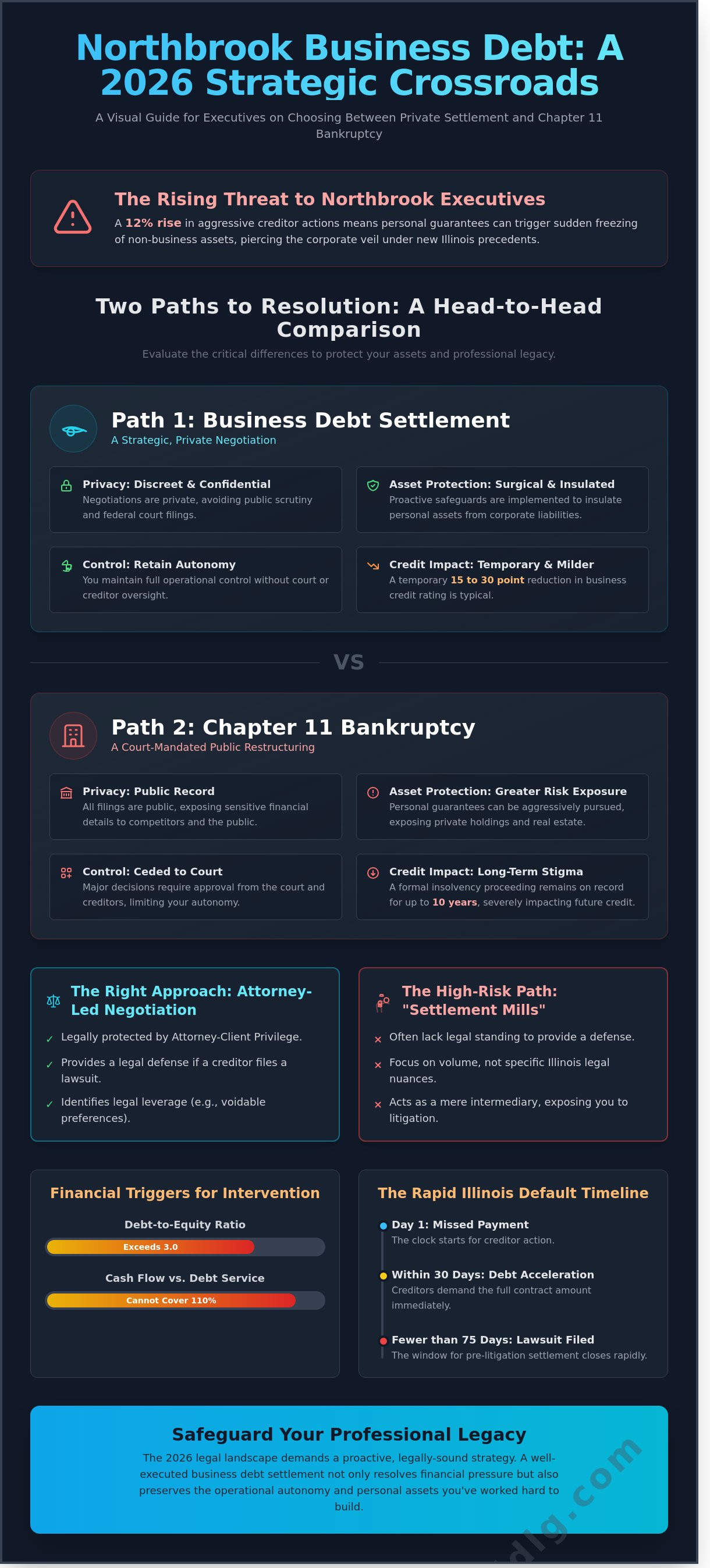
Determining the appropriate timing for a settlement requires a rigorous analysis of a firm's balance sheet. If a Northbrook enterprise maintains a debt-to-equity ratio exceeding 3.0 or if projected 2026 cash flows cannot cover 110% of monthly debt service, a strategic intervention is necessary. Identifying the nature of the creditor is equally vital. Traditional banks often prioritize recovery speed, whereas certain merchant cash advance providers may employ more aggressive litigation tactics. While a settlement can cause a temporary 15 to 30 point reduction in a business credit rating, this outcome is generally preferable to the 10-year stigma of a formal insolvency proceeding.
The Legal Reality of Business Defaults in Illinois
The Circuit Court of Cook County maintains a rigorous schedule for commercial debt litigation. Once a payment is missed, the transition from a late notice to a formal summons can occur in fewer than 75 days. Creditors in the Chicago area typically initiate the "acceleration" phase within 30 days of the first default, demanding the full contract amount immediately. Business debt settlement serves as a strategic mechanism to resolve outstanding obligations while precluding the necessity of protracted, costly litigation. By intervening before a judgment is entered, a company preserves its operational autonomy and avoids the risk of court-ordered asset seizures or bank levies under Illinois law.
Attorney-Led Negotiation vs. Debt Settlement Companies: The Legal Gap
Choosing between a high-volume settlement agency and specialized legal counsel is a decision that defines the trajectory of a company's financial recovery. In the 2026 Northbrook commercial landscape, the distinction is fundamental. Most debt settlement companies operate as "settlement mills," focusing on volume rather than the specific legal nuances of Illinois contract law. These entities often lack the standing to provide a defense if a creditor files a lawsuit. The Consumer Financial Protection Bureau offers critical debt relief program guidance, highlighting that many non-attorney programs fail to protect businesses from the immediate risk of litigation. While a debt settlement company acts as a mere intermediary, an attorney functions as a litigator. This distinction is vital when a creditor moves from collection calls to legal action. A lawyer identifies "voidable preferences" or breaches of the original loan agreement that can be used as leverage to force a more favorable settlement.The Protection of the Attorney-Client Relationship
The 2026 regulatory environment in Illinois places a premium on confidentiality. When engaging in business debt settlement discussions, maintaining the attorney-client privilege is a strategic necessity. Non-lawyer "negotiators" can be compelled to testify or produce records regarding your company's financial state; an attorney cannot. This shield allows for a candid assessment of assets without the fear of providing a roadmap for creditor seizure. Legal representation also provides an immediate filter for creditor harassment. Once a Northbrook business retains counsel, creditors must generally communicate through that attorney. This transition stops the operational drain caused by aggressive collection efforts. Without this protection, poorly handled negotiations often lead to "adversary proceedings," where creditors challenge the legitimacy of the debt restructuring in a formal legal setting.Identifying Predatory Settlement Practices
National debt relief programs frequently utilize "escrowing" models that are inherently risky for Illinois businesses. These programs require clients to stop paying creditors and instead deposit funds into a third-party account. This strategy often triggers immediate defaults and lawsuits before enough capital is accumulated for a settlement. Illinois regulators have identified these practices as high-risk, especially when the third party is not a fiduciary. Red flags in these programs include:- Requests for upfront fees before any debt is settled.
- Promises of specific percentage reductions (e.g., "50% off") without reviewing the underlying contracts.
- A lack of transparency regarding the tax implications of "forgiven" debt.
Comparison: Business Debt Settlement vs. Chapter 11 Bankruptcy
Choosing between judicial reorganization and private negotiation requires a rigorous analysis of capital structure and long-term operational goals. Business debt settlement offers a discrete path to solvency, whereas Chapter 11 bankruptcy provides a federal shield at the cost of transparency. Filing fees for a Chapter 11 case in the Northern District of Illinois currently stand at $1,738, yet the real financial burden lies in the professional fees. Legal and accounting costs for even a modest reorganization often exceed $50,000. Settlement avoids these court-mandated expenditures, focusing liquid resources on the actual reduction of principal.
Control remains a primary differentiator. While a bankruptcy petitioner acts as a "Debtor in Possession," their management decisions face scrutiny from the U.S. Trustee and creditors' committees. Major transactions, asset sales, or new financing require court approval, which can paralyze a fast-moving Northbrook enterprise. Private settlements allow executives to retain full operational autonomy. For those evaluating third-party assistance, consulting Forbes debt settlement company reviews helps distinguish between consumer-grade services and the sophisticated legal strategies required for corporate liabilities.
Speed is another critical factor. A standard business debt settlement timeline typically spans 90 to 180 days. Conversely, a traditional Chapter 11 plan requires years of reporting and compliance. This efficiency allows companies to pivot toward growth rather than remaining stagnant in litigation. Privacy also favors settlement; bankruptcy is a public record, which can damage vendor relationships and credit terms for years.
The Subchapter V Alternative for Small Businesses
The Small Business Reorganization Act (SBRA) significantly altered the 2026 landscape. Northbrook businesses with non-contingent, liquidated debts under $7.5 million qualify for this streamlined process. It eliminates the absolute priority rule, allowing owners to retain equity even if creditors aren't paid in full. Subchapter V is frequently more cost-effective than traditional settlement when a single, aggressive creditor refuses to negotiate out of court, as it allows for a "cramdown" of the reorganization plan over creditor objections.
Out-of-Court Workouts: The Quiet Alternative
Restructuring doesn't always require a judge. Out-of-court workouts utilize "composition" agreements to reduce the total debt amount or "extension" agreements to lengthen payment terms. These bilateral contracts avoid the stigma of a public bankruptcy petition. This approach is particularly effective for specialized sectors. For instance, firms utilizing Construction Law Services in Northbrook often prefer these quiet resolutions to maintain their bonding capacity and reputation with subcontractors. The process is faster, cheaper, and keeps the company's financial distress away from the public eye.
The Strategic Process: How to Settle Business Debt in Illinois
Resolving corporate liabilities in Northbrook demands a precise, five-step methodology. It's not a mere negotiation; it's a legal restructuring of obligations designed to preserve the entity's viability. The process begins with a rigorous financial audit and asset valuation to determine exactly what the business can afford to offer without triggering a total collapse. This audit must be exhaustive, covering every line item from accounts receivable to depreciated equipment values.
Once the internal data is secure, the focus shifts to identifying personal guarantees and collateral. In Illinois, the statute of limitations on written contracts is 10 years, meaning a personal guarantee represents a decade-long exposure for the business owner. Crafting the legal demand and offer letter requires a balance of transparency and tactical positioning. This document, often called a hardship package, provides the evidentiary basis for the settlement request. The negotiation phase follows, involving a series of counter-offers where the goal is to reach a lump-sum agreement that satisfies the creditor's "something is better than nothing" risk assessment.
Step 1: Assessing Your Leverage
A successful business debt settlement hinges on the cold calculation of the liquidation value. Creditors are sophisticated actors; they know that if a Northbrook firm enters a forced liquidation under Chapter 7, unsecured creditors often receive 0% of their claims after administrative costs are paid. You must demonstrate that your settlement offer provides a higher recovery than they would achieve through litigation or bankruptcy. A hardship package that stands up to legal scrutiny includes three years of tax returns and a detailed schedule of liabilities. It's a tool to prove that the business is facing a genuine insolvency crisis, not merely a temporary cash flow tightening.
The Final Settlement Agreement
The execution phase is where many business owners fail to protect their long-term interests. The final settlement agreement must be a comprehensive legal document, not a simple receipt. Essential clauses for a Northbrook business include a "Release of Claims" that prevents the creditor from pursuing any future litigation related to the account. You must ensure the agreement explicitly states the debt is "satisfied in full" to prevent the balance from being sold to a secondary debt buyer.
- Release of Claims: Protects the business and all personal guarantors from future litigation.
- Credit Reporting: Requires the creditor to report the account as "paid" or "settled" to commercial bureaus within 30 days.
- Tax Compliance: Creditors will likely issue an IRS Form 1099-C for the canceled amount. Under Section 108 of the Internal Revenue Code, businesses may exclude this "Cancellation of Debt" income if they can prove insolvency at the time of the settlement.
Executing a business debt settlement without a structured agreement leaves the door open for future liability. If you are managing complex commercial obligations, securing strategic legal counsel is the most effective way to ensure the finality of your settlement and the protection of your personal assets.
Protecting Personal Assets During Business Debt Resolution
The insulation provided by a corporate structure remains a primary defense for Northbrook entrepreneurs, yet this protection is never absolute. Illinois courts maintain a rigorous standard for piercing the corporate veil when business formalities are neglected. In the context of business debt settlement, creditors frequently scrutinize whether an entity is a mere alter ego of its owner. Commingling personal funds with business accounts or failing to maintain corporate minutes can expose your private savings to commercial litigation. This vulnerability often surfaces during 2026 debt audits, where creditors seek to bypass the LLC or corporate shield to reach the individual behind the desk.
Most commercial leases and SBA loans in the 60062 and 60065 zip codes require personal guarantees. These contractual obligations effectively bypass the corporate shield by design. When a business defaults, the creditor's first move is often to target the guarantor's personal assets. For many Northbrook residents, this places high-value residential property at immediate risk of foreclosure or judgment liens. Strategic asset protection involves creating a distinct legal separation between your personal wealth and your business liabilities before a default occurs.
Personal Guarantees and Foreclosure Defense
The transition from a business default to a residential foreclosure threat happens rapidly in the Illinois court system. Effective debt resolution requires a dual-track strategy that addresses both the corporate obligation and the individual's exposure. We coordinate the technical aspects of debt negotiation with proactive wealth preservation. By integrating these efforts with Estate Planning in Northbrook, owners can establish a legal firewall. This ensures that a commercial setback does not dismantle your family's financial legacy or the equity in your home.
Next Steps: Securing Your Business Future
The path from financial distress to operational health begins with an objective assessment of your liabilities. A flat-fee consultation provides a clear diagnostic of your current exposure without the uncertainty of hourly billing. This structured approach moves your company from reactive crisis management toward a state of long-term stability. O. Allan Fridman provides the personalized, results-driven counsel required for complex settlements. Our firm operates as a strategic partner, ensuring that every legal maneuver in business debt settlement serves your broader commercial objectives and protects your private interests. Choosing a boutique Northbrook law firm ensures that your counsel understands the local economic landscape while providing the sophisticated representation necessary for high-stakes negotiations.
Securing Your Corporate Future in Northbrook
The 2026 economic landscape in Northbrook requires a calculated approach to corporate insolvency. Choosing attorney-led business debt settlement over generic relief agencies ensures your resolution adheres to Illinois legal standards while shielding personal assets from creditors. While Chapter 11 remains a viable restructuring path, strategic negotiation often provides a more efficient exit from liability without the public disclosure of a federal filing. It's a matter of prioritizing your firm's long-term viability through precise legal maneuvers.
Fridman Legal brings nearly 20 years of Illinois bankruptcy and debt relief experience to every case. Our boutique practice focuses specifically on the Northbrook and Chicago suburban markets, providing localized expertise that national firms can't match. We maintain deep proficiency in both Chapter 7 and Chapter 11 filings, ensuring your strategy's grounded in comprehensive legal knowledge. We don't just mediate; we advocate for the structural integrity of your business interests.
Securing your firm's future requires a legally sound exit strategy rather than just a reduction in balances. Schedule a Strategic Debt Consultation with Fridman Legal to begin your recovery. Your path to financial stability starts with a single, informed decision.
Frequently Asked Questions
Is business debt settlement better than filing for Chapter 11?
Business debt settlement is often preferable to Chapter 11 for entities seeking to avoid the public disclosure and high administrative costs of federal court. While Chapter 11 provides an automatic stay, a private settlement maintains operational discretion and confidentiality. According to 2023 data, Subchapter V filings increased by 20 percent, yet private negotiations remain the primary method for Northbrook firms to maintain creditor relationships without the 15,000 dollar average minimum filing overhead.
Can a creditor sue me personally for a business debt in Illinois?
A creditor can sue you personally in Illinois if you executed a personal guarantee or if the corporate veil is pierced under 735 ILCS 5. Most commercial leases and SBA loans in the Chicago area require these guarantees. If the business defaults, the creditor bypasses the corporate entity to freeze personal bank accounts or place liens on residential property. You'll need a strategic defense to decouple personal assets from corporate liabilities during the process.
How much should I expect to pay in a business debt settlement?
You should expect to pay between 40 and 60 percent of the total debt balance based on 2024 industry benchmarks from the American Fair Credit Council. The final amount depends on the creditor's liquidity needs and the age of the delinquency. A successful business debt settlement requires a lump-sum payment or a structured plan over 24 months. We ensure every dollar allocated serves the strategic objective of total liability discharge without compromising your cash flow.
Will settling my business debt stop a pending lawsuit in Cook County?
Settling your debt stops a pending lawsuit in Cook County only after the court enters a formal Stipulation to Dismiss. Simply reaching an oral agreement doesn't pause the litigation clock. Once the settlement is signed, your counsel must file the paperwork at the Daley Center to vacate any existing judgments. This prevents the creditor from obtaining a 9 percent post-judgment interest rate allowed under Illinois law, which significantly increases the total amount owed.
What happens to my personal credit if my business settles its debt?
Your personal credit remains unaffected unless you personally guaranteed the debt or the creditor reports to consumer bureaus like Experian. If a guarantee exists, the delinquency appears on your report as a "settled for less than full balance" remark. This can lower a FICO score by 50 to 125 points. We focus on negotiating specific reporting language to mitigate long-term financial reputational damage during the settlement phase.
How long does the business debt settlement process typically take?
The business debt settlement process typically spans 4 to 9 months from the initial hardship letter to the final execution of release. Aggressive creditors might settle in 60 days, while larger institutional lenders often require 180 days of financial disclosure reviews. This timeline allows for the strategic accumulation of settlement funds while maintaining a defensive posture against potential litigation or UCC-1 filings that could disrupt your Northbrook operations.
Do I need a lawyer for business debt settlement, or can I do it myself?
You don't legally require a lawyer, but navigating the 2026 regulatory environment without counsel exposes you to significant tax risks. Legal professionals identify predatory clauses in settlement releases that non-attorney debt adjusters often miss. Since Illinois doesn't license debt settlement companies the same way it regulates the bar, an attorney provides a fiduciary duty. This ensures your business's legal integrity remains intact while managing the 1099-C consequences of forgiven debt.
What is the "Means Test" equivalent for businesses in debt?
Businesses don't face a "Means Test" like individuals, but they must satisfy the "Good Faith" standard under the Bankruptcy Code. While a consumer's eligibility for Chapter 7 is restricted by median income, a business entity can liquidate regardless of previous revenue. However, if the debt is 51 percent personal in nature, the court applies the standard Chapter 7 Means Test. We analyze your debt composition to determine the most efficient path for your specific corporate structure.

Article by
O. Allan Fridman
O. Allan Fridman has been practicing law since 2001. His practice is unique in that he does not view himself as a litigation attorney or transactional attorney. Rather, he views each area of law as a tool to pursue the best results for his clients. By practicing in both areas of law, he is able to take a 360-degree view of law. This enables the firm to catch potential drawbacks that are readily identifiable.
By practicing in litigation and transactional law and taking a holistic approach in dealing with our clients, he doesn’t put clients in box — rather, as we are all individuals, so too are the legal services we may require.
Whether it is bankruptcy or litigation or transactional, each client brings challenges and does not fit in any one box. Often times, bankruptcy clients end up not filing bankruptcy because we can achieve a better result through litigation or through an out-of-court resolution with the lender, or through a real estate sale. On the other end of the spectrum, a litigation client with multiple issues and lawsuit may fare better in a bankruptcy.
Since 2001, Allan has practiced in states and federal court, and he is a member of the trial bar of the Northern District of Illinois and admitted in the Northern District of Indiana.
We are a debt relief agency. We help people file for bankruptcy relief under the Bankruptcy Code
The materials on this site are for informational purposes only and do not constitute legal advice. Viewing this site or contacting us does not create an attorney–client relationship, and you should not act or refrain from acting based on any information here without seeking professional legal counsel.