

What if that five year repayment plan isn't a financial sentence, but the exact strategy you need to keep your front door keys? It's a common fear for homeowners, especially when you're facing a pending foreclosure sale or getting harassed by creditors while you're at work. You might feel like you've run out of options because you earn too much for other filings, but a Chicago Suburbs Chapter 13 bankruptcy attorney can help you use the law to your advantage. It's about taking control of the narrative before the bank does.
I know it's exhausting to live with the constant weight of debt and the confusion over complex court requirements. You deserve a clear path forward that protects your equity and your peace of mind. In this article, you'll discover how a strategic filing can stop foreclosure in its tracks and consolidate your bills into one single, manageable monthly payment. I'll also walk you through how the latest Illinois exemptions work to keep your assets safe while you work toward discharging your remaining unsecured debt for good.
Key Takeaways
- You'll see why Chapter 13 is the go-to option for families who want to stop foreclosure and keep their home equity intact.
- We'll explain how your repayment plan is calculated so you can move forward with one manageable monthly payment instead of juggling multiple creditors.
- You'll learn why high-income earners often find more protection in reorganization, and how a chicago Suburbs chapter 13 bankruptcy attorney helps navigate these complex rules.
- We'll break down the roadmap for filing, covering everything from your initial financial review to the required credit counseling courses.
- You'll find out how a discreet, professional approach and a clear flat-fee structure can provide the stability you need during a difficult time.
Why Chapter 13 is Often the "Homeowners Choice" in the Chicago Suburbs
For many families living in areas like Northbrook, Glenview, or Arlington Heights, a steady income is a double edged sword. You earn enough to provide for your family, but your debt levels might have climbed to a point where a standard Chapter 7 liquidation isn't an option. This is where Chapter 13 of the United States Bankruptcy Code becomes a powerful strategic tool. Often called the "wage earner plan," this process is designed specifically for individuals with a regular paycheck who need a structured way to catch up on their obligations without losing everything they've worked for. Effectively, Chapter 13 is a structured repayment plan lasting 3 to 5 years that allows you to reorganize your finances under court protection.
The primary reason suburban families choose this path is the protection of home equity. In the Chicago suburbs, property values have remained resilient, meaning many homeowners have equity that exceeds the Illinois homestead exemption. If you filed for Chapter 7, a trustee might sell your home to pay creditors. Working with a chicago Suburbs chapter 13 bankruptcy attorney ensures that you keep your keys while you pay back what you owe on terms you can actually afford. The moment your case is filed, the "Automatic Stay" goes into effect. This is a powerful legal injunction that immediately stops Illinois foreclosure sales, repossession efforts, and creditor phone calls. It buys you the time you need to breathe and plan.
Stopping Foreclosure in Cook and Lake County
If you've fallen behind on your mortgage, the threat of a foreclosure sale in Cook or Lake County can feel like a ticking clock. Chapter 13 allows you to "cure" these mortgage arrears over the life of your 3 to 5 year plan. Instead of having to come up with a massive lump sum to satisfy the bank, you pay back the missed payments in smaller, manageable increments. This fits perfectly into the Illinois foreclosure timeline, giving you a legal exit ramp even if the bank has already started the litigation process. You keep your home, even if you have significant equity that a liquidation filing wouldn't be able to protect.
Protecting Your Vehicles and Other Assets
Beyond the family home, your ability to get to work is likely tied to your vehicle. Chapter 13 offers a unique benefit known as a "cramdown." If you've owned your car for at least 910 days, you might be able to reduce your loan balance to the actual fair market value of the car rather than the inflated amount you currently owe. This is just one way the reorganization process provides more security for people with non-exempt assets. It offers a level of peace of mind that comes from knowing your property is safe while you systematically resolve your debt. You're not just surviving a financial crisis; you're executing a calculated exit strategy.
How the Chapter 13 Repayment Plan Works for You
Think of your repayment plan as a custom built financial bridge. It isn't about paying back every cent to every creditor; instead, it's about paying what you can actually afford based on your current income and expenses. According to the U.S. Courts on Chapter 13, this process allows you to keep your property while using your future earnings to pay off debts over time. A chicago Suburbs chapter 13 bankruptcy attorney will help you calculate your disposable income, which is the amount left over after the court accounts for your necessary living costs like housing, transportation, and groceries.
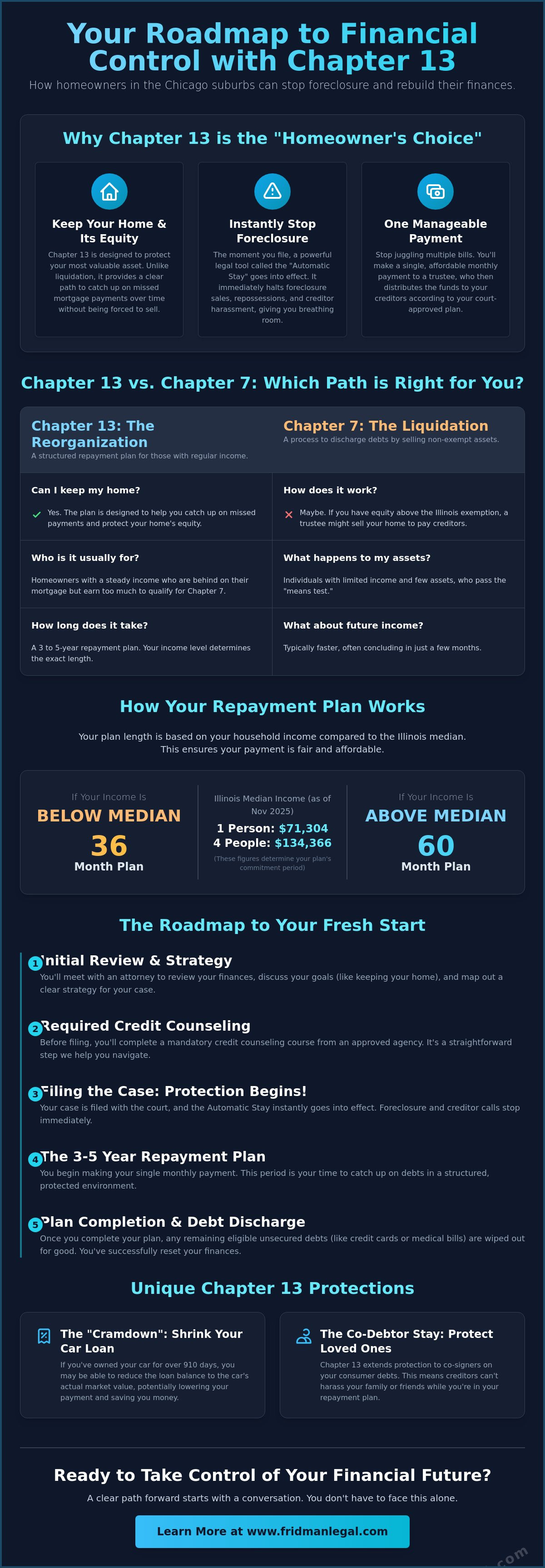
In Illinois, your household income determines the length of your commitment. As of November 2025, the state median income for a single person household is $71,304, while a four person household is set at $134,366. If your income is above these thresholds, you'll typically be on a 60 month plan. If you're below them, a 36 month plan is often the standard. Throughout this period, you make one single payment to a Chapter 13 Trustee. This official is responsible for collecting your funds and distributing them to your creditors according to the priority set by the law. At the end of the plan, most remaining unsecured debts are discharged.
The Co-Debtor Stay: Protecting Your Family Members
One of the biggest advantages of this filing is the protection it extends to others. In many suburban households, a parent or spouse might have co signed for a car or a personal loan. Unlike other bankruptcy chapters, Chapter 13 includes a co debtor stay. This stops creditors from going after your family members for consumer debts as long as you stay current with your plan. It is a vital layer of security that keeps your financial recovery from becoming a burden for your loved ones. If you're concerned about how your filing affects others, you can reach out for a professional case review to see how these protections apply to your specific situation.
Managing Your Monthly Budget
The court understands that you need to live while you're in a repayment plan. They allow for expenses that are considered reasonable and necessary. This includes everything from your Northbrook property taxes to your children's school fees and healthcare. Life doesn't stop during those three to five years. If your income drops or an emergency happens in year three, your attorney can ask the court to adjust your payments to reflect your new reality. To make things even simpler, many people choose payroll deduction. This ensures your payment is sent directly to the Trustee from your paycheck, so you never have to worry about a missed deadline.
Chapter 13 vs. Chapter 7: Which Path Makes Sense for Your Suburb Home?
Deciding between Chapter 7 and Chapter 13 often comes down to a simple question: what are you trying to protect? While Chapter 7 focuses on a quick discharge of debt through liquidation, Chapter 13 is built for reorganization. For high income earners in Northbrook and surrounding areas, the choice is often made for them by the Illinois Means Test. If your household income exceeds the state median, which is currently $110,712 for a family of three or $134,366 for a family of four, you'll likely find that Chapter 13 is your primary path to relief. You can read more about the liquidation alternative in our guide to Chapter 7 Bankruptcy in Northbrook.
Working with an experienced chicago Suburbs chapter 13 bankruptcy attorney allows you to protect assets that would otherwise be at risk. In a Chapter 7 case, a trustee might sell non exempt property to pay off your creditors. In contrast, Chapter 13 lets you keep everything. There's also a difference in how these filings impact your credit score over the long term. A Chapter 7 filing remains on your credit report for ten years, whereas a Chapter 13 filing is typically removed after seven years. This three year difference can be significant when you're planning for your financial future and want to return to the housing market sooner.
When Chapter 13 is the Only Option
If you've filed for bankruptcy before, timing is everything. You can't receive a Chapter 7 discharge if you had one in the last eight years. However, you might still be eligible for Chapter 13 even if you recently received a discharge under another chapter. This strategy is often used to handle debts that aren't easily wiped away, such as certain tax obligations or child support arrears. Reviewing the Chapter 13 Bankruptcy Basics provided by the federal court system can help you understand these specific eligibility windows and how they apply to your case.
Strategic Benefits of Choosing the Longer Path
The five year commitment of Chapter 13 offers some unique legal maneuvers that shorter filings don't. One of the most powerful is lien stripping. If your home's current market value is less than what you owe on your first mortgage, you may be able to "strip" a second mortgage or home equity line of credit. This effectively turns that secured debt into unsecured debt, which is then discharged at the end of your plan. It is a sophisticated move that requires the insight of a Strategic Bankruptcy Lawyer in Chicago to execute correctly. Slow and steady reorganization isn't just about paying bills; it's about restructuring your entire financial foundation for the better.
The Roadmap to Filing: What to Expect from Your Chicago Suburbs Attorney
Filing for bankruptcy isn't a process you should have to figure out on your own. It's a structured legal journey that requires precision at every turn. When you work with a chicago Suburbs chapter 13 bankruptcy attorney, the first step is always a comprehensive consultation. This is where we take a deep dive into your financial records to ensure that Chapter 13 is truly the most effective path for your specific goals. We'll look at your income, your debts, and your assets to build a strategy that protects your home and your future.
The process follows a very specific sequence of events:
- Step 1: The Initial Review. We analyze your full financial picture to determine your eligibility and repayment capacity.
- Step 2: Credit Counseling. You must complete a mandatory pre-filing credit counseling course from an approved agency. This is a federal requirement that must be finished before your petition can be submitted.
- Step 3: Filing the Petition. Once your paperwork is ready, we file your petition and your proposed 3 to 5 year repayment plan with the court. This triggers the Automatic Stay we discussed earlier.
- Step 4: The 341 Meeting. About a month after filing, you'll attend the Meeting of Creditors. Your attorney will be right there with you as the Trustee asks questions about your finances and your plan.
- Step 5: Confirmation. Finally, you'll have a Confirmation Hearing. This is where a judge reviews the plan and, if it meets all legal requirements, officially approves it.
Gathering Your Documents
Accuracy is the most important part of your filing. To get started, you'll need to gather at least six months of pay stubs and your last two years of federal and state tax returns. These documents are the foundation of your "schedules," which are the formal court papers detailing what you own and what you owe. Organizing this information can be overwhelming, but your Northbrook attorney will handle the heavy lifting to ensure everything is filed correctly. If you're still weighing your options, you might also find value in speaking with a Debt Settlement Lawyer in Northbrook, IL to see if a non-bankruptcy route fits your needs better.
The Role of Allan Fridman in Your Case
Having 20 years of experience in the local courts makes a significant difference in how your case proceeds. Allan Fridman provides the kind of personalized representation that is necessary during the 341 meeting and beyond. If a creditor objects to your proposed plan, you need a lawyer who knows how to negotiate effectively with the Chapter 13 Trustee to keep your case on track. This isn't just about filling out forms; it's about having a dedicated advocate who understands the nuances of the local legal landscape. To start building your roadmap to financial stability, contact our office today for a professional evaluation of your case.
Why Fridman Legal is Your Partner for Debt Reorganization in Cook & Lake County
Choosing a chicago Suburbs chapter 13 bankruptcy attorney isn't just about finding someone to fill out forms. It's about finding a partner who understands the specific legal landscape of Cook and Lake County. Allan Fridman brings a deeply professional and discreet approach to every case he handles. We don't just look at the next few months; we focus on your long term stability. One of the primary benefits of working with our firm is our flat fee structure for Chapter 13 preparation and filing. This provides you with the predictability you need during a time of financial transition. You'll know exactly what to expect as we navigate the requirements of the Northern District of Illinois courts together.
We know you're likely exhausted from the constant pressure of debt. Between your career, your family, and trying to keep up with suburban life, the last thing you need is a mountain of legal paperwork. That's why we handle all the heavy lifting. We audit your pay stubs, organize your tax returns, and ensure every schedule is filed with absolute accuracy. By managing these technical details and negotiating directly with the Chapter 13 Trustee, we free you up to focus on what matters most. Our local expertise means we've seen almost every scenario imaginable in the Chicago suburbs, and we use that knowledge to build a plan that actually works for your specific household budget.
A Human-Centric Approach to Bankruptcy
We believe every client is a person with a unique story, not just another case file on a desk. Bankruptcy is a significant journey that often spans three to five years, and we're committed to providing clear, consistent communication throughout that entire period. You'll never feel like you're in the dark about your plan's status or your progress toward a final discharge. We're here to offer expert support that's both professional and approachable. If you're ready to take the first step, a confidential conversation can help clarify your path forward and remove the mystery from the process.
Ready for a Fresh Start?
Chapter 13 is more than just a way to manage debt; it's a strategic move to change your financial trajectory. It's an investment in your future that allows you to reclaim your home equity and secure your family's peace of mind. By choosing to reorganize, you're making a calculated decision to protect your assets while systematically resolving your obligations. Don't let the fear of the process keep you from the relief you deserve. It's time to put a stop to the harassment and the uncertainty for good. Schedule a consultation with Fridman Legal today and see how we can help you build a manageable path to financial freedom.
Take the First Step Toward Financial Reorganization
You've seen how Chapter 13 serves as a strategic shield for your home and a structured path to resolving debt without losing your most valuable assets. By focusing on your disposable income and utilizing the specific protections of the Illinois bankruptcy court, you can stop the cycle of creditor harassment for good. It's about moving from a state of financial defense to a proactive, long term strategy that prioritizes your family's stability.
With nearly 20 years of specialized experience, our firm provides the discreet and professional guidance needed to navigate this complex process. We operate out of a convenient Northbrook location and offer flat fee services to ensure your transition to financial freedom is predictable and transparent. Partnering with a skilled chicago Suburbs chapter 13 bankruptcy attorney allows you to delegate the heavy legal lifting so you can focus on rebuilding your life.
It's time to replace the weight of debt with a clear, court approved plan. Get your free debt reorganization strategy session with Allan Fridman today. You have the tools and the knowledge; now it's time to claim your fresh start.
Frequently Asked Questions
Can I keep my house if I file for Chapter 13 in the Chicago suburbs?
Yes, you can almost always keep your home when filing for Chapter 13. This chapter is specifically designed to help homeowners catch up on missed mortgage payments over a three to five year period. As long as you stay current on your new monthly payments and follow your court approved plan, the bank cannot move forward with a foreclosure sale.
How much does a Chapter 13 bankruptcy attorney cost in Illinois?
The court filing fee for a Chapter 13 case in Illinois is currently $313. While legal fees vary based on the complexity of your situation, a chicago Suburbs chapter 13 bankruptcy attorney typically works within a "no-look" fee structure. This is a maximum fee amount set by the Northern District of Illinois to ensure that costs remain predictable and reasonable for local families.
What is the difference between a Chapter 7 and a Chapter 13 bankruptcy?
Chapter 7 is a liquidation process that usually finishes in a few months and involves wiping out most unsecured debts. Chapter 13 is a reorganization plan where you pay back a portion of your debt over several years. People in the suburbs often choose Chapter 13 because it offers better protection for homes with high equity and allows them to keep non exempt property.
Will my employer find out if I file for Chapter 13 bankruptcy?
Your employer won't usually find out about your filing unless you choose to have your plan payments deducted directly from your paycheck. While bankruptcy is a matter of public record, it's very rare for an employer to monitor court filings. If you have a wage garnishment in place, your employer will be notified to stop that deduction once your case is active.
How long does a Chapter 13 bankruptcy stay on my credit report?
A Chapter 13 filing stays on your credit report for seven years from the date you file the petition. This is three years shorter than a Chapter 7 filing, which remains for ten years. Many filers see their credit scores begin to improve while they are still in the plan because they are no longer falling behind on multiple high interest accounts.
Can Chapter 13 stop a car repossession in Illinois?
Yes, filing for Chapter 13 triggers an automatic stay that immediately halts any car repossession efforts. If your car was recently taken but hasn't been sold yet, the court may even allow you to get it back. You'll then pay off the loan balance through your repayment plan, often with a more manageable interest rate or a reduced principal balance.
What happens if I lose my job during a Chapter 13 repayment plan?
If your financial situation changes, your chicago Suburbs chapter 13 bankruptcy attorney can ask the court to modify your monthly payments. The court understands that life happens over a five year period. Depending on your new income level, you might be able to lower your payments, request a temporary hardship discharge, or even convert your case to a Chapter 7.
Do I have to include all of my debts in a Chapter 13 filing?
Yes, you are legally required to list every single creditor and debt you owe when you file your petition. You don't have the option to leave out a favorite credit card or a loan from a family member. However, the plan itself will dictate how each debt is treated, ensuring that priority obligations like taxes or child support are handled first.

Article by
O. Allan Fridman
O. Allan Fridman has been practicing law since 2001. His practice is unique in that he does not view himself as a litigation attorney or transactional attorney. Rather, he views each area of law as a tool to pursue the best results for his clients. By practicing in both areas of law, he is able to take a 360-degree view of law. This enables the firm to catch potential drawbacks that are readily identifiable.
By practicing in litigation and transactional law and taking a holistic approach in dealing with our clients, he doesn’t put clients in box — rather, as we are all individuals, so too are the legal services we may require.
Whether it is bankruptcy or litigation or transactional, each client brings challenges and does not fit in any one box. Often times, bankruptcy clients end up not filing bankruptcy because we can achieve a better result through litigation or through an out-of-court resolution with the lender, or through a real estate sale. On the other end of the spectrum, a litigation client with multiple issues and lawsuit may fare better in a bankruptcy.
Since 2001, Allan has practiced in states and federal court, and he is a member of the trial bar of the Northern District of Illinois and admitted in the Northern District of Indiana.
We are a debt relief agency. We help people file for bankruptcy relief under the Bankruptcy Code
The materials on this site are for informational purposes only and do not constitute legal advice. Viewing this site or contacting us does not create an attorney–client relationship, and you should not act or refrain from acting based on any information here without seeking professional legal counsel.