

What if you could finally resolve your personal debt without dragging your spouse's credit score through the mud? Many people assume that marriage creates a financial contagion during a legal filing, but that's simply not how the law works here. If you're considering filing bankruptcy without your spouse in Illinois, you're likely feeling a mix of relief at the prospect of a fresh start and intense anxiety about protecting your partner's future. It's completely normal to worry about how your choice might impact joint bank accounts or the equity in your home in Northbrook or Chicago.
I know you want to do right by your family while gaining the breathing room you need to move forward. This guide is designed to show you exactly how to shield your spouse's assets and credit rating from your individual filing. We'll explore the 2026 Illinois exemption updates, such as the $50,000 homestead protection for single filers, and explain how the state's specific property laws work in your favor. You'll get a clear look at how to secure debt relief while keeping your household's financial foundation solid and intact.
Key Takeaways
- You can file for debt relief individually without leaving a negative mark on your partner's personal credit report.
- When filing bankruptcy without your spouse in Illinois, you can use specific state laws like Tenancy by the Entirety to keep your family home secure from creditors.
- Your spouse's income is still a factor in the Chapter 7 means test, so it's important to understand how your combined household budget affects your eligibility.
- The updated 2026 Illinois exemptions offer significantly higher protections for your personal property, including your car and household goods.
- Choosing a local attorney with a flat-fee structure helps you manage the process with professional precision while avoiding any hidden legal costs.
Filing Bankruptcy Without Your Spouse in Illinois: Is It Possible?
You might feel like your finances are inseparable from your partner's, but the legal reality is quite different. You can absolutely pursue debt relief on your own. Filing bankruptcy without your spouse in Illinois is a common and often necessary strategy for families where only one person carries the weight of high interest debt or sudden medical bills. It's a way to hit the reset button without dragging your partner's financial reputation into the process. You aren't legally tethered to your partner's past financial choices, and the court recognizes you as an individual entity.
When you file an individual petition, you're the only person entering the court's jurisdiction. Your spouse doesn't become a "co-debtor" just because you share a home or a bank account. While the overarching rules for Bankruptcy in the United States follow federal statutes, Illinois law is what determines how your separate property and marital assets are treated during the case. This distinction is vital. It allows you to isolate financial trouble rather than letting it spread to your partner's credit report. Deciding between a joint petition and an individual one is a strategic choice that depends entirely on who holds the debt and what assets you need to protect.
When Filing Alone Makes the Most Sense
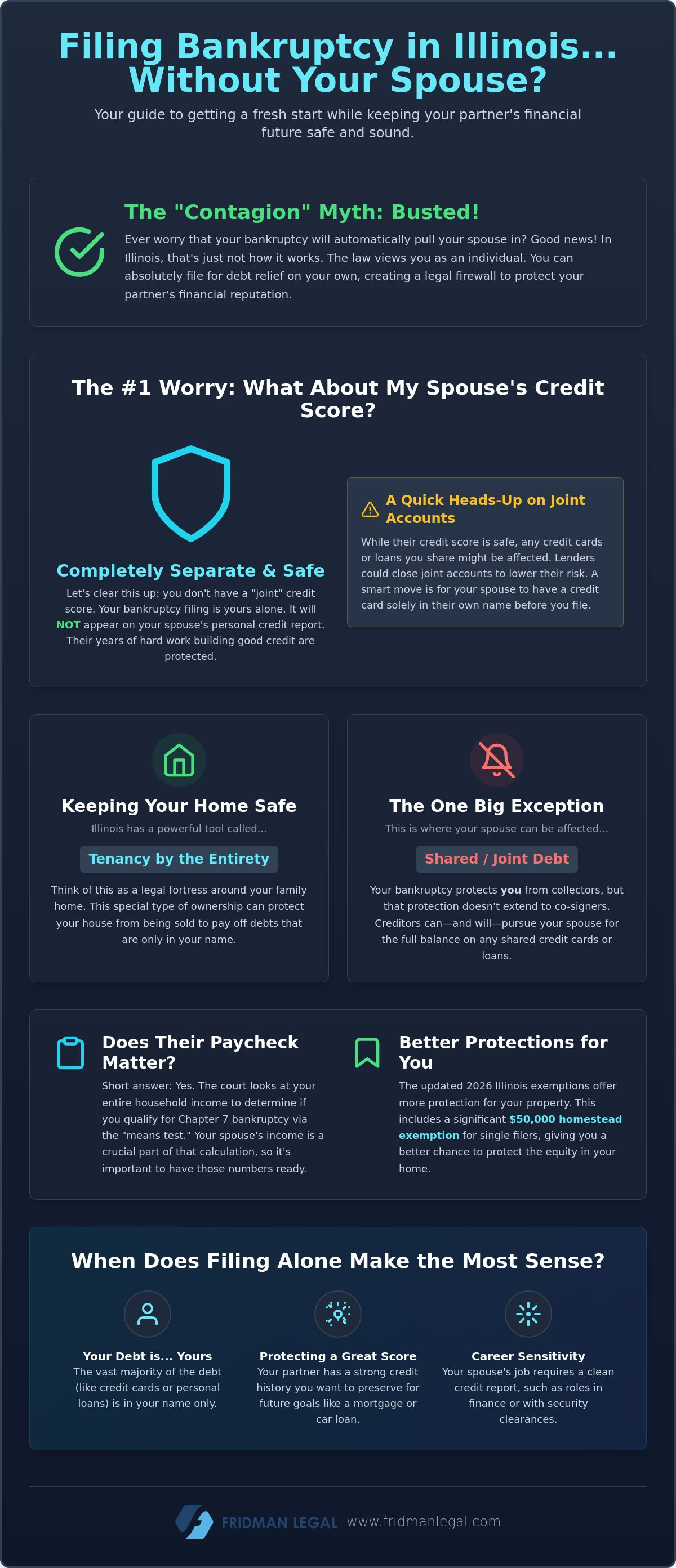
This path is often the most logical choice when the majority of the debt is strictly in your name. If you have significant credit card balances or personal loans that your spouse never signed for, there's no legal reason to impact their credit score. This approach is particularly valuable for Northbrook or Chicago professionals who hold high level security clearances or work in sensitive financial roles. Keeping one spouse's credit report pristine ensures your family can still qualify for a mortgage, a new lease, or a car loan while you work through the bankruptcy process. It provides a financial safety net for the household.
The 'Contagion' Myth: Does Your Spouse Have to File?
There's a persistent myth that marriage merges all legal liabilities into one giant, inescapable bucket. In Illinois, that's simply not true. Since we aren't a community property state, your spouse isn't automatically responsible for debts you took out individually. Creditors don't have the power to force your spouse into your bankruptcy case, and they can't pursue your spouse for debts that only you owe. By filing alone, you create a legal firewall. You're addressing your personal liabilities while maintaining a clear boundary that protects your partner's established financial stability and their future borrowing power.
How an Individual Filing Affects Your Spouse’s Credit Score
One of the most persistent fears for married couples is that financial recovery for one will mean financial ruin for the other. Let's clarify the most important fact first. Credit scores are entirely individual. Even if you have been married for thirty years, you do not have a "joint" credit score. Your bankruptcy filing will not appear on your spouse's credit report. This separation of records is the primary reason why filing bankruptcy without your spouse in Illinois is such an effective strategy for protecting the household's overall borrowing power.
While the filing itself stays off their report, we must address what I call "credit friction." If you share joint credit cards or lines of credit, the bank will notice your filing. In many cases, they will close the joint account entirely to mitigate their risk. To prevent being left without any financial tools, your spouse should ensure they have at least one or two credit cards held strictly in their own name before you start the process. The Illinois State Bar Association guide to bankruptcy confirms that while couples can file together, maintaining a separate financial identity for the non-filing spouse is often a tactical necessity.
The Danger of Joint Debt and Co-Signers
Joint debt is the one area where your filing can indirectly touch your partner. When you file for Chapter 7, the "automatic stay" protects you from collectors, but it doesn't extend to your spouse for shared debts. If you discharge a joint credit card, the creditor can legally turn their full attention to your spouse to collect the remaining balance. If you have a co-signed car loan, you must continue making those payments to prevent the lender from repossessing the vehicle. The bank's right to the collateral doesn't disappear just because one person filed for relief.
Planning for Future Joint Loans
Looking toward the future is essential for families in Northbrook or the Chicago area. If you plan to apply for a mortgage in a few years, your spouse's clean credit will be your strongest asset. Lenders often look at both scores for joint applications, and having one partner with a high score can help bridge the gap while your credit recovers. Before you file, take steps to insulate your partner by moving joint utility bills into their name or removing them as an authorized user on any accounts you plan to wipe out. If you're unsure which accounts are truly joint, a quick review of your credit obligations can help clarify your exposure and protect your spouse's future.
The Marital Adjustment: How Your Spouse’s Income Impacts Your Filing
When you're filing bankruptcy without your spouse in Illinois, you might assume your partner's paycheck is completely off-limits to the court. While they aren't filing for relief themselves, the bankruptcy code requires you to report all household income to determine if you qualify for Chapter 7. For cases filed after July 15, 2026, the median income for a two-person household in Illinois is $93,934. If your combined earnings exceed this threshold, the Illinois bankruptcy means test becomes a necessary mathematical hurdle to clear.
The good news is that the law provides a powerful tool called the "Marital Adjustment" deduction. This allows you to subtract any portion of your spouse's income that isn't actually used to support the household's shared expenses. If your spouse has their own student loans, a personal car note, or separate tax obligations, those dollars shouldn't count against your eligibility. It's a strategic way to show the court that despite a high household income on paper, you personally don't have the funds to pay back your individual creditors.
Passing the Means Test When Your Spouse Earns Well
To pass the test, we look closely at where your spouse's money goes every month. You can often deduct their payroll taxes, insurance premiums, and even their personal retirement contributions. The goal is to prove that this income isn't "available" to you for debt repayment. Because these calculations require precise documentation and a deep understanding of local court standards, working with a strategic bankruptcy lawyer in Chicago is vital. They can help you identify every allowable deduction so you don't accidentally disqualify yourself from a Chapter 7 discharge.
Chapter 7 vs. Chapter 13 for Married Individuals
If your household income remains significantly above the median even after adjustments, Chapter 13 might be the more effective shield. In this scenario, your spouse's paycheck still matters because it helps calculate your "disposable income" for the 3-to-5-year repayment plan. However, Chapter 13 offers a "co-debtor stay" that can protect your partner from collection actions on joint debts while you're in the plan. It's often the best path for families who need to protect significant assets while managing a high-income household. Choosing the right chapter ensures that filing bankruptcy without your spouse in Illinois provides the relief you need without destabilizing your partner's financial standing.
Protecting Shared Assets: What Happens to the House and Joint Debt?
The most common fear I hear from couples is the worry that filing bankruptcy without your spouse in Illinois will result in the sheriff showing up to seize the family car or, worse, put a "for sale" sign on the front lawn. It's a heavy burden to carry, but the 2026 Illinois exemption laws are designed to prevent exactly that. When you file individually, the court isn't interested in punishing your spouse. Instead, the process is about identifying what you own personally and applying specific legal shields to keep those assets in your hands.
The protection of your assets depends heavily on how they're titled and the specific exemptions available under state law. Illinois is quite generous compared to many other states, especially with the updates that went into effect on January 1, 2026. Beyond just your home and car, the law now provides a $5,000 exemption for a single piece of jewelry and an automatic $1,000 protection for funds in a bank account. Retirement accounts like 401(k)s and IRAs are almost always 100% exempt, meaning they stay completely untouched regardless of your debt level.
Will We Lose Our Northbrook Home?
For most families, the home is their most significant asset. If you and your spouse own your residence as "Tenancy by the Entirety," you have a massive shield. This specific type of ownership, available only to married couples in Illinois, prevents a creditor from forcing the sale of your home to pay off a debt that only one spouse owes. Even if you don't use that specific title, the 2026 Illinois Homestead Exemption allows an individual filer to protect up to $50,000 in equity. To keep the home, you simply need to ensure your mortgage payments remain current throughout the filing bankruptcy without your spouse in Illinois process.
Joint Bank Accounts and Titled Property
Joint bank accounts require a bit more tactical planning. If your paycheck and your spouse's paycheck both land in the same account, a bankruptcy trustee might argue that all those funds belong to you. This is known as "commingling." To avoid this, it's often wise to open separate accounts before filing so your spouse's earnings are clearly isolated. The same logic applies to vehicles. While you can protect $3,600 of equity in one motor vehicle, a car titled in both names can complicate the math. If you're concerned about how a specific asset might be treated, you should schedule a review of your property to ensure every piece of your family's wealth is properly shielded before you file.
Why a Local Northbrook Bankruptcy Attorney Makes the Difference
When you decide that filing bankruptcy without your spouse in Illinois is the right path, you aren't just looking for a form-filler. You need a strategist who understands the specific temperament of the trustees in the Cook County and Lake County courts. O. Allan Fridman brings nearly 20 years of experience to the table, helping families in Northbrook and the surrounding Chicago area navigate the delicate balance of individual debt relief within a shared marriage. Every court has its own quirks; having a local advocate means your case won't be derailed by a procedural detail that a high-volume, national firm might overlook.
Financial anxiety is often fueled by the unknown, particularly when it comes to legal costs. We eliminate that stress by utilizing a flat-fee pricing structure for our bankruptcy services. You won't have to worry about a ticking clock or surprise invoices every time you have a question about your spouse's assets or your credit score. This transparency allows us to focus entirely on the goal at hand: wiping out your debt while ensuring your partner's financial future remains secure. Choosing the right strategy for filing bankruptcy without your spouse in Illinois requires a tailored approach that accounts for your specific family dynamics and long-term goals.
Our firm prides itself on providing a level of discretion and intelligence that matches the complexity of your situation. We don't just look at your current bills. We look at your future mortgage eligibility, your retirement goals, and your family's overall stability. By positioning ourselves as strategic supporters of your financial health, we ensure that the legal process serves your life, rather than the other way around. This specialized approach is why so many professionals in the Northbrook area trust us to handle their most sensitive financial matters.
A Conversational Approach to Tough Financial Times
At Fridman Legal, we don't believe in hiding behind "legalese" or using robotic terminology that leaves you more confused than when you started. We prioritize clear, human-centric advice because we know how personal these decisions are. During your initial consultation, we'll sit down and look at your entire family's financial picture, not just your balance sheet. We handle the heavy lifting of the paperwork and the court filings so you can focus on your daily life and your relationships. Our role is to be your expert guide, providing a steady hand through a process that can otherwise feel overwhelming.
Take the First Step Toward Debt Relief
If you're ready to see if filing alone is right for you, we invite you to contact us today. Whether you need a Chapter 13 plan to save your home or want to explore Chapter 7 bankruptcy services in Northbrook, we have the tools to help. Let's build a personalized plan together that protects your spouse, clears your path, and finally gives you the fresh start you deserve.
Secure Your Family's Financial Future Today
Deciding to take control of your debt is a significant step, but it doesn't have to be a burden your partner carries too. As we've explored, filing bankruptcy without your spouse in Illinois allows you to isolate personal liabilities while leveraging the 2026 homestead exemptions to keep your family home safe. By maintaining separate credit identities and carefully navigating the marital adjustment in the means test, you can wipe the slate clean without destabilizing your household's overall financial health or your partner's credit score.
With nearly 20 years of bankruptcy experience, O. Allan Fridman provides the strategic guidance needed to navigate the specific court systems in Northbrook, Chicago, and all surrounding suburbs. We offer flat-fee Chapter 7 filings to ensure you have total clarity on your legal costs from the very beginning. Our goal is to provide a professional, discreet environment where you can find the debt relief you need while protecting the people you love most.
If you're ready to explore a personalized strategy that protects your spouse and secures your fresh start, book a consultation with Fridman Legal today. You don't have to manage this complex transition alone; we're here to help you move forward with confidence and peace of mind.
Frequently Asked Questions
Can I file for bankruptcy without my spouse knowing?
Technically, you can file an individual petition without your spouse's signature or formal consent. However, keeping a filing secret is practically very difficult. Bankruptcy is a matter of public record, and if you share a home or bank accounts, your spouse will likely see court mailings or notices from creditors. Transparency is usually the best policy to ensure your household stays unified during the legal process.
Will my spouse's credit cards be canceled if I file alone?
Credit cards held strictly in your spouse's name will not be canceled because of your filing. The bank only has a contract with them, and your bankruptcy doesn't breach that agreement. However, any joint accounts or cards where your spouse is an authorized user will likely be closed by the lender. This is why establishing separate credit identities is a vital step before filing bankruptcy without your spouse in Illinois.
Does my spouse have to come to the bankruptcy court with me?
No, your spouse isn't required to attend the Meeting of Creditors or any other court hearings if they aren't a co-filer. Since they haven't signed the petition, they aren't under the court's jurisdiction. You're the only one responsible for testifying about your debts and assets. Your spouse can stay home while you and your attorney handle the formal proceedings with the trustee.
Are we responsible for each other's medical bills in Illinois?
Yes, Illinois has a specific law called the Family Expense Act that can make you liable for your spouse's medical debts. Even if you didn't sign for the treatment, creditors can sometimes pursue both spouses for "family expenses." This legal quirk is a major reason why we carefully review all medical liabilities before deciding whether an individual or joint filing provides the most effective protection for your family.
What happens to our joint tax refund if I file bankruptcy?
The bankruptcy trustee may view your portion of a joint tax refund as an asset that can be used to pay creditors. We often use the $4,000 "wildcard" exemption to protect these funds, but timing is everything. If you're expecting a large refund, it's often smarter to wait until you've received and spent the money on necessary living expenses before you officially submit your bankruptcy petition to the court.
Can we still file for a joint mortgage after one of us files bankruptcy?
You can certainly apply for a joint mortgage in the future, though you'll typically need to wait two to four years after your discharge. During this waiting period, your spouse's clean credit score will be your household's greatest asset. Lenders will still look at both of your credit profiles, but having one partner with a high score can help you secure a better interest rate once the mandatory waiting period ends.
How does the 'Marital Adjustment' help me qualify for Chapter 7?
The Marital Adjustment is a legal deduction that lets you subtract your spouse's personal expenses from your total household income during the means test. If your spouse has their own car payment, student loans, or separate tax debts, those costs don't count toward your "disposable income." This adjustment is the primary tool used when filing bankruptcy without your spouse in Illinois to help high-income households qualify for a total debt discharge.

Article by
O. Allan Fridman
O. Allan Fridman has been practicing law since 2001. His practice is unique in that he does not view himself as a litigation attorney or transactional attorney. Rather, he views each area of law as a tool to pursue the best results for his clients. By practicing in both areas of law, he is able to take a 360-degree view of law. This enables the firm to catch potential drawbacks that are readily identifiable.
By practicing in litigation and transactional law and taking a holistic approach in dealing with our clients, he doesn’t put clients in box — rather, as we are all individuals, so too are the legal services we may require.
Whether it is bankruptcy or litigation or transactional, each client brings challenges and does not fit in any one box. Often times, bankruptcy clients end up not filing bankruptcy because we can achieve a better result through litigation or through an out-of-court resolution with the lender, or through a real estate sale. On the other end of the spectrum, a litigation client with multiple issues and lawsuit may fare better in a bankruptcy.
Since 2001, Allan has practiced in states and federal court, and he is a member of the trial bar of the Northern District of Illinois and admitted in the Northern District of Indiana.
We are a debt relief agency. We help people file for bankruptcy relief under the Bankruptcy Code
The materials on this site are for informational purposes only and do not constitute legal advice. Viewing this site or contacting us does not create an attorney–client relationship, and you should not act or refrain from acting based on any information here without seeking professional legal counsel.