
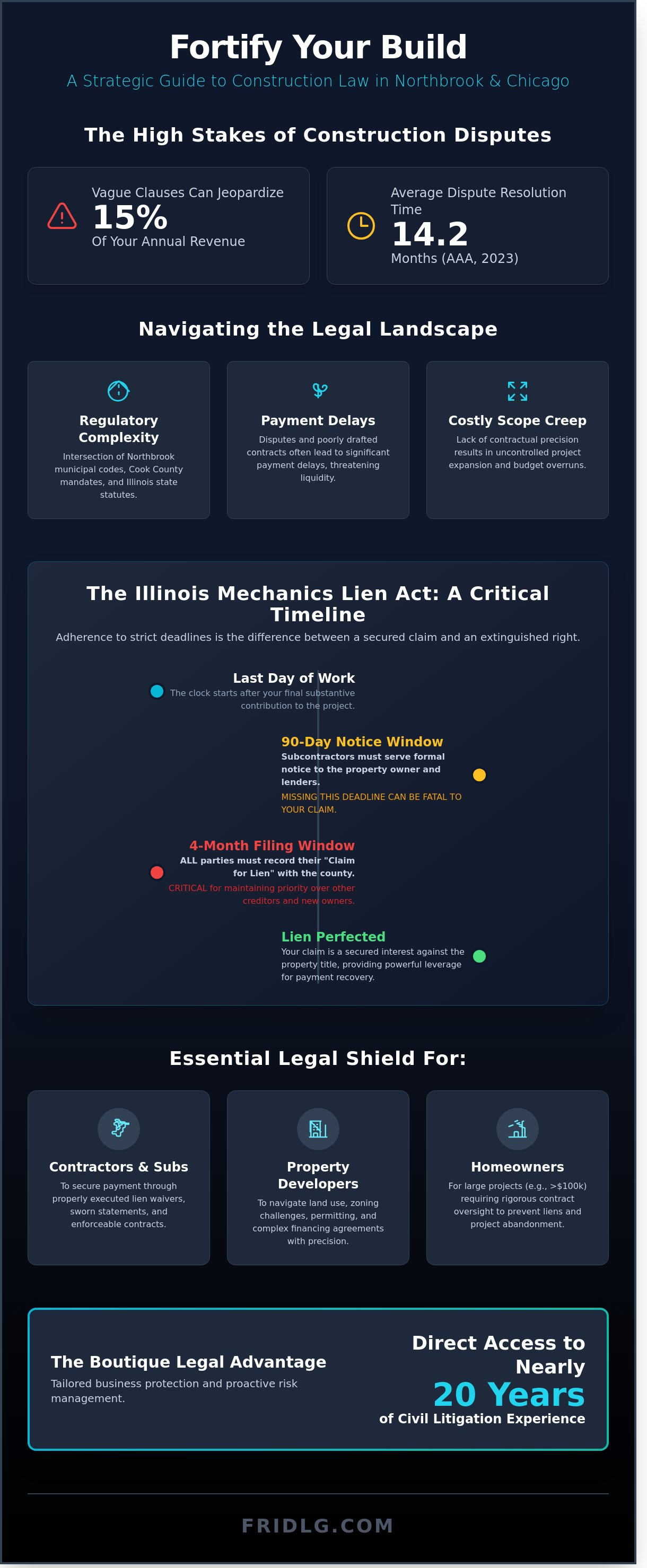
Could a single vague clause in your subcontractor agreement jeopardize 15% of your annual revenue? In 2023, the American Arbitration Association reported that construction disputes averaged 14.2 months to resolve; a timeline that often outlasts the project's actual duration. For developers and contractors in Northbrook, the margin for error has narrowed as 2026 approaches. Engaging specialized construction law services isn't merely a defensive measure; it's a strategic necessity to maintain liquidity and operational momentum. You likely recognize that the evolving regulatory environment in Cook County makes even standard projects susceptible to payment delays and costly scope creep.
This guide provides the professional clarity required to protect your business interests against the threat of prolonged litigation. We'll examine how to implement enforceable contracts that define project boundaries with clinical precision and utilize mechanics liens to secure unpaid invoices effectively. By the end of this analysis, you'll possess a clear roadmap for managing the legal requirements of the Chicago area with the confidence that your firm's stability is legally fortified.
Key Takeaways
- Understand how the intersection of municipal codes and Illinois statutes provides a precise regulatory framework for projects in the Northbrook and Chicago areas.
- Learn to utilize the Illinois Mechanics Lien Act as a strategic tool for debt recovery while adhering to the critical 90-day and 4-month filing windows.
- Discover how professional construction law services facilitate the resolution of complex litigation involving project delays, defects, and breach of contract.
- Identify the essential contractual clauses required to transition from high-risk handshake deals to structured, legally sound agreements for the 2026 market.
- Explore the advantages of boutique legal representation, where direct access to nearly twenty years of civil litigation experience ensures tailored business protection.
What Are Construction Law Services and Why Do They Matter in Northbrook?
Construction law represents a specialized intersection of contract law, real property rights, and regulatory compliance. It governs the entire lifecycle of a build, from the initial procurement phase to final occupancy. Construction law provides the structural framework for managing the complex relationships between stakeholders, ensuring that technical specifications align with legal obligations. In Northbrook, this discipline requires a precise understanding of the Village’s specific amendments to the 2021 International Building Code (IBC) and the broader mandates of Cook County. Effective construction law services provide the necessary stability to navigate these overlapping jurisdictions with precision.
The strategic value of legal counsel extends beyond simple dispute resolution; it functions as a preventative mechanism. For projects within the 60062 and 60065 zip codes, adherence to local zoning ordinances and the Northbrook Municipal Code is non-negotiable. Legal experts protect the interests of both builders and property owners by identifying potential liabilities before ground is broken. This oversight spans the project lifecycle. It includes land acquisition, permitting, labor relations, and the eventual closeout of the project. By integrating legal strategy into the construction process, parties minimize the risk of work stoppages or financial penalties.
The Scope of Construction Legal Support
Legal support in this sector is multifaceted, prioritizing the structural integrity of the business relationship. Professionals focus on these critical areas:
- Contract drafting and negotiation: Tailoring American Institute of Architects (AIA) standard forms or bespoke agreements for residential and commercial developments to ensure clarity in scope and payment.
- Regulatory compliance: Ensuring contractors meet Illinois licensing requirements and strictly adhere to the 770 ILCS 60/ Mechanic’s Lien Act to secure payment rights.
- Risk management: Implementing protocols that address delays, site safety, and material cost fluctuations to prevent litigation.
Who Needs Construction Law Services in 2026?
The demand for specialized legal guidance remains high as Northbrook continues to see redevelopment in its commercial corridors and residential sectors. General contractors and subcontractors rely on construction law services to ensure payment security through properly executed lien waivers and sworn statements. Property developers need sophisticated counsel to navigate land use and zoning challenges in the Chicago suburbs, particularly when seeking variances for high-density or mixed-use projects. Homeowners also require protection; it's essential when managing custom builds or renovations exceeding $100,000, where the financial stakes demand rigorous contract oversight to prevent mechanic's liens and project abandonment.
The Illinois Mechanics Lien Act: Securing Your Right to Payment
The Illinois Mechanics Lien Act, codified as 770 ILCS 60/, provides a robust statutory framework for debt recovery within the construction sector. It's a specialized tool that transforms a standard breach of contract claim into a secured interest against the real property. This lien attaches directly to the property title, ensuring that contractors and material suppliers have a prioritized claim to the asset's value. For firms providing construction law services in Northbrook, the objective is the precise perfection of these rights to prevent the loss of leverage during payment disputes.
Adherence to the Act's strict timelines is the most critical factor in a successful claim. Illinois law dictates two primary deadlines. First, subcontractors must serve a formal 90-day notice of their claim to the property owner and any lending institutions. Second, both prime contractors and subcontractors must record their "Claim for Lien" within 4 months of their last date of substantive work to maintain priority over third-party purchasers or mortgage holders. If a contractor misses these windows, their claim against the property is typically extinguished, leaving them with only a standard contract action against the party who hired them. A construction lawyer ensures that every date is documented and every notice is served via certified mail with return receipt requested, as required by statute.
Filing a Lien in Cook and Lake Counties
The recording process in the Cook County Clerk’s office or the Lake County Recorder requires technical precision. The "Claim for Lien" must include a verified statement of the contract, the specific balance due after all credits, and a pinpoint legal description of the property. Errors in the property index number (PIN) or the misidentification of the owner of record often lead to the invalidation of the lien. Subcontractors face higher scrutiny; they must demonstrate that their 90-day notice was served correctly before the lien was recorded. Many claimants fail by including "soft costs" or unapproved change orders that haven't been properly documented, which can lead to claims of constructive fraud under Illinois law.
Defending Against Improper Liens
Property owners and developers often encounter "frivolous" or technically deficient liens that cloud a title and stall financing. Section 34 of the Act provides a powerful defense by allowing an owner to serve a written demand that forces the lienholder to file a lawsuit within 30 days. If the contractor doesn't initiate litigation within this window, the lien is forfeited. For urgent real estate transactions, Section 38.1 allows an owner to "bond over" the lien. This involves posting a surety bond equal to 175% of the lien amount. This process detaches the lien from the real estate and attaches it to the bond, allowing a 2026 sale or refinancing to proceed while the legal dispute is resolved. Strategic construction law services allow owners to manage these risks with surgical accuracy, ensuring that invalid claims don't disrupt long-term business objectives.
Navigating Construction Disputes and Litigation in the Chicago Area
Managing litigation within the Chicago metropolitan area requires a clinical understanding of the Cook County Circuit Court’s Law Division. In 2024, construction-related filings remained a primary driver of the court’s civil docket, reflecting the high stakes of Northbrook’s development boom. Disputes typically arise from three distinct catalysts: schedule overruns, latent workmanship failures, and non-performance of contractual obligations. While the judicial process provides a formal mechanism for resolution, the inherent complexity of high-value projects often necessitates a more nuanced approach than standard litigation.
Fridman Legal approaches these conflicts with a focus on procedural precision and strategic enforcement. Our methodology treats litigation as a tool for commercial leverage rather than an end in itself. By maintaining a professional objectivity, we ensure that every motion filed serves a specific objective within the client’s broader business strategy. Effective construction law services in Northbrook must account for the specific procedural rules of the 12th Subcircuit and the broader Law Division to avoid unnecessary delays.
Alternative Dispute Resolution (ADR) serves as a critical instrument for risk mitigation. Mediation and arbitration offer confidential environments where technical complexities are evaluated by industry-specific neutrals rather than generalist jurors. We integrate these methods into a broader strategic framework, ensuring that construction law services prioritize the client’s commercial viability over prolonged courtroom conflict. This disciplined perspective provides the security business leaders need when facing high-stakes confrontations.
Construction Defect Claims
Illinois law distinguishes between patent defects, which are discoverable via reasonable inspection, and latent defects, which remain hidden for years. Under 735 ILCS 5/13-214, a four-year statute of limitations applies from the moment the defect is discovered. However, the ten-year statute of repose creates an absolute cutoff for claims regardless of discovery dates. Proving structural failures in 2026 requires meticulous forensic evidence and the testimony of licensed structural engineers to establish a clear deviation from the standard of care.
Breach of Contract and Delay Damages
A material breach occurs when a party’s failure to perform undermines the entire agreement’s purpose. In Illinois, "time is of the essence" clauses aren't merely boilerplate; they’re essential for recovery. Proving delay damages involves the Critical Path Method (CPM) to quantify lost productivity. We analyze project schedules to isolate excusable versus non-excusable delays, ensuring that claims for liquidated damages remain enforceable under current judicial scrutiny. Our firm’s approach focuses on the intersection of technical data and contract law to secure measurable outcomes.
Strategic Contract Drafting: The Foundation of Project Success
Handshake deals are a relic of a less litigious era and represent a catastrophic risk in the 2026 construction market. By the end of the 2025 fiscal year, data from the Illinois Department of Labor indicated a 14% increase in wage and contract disputes originating from undocumented verbal agreements. In Northbrook, where municipal codes and zoning requirements are increasingly rigid, relying on informal understandings exposes contractors and developers to significant financial liability. Professional construction law services provide the necessary framework to transform these vulnerabilities into enforceable safeguards.
Precise drafting is the only mechanism that ensures project equilibrium. Our firm identifies the specific pressure points that lead to litigation, including poorly defined indemnity obligations and ambiguous termination rights. We ensure that every agreement serves as a strategic roadmap rather than a mere formality. This rigorous approach protects your capital and professional reputation against the unpredictability of the regional labor market and supply chain fluctuations.
Essential Contract Provisions
Scope of work definitions must be granular to prevent the phenomenon of scope creep, which accounted for approximately 31% of project cost overruns in Cook County over the last 18 months. We implement strict change order procedures that mandate written documentation and prior approval for any deviation from the original plan. This "no signature, no work" policy is non-negotiable for maintaining fiscal discipline. Furthermore, we navigate the complexities of payment schedules by carefully structuring "pay-when-paid" and "pay-if-paid" clauses to align with the Illinois Mechanics Lien Act, ensuring that your cash flow remains protected even when upstream delays occur.
Insurance and Liability Shifting
Insurance certificates often provide a false sense of security. We verify that "Additional Insured" status is granted via specific endorsements, such as ISO Form CG 20 10 04 13, to cover both ongoing and completed operations. Without this level of detail, a policy might only offer protection while the crew is physically on-site, leaving you exposed to future defect claims. Waivers of subrogation are equally vital, as they prevent insurance carriers from seeking recovery against project partners, thereby stabilizing long-term premiums across the board.
The Knock-for-Knock indemnity principle establishes a contractual framework where each party assumes liability for its own assets and employees to minimize litigation complexity during multi-party project failures.
Fridman Legal integrates deep real estate law expertise directly into every construction agreement, ensuring that zoning encumbrances and title issues are resolved long before the first shovel hits the ground. This dual-lens perspective allows us to anticipate obstacles that traditional firms often overlook.
Protect your project from the start by securing comprehensive construction law services tailored to the Northbrook market.
Fridman Legal: Personalized Construction Law Representation in Northbrook
Choosing a boutique firm ensures that your legal strategy isn't delegated to junior associates. At Fridman Legal, clients maintain direct access to Attorney O. Allan Fridman, ensuring every decision benefits from 19 years of experience in Illinois civil litigation and real estate. This level of seniority is vital when navigating the high-stakes environment of Northbrook development projects in 2026. The firm operates on a results-oriented model that views legal intervention through the lens of your company's financial stability. Protecting your assets requires more than just winning a case; it requires a strategy that minimizes overhead and preserves operational capital.
The firm's expertise in construction law services covers the full spectrum of the industry. From initial site acquisition to final closeout, the focus remains on risk mitigation. By applying rigorous scrutiny to every document, the firm identifies hidden liabilities that often lead to costly delays. This disciplined approach provides the professional integrity necessary to handle complex business disputes in a competitive market. Every legal action is calculated to support the client's long-term commercial viability.
A Strategic Partner for Northbrook Businesses
Modern legal support must move beyond simple transactional help. Fridman Legal acts as a long-term strategic advisor for contractors and developers across Northbrook, Glenview, and the greater Chicago area. This partnership is particularly critical for contractors dealing with economic volatility. The firm integrates specialized debt negotiation and settlement expertise to help struggling businesses restructure their obligations without halting production. By addressing financial friction early, the firm helps clients maintain the liquidity needed for project completion. This local focus ensures that your counsel is familiar with the specific judicial preferences and municipal codes of the Cook County area.
Next Steps: Securing Your Project
Proactive contract reviews are the most effective tool for project security. Reviewing a contract before signature can prevent the majority of litigation issues that arise from ambiguous terms or unfair indemnity clauses. Fridman Legal provides large law firm capabilities within a focused, boutique environment. This means you receive sophisticated litigation support without the bureaucratic delays of a massive organization. The firm handles everything from multi-million dollar breach of contract cases to nuanced zoning disputes with the same level of precision.
Whether you're dealing with a mechanic's lien, a structural defect claim, or a partnership disagreement, the path forward starts with a precise evaluation of your rights. Professional construction law services provide the clarity needed to navigate Illinois' complex regulatory environment. Schedule a consultation with Fridman Legal for your construction law needs. Secure the future of your Northbrook project by establishing a foundation of legal excellence today.
Securing Your Construction Interests for 2026 and Beyond
Success in the Northbrook construction sector requires more than just operational excellence; it demands a rigorous legal framework. Navigating the Illinois Mechanics Lien Act ensures your right to payment remains protected, while meticulous contract drafting serves as the primary defense against future disputes. As project complexities increase into 2026, the integration of comprehensive construction law services becomes a strategic necessity rather than an elective expense.
O. Allan Fridman brings nearly 20 years of Illinois legal experience to every engagement, offering a depth of knowledge that spans bankruptcy, real estate, and civil litigation. This multidisciplinary background allows for a nuanced approach to risk management and complex dispute resolution. Whether you're addressing a lien claim or refining a master service agreement, seasoned representation ensures your business interests are shielded throughout the project lifecycle.
Protect your construction project with strategic legal counsel from Fridman Legal.
Building a secure future for your firm starts with the right legal partnership today.
Frequently Asked Questions
How long do I have to file a mechanics lien in Illinois?
In Illinois, you must file a mechanics lien within four months of your last date of work to ensure the claim is enforceable against third-party purchasers or mortgagees. This 120 day window is a strict requirement under the Illinois Mechanics Lien Act (770 ILCS 60/). If you're only seeking to enforce the lien against the original property owner, the deadline extends to two years from the date of completion.
Missing these statutory deadlines typically results in the permanent loss of your lien rights. It's vital to document the exact date of your final delivery of materials or labor to calculate these periods with precision.
Can a contractor sue me without a written contract in Northbrook?
A contractor can sue you without a written contract in Northbrook by asserting an oral agreement or a claim for quantum meruit, which addresses unjust enrichment. Illinois law recognizes verbal contracts if the essential terms like price and scope are clearly identifiable. However, the Home Repair and Remodeling Act (815 ILCS 513/) mandates written contracts for residential projects exceeding 1,000 dollars.
Failure to provide a written contract for such projects can complicate a contractor's ability to recover funds. While they might still seek payment for the value of work performed, the lack of documentation often leads to protracted litigation over the original intent of the parties.
What is the difference between a residential and commercial construction dispute?
Residential disputes are primarily governed by consumer protection statutes like the Home Repair and Remodeling Act, which doesn't apply to commercial projects. Commercial construction law services focus on sophisticated risk allocation, liquidated damages, and multi-tiered subcontracting agreements that are standard in industrial developments. While residential cases often involve 15 percent cost overruns on small scales, commercial litigation frequently addresses multi-million dollar delays.
The evidentiary requirements also differ significantly. Commercial disputes rely heavily on detailed project schedules and daily logs, whereas residential cases often center on the quality of craftsmanship and direct communication between the homeowner and the builder.
How much does a construction law attorney cost in the Chicago area?
According to the Clio 2023 Legal Trends Report, the average hourly rate for an attorney in Illinois is approximately 322 dollars. In high-demand areas like Northbrook and Chicago, rates often exceed this state average due to the complexity of regional building codes and high-value property disputes. Most firms provide strategic legal support through either hourly billing or fixed-fee arrangements for specific tasks like contract drafting.
Clients should expect variations based on the attorney's experience level and the technical nature of the dispute. Precise fee structures are typically outlined in a formal engagement letter before any work commences.
What should I do if a subcontractor files a lien against my home?
You should immediately verify whether the subcontractor served a 90 day notice of intent to lien as mandated by Illinois law. If you've already paid your general contractor in full and obtained a signed lien waiver, you can often compel the subcontractor to release the claim. Subcontractors who fail to provide this 90 day notice generally lose their right to a valid lien against a single-family owner-occupied residence.
It's important to review your sworn statements and payouts. If the general contractor failed to pay the subcontractor despite receiving funds from you, legal remedies are available to clear your title.
Can I recover attorney fees in an Illinois construction lawsuit?
You can recover attorney fees in an Illinois construction lawsuit only if the underlying contract or a specific state statute explicitly permits it. Section 17 of the Illinois Mechanics Lien Act allows a court to award fees to the prevailing party if the opposing side acted without reasonable cause. Without these specific provisions, the American Rule applies, meaning each party pays their own legal costs.
Many sophisticated construction contracts include a "prevailing party" clause to mitigate the financial burden of litigation. We recommend reviewing your agreement to determine if such a provision exists before initiating a claim.
Is mediation better than going to court for a construction delay claim?
Mediation is often more effective than court for delay claims because it provides a resolution in roughly 90 days, whereas Cook County litigation can last over two years. This private process allows for flexible settlements that a judge cannot order, such as modified project schedules or trade-offs in labor. Utilizing construction law services during mediation ensures that the technical analysis of the delay remains the primary focus.
Because construction projects require ongoing cooperation, mediation helps preserve professional relationships. It's a strategic choice for businesses that want to avoid the public record and high costs associated with a full trial.
What is the statute of limitations for construction defects in Illinois?
The statute of limitations for construction defects in Illinois is four years from the date you discovered, or reasonably should've discovered, the defect. Additionally, 735 ILCS 5/13-214 establishes a 10 year statute of repose, which acts as an absolute deadline for filing a claim after the act or omission occurred. This means that once 10 years pass from the date of completion, you can't sue the builder regardless of when the defect appears.
There are rare exceptions for fraudulent concealment, but these are difficult to prove in court. Monitoring your property's structural integrity within this 10 year window is essential for protecting your legal rights.
Article by
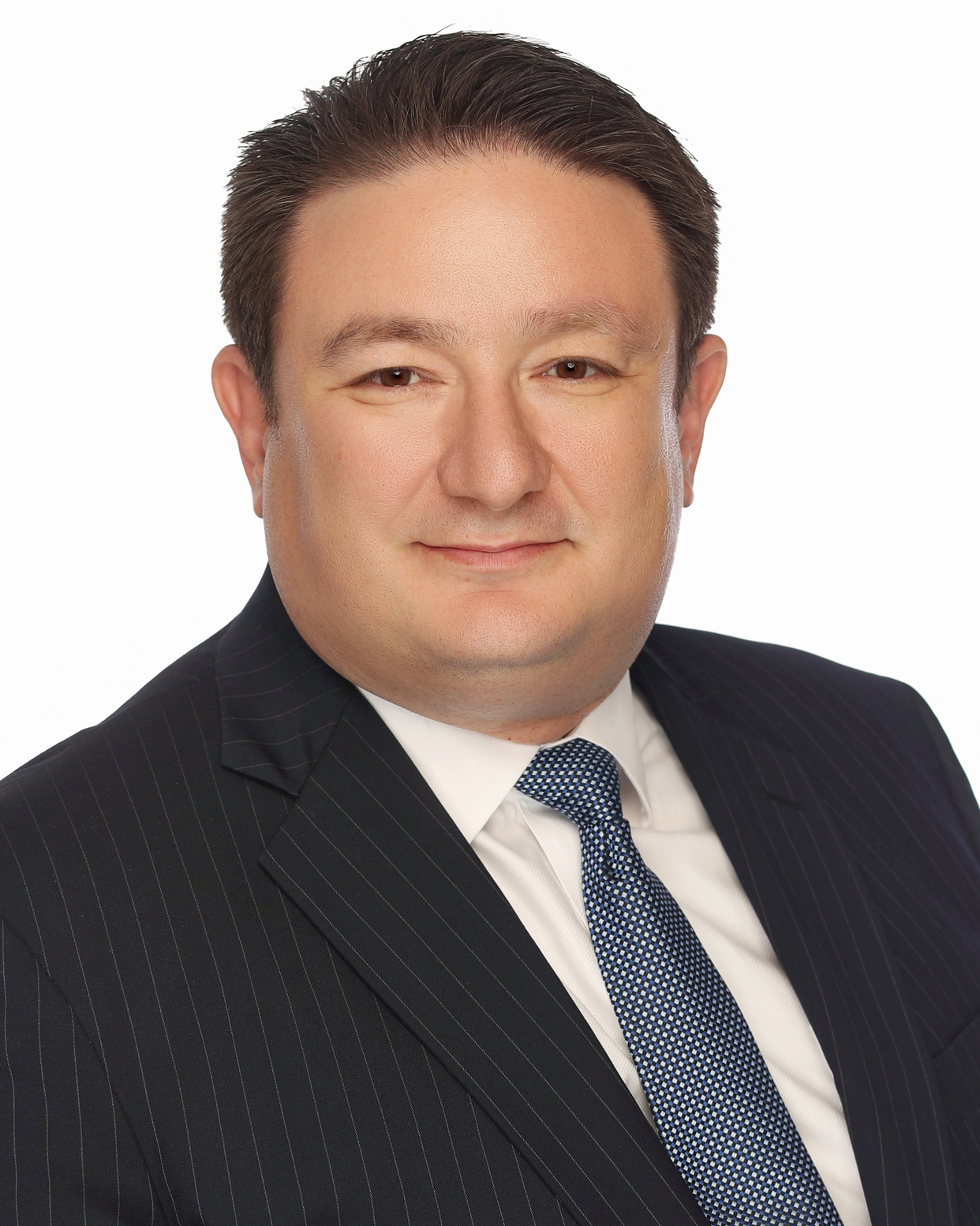
O. Allan Fridman
O. Allan Fridman has been practicing law since 2001. His practice is unique in that he does not view himself as a litigation attorney or transactional attorney. Rather, he views each area of law as a tool to pursue the best results for his clients. By practicing in both areas of law, he is able to take a 360-degree view of law. This enables the firm to catch potential drawbacks that are readily identifiable.
By practicing in litigation and transactional law and taking a holistic approach in dealing with our clients, he doesn’t put clients in box — rather, as we are all individuals, so too are the legal services we may require.
Whether it is bankruptcy or litigation or transactional, each client brings challenges and does not fit in any one box. Often times, bankruptcy clients end up not filing bankruptcy because we can achieve a better result through litigation or through an out-of-court resolution with the lender, or through a real estate sale. On the other end of the spectrum, a litigation client with multiple issues and lawsuit may fare better in a bankruptcy.
Since 2001, Allan has practiced in states and federal court, and he is a member of the trial bar of the Northern District of Illinois and admitted in the Northern District of Indiana.
We are a debt relief agency. We help people file for bankruptcy relief under the Bankruptcy Code
The materials on this site are for informational purposes only and do not constitute legal advice. Viewing this site or contacting us does not create an attorney–client relationship, and you should not act or refrain from acting based on any information here without seeking professional legal counsel.