
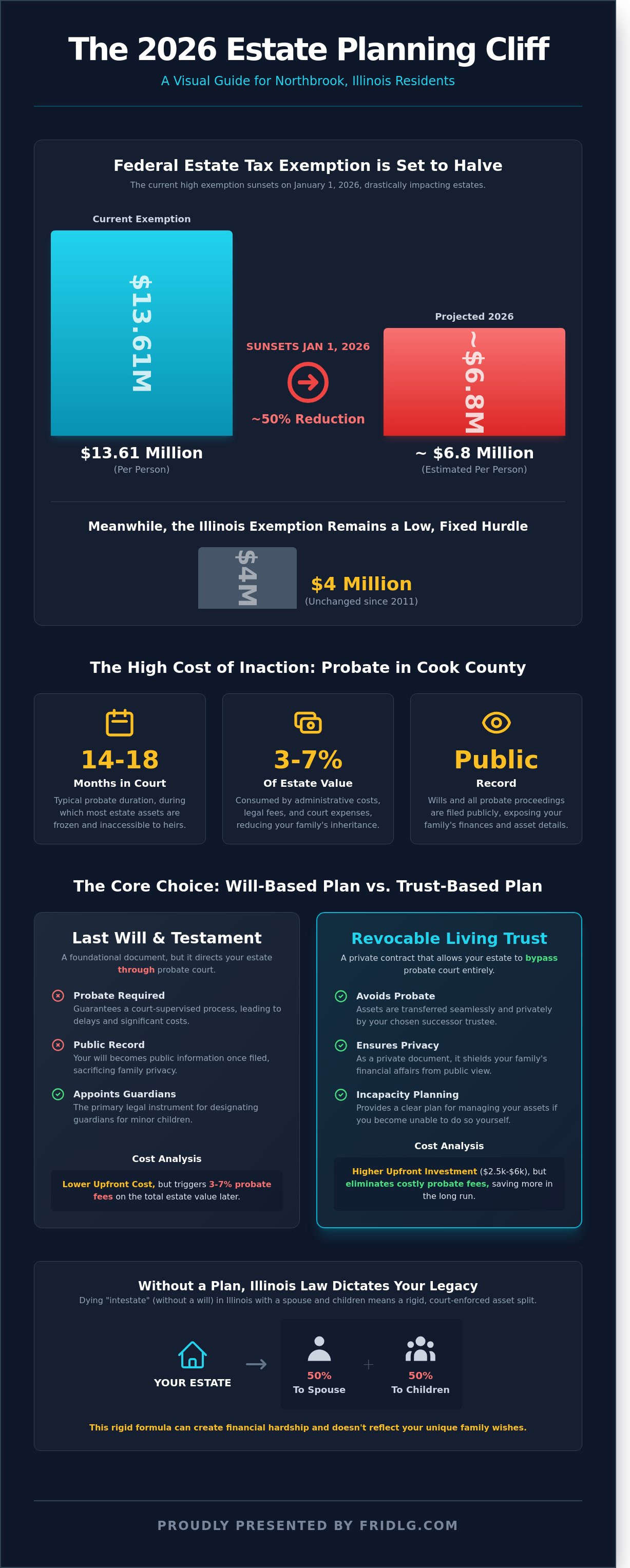
On January 1, 2026, the federal estate tax exemption is scheduled to sunset, which will likely reduce the current 13.61 million dollar threshold by nearly 50 percent. For Northbrook residents, this shift occurs alongside a stagnant 4 million dollar Illinois estate tax exemption that has remained unchanged since 2011. You've worked hard to build a portfolio of North Shore real estate and business interests, so it's natural to feel concerned about how much of that wealth will actually reach your heirs. Effective estate planning in this environment requires a precise, strategic approach that moves beyond basic templates to address the specific complexities of Cook and Lake County probate courts.
This article provides a clear roadmap for asset protection that minimizes tax exposure and preserves your family's privacy. You'll discover how to utilize sophisticated trust structures to bypass the lengthy probate process and ensure your wishes are honored exactly as intended. We'll analyze the critical differences between various legal instruments to provide the peace of mind that comes from a secure, professionally managed financial legacy. By the end of this guide, you'll understand the exact steps necessary to prevent legal disputes and secure your assets for the next generation.
Key Takeaways
- Understand why a comprehensive legal strategy in Northbrook requires more than a simple Will to effectively safeguard your family's financial legacy.
- Learn how to utilize Revocable Living Trusts to bypass the complexities of probate and ensure a seamless transfer of assets to your designated heirs.
- Discover how the specific legal title of your property, such as Tenancy by the Entirety, provides essential protections for your primary residence in Illinois.
- Navigate the upcoming 2026 tax landscape by implementing strategic estate planning solutions designed to minimize both state and federal liabilities.
- Identify the advantages of boutique legal counsel in managing complex asset protection and mitigating financial risks for high-net-worth estates.
What is Estate Planning and Why Does it Matter in Northbrook?
Estate planning isn't a mere collection of documents; it's a calculated legal architecture designed to govern your capital during your lifetime and dictate its transition after death. When asking What is Estate Planning?, one must view it as a comprehensive strategy involving trusts, powers of attorney, and tax mitigation. In high-value enclaves like Northbrook, simple templates fail to address the complexities of Cook County real estate or the current Illinois estate tax thresholds. Effective planning ensures that your assets remain under the control of your chosen representatives rather than falling under the jurisdiction of state-appointed officials.
The Cook County Probate Court is notorious for its procedural density. An uncontested probate case in Illinois typically lasts 14 to 18 months. During this period, assets are often frozen, preventing heirs from accessing necessary funds. Administrative costs and legal fees can consume 3% to 7% of the total estate value. Proper estate planning allows Northbrook families to bypass this public and expensive process entirely, ensuring a private transfer of wealth.
The Consequences of Dying Without a Will in Illinois
If you die "intestate," the Illinois Probate Act (755 ILCS 5/) dictates your legacy. For Northbrook residents with a spouse and children, the state mandates a 50/50 split of assets. This rigid formula often creates liquidity crises for surviving spouses who may need full access to accounts. Homeowners in the 60062 zip code face specific risks regarding property title transfers. Without a plan, the court appoints an administrator who charges hourly rates, which quickly erodes the inheritance intended for your family.
The Role of an Estate Planning Attorney
Professional legal counsel provides a defensive perimeter against shifting legislation. It's not just about document preparation; it's about strategic asset protection. The upcoming 2026 sunset of the Tax Cuts and Jobs Act will significantly lower federal exemption limits, making estate planning a dynamic necessity. An attorney ensures your documents comply with these evolving 2026 laws. Regular audits are required every 3 to 5 years to account for changes in your financial structure or family dynamics, such as the acquisition of new business interests or real estate.
The Pillars of a Modern Illinois Estate Plan: Wills, Trusts, and Directives
A sophisticated legal framework for your legacy begins with a Last Will and Testament. This document serves as the primary instrument for designating guardians for minor children and defining the distribution of tangible assets. Without it, Illinois intestacy laws dictate asset allocation, often disregarding the specific intentions of the deceased. While a Will is foundational, relying on it alone requires your estate to pass through the Cook County probate court. This public process often lasts 14 to 18 months before heirs receive their inheritance.
Revocable Living Trusts offer a more streamlined alternative for estate planning. By transferring title of assets to a trust during your lifetime, you ensure these holdings bypass the probate system entirely. This mechanism maintains family privacy and allows for immediate asset management by a successor trustee. For Northbrook residents with diverse portfolios, a trust provides the structural integrity needed to manage complex assets without judicial interference.
Wills vs. Trusts: Which is Right for You?
The choice between a Will and a Trust often hinges on a cost-benefit analysis of immediate versus deferred expenses. A Trust requires a higher upfront investment, typically ranging from $2,500 to $6,000 depending on complexity. However, it eliminates the 3% to 7% in probate fees often associated with Will-based estates. Privacy is another critical factor. A Will becomes a public record once filed in Skokie or Chicago courts; a Trust remains a private contract. High-net-worth individuals in the North Shore area frequently prioritize Trusts to shield their financial details from public scrutiny.
Essential Directives for Incapacity Planning
Comprehensive protection extends beyond death to include periods of potential incapacity. The Illinois Power of Attorney Act governs how your affairs are handled if you're unable to make decisions. Recent legislative updates, including new statutory requirements effective by January 1, 2026, demand precise adherence to witness and notary protocols to ensure document validity. You must distinguish between a Healthcare Proxy and a Financial Power of Attorney. A Healthcare Proxy manages medical interventions and end-of-life care, while a Financial Power of Attorney manages bank accounts, real estate, and tax filings.
- Healthcare Power of Attorney: Appoints an agent to make medical decisions based on your predetermined values.
- Financial Power of Attorney: Grants authority to manage business interests and personal finances, which is vital for Chicago-area entrepreneurs.
- Living Wills: Provides specific instructions regarding life-sustaining treatments to relieve family members of difficult ethical burdens.
Securing a valid Illinois Estate Plan requires more than filling out forms; it demands a tactical approach to asset protection. Business owners must ensure their financial directives include specific language allowing agents to operate their companies to avoid operational paralysis. If you require a strategic legal consultation to audit your current documents, professional oversight is recommended to ensure compliance with the 2026 standards.
Real Estate and Estate Planning: Protecting Your Northbrook Home
For a Northbrook resident, the family home often represents the largest single line item on the balance sheet. With median home values in the village reaching approximately $685,000 in early 2024, the legal structure of property ownership dictates the efficiency of the entire transfer process. How you hold title determines whether your heirs face a streamlined transition or a public court proceeding. Joint Tenancy allows for automatic transfer; however, Tenancy by the Entirety provides specific statutory protections against individual creditors for married couples in Illinois. It's a critical distinction that impacts your overall estate planning strategy.
Strategic planning requires a technical understanding of these instruments. The Illinois State Bar Association's Guide to Estate Planning details how these titles interact with broader testamentary goals. Beyond simple titling, the Illinois Transfer on Death Instrument (TODI) Act, which was significantly expanded in 2022 to include commercial property, serves as a vital non-probate transfer mechanism. It functions like a beneficiary designation for your deed. It's a precise tool for those seeking to maintain control during their lifetime while ensuring a direct transfer at death without the need for a living trust in every instance.
Avoiding the Cook County Probate Court
Probate filings in Cook and Lake Counties frequently stall for 12 to 18 months before final distribution. This delay freezes liquidity and exposes private family matters to the public record. Land trusts remain a staple of Illinois practice for this reason. By vesting legal and equitable title in a trustee, you maintain privacy and facilitate a succession that bypasses the courthouse entirely. We focus on these structural details to ensure that a residence isn't trapped in a bureaucratic backlog.
Managing Commercial Property in Your Estate
Business owners with holdings along the Skokie Boulevard corridor or in Northbrook’s industrial parks face higher complexity. Commercial assets require a synchronized approach between estate planning and corporate governance. We ensure that rental portfolios or storefronts are properly funded into a trust. This prevents the operational paralysis that occurs when a sole manager passes away without a designated successor. Strategic coordination ensures your commercial legacy remains a functional business rather than a frozen asset. We align your real estate closings with your long-term legacy goals to prevent gaps in management or ownership.
Strategic Asset Protection: Navigating Taxes and Financial Risks
Northbrook families face a unique fiscal environment where local and federal tax codes diverge sharply. Wealth preservation requires clinical precision. While the federal exemption sits at $13.61 million for 2024, Illinois enforces a rigid $4 million threshold. This disparity means an estate might be exempt from federal taxes but still owe hundreds of thousands to the state of Illinois. Effective estate planning mitigates this through calculated asset transfers and the use of specialized legal vehicles designed to isolate wealth from tax exposure.
Minimizing Illinois Estate Taxes
Current Illinois law doesn't index its $4 million exemption to inflation. This stagnation forces many Northbrook homeowners into taxable territory as property values rise. Using Irrevocable Gift Trusts or Qualified Personal Residence Trusts (QPRTs) allows you to remove future appreciation from your taxable estate before it triggers a tax event. You can also utilize annual exclusion gifts, currently capped at $18,000 per recipient, to systematically reduce the estate's size without depleting your lifetime exemption. For estates exceeding the $4 million threshold in 2026, the Illinois estate tax functions as a graduated levy that can reach an effective rate of 35% on assets surpassing the exemption limit.
Legacy Planning During Financial Recovery
A history of Chapter 7 or Chapter 13 bankruptcy doesn't terminate your ability to protect future generations; it simply shifts the focus toward asset isolation. We utilize Spendthrift Trusts to ensure that your heirs' inheritance remains shielded from their own potential creditors or civil litigation. This legal structure prevents a beneficiary's financial missteps or legal judgements from draining the family legacy. Balancing active debt settlement with these long-term vehicles ensures that your current obligations don't cannibalize the wealth intended for your children. If you're managing existing liabilities, we structure the timing of asset transfers to avoid claims of fraudulent conveyance while still maximizing the remainder for your heirs. A robust estate planning strategy provides the necessary firewall between your past financial challenges and your family's future security.
Securing Your Future with Fridman Legal: Expert Counsel in Northbrook
Securing a legacy requires more than standard templates; it demands a sophisticated understanding of how different legal disciplines intersect. Attorney O. Allan Fridman provides this high-level oversight by drawing on 20 years of experience in bankruptcy, real estate, and civil litigation. At our Northbrook boutique firm, we don't just process paperwork. We provide a strategic partnership that prioritizes the professional integrity of your financial and personal legacy.
Effective estate planning must account for the complexities of modern wealth. We take a holistic view of your situation, analyzing outstanding debts, diverse property holdings, and specific family objectives. This results-driven approach ensures that your plan is resilient against future challenges. By integrating insights from two decades of litigation, we identify and resolve potential vulnerabilities before they become costly disputes for your heirs.
The Fridman Legal Approach to Estate Planning
Our methodology centers on a comprehensive initial consultation designed to map every asset and objective with precision. We examine your portfolio to ensure that your estate planning strategy aligns with your long-term goals. This phase isn't a mere formality; it's a deep dive into the legal structures that will protect your family's future. We then move to custom-tailored document drafting. These instruments are built to reflect your unique family dynamics and business interests, avoiding the pitfalls of generic legal forms.
Support at Fridman Legal continues well after the documents are signed. We provide ongoing counsel for real estate closings and civil litigation matters that may impact your estate's health. Whether you're acquiring new property in Chicago or restructuring assets, our team ensures every transaction reinforces your primary plan. This continuity of service provides a level of security that larger, less personal firms often fail to deliver.
Schedule Your Consultation Today
Professional legal counsel is accessible at our office located at 555 Skokie Blvd in Northbrook. We serve a sophisticated clientele throughout Cook County, Lake County, and the broader Illinois region. Our process is designed to be transparent and efficient, respecting the value of your time while delivering meticulous results. Every client receives the direct attention of an experienced attorney who understands the high stakes of asset protection.
Don't leave your family's stability to chance or outdated legal structures. Take the first step toward a secure and well-defined future by reaching out to our team. Contact Fridman Legal to start your estate plan today and ensure your interests are protected by a seasoned professional.
Architecting Your Strategic Financial Future
Effective estate planning in 2026 requires a disciplined integration of wills, trusts, and healthcare directives to navigate the evolving Illinois tax landscape. Protecting a Northbrook residence involves more than basic documentation; it requires a precise legal framework that accounts for market volatility and asset preservation. By prioritizing these structural pillars, you ensure that your family's wealth remains secure against unforeseen civil litigation or financial liabilities. It's a process that demands technical precision and a forward-looking perspective to be successful.
Fridman Legal brings nearly 20 years of Illinois legal experience to every client engagement. Our boutique firm provides specialized expertise across bankruptcy, real estate, and civil litigation, ensuring your strategy is both comprehensive and resilient. We don't rely on generic templates; we focus on the professional integrity and meticulous detail required to manage complex legacies in the modern business environment. It's time to transform your intentions into a legally binding reality that stands the test of time.
Protect your legacy, schedule a consultation with Fridman Legal in Northbrook. Your family's long-term stability is a goal we can achieve together through rigorous preparation and expert counsel.
Frequently Asked Questions
Do I need a lawyer for estate planning in Illinois?
Illinois law doesn't strictly mandate legal counsel for drafting documents, yet self-prepared instruments frequently fail to satisfy the formal requirements of the Illinois Probate Act (755 ILCS 5/). Technical errors in witness attestation or notary placement can invalidate a document entirely. Professional oversight ensures your strategy aligns with current state statutes and prevents the 12 to 18 months of litigation often associated with contested estates in Cook County courts.
How much does estate planning cost in Northbrook?
Professional fees for estate planning in the Northbrook area typically range from $1,500 for basic individual packages to $6,000 or more for complex trust-based strategies involving business succession. These figures reflect the sophisticated nature of local asset portfolios and the necessity for precise tax mitigation. Hourly rates for senior counsel in the 60062 zip code often fall between $350 and $550, depending on the complexity of the corporate or real estate holdings involved.
What happens to my house in Illinois if I die without a will?
Your real estate will be distributed according to the rigid formula established by the Illinois Laws of Intestacy under 755 ILCS 5/2-1. If you leave a surviving spouse and descendants, the law mandates a 50/50 split of the property's value. This often forces a sale of the family home to satisfy the legal shares of each heir. Without a designated executor, the court appoints an administrator to manage the liquidation, a process that typically consumes 5% to 8% of the estate's total value in administrative fees.
Can I change my estate plan after it is signed?
You maintain the absolute right to modify or revoke your documents at any time as long as you possess the requisite mental capacity. Formal changes are executed through codicils for wills or amendments for trusts, which must adhere to the same execution formalities as the original documents. It's vital to physically destroy outdated versions to prevent confusion. We recommend a formal review whenever your net worth fluctuates by more than 20% or if there's a shift in Illinois tax legislation.
What is the difference between a Will and a Living Trust in Illinois?
A Will only takes effect upon death and requires a public probate proceeding in the Cook County Circuit Court if assets exceed $100,000. Conversely, a Living Trust functions during your lifetime and allows for the immediate, private transfer of assets without court intervention. Trusts provide a seamless transition of management if you become incapacitated, whereas a Will offers no protection during your life. While a Trust requires higher initial investment, it saves the estate roughly $3,000 to $10,000 in probate costs later.
How does the Illinois estate tax work in 2026?
Illinois currently enforces a $4 million estate tax exemption threshold, which is significantly lower than the federal limit of $13.61 million. This $4 million cliff remains static for 2026 unless the General Assembly passes specific legislation to adjust it. Estates exceeding this value face graduated tax rates reaching up to 16%. Strategic planning is essential because the state taxes the entire estate once it crosses the threshold, not just the amount over the $4 million limit.
Does estate planning help avoid creditors?
Specific legal structures like irrevocable trusts or spendthrift clauses provide robust protection against third-party claims and judgment creditors. Once assets are legally transferred into an irrevocable vehicle, they're no longer considered your personal property for debt collection purposes. However, Illinois doesn't recognize Domestic Asset Protection Trusts, so we utilize alternative strategies like Tenancy by the Entirety for primary residences. This specific deed designation protects your home from the individual debts of one spouse, provided the debt isn't joint.
How often should I update my estate plan?
You should conduct a comprehensive review of your strategy every 3 to 5 years to account for shifting legal landscapes and personal financial growth. Major life events, such as a 20% change in asset value or the birth of a beneficiary, necessitate immediate updates. The sunsetting of the Tax Cuts and Jobs Act in 2025 makes a 2026 review particularly critical for Northbrook residents. Regular audits ensure your designations remain compliant with the evolving Illinois Power of Attorney Act and federal gift tax exemptions.

Article by
O. Allan Fridman
O. Allan Fridman has been practicing law since 2001. His practice is unique in that he does not view himself as a litigation attorney or transactional attorney. Rather, he views each area of law as a tool to pursue the best results for his clients. By practicing in both areas of law, he is able to take a 360-degree view of law. This enables the firm to catch potential drawbacks that are readily identifiable.
By practicing in litigation and transactional law and taking a holistic approach in dealing with our clients, he doesn’t put clients in box — rather, as we are all individuals, so too are the legal services we may require.
Whether it is bankruptcy or litigation or transactional, each client brings challenges and does not fit in any one box. Often times, bankruptcy clients end up not filing bankruptcy because we can achieve a better result through litigation or through an out-of-court resolution with the lender, or through a real estate sale. On the other end of the spectrum, a litigation client with multiple issues and lawsuit may fare better in a bankruptcy.
Since 2001, Allan has practiced in states and federal court, and he is a member of the trial bar of the Northern District of Illinois and admitted in the Northern District of Indiana.
We are a debt relief agency. We help people file for bankruptcy relief under the Bankruptcy Code
The materials on this site are for informational purposes only and do not constitute legal advice. Viewing this site or contacting us does not create an attorney–client relationship, and you should not act or refrain from acting based on any information here without seeking professional legal counsel.