

What if the "fresh start" you're working so hard for still leaves you with the very bills that keep you up at night? It's a common fear, and the conflicting advice found online often adds to the anxiety rather than easing it. You want the collection calls to stop for good, but you're likely worried about what debts are not discharged in chapter 7. It's natural to feel cautious; understanding the specific boundaries of the law is the only way to ensure your filing delivers the financial relief you're looking for.
In this 2026 guide, we'll replace that uncertainty with a clear, professional look at which obligations stay and which ones go. We'll cover the latest 2026 thresholds, such as the $900 limit for luxury goods and the $1,250 rule for cash advances, so you won't be caught off guard by creditor objections. You'll gain a realistic expectation of your post-bankruptcy life and a solid plan to handle the debts that remain, allowing you to move forward with genuine confidence and a strategy for a successful recovery.
Key Takeaways
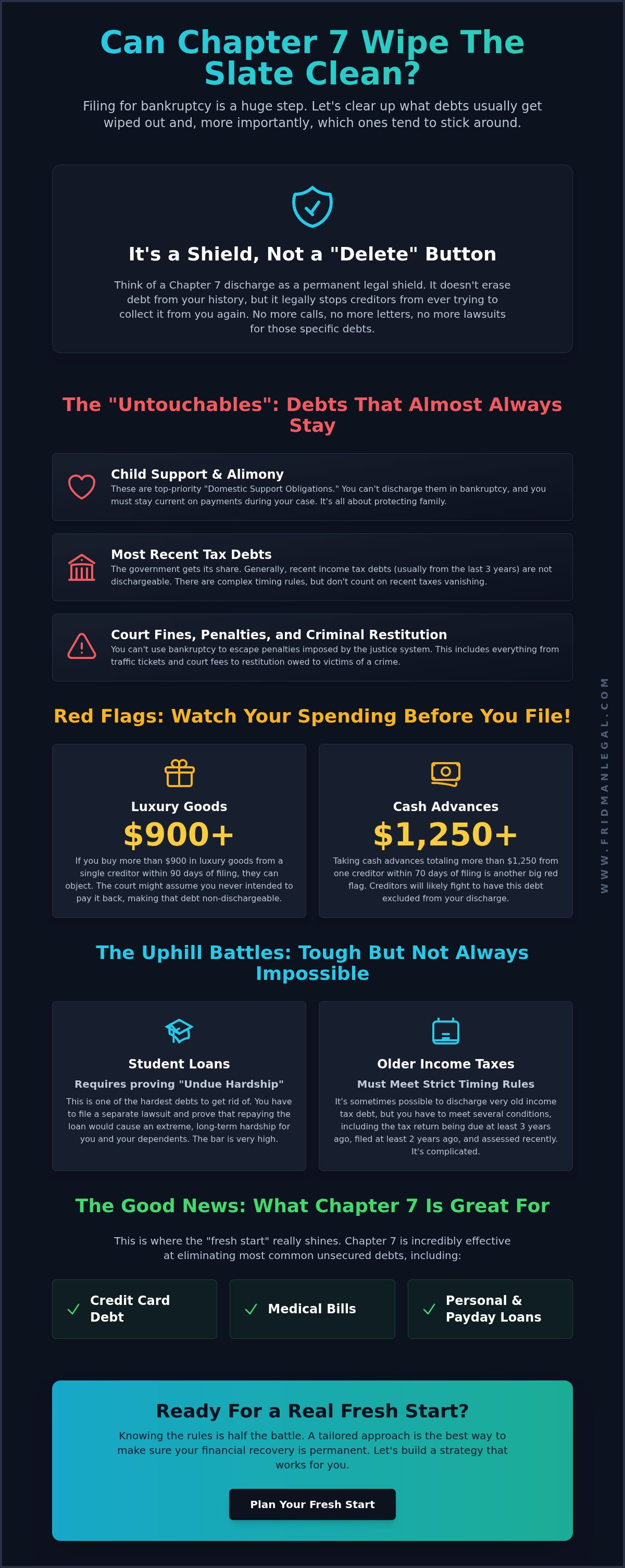
- Think of a discharge as a legal shield rather than a "delete" button; it doesn't erase your history, but it stops creditors from ever contacting you again.
- We'll provide a definitive list of what debts are not discharged in chapter 7, including priority obligations like child support and alimony that always stay with you.
- Discover how certain spending habits right before you file can trigger creditor objections and why the "luxury goods" rule is so important to watch.
- Understand the strict "undue hardship" test for student loans and the specific timing rules that might allow you to discharge older income tax debt.
- Learn why a tailored approach to categorizing your debt is the best way to avoid expensive mistakes and ensure your financial recovery is actually permanent.
Understanding the "Fresh Start": What Does Discharge Actually Mean?
When you hear the term "fresh start," it is easy to imagine a giant eraser wiping your financial slate completely clean. In reality, a Chapter 7 discharge is more like a permanent legal shield. It doesn't actually delete the record of the debt from existence or remove it from your credit history immediately. Instead, it creates a court-ordered injunction that prevents creditors from ever taking action against you personally to collect that money. Understanding exactly what debts are not discharged in chapter 7 is the first step toward building a recovery plan that actually works.
This "shield" is incredibly effective for unsecured debts like credit cards and medical bills, but it behaves differently when collateral is involved. For example, if you have a car loan, the discharge wipes out your personal liability for the balance. However, the lien on the vehicle remains. If you want to keep the car, you'll generally need to keep paying for it. This is why a successful Chapter 7 bankruptcy filing requires a strategic look at your assets and liabilities before you ever file a single document with the court.
The Legal Power of the Discharge Order
The moment the judge signs your discharge order, your relationship with your creditors changes forever. This document is a federal injunction that stops phone calls, collection letters, and lawsuits in their tracks. If a creditor attempts to garnish your wages or freeze your bank account for a discharged debt, they aren't just being rude; they're breaking federal law. This relief is permanent. You don't have to worry about these specific bills resurfacing years down the line because the law has effectively severed your legal obligation to pay them.
Why Some Debts Are "Protected" from Bankruptcy
You might wonder why the law doesn't just wipe everything away. The reason is rooted in public policy. Congress decided that certain financial obligations are so important to society that they should survive the bankruptcy process. This includes things like child support, alimony, and most recent tax debts. There are several Exceptions to Bankruptcy Discharge that ensure you can't use the court system to walk away from these specific responsibilities.
It's helpful to view the system as a balance of interests. The court wants to give you room to breathe, but it also has to protect the rights of certain "priority" creditors who rely on those payments for their own stability. Think of bankruptcy as a safety net designed to catch you when you fall, not a get out of jail free card that lets you ignore every type of obligation. By knowing what debts are not discharged in chapter 7 ahead of time, you can prioritize your post-bankruptcy budget and ensure your path to a clean slate is actually sustainable.
The "Untouchables": Debts That Almost Never Go Away
Many people approach bankruptcy hoping to wipe away every single obligation they have. While the law is generous, it isn't absolute. There are certain categories of debt that the legal system considers "untouchable" for reasons of public policy and social responsibility. Knowing exactly what debts are not discharged in chapter 7 helps you set a realistic baseline for your financial future. If you're carrying these specific types of balances, they'll likely still be there once your case is closed.
The goal of obtaining a 'fresh start' is to remove the burdens that prevent you from being a productive member of the economy. However, the court balances your need for relief against the rights of others who depend on you. This is why some debts are prioritized over your personal discharge. If your portfolio includes family obligations, recent taxes, or court-ordered penalties, you'll need a more nuanced strategy than just filing and walking away.
Family First: Child Support and Alimony
Child support and alimony are at the very top of the priority list. The bankruptcy court will never let you walk away from your family responsibilities. These obligations are considered "Domestic Support Obligations" and are strictly protected under federal law. During the bankruptcy process, you must continue making these payments as they come due. In fact, failing to stay current on child support during your case can actually jeopardize your ability to receive a discharge for your other debts. It's a non-negotiable part of the system that ensures vulnerable family members aren't left behind while you reorganize your life.
Taxes and the IRS: When the Government Still Wants Its Cut
Taxes are another area where the rules get complicated. While some older income taxes can be erased, "new" taxes are almost always here to stay. The IRS generally follows a "3-2-1" rule to determine eligibility: the debt must be at least three years old, the return must have been filed at least two years ago, and the tax must have been assessed at least 240 days before you file. If you haven't filed your returns on time, you can effectively forget about discharging those balances. When we look at your case, Fridman Legal carefully reviews your tax history to see if any of your government debt qualifies for relief.
Beyond family and taxes, the law also blocks relief for debts tied to illegal acts or specific types of negligence. This includes:
- Court-ordered criminal fines and restitution meant to punish or compensate for a crime.
- Government-imposed penalties that aren't purely compensatory in nature.
- Debts resulting from personal injury or death caused by driving while intoxicated (DUI).
These exceptions exist because the court refuses to provide financial relief for behavior that endangers the public or violates the law. If you're concerned about how these specific rules apply to your situation, you can reach out to us for a professional assessment of your current liabilities. Understanding these boundaries early on is the best way to ensure your path to a clean slate is actually sustainable.
When Creditors Fight Back: Debts Discharged Unless an Objection is Filed
While many debts disappear automatically, some categories require a creditor to actively step up and challenge your right to a discharge. In these cases, the question of what debts are not discharged in chapter 7 often hinges on the timing of your last few purchases or the intent behind your actions. If a creditor believes you acted in bad faith, they can file an "adversary proceeding," which is essentially a mini-lawsuit within your bankruptcy case to keep their specific debt alive.
The most common hurdles involve recent spending. Under current 2026 guidelines, if you purchase more than $900 in luxury goods or services from a single creditor within 90 days of filing, the court presumes you committed fraud. Similarly, cash advances totaling more than $1,250 taken within 70 days of your filing date are also under the microscope. The law assumes that if you were borrowing heavily right before seeking bankruptcy protection, you likely didn't intend to pay it back. This doesn't mean the debt is automatically stuck, but it shifts the burden of proof to you to show a legitimate reason for the spending.
Beyond recent spending, the court also protects others from "willful and malicious" injury. If you intentionally caused harm to a person or their property, that debt won't just vanish. This isn't about accidents, like a typical car wreck; it's about deliberate actions meant to cause damage. When these issues arise, creditors have a limited window to object. If they miss the deadline, the debt might still be discharged, which is why having a clear strategy from the start is so vital.
The Presumption of Fraud
The 90-day window for luxury purchases is a common trap for the unwary. It's easy to think a few necessary upgrades or a final trip won't matter, but the court views "luxury" as anything not reasonably necessary for the support of you or your dependents. Honesty is your best policy here. Trying to hide these transactions or provide false information on your schedules can lead to more than just a denied discharge; it can lead to allegations of bankruptcy fraud. We focus on reviewing your recent financial history to identify these red flags before they become a problem in court.
The Importance of Listing ALL Your Debts
One of the most dangerous mistakes you can make is "forgetting" to list a creditor. If you don't include a debt on your paperwork, and that creditor doesn't otherwise find out about your case, the debt generally won't be discharged. This means you could go through the entire process only to find out you're still legally on the hook for a bill you tried to ignore. It's a good idea to double-check your credit report and all old billing statements with your bankruptcy lawyer in Chicago. Ensuring every single creditor is notified is the only way to guarantee the legal shield of the discharge covers your entire financial history.
The Gray Areas: Student Loans and Older Income Taxes
While some debts are clearly out of reach and others are easily erased, there's a middle ground where the outcome depends on specific legal tests and timing. When people ask what debts are not discharged in chapter 7, they often find the answer is "it depends" for things like student loans or certain tax balances. These gray areas require a more surgical approach to ensure you don't leave money on the table or face surprises after your case closes. Understanding these nuances is the difference between a partial fix and a total recovery.
The Student Loan Struggle
For years, discharging student loans was seen as nearly impossible. You have to prove "undue hardship," which usually involves showing that you can't maintain a minimal standard of living, your situation is unlikely to change, and you've made a good faith effort to pay. Between 2024 and 2026, the Department of Justice and the Department of Education updated their guidelines to make this process more objective and less of a legal marathon. While the bar remains high, it's no longer the brick wall it used to be. Success often comes down to how well your specific financial story is documented and presented to the court. While it's a difficult path, it's not always impossible with a precise strategy.
Winning the Battle with Old Tax Debt
In Illinois, tax debt is one of the most misunderstood parts of bankruptcy. Many believe the IRS is always untouchable, but that isn't true. The date you actually filed your return is often more critical than the tax year itself. If you filed late, the clock for the two-year rule doesn't start until that return is processed. We often work with clients to pull official IRS transcripts, ensuring the timing is perfect before filing. If you're dealing with complex tax issues or benefit overpayments from Social Security or Unemployment, you can explore our specialized bankruptcy services to see how we categorize these liabilities and protect your interests.
Finally, don't overlook your housing-related obligations. If you live in a condo or a community with a Homeowners Association (HOA), your Chapter 7 filing will wipe out the fees you owed before the filing date. However, you're still legally responsible for any fees that accrue after the petition is filed as long as you remain the legal owner. This distinction is vital for anyone planning to surrender a property while trying to avoid new debt post-bankruptcy. Getting these details right is what separates a standard filing from a truly successful financial reset.
Planning Your Fresh Start with Fridman Legal
Navigating the legal system alone often feels like trying to find your way through a maze in the dark. A generic, one-size-fits-all approach to bankruptcy is one of the most expensive mistakes you can make. While the federal code dictates what debts are not discharged in chapter 7, how you apply those rules to your specific life requires a high level of precision. At Fridman Legal, we don't just fill out forms; we build a comprehensive roadmap for your recovery. We focus on the details that others might miss, ensuring your filing is a strategic move rather than a desperate one.
Before we ever step foot in a courtroom, we sit down to categorize every obligation you have. We separate the "erasable" credit card balances and medical bills from the "permanent" obligations like domestic support or certain court-ordered fines. By doing this, you'll know exactly what your budget will look like on day one of your post-bankruptcy life. This level of clarity is what replaces anxiety with a sense of control. You won't have to guess which bills will still be in your mailbox; you'll have a documented plan to handle them.
Customizing Your Debt Relief Strategy
We look at the unique chemistry of your finances. If you're carrying a mix of student loans, recent tax debt, and high-interest unsecured loans, the timing of your filing becomes your most powerful tool. Sometimes waiting just a few extra weeks can be the difference between being stuck with a tax bill and seeing it wiped away entirely. We focus on these strategic windows to maximize your relief. Even if a few "untouchable" debts remain, the sheer weight lifted from your other accounts creates the breathing room you need to finally move forward. Understanding what debts are not discharged in chapter 7 is only half the battle; knowing how to manage what's left is what ensures long-term success.
Your Next Step Toward Financial Freedom
When you meet with O. Allan Fridman, you aren't just getting a legal representative; you're gaining a partner who understands the Northbrook and greater Chicago legal landscape. We take the heavy lifting of the paperwork off your shoulders, ensuring every creditor is listed and every asset is protected to the fullest extent of the law. Our flat-fee service model ensures you have total financial predictability throughout the process, with no hidden surprises or hourly billing traps. If you're ready to move from feeling overwhelmed to being completely organized, we invite you to reach out and start the conversation today. Your clean slate is closer than you think, and we're here to help you claim it.
Taking the First Step Toward Your Permanent Fresh Start
A Chapter 7 discharge is a powerful tool, but its effectiveness depends entirely on how well you prepare for the exceptions. We've seen how the legal shield of bankruptcy protects you from credit cards and medical bills while leaving priority obligations like child support and recent taxes in place. Knowing exactly what debts are not discharged in chapter 7 allows you to build a budget that actually works for your future. It's about moving from a state of constant financial anxiety to a position of informed control.
With over 20 years of local Illinois legal experience, O. Allan Fridman provides the personalized attention your case deserves. We offer transparent flat-fee bankruptcy services so you never have to worry about unpredictable legal costs while you're trying to rebuild. You don't have to navigate these complex rules alone. Talk to a friendly Northbrook bankruptcy expert at Fridman Legal today and let us help you categorize your debt and secure the relief you need. You deserve a future that isn't defined by your past financial struggles, and that journey starts with a single, expert conversation.
Frequently Asked Questions
Can I get rid of my credit card debt in Chapter 7?
Yes, credit card debt is a general unsecured debt that is typically wiped out completely in a Chapter 7 filing. However, you must be careful about recent spending. If you've charged more than $900 for luxury goods in the 90 days before filing, or taken cash advances over $1,250 within 70 days, those specific balances might be flagged as fraudulent and excluded from your discharge.
Will Chapter 7 bankruptcy stop my wage garnishment in Illinois?
Yes, the moment you file your petition, an "automatic stay" goes into effect that legally requires creditors to stop garnishing your wages. This provides immediate relief for your take-home pay. It's important to remember that if the garnishment is for a debt that isn't dischargeable, such as child support or certain tax obligations, the stay might be temporary or may not apply to those specific collections.
What happens to my car loan if I file for Chapter 7?
You can generally keep your car as long as you stay current on your payments and "reaffirm" the debt. Reaffirmation is a formal agreement where you waive the discharge for that specific loan to keep the collateral. If you choose not to reaffirm, the discharge wipes out your personal liability for the loan, but the lender still holds a lien and can repossess the vehicle if you stop paying.
Is medical debt ever considered non-dischargeable?
No, medical debt is almost always dischargeable because it is classified as general unsecured debt. There are no special "public policy" protections for hospitals or doctors like there are for child support or taxes. Whether you owe $5,000 or $50,000 in medical bills, these are typically some of the easiest obligations to eliminate through the Chapter 7 process.
Can I discharge a debt if I am being sued for it right now?
Yes, filing for bankruptcy will stop an active lawsuit and can eliminate the underlying debt entirely. The automatic stay halts the litigation in its tracks. As long as the lawsuit isn't based on fraud or another category on the list of what debts are not discharged in chapter 7, the final discharge order will permanently prevent the creditor from getting a judgment against you.
What if I forgot to list a debt on my bankruptcy petition?
If you unintentionally leave a creditor off your schedules, that debt might not be discharged because the creditor didn't receive formal notice of your case. In "no-asset" cases where there is no money for anyone to collect, some courts are more lenient, but it's a significant risk. You should always double-check your credit reports and old mail to ensure every single person or company you owe is included.
How long does it take for my debts to be officially discharged?
The entire Chapter 7 process usually takes between four and six months from start to finish. You'll typically receive your official discharge order from the court about 60 to 90 days after your 341 Meeting of Creditors. Once that order is signed, your legal obligation to pay the dischargeable debts is officially and permanently severed.
Do I still have to pay my student loans during the bankruptcy process?
Yes, you generally need to keep making your student loan payments while your case is active. Because student loans aren't automatically discharged without a separate "undue hardship" lawsuit, the obligation to pay doesn't go away just because you filed for bankruptcy. Stopping payments without a specific court order could lead to late fees and damage to your credit during the process.

Article by
O. Allan Fridman
O. Allan Fridman has been practicing law since 2001. His practice is unique in that he does not view himself as a litigation attorney or transactional attorney. Rather, he views each area of law as a tool to pursue the best results for his clients. By practicing in both areas of law, he is able to take a 360-degree view of law. This enables the firm to catch potential drawbacks that are readily identifiable.
By practicing in litigation and transactional law and taking a holistic approach in dealing with our clients, he doesn’t put clients in box — rather, as we are all individuals, so too are the legal services we may require.
Whether it is bankruptcy or litigation or transactional, each client brings challenges and does not fit in any one box. Often times, bankruptcy clients end up not filing bankruptcy because we can achieve a better result through litigation or through an out-of-court resolution with the lender, or through a real estate sale. On the other end of the spectrum, a litigation client with multiple issues and lawsuit may fare better in a bankruptcy.
Since 2001, Allan has practiced in states and federal court, and he is a member of the trial bar of the Northern District of Illinois and admitted in the Northern District of Indiana.
We are a debt relief agency. We help people file for bankruptcy relief under the Bankruptcy Code
The materials on this site are for informational purposes only and do not constitute legal advice. Viewing this site or contacting us does not create an attorney–client relationship, and you should not act or refrain from acting based on any information here without seeking professional legal counsel.


