

Imagine finishing a major project in Northbrook, only to watch your invoices sit unpaid while the 90-day clock for your subcontractor notice ticks away. It's a frustrating spot to be in, especially with the 2025 updates to the Illinois Mechanics Lien Act that changed how those notices must be served. You've put in the work, and the last thing you need is for a missed deadline or a technical error to stand between you and your paycheck. If you're searching for a construction lien lawyer near me, you likely know that the legal landscape in Cook and Lake County is demanding and unforgiving of mistakes.
We understand that the stress of unpaid invoices can stall your cash flow and disrupt your entire business. That's why we've put together this guide to help you manage the complexities of Illinois statutes with confidence. You'll learn exactly how to meet the strict four-month recording deadline and use the new delivery methods to your advantage. Whether you're trying to recover a payment or need to clear a title for a real estate transaction, this overview provides the local legal guidance you need to protect your property and your bottom line.
Key Takeaways
- Understand that Illinois Mechanic’s Liens are governed by strict, technical rules that require more than just a basic invoice to secure your payment rights.
- Learn why missing a filing deadline by even 24 hours can result in a total loss of claim, making it vital to work with a construction lien lawyer near me.
- Find out how homeowners can protect their titles and resolve liens that arise when a general contractor fails to pay their suppliers or crew.
- Identify the common pitfalls of DIY filing, such as using incorrect property descriptions that often lead to cases being dismissed by the court.
- Gain insights into navigating the Cook and Lake County systems with strategic guidance based on nearly twenty years of local legal experience.
What Exactly is a Construction Lien in Illinois?
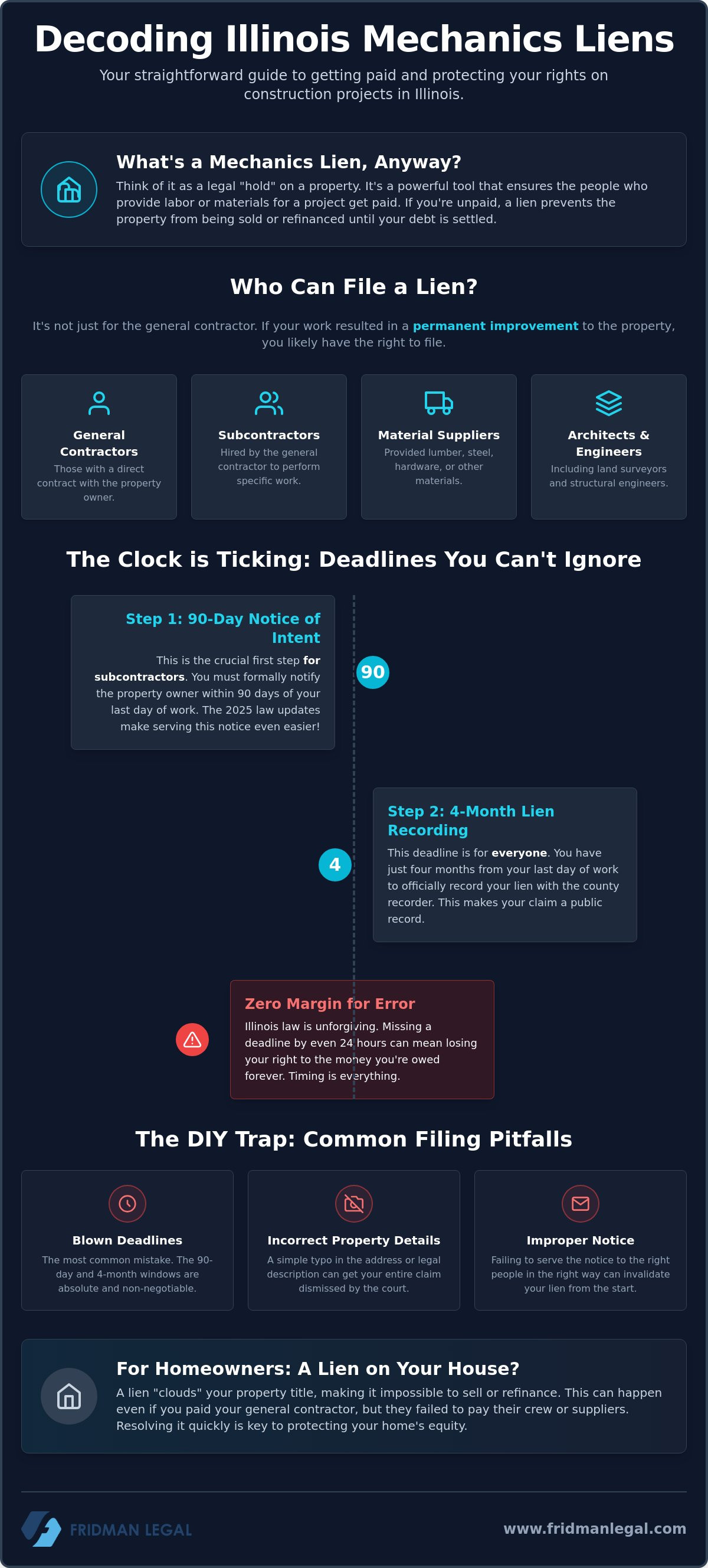
If you've spent any time on a construction site in the Chicago suburbs, you've likely heard someone mention a lien. It's a powerful word, but many people don't fully grasp what it entails until a payment stops or a title search comes back with a surprise. Basically, a lien is a legal claim against a piece of property. It acts as a security interest, ensuring that the people who provide the sweat and materials to build or improve a home actually get their fair share. If you are currently searching for a construction lien lawyer near me, you are probably looking for a way to secure your spot in line for a payment that is long overdue.
To understand the broader context, you might ask, What is a mechanic's lien? In our state, these are specifically governed by the Illinois Mechanic’s Lien Act. This isn't just a simple piece of paper; it's a technical legal document that attaches to the real estate itself. It means the property cannot be sold or transferred without the debt being addressed. It’s the law's way of making sure that if you improve someone else's land, you have a way to get paid even if the contract is breached.
Who Can Actually File a Lien?
Many people assume only the general contractor has the power to file a claim. That's a common misconception. Illinois law actually extends these rights to a broad group of professionals. If you contributed to the project, you might have standing. This group includes:
- General contractors and their subcontractors
- Material suppliers who provided things like lumber, steel, or hardware
- Architects, structural engineers, and land surveyors
The key requirement is that the work must constitute a permanent improvement to the property. While building a new deck or installing a kitchen counts, simple maintenance usually doesn't. If you're unsure if your specific contribution qualifies, consulting a construction lien lawyer near me can help clarify your standing before you miss a critical deadline.
Why This Matters for Northbrook Homeowners
For homeowners in Northbrook or the surrounding suburbs, a lien is more than just a nuisance. It "clouds" your title, which is a way of saying it creates a legal hurdle that prevents you from selling or refinancing. Imagine being days away from a real estate closing only to have a title company discover an unresolved claim from a subcontractor you didn't even know was unpaid. It happens more often than you'd think. Because these liens are public records, they don't just go away on their own. You have to move fast to resolve them, or you risk being stuck in a situation where your home's equity is essentially frozen. Understanding the local court systems in Cook or Lake County is vital here, as the rules for clearing these records are incredibly specific.
The Illinois Mechanic’s Lien Process: Deadlines You Can’t Ignore
In the world of Illinois construction law, there are no "participation trophies" for effort. Our state is notorious for having some of the strictest, most unforgiving deadlines in the country. If you miss a filing date by even 24 hours, you don't just get a late fee; you likely lose your legal right to collect that debt forever. This technicality is precisely why so many contractors and homeowners look for a construction lien lawyer near me the moment a payment dispute arises. The Illinois Mechanics Lien Act is the rulebook we all have to play by, and it doesn't offer much room for interpretation or "honest mistakes."
The process looks a bit different depending on your role in the project. "Prime" or general contractors have a direct relationship with the property owner, while subcontractors and material suppliers are one step removed. Because subs don't have that direct contract, the law requires them to jump through a few extra hoops to ensure the owner knows they haven't been paid. Whether you're working on a high-rise in Chicago or a residential renovation in Northbrook, your paperwork needs to hit the county recorder’s office with perfect timing and accuracy.
The 90-Day Notice for Subcontractors
If you're a subcontractor, your first major hurdle is the 90-day notice of intent to lien. You must serve this formal notice to the property owner within 90 days of your last day of work. It’s the foundation of your entire legal claim. A significant update to the law took effect on January 1, 2025, which modernized how this works. Now, a notice is officially considered "served" the moment you place it with a nationally recognized delivery service like FedEx or UPS, or send it via USPS certified mail. This is a helpful shift, but you still have to be meticulous. For instance, if a married couple owns the property, you generally need to serve both parties individually to ensure the lien holds up in court.
The Four-Month Rule for Filing
While you have up to two years to actually file a lawsuit to foreclose on a lien, there’s a much shorter "gold standard" deadline you need to know. To be effective against "third parties," such as a bank or a future buyer, the lien must be recorded within four months of the completion of your work. If you record the lien after that four-month window but before the two-year mark, it only remains valid against the original owner, not against any lenders or new purchasers. This makes the four-month rule the most critical date on our calendar. To make sure you don't miss these windows, it's often best to consult with an experienced professional who can track these dates for you.
Dealing with a Lien on Your Property? How to Resolve It
Discovering a lien on your property is a jarring experience. It usually happens at the worst possible time, like when you're preparing to sell your home or finalizing a refinance. While it feels like a personal attack on your financial stability, it's often the result of a breakdown in communication between a general contractor and their subcontractors. If you're currently searching for a construction lien lawyer near me, you're likely looking for a way out of a situation that wasn't your fault to begin with. You might have paid your general contractor in full, only to find out they never distributed those funds to the people who actually did the work.
It's a frustrating reality in the Chicago suburbs, but you aren't powerless. The Illinois Mechanics Lien Act provides several paths to resolve these disputes and clear your title. Whether the lien is technically flawed or simply based on a misunderstanding of the contract, there are strategic steps we can take to protect your interests. Moving quickly is essential because an unresolved lien is a public record that can stay attached to your property for years, complicating every future financial move you make.
Negotiation and Settlement
In many cases, a well-drafted legal letter is enough to bring a claimant to the table. We specialize in identifying technical flaws in the original filing, such as an incorrect legal description or a missed notice deadline. When a contractor realizes their claim might not hold up in a Cook County court, they're often much more willing to settle for a reasonable amount. If you're in the middle of a sale, our real estate lawyer for closing guide explains how these disputes can halt a transaction and why settling early is often the most cost-effective path forward.
The "Section 34" Demand
When a lien is clearly invalid or the contractor is being unreasonable, we often turn to a "Section 34" demand. This is a powerful, high-stakes tactic that essentially forces the contractor to "put up or shut up." Once served, the contractor has exactly 30 days to file a lawsuit to foreclose on the lien. If they fail to meet this 30-day deadline, the lien is forfeited and can be removed from your title. It's an aggressive move that requires precision, but it's one of the most effective ways to call a contractor's bluff. Reaching out to a construction lien lawyer near me can provide the clarity needed to decide if this is the right strategic move for your specific situation.
Why DIY Lien Filing Usually Ends in a Headache
Taking the DIY route for a mechanic’s lien might seem like a cost-effective way to handle a dispute, but in Illinois, it’s often a recipe for disaster. The legal requirements are so granular that a single typo can invalidate your entire claim. For example, most people assume a street address is sufficient for the property description. In reality, the Cook County or Lake County recorder requires a full, formal legal description and the correct Property Index Number (P.I.N.). If those don't match the official records, your lien is essentially worthless. This is a primary reason why contractors search for a construction lien lawyer near me when they need to ensure their claim is bulletproof.
Beyond the property description, you have to be incredibly precise about who you are naming as the owner. If the property is held in a trust or owned by a specific LLC that isn't the name on your contract, naming the wrong party will get your case thrown out of court. Then there’s the service of process. If you don't follow the exact statutory methods for delivery, the court won't even hear your case. A professional attorney doesn't just fill out a template; they conduct a title search to verify ownership and ensure every person with an interest in the property is notified according to the law.
The Hidden Dangers of "Slander of Title"
There’s a significant risk that DIYers often overlook: slander of title. If you record a lien that is demonstrably false, inflated, or filed with reckless disregard for the facts, the homeowner can sue you for damages. In a tight-knit community like Northbrook, a reputation for filing "bad" liens can be more damaging than the initial loss of payment. We ensure your claim is supported by a clear paper trail, protecting your professional standing while pursuing the funds you're owed. This level of diligence is what distinguishes a strategic legal filing from a simple administrative task.
Litigation and Foreclosure
It’s important to remember that a recorded lien is simply a placeholder. It doesn't automatically force a check into your hands. To actually recover the money, you may eventually need to "foreclose" on that lien through a lawsuit. This is where the process moves into the courtroom. We provide the civil litigation representation necessary to move beyond the paperwork and into active recovery. If the other party refuses to budge, you need a strategy that includes the threat of a court-ordered sale of the property to satisfy your debt.
If you're facing a complex payment issue, don't risk your claim on a DIY form. Contact Fridman Legal today to build a strategy that actually secures your payment.
Expert Construction Law Guidance in Northbrook and Chicago
Fridman Legal isn't just another name in a local directory. We're deeply rooted in the Northbrook community, and we've spent nearly twenty years helping business owners and residents manage the specific challenges of the Chicago real estate market. We know the local court systems in Cook and Lake County inside and out. That's a significant advantage when you're dealing with the strict timelines and technicalities we discussed earlier. If you're looking for a construction lien lawyer near me, you don't just need someone to file paperwork. You need a partner who understands how a lien affects your professional reputation, your cash flow, and your long-term business goals.
Whether you're a general contractor trying to secure a six-figure payment or a homeowner who just found a "surprise" lien days before a closing, we've seen these scenarios play out many times. We know exactly how a single technical error can cost you thousands of dollars. We make it our mission to ensure those mistakes don't happen. Our approach is built on professional integrity and precision, providing a sense of security in a regulatory environment that often feels like a minefield. When you choose to work with a construction lien lawyer near me who has local roots, you're choosing a steady hand to guide you through the complexities of the Illinois statutes.
Personalized Solutions for Local Businesses
We don't believe in the "big firm" approach where your case gets handed off to a junior associate you've never met. When you work with us, you'll have direct access to O. Allan Fridman. This allows for a more focused, strategic conversation about the specifics of your dispute. Our goal is always to find the most efficient path to a resolution so you can stop worrying about legal documents and get back to your actual work. If you're ready to discuss your situation and find a way forward, you can visit our contact page to schedule a time to talk.
Beyond Liens: Comprehensive Real Estate Support
Construction disputes rarely exist in a vacuum. Often, they're tied to broader financial issues or complex real estate deals that require a more holistic approach. If a project has gone sideways and led to significant financial strain, we can provide guidance on debt settlement strategies to help you regain your footing. In cases where the situation is more severe, we also handle Chapter 7 bankruptcy filings to protect your future. We aim to be more than just a one-time service provider. We want to be your long-term partner for all legal matters in the Chicago area, offering steady, intelligent support whenever the business landscape shifts.
Secure Your Payment and Protect Your Property Today
Navigating the Illinois Mechanics Lien Act isn't something you should do alone. The difference between getting paid and losing your legal rights often comes down to a single calendar day or a specific property index number. Whether you're managing the updated 2025 notice requirements or trying to clear a title before a high-stakes closing, precision is your best defense. Mistakes in this area are expensive, but they're also entirely avoidable with the right professional guidance.
If you're searching for a construction lien lawyer near me, you need the specialized approach that only comes with nearly twenty years of experience in the Chicago suburbs. Based right here in Northbrook, our firm bridges the gap between complex construction statutes and practical real estate solutions. We don't just fill out forms; we build the legal strategy necessary to protect your interests in both the Cook and Lake County court systems. Don't let a technicality derail your business or your home sale. Talk to a Northbrook construction lien expert today to ensure your rights are fully protected. We're ready to help you move forward with confidence.
Common Questions About Illinois Mechanic’s Liens
How long do I have to file a construction lien in Illinois?
You have four months from your last day of work to record a lien if you want it to be enforceable against lenders or third-party purchasers. While you technically have up to two years to file a lawsuit to foreclose, that four-month recording window is the gold standard for protecting your priority. If you miss that shorter deadline, your claim only remains valid against the original owner, which can make recovery much harder if the property is sold or refinanced.
Can a subcontractor file a lien if they didn’t have a direct contract with the owner?
Yes, subcontractors have strong legal rights in Illinois even without a direct contract with the homeowner. The critical step is serving a formal 90-day notice of intent to lien on the owner after your work is completed. Thanks to a 2025 update in the law, this notice is now considered served the moment you place it with a delivery service like FedEx or UPS, which helps you avoid the stress of tracking down an owner who might be avoiding service.
What happens if a contractor files a lien but never sues?
If a lien is recorded but the contractor doesn't follow up with a lawsuit, the claim will eventually expire after two years. However, you don't have to wait that long if the lien is holding up a sale or refinance. You can serve a Section 34 demand, which forces the contractor to file a lawsuit within 30 days. If they don't sue within that month, they forfeit their lien rights entirely, and you can move to have the claim cleared from your title.
How much does it cost to have a lawyer file a construction lien?
The cost to handle a lien matter depends on the complexity of the project and whether the dispute requires active litigation. When you are looking for a construction lien lawyer near me, it's best to ask for a clear explanation of how they structure their fees during your first meeting. A professional will look at your specific contract and the status of your deadlines to give you a realistic idea of the investment needed to secure your payment.
Can I file a lien on a public project in Chicago?
You cannot file a lien against the actual real estate of a public project, such as a school or a city-owned building. Instead, Illinois law provides a different path called a "Lien against Public Funds" or a claim against a payment bond. This allows you to secure the money that has been set aside for the project rather than trying to place a claim on government-owned land, which is prohibited by state law.
How do I remove a mechanic’s lien from my property title?
Removing a lien usually requires the contractor to record a formal Release of Lien after the debt is settled. If you've already paid or if the lien is clearly invalid, a construction lien lawyer near me can help you negotiate a settlement or use a Section 34 demand to force its removal. In cases where a contractor is being completely unreasonable, you may need a court order to officially strike the lien from the public record so your title is clear for a closing.
Does an Illinois mechanic’s lien expire?
Yes, an Illinois mechanic’s lien expires two years after the last date of furnishing labor or materials if a foreclosure lawsuit hasn't been filed. Once that two-year window closes, the contractor loses their right to use the property as security for the debt. It's important to remember that even an expired lien can show up on a title report, so you'll still need to take formal steps to ensure it doesn't interfere with your future real estate transactions.
Can I file a lien for "extra" work that wasn’t in the original contract?
You can include extra work in your lien claim, but it must be for labor or materials that resulted in a permanent improvement to the property. These "extras" are often the most contested part of a lien, so having written change orders or proof that the owner authorized the work is vital. If the work was performed and agreed upon, it can be added to your total claim as long as you meet the same strict 90-day and four-month deadlines required for the rest of the project.

Article by
O. Allan Fridman
O. Allan Fridman has been practicing law since 2001. His practice is unique in that he does not view himself as a litigation attorney or transactional attorney. Rather, he views each area of law as a tool to pursue the best results for his clients. By practicing in both areas of law, he is able to take a 360-degree view of law. This enables the firm to catch potential drawbacks that are readily identifiable.
By practicing in litigation and transactional law and taking a holistic approach in dealing with our clients, he doesn’t put clients in box — rather, as we are all individuals, so too are the legal services we may require.
Whether it is bankruptcy or litigation or transactional, each client brings challenges and does not fit in any one box. Often times, bankruptcy clients end up not filing bankruptcy because we can achieve a better result through litigation or through an out-of-court resolution with the lender, or through a real estate sale. On the other end of the spectrum, a litigation client with multiple issues and lawsuit may fare better in a bankruptcy.
Since 2001, Allan has practiced in states and federal court, and he is a member of the trial bar of the Northern District of Illinois and admitted in the Northern District of Indiana.
We are a debt relief agency. We help people file for bankruptcy relief under the Bankruptcy Code
The materials on this site are for informational purposes only and do not constitute legal advice. Viewing this site or contacting us does not create an attorney–client relationship, and you should not act or refrain from acting based on any information here without seeking professional legal counsel.