

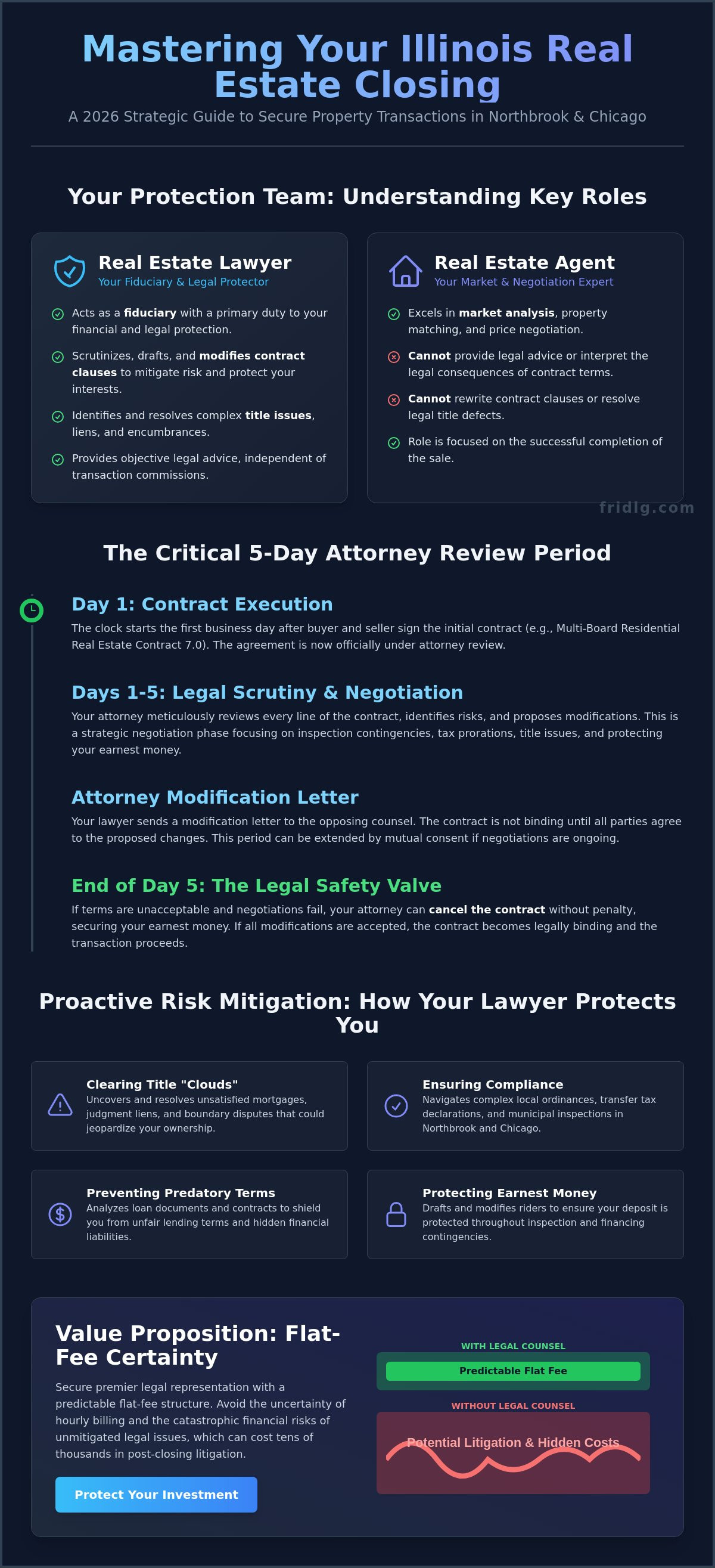
The standard 5-day attorney review period in Illinois is frequently misconstrued as a procedural grace period when, in reality, it's the primary mechanism for strategic risk mitigation. You've worked hard to secure your capital, and the prospect of encountering undisclosed liens or unresolvable title defects during a Northbrook or Chicago transaction is a valid concern. Engaging a specialized real estate lawyer for closing ensures that your contractual obligations are precisely defined and that no predatory lending terms compromise your financial position. Professional integrity demands that every line of the 7.0 Multi-Board Residential Real Estate Contract is scrutinized to protect your long-term interests.
You likely seek a property transfer characterized by professional rigor rather than administrative chaos or unexpected litigation. This 2026 guide provides the exact strategic oversight required to master the legal framework governing your investment, ensuring you don't sign complex documents you don't fully understand. We'll analyze the essential phases of the Illinois closing sequence, including title clearance, the resolution of inspection contingencies, and the final verification of transfer tax declarations. By prioritizing legal precision, you can move from contract to keys with absolute confidence in your property's legal standing.
Key Takeaways
- Understand the essential legal fiduciary duties that distinguish an attorney's role from a real estate agent’s during a complex property transaction.
- Navigate the high-stakes 5-day Attorney Review period and learn how the Multi-Board Residential Real Estate Contract 7.0 governs your local deal.
- Discover how a real estate lawyer for closing proactively identifies and mitigates title "clouds," including unsatisfied mortgages and judgment liens in Cook County.
- Master the closing table checklist by accurately reviewing Closing Disclosures and ensuring compliance with Northbrook and Chicago-specific transfer stamp protocols.
- Evaluate the strategic benefits of securing local legal expertise and the financial predictability of a flat-fee structure for your residential investment.
Why You Need a Real Estate Lawyer for Closing in Illinois
Illinois operates as an attorney-standard state, a distinction that fundamentally alters the dynamic of property transfers compared to escrow-managed states. In this jurisdiction, a real estate lawyer for closing is not merely a luxury; they're a structural necessity for a secure transaction. While title companies handle the administrative filing, the legal attorney manages the contractual integrity of the deal. They review the chain of title, resolve encumbrances, and ensure that the deed transfer complies with the rigorous standards of Cook County law. Without this oversight, buyers and sellers risk long-term litigation over undisclosed liens or boundary disputes.
The financial stakes in Northbrook and Chicago remain high. Property values in these areas require a level of precision that goes beyond standard paperwork. A legal professional acts as a fiduciary, meaning their primary obligation is your financial and legal protection. This differs from other parties in the transaction who may be focused on the completion of the sale. Engaging a real estate lawyer for closing ensures that every document signed at the real estate closing table has been scrutinized for accuracy and fairness.
Legal Protection vs. Real Estate Agency
Real estate agents play a vital role in market analysis and property matching, but their legal authority is strictly limited. They cannot provide legal advice or rewrite contract clauses to suit specific needs. If a contract contains an "as-is" clause, an agent might explain its general meaning, but an attorney will investigate what that clause actually hides. We identify risks related to structural integrity or zoning issues that could cost tens of thousands of dollars post-closing. Our role is to provide an objective, hűvös (cool) analysis of the contract, unaffected by the commission-driven nature of the brokerage industry. This independence is your strongest defense against predatory terms.
The Complexity of Illinois Property Law
Illinois property law is dense and governed by specific statutes like the Residential Real Property Disclosure Act. These laws require sellers to be transparent about the condition of the home, but the burden of proof often shifts during the process. In Northbrook, local ordinances regarding transfer taxes and municipal inspections add layers of bureaucracy that vary significantly from Chicago requirements. It's also vital to understand how much are closing costs in illinois to avoid surprises at the final hour. We provide the strategic support needed to navigate these complexities, ensuring that local 2026 regulations don't stall your transaction or lead to unexpected financial liabilities.
- Review of all local Northbrook and Cook County tax obligations.
- Verification of clear title and resolution of any outstanding judgments.
- Drafting and modification of riders to protect your earnest money.
- Coordination with lenders to ensure loan documents reflect agreed-upon terms.
The Critical 5-Day Attorney Review Period Explained
The Attorney Review period represents the most decisive phase of an Illinois real estate transaction. This window typically opens the first business day after both parties execute the initial contract. It is not a mere formality but a strategic interval where a real estate lawyer for closing scrutinizes the legal obligations and financial risks embedded in the agreement. During these five business days, the contract remains in a state of flux, allowing for essential modifications or, if necessary, a complete withdrawal without the forfeiture of earnest money. This period serves as a legal safety valve, ensuring that neither the buyer nor the seller is bound to a document that contains unfavorable or overlooked terms.
Navigating the Multi-Board Contract
In Northbrook and the broader Chicago market, the Multi-Board Residential Real Estate Contract 7.0 is the standard instrument. While this document is comprehensive, its boilerplate language requires precise adjustment to reflect the specificities of the 2026 market. Section 12, which governs home inspections, is a primary focus. Your attorney will negotiate repair credits or purchase price reductions based on the professional inspection report. For 2026, ensuring mortgage contingency dates align with current institutional lending speeds is vital; the traditional 30-day window often proves insufficient for modern, complex underwriting processes. A failure to extend these dates during the review period can leave a buyer's deposit at risk if financing delays occur.
Negotiating Terms and Disclosures
Cook County property tax prorations remain a point of significant friction due to the "rear-facing" billing cycle. A skilled attorney ensures the proration percentage, often set between 105% and 110% of the last known full year bill, adequately protects the buyer from future tax liabilities that have not yet been billed. As your legal representative navigates title issues to ensure the chain of ownership is unencumbered, they also manage respa real estate compliance to provide transparency regarding settlement costs and service provider relationships.
Protecting the earnest money deposit requires strict adherence to notice requirements and deadlines. A single missed communication can result in the loss of a deposit that often represents 5% to 10% of the total purchase price. Engaging a strategic legal partner during these initial five days ensures your interests remain the priority while the foundation of the transaction is solidified. This stage is about more than just reading the fine print; it's about engineering a contract that survives the complexities of the closing process.
How a Closing Attorney Navigates Title Issues and Liens
A property's history in the Cook County Recorder of Deeds is rarely a straight line. Your real estate lawyer for closing conducts a rigorous examination of the chain of title to ensure the seller possesses the legal right to transfer ownership. This process involves tracing every deed, mortgage, and easement recorded over the past 40 years. Discrepancies often emerge during this stage. A single unreleased mortgage from 1998 or a misfiled easement can halt a transaction. Our firm identifies these "clouds" early to prevent delays that jeopardize your interest rate lock or occupancy timeline.
Identifying and Clearing Liens
Encumbrances take many forms, but few are as persistent as "zombie mortgages" or stale mechanic’s liens. These are often financial obligations that were paid off but never formally released in public records. A judgment lien is a court-ordered claim against a property resulting from the owner's failure to pay a debt, effectively preventing a clean title transfer until the debt is satisfied or vacated. Fridman Legal leverages deep expertise in bankruptcy and debt restructuring to resolve these complexities. We facilitate the direct payoff of creditors and coordinate the filing of formal releases. This strategic approach ensures that when you reach the closing table, the property's financial slate is clean.
- Verification of municipal lien certificates to ensure no outstanding water bills or building code violations exist.
- Resolution of "zombie" mortgages where the original lending institution no longer exists.
- Negotiation with contractors to satisfy and release mechanic's liens before the transfer of funds.
Title Insurance and the Closing Letter
Title insurance serves as the final layer of defense against undiscovered defects. While the Lender’s Policy protects the financial institution's investment, the Owner’s Policy is what secures your equity and right to possession. Your real estate lawyer for closing scrutinizes the title commitment issued by the title company before the scheduled date. We focus on "Schedule B" exceptions, which list specific items the insurance won't cover. If a utility easement or a restrictive covenant appears overly broad, we negotiate with the underwriter to remove or amend these exceptions. This diligence ensures that the title you receive is not only marketable but also free from future litigation risks. We verify that all taxes for the 2024 and 2025 tax years are correctly prorated and accounted for in the final closing letter.
What Happens at the Closing Table: Your Lawyer’s Checklist
The closing table represents the final checkpoint where legal theory meets financial reality. It's the moment where the abstract promises of the purchase agreement transform into a recorded transfer of ownership. Your real estate lawyer for closing manages this transition with surgical precision, ensuring that the final numbers reflect every negotiation point reached during the preceding weeks.
The process begins with a meticulous comparison of the Closing Disclosure (CD) against the initial Loan Estimate. Under federal TILA-RESPA Integrated Disclosure (TRID) rules, certain fees shouldn't increase by more than 10%, while others must remain fixed. Your attorney identifies these discrepancies immediately, preventing last-minute cost overruns that could jeopardize your liquidity. Beyond the loan, the lawyer verifies that local obligations are satisfied. In Chicago, this involves calculating the City Transfer Tax, currently set at a combined $5.25 per $500 of the purchase price. For Northbrook transactions, while there's no municipal transfer tax, your lawyer confirms that the final water bill is paid and the certificate is ready for the title company.
The distribution of funds is the final act of the closing. Your attorney oversees the wire transfers and escrow disbursements, ensuring that the seller's existing mortgage is paid off in full and that the title company issues a "clean" commitment. This oversight prevents the nightmare scenario of a buyer inheriting the seller's old debt due to a clerical error in the payoff statement.
Document Review and Execution
The physical signing process involves a significant volume of legal instruments. Your lawyer distills these into actionable information. The Bill of Sale is reviewed to confirm that all personal property, such as high-end appliances or smart home systems, is legally transferred. The Deed is checked for correct legal descriptions, which are often complex strings of coordinates that must match Cook County records exactly. Crucially, your attorney verifies that any repair credits, such as a $3,500 allowance for a faulty HVAC system negotiated during the inspection period, are correctly applied to the ledger. This ensures you don't pay for the seller's deferred maintenance.
Post-Closing Responsibilities
A transaction isn't complete when you leave the title company. The "gap period" between signing and recording is a time of high risk. Your lawyer ensures the deed is promptly recorded with the Cook County Recorder of Deeds to establish your priority of interest. They also track the delivery of the final title policy, which usually arrives 30 to 60 days after the closing date. Engaging a closing attorney real estate specialist is vital for this oversight, as it guarantees that the administrative tail-end of the deal is handled with the same rigor as the initial contract.
Precision at the closing table prevents litigation in the years to follow. Secure professional oversight for your Northbrook or Chicago closing today.
Choosing the Right Closing Representation in Northbrook
Selecting a real estate lawyer for closing in the Northbrook and Chicago markets requires more than a basic understanding of property law. Local expertise is essential. Northbrook has specific municipal requirements and Cook County property tax complexities that can derail a transaction if they aren't handled with precision. A professional approach ensures that every contractual obligation is met. This protects your financial interests from the moment the contract is signed until the keys are exchanged.
O. Allan Fridman leverages over 20 years of experience to provide clients with a strategic advantage. This tenure allows for the anticipation of potential title issues or inspection disputes before they escalate into costly delays. For many homeowners, the closing process is also the ideal time to consider estate planning to secure family assets for the long term. Integrating these services provides a comprehensive shield for your investment. It ensures that your new property is properly titled to fit within your broader financial legacy.
The Fridman Legal Advantage
Clients receive direct, personalized attention from a principal attorney. This differs from larger firms where files are often delegated to paralegals or junior associates. Whether you are navigating a complex commercial acquisition or a single-family residential purchase, the focus remains on results-driven solutions. This methodology is particularly effective during the final 48 hours of a deal. When last-minute disputes regarding repairs or closing credits arise, having a seasoned real estate lawyer for closing ensures that your position is defended with authority and technical accuracy.
Transparent Fees and Communication
Clarity regarding costs is a cornerstone of professional legal service. Most residential transactions benefit from a flat-fee structure. This model provides predictability and prevents the unexpected billing spikes that often occur with hourly rates. You can review the specific breakdown of costs in our real estate attorney fees guide to understand the investment required for 2026 transactions.
During your initial consultation, you should ask specific questions to gauge the firm's fit for your needs:
- How do you handle specific Northbrook village inspection requirements?
- What is your protocol for communicating with lenders and title companies to ensure a 2026 deadline is met?
- How are escrow holdbacks managed if repairs aren't completed by the closing date?
Secure your representation early in the transaction. Waiting until the inspection period is nearly over can limit your lawyer's ability to negotiate effectively. By engaging a dedicated professional at the start, you ensure that every legal detail of your Northbrook or Chicago property transfer is executed with the highest level of professional integrity.
Securing Your 2026 Property Transaction in Northbrook
The successful acquisition or sale of Northbrook property in 2026 hinges on precise legal execution. The mandatory 5-day attorney review period represents a pivotal phase where contractual terms are refined to protect your long-term interests. Addressing title encumbrances and complex lien resolutions requires a methodical strategy that only deep experience provides. Our firm leverages nearly 20 years of Illinois legal experience to oversee these intricate details. We prioritize financial clarity by providing flat-fee options for transparent closing costs. Selecting a qualified real estate lawyer for closing is the final step in securing your investment against unforeseen liabilities. This structured approach provides the stability required for a seamless transfer of ownership. You've navigated the market's challenges to reach this point. Don't let technical oversights undermine your success at the final hour. Our team ensures that every document is verified and every legal obligation is met with absolute rigor. We're committed to providing the strategic support your transaction requires.
Secure your Northbrook property transaction with Fridman Legal today.
Frequently Asked Questions
Is a real estate lawyer required for closing in Illinois?
Illinois law doesn't strictly mandate a lawyer for every transaction, yet local customs and the complexity of the Multi-Board Residential Real Estate Contract 7.0 make legal representation standard. A real estate lawyer for closing ensures all contractual obligations and title requirements are satisfied before the deed transfers. Without professional oversight, parties risk significant financial exposure during the mandatory attorney review and inspection periods.
How much does a real estate attorney for closing cost in Chicago?
Legal fees for residential closings in Chicago typically range between $500 and $1,500 based on the complexity of the transaction and the firm's experience level. These figures are derived from 2024 market data provided by regional legal service surveys. Some firms charge a flat fee for standard purchases, while others apply hourly rates for complex commercial deals or distressed property sales.
What is the difference between a title company and a closing lawyer?
A title company acts as a neutral third party that issues title insurance and facilitates the escrow process, while a closing lawyer provides dedicated legal advocacy for a specific party. The attorney reviews the title commitment to identify encumbrances that the title company merely lists. This distinction ensures your specific financial interests are protected throughout the 30 to 45 day closing cycle.
When should I hire a lawyer for my home purchase?
You should engage a real estate lawyer for closing immediately after signing the initial purchase agreement to maximize the benefit of the five business day attorney review period. This window allows your counsel to propose essential modifications to the contract terms. Engaging a professional early prevents the inadvertent waiver of rights regarding home inspections or mortgage contingencies.
Can one attorney represent both the buyer and the seller at closing?
An attorney cannot represent both the buyer and the seller in an Illinois real estate transaction due to the inherent conflict of interest. Rule 1.7 of the Illinois Rules of Professional Conduct dictates that a lawyer must maintain undivided loyalty to a single client. Separate representation ensures that negotiations regarding repairs or credits remain adversarial and fair for both parties involved.
What happens if the title search reveals a lien on the property?
The seller must satisfy or clear any discovered liens before the title company can issue a clean policy for the buyer. If a search reveals a $5,000 mechanic's lien, the closing cannot proceed until the debt's paid or an escrow agreement is established. Your attorney will negotiate with the lienholder to ensure the title is unencumbered at the time of conveyance.
Does a real estate lawyer attend the actual closing meeting?
A real estate lawyer typically attends the closing meeting to oversee the execution of the 50 to 100 pages of loan and title documents. They verify that the Closing Disclosure matches the agreed upon terms and explain the legal implications of each signature. Their presence provides a final layer of security against clerical errors or last minute changes by the lending institution.
How long does the attorney review period last in Northbrook?
The standard attorney review period in Northbrook and surrounding Cook County suburbs lasts five business days from the date of contract acceptance. This timeframe is defined in Paragraph 10 of the standard Multi-Board Residential Real Estate Contract used across Illinois. Parties can agree to extend this deadline in writing if complex issues like structural defects or zoning variances require additional investigation.

Article by
O. Allan Fridman
O. Allan Fridman has been practicing law since 2001. His practice is unique in that he does not view himself as a litigation attorney or transactional attorney. Rather, he views each area of law as a tool to pursue the best results for his clients. By practicing in both areas of law, he is able to take a 360-degree view of law. This enables the firm to catch potential drawbacks that are readily identifiable.
By practicing in litigation and transactional law and taking a holistic approach in dealing with our clients, he doesn’t put clients in box — rather, as we are all individuals, so too are the legal services we may require.
Whether it is bankruptcy or litigation or transactional, each client brings challenges and does not fit in any one box. Often times, bankruptcy clients end up not filing bankruptcy because we can achieve a better result through litigation or through an out-of-court resolution with the lender, or through a real estate sale. On the other end of the spectrum, a litigation client with multiple issues and lawsuit may fare better in a bankruptcy.
Since 2001, Allan has practiced in states and federal court, and he is a member of the trial bar of the Northern District of Illinois and admitted in the Northern District of Indiana.
We are a debt relief agency. We help people file for bankruptcy relief under the Bankruptcy Code
The materials on this site are for informational purposes only and do not constitute legal advice. Viewing this site or contacting us does not create an attorney–client relationship, and you should not act or refrain from acting based on any information here without seeking professional legal counsel.


