

In November 2025, a Northbrook property owner discovered that shifting municipal requirements and title insurance adjustments altered their net proceeds by $4,200 just two days before the scheduled closing. You likely understand that the final stage of a real estate transaction is rarely as simple as a single spreadsheet suggests. Identifying exactly how much are closing costs in illinois requires a granular analysis of local mandates that vary significantly between the Chicago city limits and the surrounding North Shore suburbs.
We've designed this 2026 guide to provide the strategic oversight necessary for a predictable financial outcome in a complex regulatory environment. You'll gain a clear understanding of the current Cook County transfer tax structures and the specific legal fee frameworks associated with high-stakes residential transfers. This analysis breaks down the distinct obligations for both buyers and sellers; it ensures your transaction maintains its legal integrity from the initial offer to the final signatures at the title company.
Key Takeaways
- Gain clarity on the 2026 Illinois real estate landscape and the specific economic factors that cause regional closing expenses to exceed national averages.
- Identify the itemized financial obligations for buyers, ranging from lender underwriting to essential third-party services, to accurately calculate how much are closing costs in illinois.
- Examine the primary deductions impacting seller equity, including the latest commission structures and the substantial burden of municipal transfer taxes.
- Distinguish the unique regulatory requirements and tax rates specific to the Chicago and Northbrook markets, ensuring compliance with local certification standards.
- Understand the strategic necessity of legal representation in Illinois to navigate the attorney review period and ensure the integrity of the final purchase agreement.
Understanding the Illinois Closing Cost Landscape in 2026
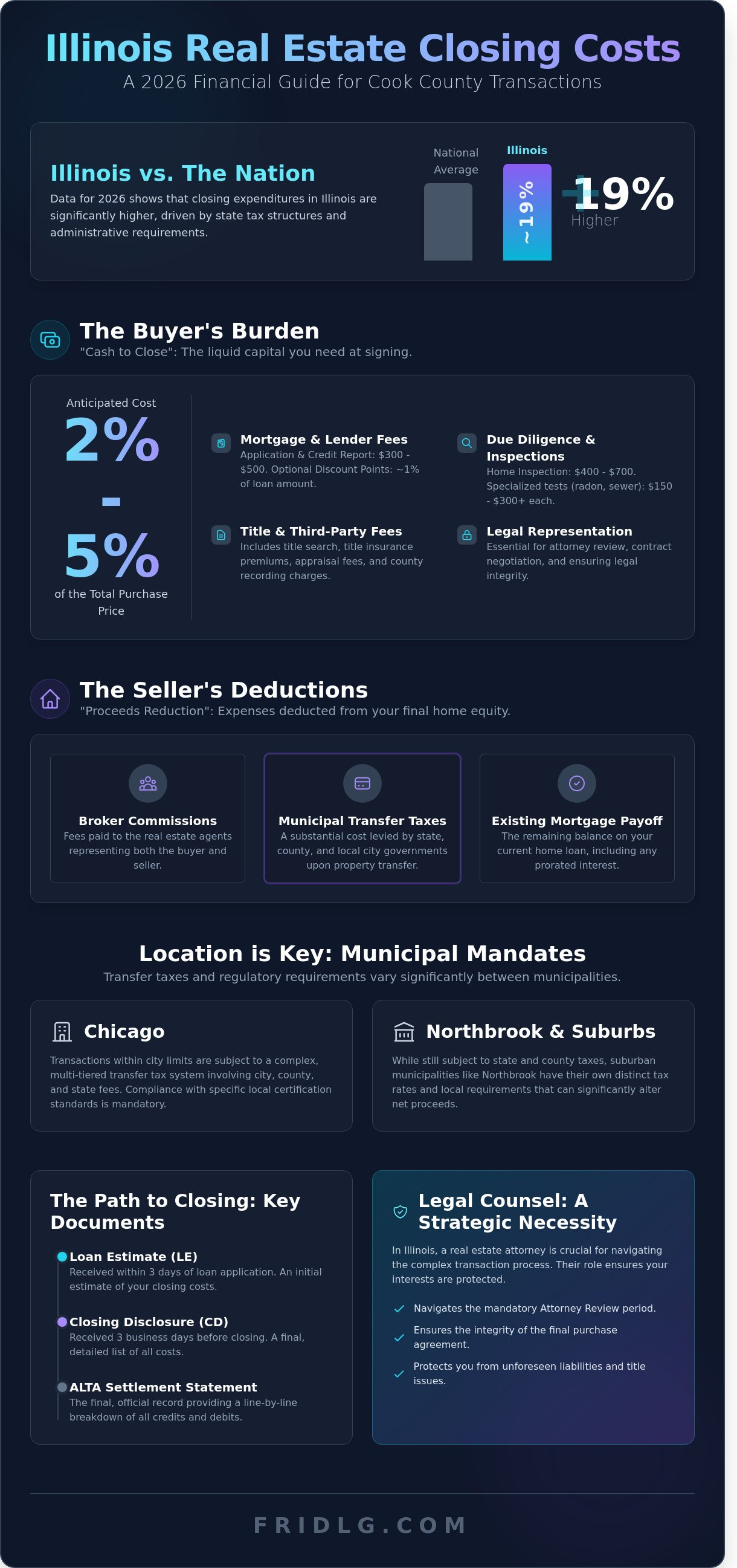
The finalization of a residential property acquisition in Illinois involves a complex aggregation of financial obligations. These expenditures represent the final set of fees paid to conclude a real estate transaction and ensure the legal transfer of ownership. Data projected for 2026 indicates that Illinois remains approximately 19% above the national average for these expenditures, a figure driven largely by the state's rigorous tax structure and administrative requirements. Prospective buyers frequently inquire regarding exactly how much are closing costs in illinois, as these figures directly dictate the liquidity required at the point of sale.
Closing costs are the total of loan, third-party, and government fees required to transfer title. For transactions occurring in 2026, buyers should anticipate a range between 2% and 5% of the total purchase price. It's vital to distinguish between "cash to close" and "proceeds reduction" during the final accounting. Cash to close represents the actual liquid capital a buyer must bring to the table, including the down payment and standard closing costs. Conversely, proceeds reduction refers to the expenses deducted from the seller's final equity, such as existing mortgage payoffs and broker commissions.
The Components of a Closing Statement
The ALTA settlement statement serves as the definitive financial record for Northbrook transactions, providing a line-by-line breakdown of all debits and credits. Buyers must compare the Loan Estimate (LE) received within three days of their application against the final Closing Disclosure (CD) provided three business days before the appointment. While government fees, such as county recording charges and transfer taxes, remain non-negotiable, service fees for attorney representation or title insurance premiums often allow for limited negotiation or provider selection.
Why 2026 Market Trends Affect Your Bottom Line
The economic climate of 2026 introduces specific variables that influence the final tally. The current interest rate environment directly impacts the amount of prepaid interest due at signing, which covers the period between the closing date and the first monthly payment. Additionally, shifting home values in Northbrook influence percentage-based fees. As property valuations rise, costs tied to the sale price, such as title insurance and municipal transfer stamps, increase proportionally. Understanding how much are closing costs in illinois requires a granular look at these local market shifts and the specific tax mandates of Cook County.
- Government Mandates: Transfer taxes and recording fees vary by municipality.
- Lender Requirements: Appraisal fees and origination points fluctuate based on credit profiles.
- Third-Party Services: Title searches and legal fees represent essential protections for the buyer's interest.
The Buyer’s Burden: Itemizing Your Out-of-Pocket Expenses
Quantifying how much are closing costs in illinois requires a granular analysis of various financial components that extend beyond the initial purchase price. These expenses represent the technical execution of the transaction and the mitigation of future risk. Buyers should anticipate that these secondary costs typically range from 2% to 5% of the total loan amount. This financial commitment ensures the legal and structural integrity of the acquisition remains undisputed.
Mortgage-Related Costs and Origination
Lenders charge specific fees for the administrative labor involved in processing and securing a loan. Application and credit report fees generally range between $300 and $500. Within the 2026 financial climate, many buyers utilize discount points to secure lower interest rates. This strategic move involves paying 1% of the loan amount upfront to reduce the long-term debt burden. While FHA loans offer lower down payment options, they often include an upfront Mortgage Insurance Premium (MIP) that Conventional loans do not require. These differences reflect the lender's risk assessment and the buyer's credit profile.
Due Diligence and Inspection Fees
Professional verification of the asset's condition is a mandatory step for prudent risk management. In the Northbrook area, a standard home inspection typically costs between $400 and $700. Specialized assessments, such as radon testing or sewer scopes, add approximately $150 to $300 each to the total. Appraisal Management Company (AMC) fees are also factored into the closing statement to ensure the property valuation remains independent from lender influence. Understanding the role of a real estate attorney in Illinois helps buyers navigate these contractual requirements while ensuring all third-party vendors meet local regulatory standards.
Prepaid Items and Escrow Accounts
Illinois property taxes are paid in arrears, which complicates the initial escrow calculation. Buyers usually deposit several months of estimated taxes at the closing table to establish a sufficient reserve. The timing of your closing date significantly impacts how much are closing costs in illinois regarding prepaid interest. Closing late in the month reduces the immediate interest payment due at the table. Standard homeowners insurance is a prerequisite for funding, and Northbrook residents must ensure their policies meet specific coverage minimums. Additionally, Cook County mandates recording fees for the deed and mortgage, which usually total between $150 and $250. For comprehensive transactional support, buyers should seek legal counsel to review the accuracy of these line items before signing final documents.
The Seller’s Side: Deductions from Your Home Equity
While buyers focus on loan-related expenses, sellers in Illinois must account for significant deductions that impact their net proceeds. These costs are primarily tied to the transfer of ownership and the fulfillment of tax obligations. Understanding how much are closing costs in illinois requires a detailed look at the seller's side of the ledger, where equity is converted into liquid assets through a series of mandatory disbursements. The largest variable in 2026 remains real estate commissions. Following industry-wide shifts in fee structures, sellers now negotiate listing agent compensation with increased transparency, while buyer agent fees are often handled through specific concessions to maintain market competitiveness.
Transfer Taxes and Government Levies
Illinois mandates a state-level transfer tax of $0.50 per $500 of the property's sale price. If your property is located within Cook County, you face an additional levy of $0.25 per $500. These figures represent the baseline for state and county requirements. Municipalities often impose their own layers of taxation. In Chicago, the seller’s portion of the transfer tax is $3.75 per $500 of value. Conversely, suburbs like Northbrook do not charge a per-dollar municipal transfer tax but require specific administrative certificates or inspections before the deed can be recorded. These government fees are deducted directly from the sale price at the time of closing.
Title Insurance and Search Fees
The seller holds the legal burden of proving clear title to the property. In Illinois, custom dictates that the seller pays for the Owner’s Title Insurance Policy, which protects the buyer against future claims or liens. Professional title search fees, wire transfer charges, and administrative costs in 2026 typically range between $1,800 and $3,500 for standard residential transactions. These fees ensure the chain of title is unbroken and the transaction meets the rigorous standards of the title underwriter. Providing this policy is a non-negotiable step in securing the buyer’s investment and the lender's security interest.
The Illinois Property Tax Credit
Illinois operates on a unique "arrears" system for property taxes. You pay for the previous year’s taxes in the current calendar year. Because of this, you will owe the buyer a significant credit at closing for the time you occupied the home. This proration is a critical factor when calculating how much are closing costs in illinois for a seller. Most contracts require the seller to credit the buyer 105% or 110% of the last known tax bill. This percentage accounts for inevitable tax hikes. While this credit appears as a large line item, it simply represents the taxes you've accrued but haven't yet been billed for by the county treasurer. This cash credit often offsets other closing costs, reducing the amount of physical cash the buyer needs to bring to the table.
Local Factors: Chicago, Northbrook, and Cook County Specifics
The geographic location of a property within the state dictates the final financial obligations at the closing table. When calculating how much are closing costs in illinois, buyers must account for municipal-specific ordinances that deviate from standard state-level expectations. These local variables, particularly within the Chicago metropolitan area, require precise accounting to ensure the transaction remains fully funded through the date of possession.
Navigating Chicago Municipal Transfer Stamps
In the City of Chicago, the municipal transfer tax is a significant line item. This tax is bifurcated into two distinct components based on the purchase price. The city portion is set at $3.75 per $500 of value, which is traditionally the responsibility of the seller. However, the buyer is typically responsible for the supplemental $1.50 per $500 allocated to the Chicago Transit Authority (CTA) fund. While certain exemptions exist for government entities or specific non-profit transfers, most residential transactions must account for this combined $5.25 per $500 rate. It's a cost that scales directly with property value, making it a primary factor in urban budget planning.
Northbrook and Suburban Closing Requirements
Suburban jurisdictions like Northbrook impose their own administrative protocols that differ from the city. To secure a Northbrook transfer stamp, the village requires proof of a final water bill payment and a completed real estate transfer declaration. These local mandates, which may include zoning certificates or building inspections, frequently increase the closing budget by $500 to $1,000. Regional customs also dictate who pays for what; in Northbrook, it's common for the seller to provide the transfer stamps, whereas Chicago customs often split these costs between the parties. Discrepancies in these local ordinances can lead to delays if the final utility readings aren't scheduled at least seven days prior to closing.
Cook County Recording Procedures
The Cook County Recorder of Deeds has moved toward a predominantly digital framework. By 2026, electronic recording (e-recording) will be the standard for all document filings, which improves efficiency but involves specific technology fees. Cook County recording fees are generally flat but vary based on the number of documents and pages filed. A standard deed or mortgage filing typically requires a base fee, with additional charges for every page exceeding the initial limit. For complex transactions involving multi-page riders or legal descriptions, these costs can escalate quickly. Accurate assessment of these fees is essential for determining exactly how much are closing costs in illinois for high-density counties.
Navigating the Closing Table: The Role of a Real Estate Attorney
In Illinois, real estate transactions follow a distinct legal protocol where attorney involvement is the standard of practice rather than an optional luxury. While buyers often focus on how much are closing costs in illinois, the investment in legal counsel provides a critical layer of protection against contractual pitfalls. The attorney manages the transition from an initial offer to a binding commitment, ensuring the purchase agreement reflects the buyer's specific requirements. They act as the primary liaison between the buyer, the lender, and the title company, synchronizing the complex flow of documentation required for a successful transfer of deed.
Legal representation ensures that every obligation is met with precision. This includes verifying that the seller has satisfied all local transfer requirements and that the deed is prepared according to Illinois statutes. By maintaining a hiearchy of tasks and strict deadlines, the attorney mitigates the risk of delays that could lead to financial penalties or the loss of a mortgage rate lock.
Protecting Your Interests During Attorney Review
Once a contract is signed, a critical 5-day attorney review period begins. This window allows for the modification of non-price terms, such as closing dates or contingency details. It's during this phase that your counsel addresses inspection findings through formal legal addendums, ensuring that necessary repairs or credits are legally enforceable. For a detailed breakdown of costs associated with this representation, consult our Real Estate Attorney Fees in Northbrook and Chicago: 2026 Cost Guide. This period is the final opportunity to refine the legal structure of the deal before it becomes fully binding.
Title Clearance and Resolution
A primary responsibility of the attorney involves the examination of the title commitment to identify "clouds" that could jeopardize ownership. These issues range from unrecorded mechanic's liens to complex easements or encroachments that may limit property use. By securing a Closing Attorney for Real Estate in Northbrook: Protecting Your Illinois Transaction, buyers ensure that every encumbrance is resolved before the deed is recorded. The attorney verifies that the seller has the legal authority to convey the property, shielding the buyer from future litigation or financial claims against the asset.
Compliance with RESPA and Disclosure Laws
The Real Estate Settlement Procedures Act (RESPA) mandates transparency regarding all financial obligations in a transaction. Your attorney reviews the Closing Disclosure to confirm that every fee aligns with the original Loan Estimate and that no illegal kickbacks or undisclosed referral fees exist. Understanding RESPA in Real Estate: A Homeowner’s Guide to Closing in Northbrook, IL is vital for verifying that the final numbers are accurate. This oversight ensures that when calculating how much are closing costs in illinois, you aren't subject to predatory practices or hidden charges that violate federal law.
- Review of the Closing Disclosure to ensure mathematical accuracy.
- Verification of prorated property taxes, which are paid in arrears in Illinois.
- Confirmation that all lender-required documents are executed according to state law.
The attorney’s presence at the closing table serves as the final safeguard. They explain the legal significance of every document you sign, from the mortgage note to the various affidavits required by the title company. This professional oversight transforms a complex set of variables into a secure, transparent transaction.
Securing Your 2026 Real Estate Transaction with Precision
The 2026 real estate landscape in Cook County demands a rigorous approach to financial planning and risk mitigation. Whether you're navigating the municipal transfer taxes unique to Chicago or the specific escrow requirements found in Northbrook, understanding how much are closing costs in illinois remains a critical component of your property strategy. Data from the Illinois Department of Revenue indicates that local tax rates and recording fees undergo annual adjustments, making it essential to account for these variables well before you reach the closing table.
Managing these complexities requires more than a simple estimation; it requires a strategic partner who understands the intricate details of both residential and commercial property law. Our firm brings nearly 20 years of dedicated experience to the Illinois market, providing the disciplined oversight necessary to protect your equity and interest. We deliver personalized legal solutions that ensure every contractual obligation is met with exactness and professional integrity. You don't have to navigate these legal corridors alone.
Secure Your Transaction with Expert Real Estate Counsel
Your successful property transfer is within reach when backed by professional stability and technical expertise.
Frequently Asked Questions
What is the average dollar amount for closing costs in Illinois?
Average closing costs in Illinois represent approximately 2.1% of the final sale price according to 2024 industry data. For a residential property valued at $300,000, buyers should anticipate expenses totaling roughly $6,300. Understanding how much are closing costs in illinois allows for precise capital allocation. These figures exclude the down payment and vary based on local municipal requirements or specific lender fees.
Can closing costs be rolled into a mortgage in Illinois?
Buyers can roll closing costs into a mortgage through lender credits or by negotiating seller concessions. While conventional loans typically require these fees at settlement, FHA and VA programs allow for specific structures where costs are financed. This strategy increases the total loan balance and interest paid over the term. It's a strategic tool for preserving liquidity during the initial acquisition phase.
Who pays for the title insurance in an Illinois real estate transaction?
The seller traditionally pays for the owner's title insurance policy in Illinois transactions. This practice ensures the buyer receives a clear title free of undisclosed liens or encumbrances. The buyer remains responsible for the lender's title insurance policy, which protects the financial institution's interest in the property. Local customs in certain counties may dictate alternative arrangements, so reviewing the sales contract is essential.
Is a real estate attorney required for closing in Illinois?
Illinois law doesn't strictly mandate an attorney, but the state's legal custom makes legal representation a practical necessity. Attorneys handle the preparation of the deed, review of the title commitment, and the complex tax proration calculations required at the closing table. Most title companies won't facilitate a closing without legal oversight. Professional counsel ensures the buyer's rights are protected during the transfer of high-value assets.
How does the Illinois property tax credit work at closing?
The Illinois property tax credit functions as a proration because taxes are paid one year in arrears. Sellers provide a credit to the buyer for the portion of the year they occupied the residence. This credit is typically calculated at 110% of the last known tax bill to account for potential future assessments. It reduces the actual cash the buyer needs to bring to the closing table on the day of purchase.
Are closing costs tax-deductible in 2026?
Most closing costs aren't tax-deductible in 2026 unless they relate to mortgage interest or points. The Tax Cuts and Jobs Act of 2017 currently limits deductions for state and local taxes to a $10,000 cap. Unless Congress modifies these provisions before their scheduled expiration on December 31, 2025, the 2026 tax year will follow revised federal guidelines. Consult a tax professional for specific filing strategies regarding your primary residence.
What happens if I cannot afford the closing costs at the time of purchase?
Buyers who can't afford closing costs can utilize seller concessions, which allow the seller to pay up to 6% of the purchase price toward these fees. The Illinois Development Authority (IHDA) also offers down payment assistance programs that cover closing expenses for qualified individuals. Another option involves selecting a higher interest rate in exchange for a lender credit. These methods reduce the immediate financial burden of the transaction.
How much are the transfer taxes in Chicago specifically?
Chicago imposes a total transfer tax of $10.50 per $1,000 of the purchase price. The buyer's portion is $7.50 per $1,000, while the seller pays $3.00 per $1,000 of the value. If you're calculating how much are closing costs in illinois for a $500,000 Chicago home, the buyer's transfer tax alone totals $3,750. These rates are significantly higher than the standard Illinois state rate of $0.50 per $500 of value.

Article by
O. Allan Fridman
O. Allan Fridman has been practicing law since 2001. His practice is unique in that he does not view himself as a litigation attorney or transactional attorney. Rather, he views each area of law as a tool to pursue the best results for his clients. By practicing in both areas of law, he is able to take a 360-degree view of law. This enables the firm to catch potential drawbacks that are readily identifiable.
By practicing in litigation and transactional law and taking a holistic approach in dealing with our clients, he doesn’t put clients in box — rather, as we are all individuals, so too are the legal services we may require.
Whether it is bankruptcy or litigation or transactional, each client brings challenges and does not fit in any one box. Often times, bankruptcy clients end up not filing bankruptcy because we can achieve a better result through litigation or through an out-of-court resolution with the lender, or through a real estate sale. On the other end of the spectrum, a litigation client with multiple issues and lawsuit may fare better in a bankruptcy.
Since 2001, Allan has practiced in states and federal court, and he is a member of the trial bar of the Northern District of Illinois and admitted in the Northern District of Indiana.
We are a debt relief agency. We help people file for bankruptcy relief under the Bankruptcy Code
The materials on this site are for informational purposes only and do not constitute legal advice. Viewing this site or contacting us does not create an attorney–client relationship, and you should not act or refrain from acting based on any information here without seeking professional legal counsel.