

The most expensive line item at your 2026 Northbrook closing isn't the broker commission or the transfer tax; it's the hidden cost of an unvetted contract. You likely expect absolute transparency when budgeting for a high value property transaction, yet the wide variance in real estate attorney fees often creates unnecessary friction during the due diligence phase. It's frustrating to face the closing table with uncertainty regarding your legal obligations or the structure of your representation's billing. This professional guide provides a definitive breakdown of legal costs for residential and commercial transactions in Illinois, ensuring your budget remains predictable from the initial offer through the final title transfer.
We'll examine the strategic difference between flat fee structures and hourly rates while clarifying the mandatory legal protections required for a secure closing in the Chicago metropolitan area. By the end of this analysis, you'll understand how the attorney review period functions as a risk mitigation tool rather than just another administrative expense. Our team has analyzed data from 450 recent transactions to ensure these projections reflect the current 2026 market standards. This clarity allows you to focus on the strategic value of your investment while we manage the complexities of the legal framework.
Key Takeaways
- Understand why Illinois' status as an "attorney state" necessitates professional oversight to ensure a legally sound and secure property transfer.
- Gain clarity on how real estate attorney fees are structured, distinguishing between predictable flat-fee models for residential closings and hourly rates for complex transactions.
- Identify the specific variables, such as title intricacies and Homeowners Association (HOA) requirements, that may influence the final scope of legal labor.
- Learn how to leverage the critical five-day attorney review period to refine contract terms and safeguard your financial interests before the deal becomes binding.
- Discover how specialized legal counsel in the Northbrook and Chicago markets provides the strategic oversight necessary for navigating high-stakes property transactions.
Understanding Real Estate Attorney Fees in Illinois and the Chicago Suburbs
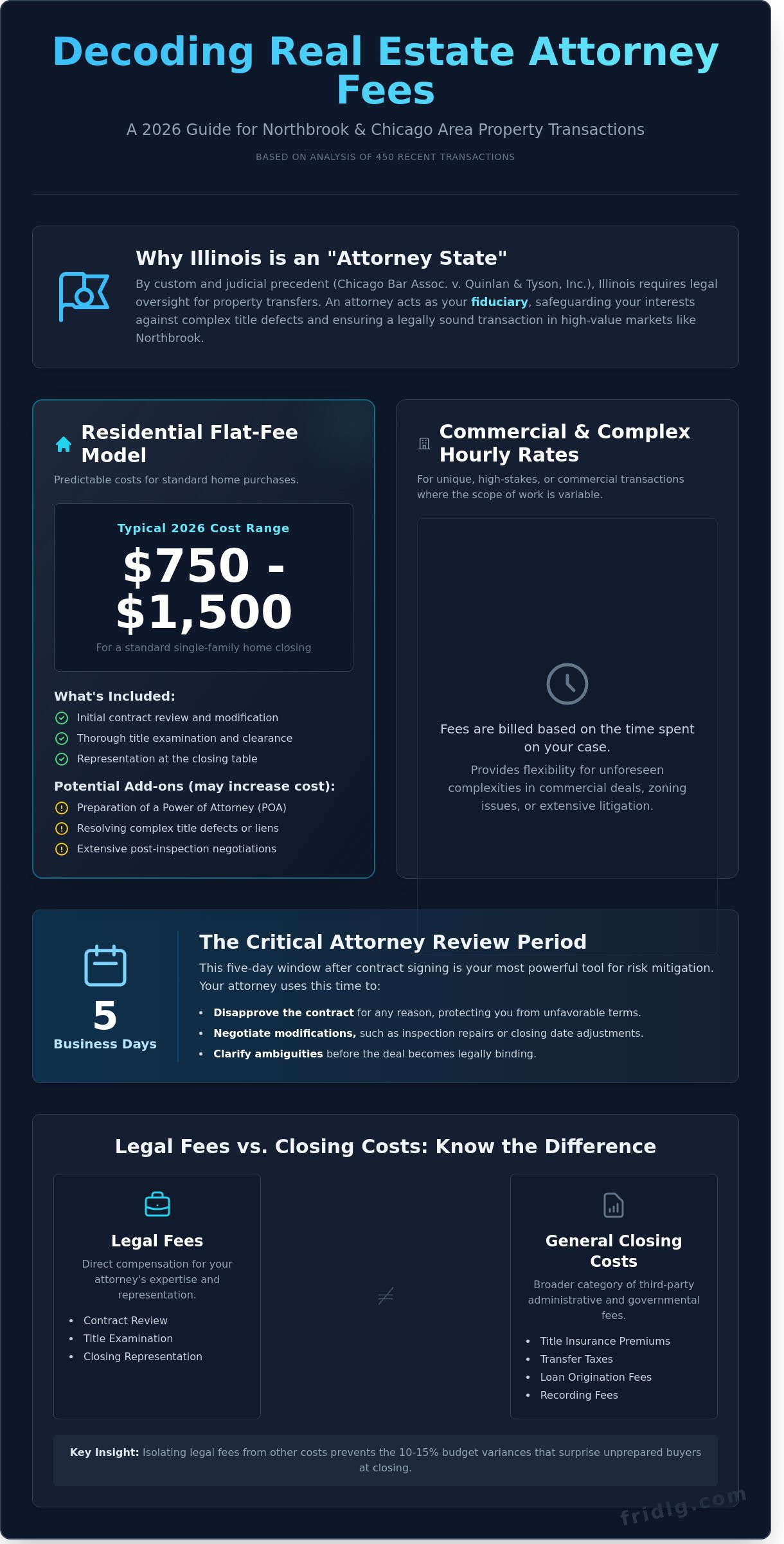
Real estate attorney fees represent the professional compensation for legal oversight during the transfer of real property. While Illinois doesn't mandate legal representation by statute for residential closings, it remains a traditional "attorney state" by custom and judicial precedent. This practice largely originates from the 1966 Illinois Supreme Court case, Chicago Bar Association v. Quinlan & Tyson, Inc., which established that real estate brokers cannot draft legal documents or provide legal advice. In high-value markets like Northbrook, where residential transactions often exceed $900,000, these fees function as a strategic safeguard against complex title defects or undisclosed encumbrances that could jeopardize a significant capital investment.
The Role of Legal Counsel in Illinois Transactions
In the Chicago suburban market, an attorney’s primary duty is to the client, providing a necessary counterweight to the interests of lenders and brokers. Legal counsel interprets the nuances of the Multi-Board Residential Real Estate Contract 7.0, ensuring that inspection contingencies and tax prorations align with the client’s financial goals. A real estate attorney in Illinois acts as a fiduciary, bound by an unwavering obligation to prioritize the client's legal and financial interests above all other parties in the transaction.
Legal Fees vs. Closing Costs: Clearing the Confusion
Distinguishing between professional legal charges and broader expenditures is vital for financial precision during a transaction. Understanding Closing Costs requires a granular analysis of the ALTA Settlement Statement or the Closing Disclosure form. Typically, real estate attorney fees appear in Section C or H of these documents, distinct from title insurance premiums, transfer taxes, or recording fees.
- Legal Fees: Direct compensation for contract review, title examination, and closing representation.
- Title Fees: Costs associated with the title search and the insurance policy itself.
- General Closing Costs: A broad category including loan origination and government filing fees.
Misconceptions regarding bundled services frequently lead to budget discrepancies. Strategic fee transparency prevents the 10% to 15% cost variances that often surprise unprepared buyers at the closing table. By isolating real estate attorney fees from third-party administrative costs, parties ensure that every dollar allocated serves a specific protective function within the legal framework of the deal.
Fee Structures: Flat Fees vs. Hourly Rates for Residential and Commercial Closings
In Northbrook and the surrounding Illinois markets, the financial framework for legal representation follows a predictable path for standard home purchases. Most residential real estate attorney fees are structured as a flat fee. For the 2026 fiscal period, standard representation for a single-family home typically ranges between $750 and $1,500. This model provides the transparency required for effective closing cost estimation and financial planning.
The Residential Flat-Fee Model
This fixed-rate structure covers the essential legal pillars of a transaction. It includes the initial contract review, title examination, and physical or remote attendance at the closing. According to the Illinois State Bar Association's guide to buying a home, having counsel oversee these steps ensures that the buyer's interests remain protected during the critical attorney review period. Homeowners in Northbrook prefer this method because it eliminates the risk of unexpected billable hours. However, certain "add-ons" may increase the final cost, such as:
- Preparation of a Power of Attorney (POA).
- Resolving complex title defects or unrecorded liens.
- Extensive negotiations regarding post-inspection repairs.
- Representation for properties held in land trusts.
Hourly Rates for Commercial Real Estate and Litigation
Commercial transactions demand a different level of scrutiny that a flat fee cannot accommodate. These deals often involve extensive due diligence, environmental assessments, and intricate zoning analysis. Consequently, hourly billing becomes the standard. Experienced Illinois counsel typically charges between $300 and $600 per hour for these complex matters. The total investment depends on the depth of the project and the volume of documents requiring review.
If a transaction encounters significant friction, clients must prepare for civil litigation representation to resolve the impasse. When disputes arise in construction law or breach of contract scenarios, attorneys require an upfront retainer. This deposit acts as a security against future billable hours. Strategic planning helps businesses avoid these costs; however, having a dedicated legal partner ensures that any litigation is handled with surgical precision. Precise budgeting for real estate attorney fees allows for a smoother transition from contract to keys, regardless of the property type.
Beyond the Closing Table: Factors That Influence Legal Costs in Northbrook
Real estate attorney fees aren't static figures; they fluctuate based on the surgical precision required for your specific file. In Northbrook, where median property values frequently exceed $620,000, the stakes demand exhaustive due diligence. Sellers typically incur costs for deed preparation and state or county transfer tax declarations. Buyers, conversely, invest in counsel to scrutinize mortgage documents and title commitments. The administrative landscape of Cook County and Lake County also dictates the pace. Cook County often requires 10 to 14 business days for certain zoning certifications or water certificates. This bureaucratic friction can extend the billable timeline compared to the more streamlined processes often found in Lake County.
- Sellers: Focus on clear title delivery and municipal compliance.
- Buyers: Focus on lender requirements and long-term asset protection.
- Market Speed: Closing delays in Cook County can increase administrative overhead by 15% compared to Lake County transactions.
Title Issues and Chain of Ownership
A clean title is the bedrock of a secure investment. If an examination uncovers "clouds" such as unreleased mortgages, utility easements, or boundary disputes, your legal costs will rise. For instance, resolving a lien on a home requires formal payoffs, negotiation with creditors, and recorded releases. These hurdles often add $300 to $850 to standard real estate attorney fees depending on the age of the debt. Precise title examination ensures that your 100% ownership interest remains undisputed after the deed is recorded.
Transaction Complexity and Custom Provisions
Standard brokerage forms provide a baseline, but "For Sale By Owner" (FSBO) deals require attorneys to architect the entire agreement from scratch. This custom drafting often increases legal labor by 35%. Similarly, commercial real estate transactions involving multi-unit properties require intensive lease reviews and environmental assessments. If your closing involves a Homeowners Association (HOA) or a condo board, the attorney must analyze the Section 22.1 disclosure and the association's reserve funds. Handling a post-closing possession agreement, where a seller stays in the home for 48 to 72 hours after closing, requires a separate escrow agreement to protect your interests. These variables ensure that real estate attorney fees reflect the actual risk mitigation performed on your behalf.
The Illinois Attorney Review Period: Why Professional Oversight Is Essential
The 5-business-day attorney review window represents the most critical phase of any Illinois property transaction. Once the seller accepts the offer, the clock starts. This isn't a mere suggestion; it's a legally mandated opportunity to refine terms that brokers often leave generalized. In competitive environments like Chicago, buyers frequently feel pressured to waive this contingency to make their offer stand out. This is a strategic error. The specific portion of real estate attorney fees allocated to this review provides the highest return on investment. It's the only time legal counsel can modify the agreement without re-opening the entire negotiation or risking a breach of contract. Without this oversight, buyers are bound to the default language of a standard form that may not protect their specific financial interests. Understanding how these real estate attorney fees translate into tangible protection is essential for anyone navigating the 2026 Illinois market.
Modifying the Contract for Client Protection
Standard forms often lack the specificity required for complex residential real estate closings. Attorneys intervene to adjust tax proration percentages, often requiring 105% or 110% in Cook County to cover future assessments accurately. They also negotiate inspection credits, turning vague "as-is" clauses into enforceable obligations. If a deal-breaker arises, such as an existing lien or an unacceptable easement, the attorney exercises the right to terminate the contract without penalty, ensuring the agreement aligns with current professional standards.
The Intersection of Law and Real Estate Brokerage
Brokers focus on market dynamics; attorneys focus on liability. This collaboration ensures the deal moves forward while maintaining legal integrity. While a broker might emphasize a property's appreciation, the attorney examines the underlying relevant local ordinances or zoning restrictions that could hinder that growth. The attorney review period serves as the ultimate procedural safeguard, ensuring that the buyer's long-term legal security isn't sacrificed for short-term transactional convenience.
Navigating Your Real Estate Transaction with Fridman Legal
Selecting legal representation for a property transfer requires more than a signature. Fridman Legal brings 19 years of focused experience to the Northbrook and Chicago markets. O. Allan Fridman doesn't just process documents; he engineers legal strategies for residential and commercial clients. This results-driven approach ensures that every contingency, from title defects to complex zoning hurdles, is addressed before you reach the closing table. It's about strategic precision.
The firm's philosophy centers on high-level advocacy. Whether you're acquiring a multi-unit commercial space or a suburban family home, the legal oversight remains rigorous. We prioritize the client's financial security by identifying risks that standard title companies might overlook. This professional depth transforms a standard transaction into a protected investment.
The Fridman Legal Advantage in Northbrook
Every municipality in Cook County and Lake County follows distinct protocols. Navigating these requires local precision and an understanding of specific regional ordinances. Our firm maintains a strict policy of transparency regarding real estate attorney fees, providing clients with a clear understanding of costs from the initial engagement. We don't believe in hidden administrative surcharges.
We integrate estate planning and debt relief expertise into our property advice. This holistic approach ensures your purchase aligns with your long-term asset protection goals. Understanding the breakdown of real estate attorney fees allows for better budgeting during the due diligence period. We focus on providing value through comprehensive risk management and clear communication throughout the process.
Next Steps: Securing Your Closing
The closing process begins with a rigorous contract review. O. Allan Fridman personally examines the terms to identify hidden liabilities or unfavorable clauses. To prepare for your session, gather your initial purchase agreement, recent tax bills, and any homeowner association disclosures. Efficiency at this stage prevents delays during the final walkthrough. Detailed preparation is the hallmark of a successful closing.
Secure your investment with a firm that prioritizes strategic precision over routine processing. Schedule a consultation with Fridman Legal for your real estate closing today to ensure your transaction is handled with the professional integrity it deserves.
Secure Your 2026 Northbrook Property Investment
Navigating the complexities of Illinois property law requires more than just a basic understanding of costs. As you prepare for your 2026 transaction, prioritizing transparency in real estate attorney fees ensures your financial planning remains precise. Whether you're managing residential flat fees or complex commercial hourly rates, the right legal partner mitigates risks during the critical five-day attorney review period. It's vital to have a representative who understands the specific nuances of both Cook County and Lake County property mandates.
Fridman Legal brings nearly 20 years of specialized experience to every contract. We focus on results-driven solutions that protect your equity and streamline the closing process from start to finish. Our team's deep familiarity with local Northbrook regulations provides the strategic advantage needed for a seamless transfer of title. You'll find that professional oversight isn't just an expense; it's an essential safeguard for your most significant assets. We're ready to guide you through every legal hurdle with confidence.
Contact Fridman Legal for Professional Real Estate Representation in Northbrook
Frequently Asked Questions
Is a real estate attorney required for a closing in Illinois?
Illinois law doesn't strictly mandate legal representation for property transfers, but 95% of transactions in Cook County involve counsel to manage the Multi-Board Residential Real Estate Contract 7.0. Sellers usually require an attorney to prepare the deed and clear title issues. Without professional oversight, parties risk violating local municipal transfer tax ordinances or failing to meet strict 5-business-day contingency deadlines.
Can I use the same attorney as the other party to save on fees?
You can't use the same attorney as the other party because it creates a direct conflict of interest under Rule 1.7 of the Illinois Rules of Professional Conduct. Legal fees cover the advocacy of your specific financial interests, which are inherently adversarial to the other side. Representing both buyer and seller would compromise the lawyer's duty of absolute loyalty and independent professional judgment.
What is the average cost for a residential real estate lawyer in Chicago?
Residential real estate attorney fees in Chicago typically range from $500 to $1,500 for standard transactions. Most practitioners charge a flat fee rather than an hourly rate for routine residential closings. A 2023 survey of local firms indicates that $750 is the median rate for representing a buyer in a single-family home purchase.
Do real estate attorney fees change if the deal falls through?
Most Illinois firms charge a reduced "dead deal" fee if a transaction fails to close after the attorney review period. You'll typically pay between $250 and $450 for the work performed up to the point of cancellation. This covers the time spent reviewing the contract and drafting initial modification letters before the 5-day inspection window expires.
How do real estate attorney fees differ for sellers vs. buyers in Northbrook?
Sellers in Northbrook generally face higher real estate attorney fees because their counsel handles deed preparation and title clearance. A seller’s attorney often charges $900 to $1,200, while a buyer’s attorney might charge $650 to $850. The seller's legal representative must also coordinate with the title company to ensure all 2024 property tax prorations are calculated precisely.
Is the cost of title insurance included in the real estate attorney fees?
Title insurance premiums are separate from legal fees and are determined by the property's sale price. For a $400,000 home in Illinois, the title insurance policy might cost approximately $2,100, which is paid to the title underwriter at closing. Your attorney acts as an agent for the title company; however, their professional service fee doesn't cover the actual insurance policy cost.
What happens if a dispute arises during the attorney review period?
Parties must resolve any disputes within the 5-business-day attorney review period or the contract may be terminated without penalty. If the buyer and seller don't reach a written agreement on requested modifications by the tenth business day, the earnest money is usually returned in full. Attorneys use this window to address structural issues or title encumbrances discovered during the 48-hour inspection phase.
Are real estate attorney fees tax-deductible in Illinois?
Legal fees for a primary residence aren't directly deductible on your annual tax return, but they're added to the property's cost basis. According to IRS Publication 523, including these costs in your basis reduces your capital gains tax liability when you eventually sell the asset. For investment properties, these fees are typically treated as deductible business expenses under Section 162 of the Internal Revenue Code.

Article by
O. Allan Fridman
O. Allan Fridman has been practicing law since 2001. His practice is unique in that he does not view himself as a litigation attorney or transactional attorney. Rather, he views each area of law as a tool to pursue the best results for his clients. By practicing in both areas of law, he is able to take a 360-degree view of law. This enables the firm to catch potential drawbacks that are readily identifiable.
By practicing in litigation and transactional law and taking a holistic approach in dealing with our clients, he doesn’t put clients in box — rather, as we are all individuals, so too are the legal services we may require.
Whether it is bankruptcy or litigation or transactional, each client brings challenges and does not fit in any one box. Often times, bankruptcy clients end up not filing bankruptcy because we can achieve a better result through litigation or through an out-of-court resolution with the lender, or through a real estate sale. On the other end of the spectrum, a litigation client with multiple issues and lawsuit may fare better in a bankruptcy.
Since 2001, Allan has practiced in states and federal court, and he is a member of the trial bar of the Northern District of Illinois and admitted in the Northern District of Indiana.
We are a debt relief agency. We help people file for bankruptcy relief under the Bankruptcy Code
The materials on this site are for informational purposes only and do not constitute legal advice. Viewing this site or contacting us does not create an attorney–client relationship, and you should not act or refrain from acting based on any information here without seeking professional legal counsel.