

A single undisclosed referral fee during your Northbrook property transfer isn't just a minor financial oversight; it's a direct violation of federal law that can jeopardize your entire investment. Since its enactment in 1974, the Real Estate Settlement Procedures Act has served as the primary defense against predatory lending and opaque closing costs. You likely expect your final settlement to be a transparent reflection of services rendered, yet the complexity of modern respa real estate requirements often masks arrangements that prioritize agent commissions over your financial security. Confusion regarding the Closing Disclosure is common, especially when high-stakes suburban Chicago transactions are on the line.
We've designed this guide to provide the strategic clarity required to ensure your Cook County closing remains legally sound and free of hidden liabilities. You'll gain the precise knowledge needed to identify illegal kickbacks and verify that your lender meets every mandatory disclosure deadline. We'll examine the specific documentation required for a compliant transaction and provide the tools to spot irregularities before you sign the final deed.
Key Takeaways
- Understand how the Real Estate Settlement Procedures Act serves as a federal safeguard against undisclosed fees, ensuring total transparency during your Northbrook property transaction.
- Identify the specific protections under Section 8 that prohibit illegal kickbacks and unearned referral fees, preventing the artificial inflation of your settlement costs.
- Navigate mandatory TRID disclosure timelines to ensure you receive accurate documentation of all respa real estate settlement costs well before reaching the closing table.
- Learn the "one-sixth rule" for escrow accounts to verify that your lender does not exceed federal limits for tax and insurance cushions in Cook County.
- Discover how professional legal counsel identifies hidden "junk fees" during the attorney review period to ensure your transaction maintains strict regulatory compliance.
What is RESPA? Understanding Your Rights in Illinois Real Estate
The Real Estate Settlement Procedures Act, enacted by Congress in 1974, serves as the primary federal framework for consumer protection during the home buying process. In the context of respa real estate transactions, the law demands absolute transparency regarding settlement costs and prohibits unethical referral fees. For homeowners in Northbrook, where median home prices reached $645,000 in early 2024, these protections ensure that closing costs remain predictable and free from hidden markups. While the Department of Housing and Urban Development (HUD) originally oversaw these regulations, the Consumer Financial Protection Bureau (CFPB) assumed full enforcement authority on July 21, 2011, following the passage of the Dodd-Frank Act. This shift centralized oversight, providing a more robust mechanism for penalizing lenders or title companies that violate consumer rights.
Who is Covered by RESPA Regulations?
RESPA applies to federally related mortgage loans secured by first or subordinate liens on residential properties designed for one-to-four families. This definition encompasses the vast majority of residential acquisitions in suburban Chicago, including single-family homes, condominiums, and townhouses. Most buyers working with traditional lenders or credit unions in Cook County will find their transactions strictly governed by these rules. However, specific exemptions exist. Loans on properties exceeding 25 acres, strictly commercial or agricultural ventures, and certain temporary construction loans fall outside these regulatory boundaries. Cash-only transactions also generally bypass RESPA, though many local practitioners still follow its disclosure spirit to maintain professional standards and mitigate liability.
The Core Objectives of Regulation X
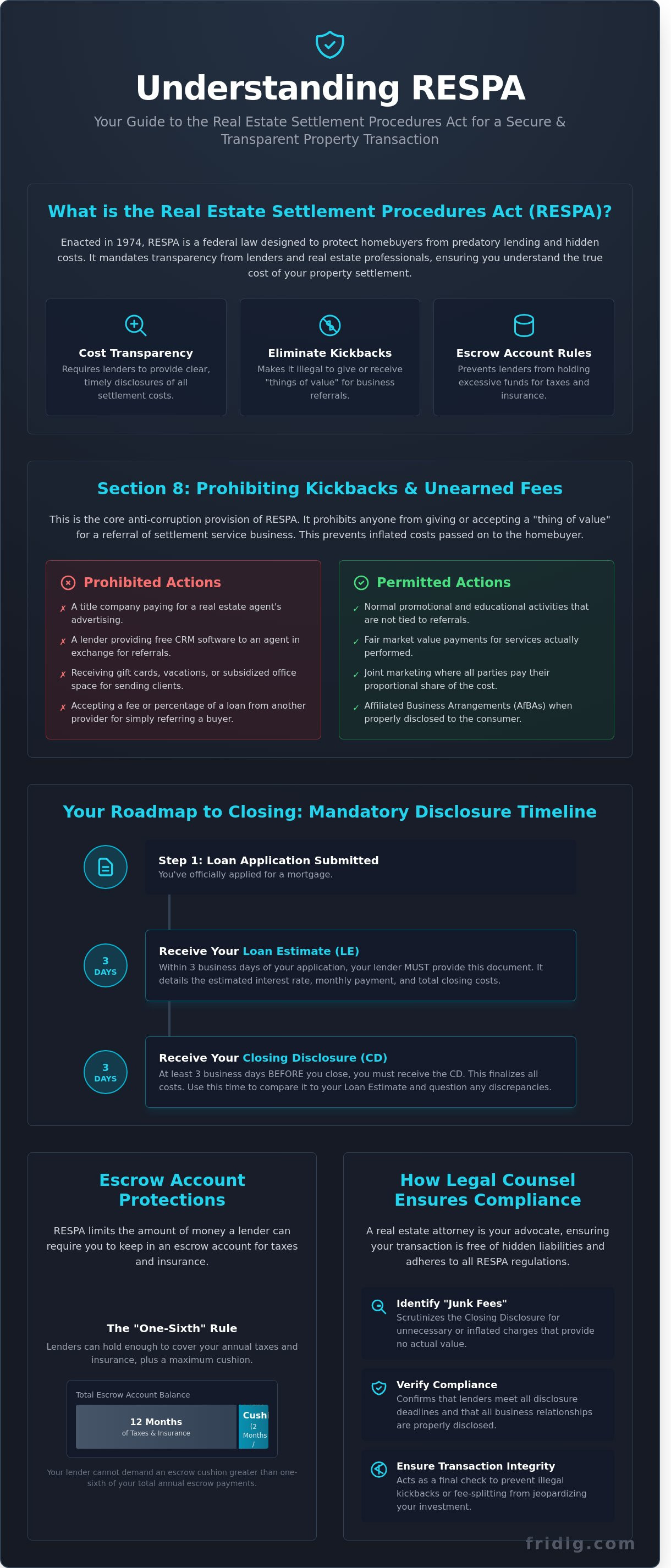
Regulation X implements RESPA's mandates by standardizing how lenders and settlement agents communicate with buyers throughout the closing timeline. The core objective focuses on the timely delivery of disclosures, such as the Loan Estimate and Closing Disclosure. Lenders must provide the Loan Estimate within three business days of receiving an application. These protocols prevent abusive practices like "kickbacks" for title insurance or inspections that artificially inflate costs. Section 8 of the act specifically prohibits anyone from giving or accepting a fee, kickback, or anything of value in exchange for referrals of settlement service business. Additionally, the regulation governs mortgage servicing, requiring lenders to manage escrow accounts with precision and respond to borrower inquiries within specific 30-day windows. This structured approach ensures that respa real estate requirements protect the homeowner's equity from the initial application through the final payment of the mortgage.
Section 8: Prohibiting Kickbacks and Unearned Fees
Section 8 remains the most scrutinized provision of the 1974 Real Estate Settlement Procedures Act. Its primary objective is the elimination of kickbacks and referral fees that unnecessarily increase the costs of settlement services. In the context of respa real estate compliance, any "thing of value" exchanged for a referral is strictly prohibited. This term encompasses more than just liquid currency; it includes gift cards, discounted services, subsidized office space, or even lead generation tools provided at no cost. When service providers engage in these opaque financial arrangements, the homebuyer often pays the price through inflated premiums or administrative fees that offer no actual utility.
Within the Chicago metropolitan area, the distinction between legitimate joint marketing and illegal inducements is often razor-thin. Regulatory bodies like the Consumer Financial Protection Bureau (CFPB) monitor these relationships with high precision. A valid marketing agreement requires that all parties pay a fair market value for the exposure they receive. If a title company pays 100% of the cost for a co-branded mailer that features a real estate agent, it constitutes a violation. The agent receives a financial benefit in exchange for potential client referrals, which compromises the neutrality of the transaction.
Common Examples of Section 8 Violations
Violations often manifest in subtle ways that homeowners might overlook during the high-pressure environment of a closing. For instance, a lender might provide a real estate agent with free access to high-end CRM software, a service that typically costs $200 to $500 per month. Other examples include title companies paying for an agent’s office supplies or sponsoring lavish client appreciation events. Unearned fees are another critical concern. This occurs when a professional charges for a service, such as a "document delivery fee," without actually performing any distinct work. Under Section 8, these practices can result in civil penalties of up to $11,000 per violation and even criminal prosecution.
Affiliated Business Arrangements (AfBA)
An Affiliated Business Arrangement exists when a person in a position to refer settlement business has either an affiliate relationship with or a direct ownership interest of at least 1% in a provider of settlement services. While these arrangements are legal, they require strict adherence to disclosure protocols. The referring party must provide an AfBA Disclosure Statement at the time the referral is made. This document informs the buyer of the relationship and provides an estimate of the charges by the affiliate. Most importantly, it clarifies that you aren't required to use the affiliated provider. Exercising your right to shop for services is a key component of strategic transactional support during a Northbrook closing. You should always compare rates to ensure the affiliate’s pricing is competitive with the broader market.
Mandatory Disclosures: The Roadmap to Your Closing Costs
Transparency in mortgage lending underwent a significant transformation on October 3, 2015, with the implementation of the TRID rule. Often called "Know Before You Owe," this regulation consolidated complex paperwork into two streamlined documents. It ensures that respa real estate requirements are met with precision; this protects Northbrook buyers from predatory lending practices. The efficacy of the TRID framework lies in its strict timeline, which prevents lenders from introducing surprise fees at the eleventh hour.
Step 1: The Loan Estimate (LE)
Lenders must provide the Loan Estimate within three business days of receiving your completed application. This three-page document details your projected interest rate, monthly payment, and total closing costs. It's not a mere suggestion. It's a binding commitment subject to specific tolerance levels. For instance, lender-controlled fees and transfer taxes have a zero-percent tolerance for increase. Other services, such as title insurance where the lender allows you to shop around, are capped at a 10% aggregate increase from the initial estimate provided in the LE.
Step 2: The Closing Disclosure (CD)
The Closing Disclosure serves as the final audit of your financial obligations. Under TRID mandates, you must receive this document at least 72 hours before you sign the final paperwork. This three-day window allows you to perform a line-by-line comparison against your initial Loan Estimate. You'll need to scrutinize three specific areas to ensure compliance with respa real estate standards:
- Origination Charges: These should remain identical to the LE unless a documented "change in circumstance" occurred, such as a shift in the loan program.
- Title Insurance: You must verify that the Northbrook-specific title fees align with current local market rates.
- Government Recording Fees: Ensure the Cook County recording charges reflect the current 2024 fee schedules exactly.
In Northbrook, the attorney review period is a critical safeguard for the homebuyer. While federal law mandates these disclosures, local legal counsel interprets them within the specific context of Illinois real estate law. Your attorney will verify that the lender hasn't exceeded the 10% tolerance threshold for third-party services. If discrepancies exist, your legal representative can demand a "cure" or a lender credit before the closing commences. This professional oversight transforms a standard transaction into a secure, legally sound investment. Precise verification of these figures is the only way to guarantee that the financial terms you accepted at the start of the process are the ones you sign at the end.
Escrow Accounts and Servicing Protections in Cook County
The regulatory framework established by RESPA ensures that lenders don't exploit the escrow process for their own liquidity. Under federal law, a lender is prohibited from requiring a homeowner to maintain an excessive balance in their escrow account. Specifically, the statute permits a maximum "cushion" equivalent to one-sixth of the total annual disbursements for property taxes and hazard insurance. This equates to approximately two months of escrow payments. In Northbrook, where property values and tax assessments are high, this 16.6% cap prevents the unnecessary stagnation of your capital.
Precision in escrow management is particularly critical because of Cook County’s unique tax cycle. Unlike other jurisdictions, Cook County issues tax bills in two installments. The first installment is consistently 55% of the previous year’s total tax, while the second installment varies based on new assessments and equalization factors. This fluctuating 55% baseline often triggers escrow volatility. Without strict adherence to respa real estate guidelines, homeowners might face sudden, significant increases in their monthly mortgage obligations due to miscalculated projections.
Managing Your Escrow Account
Lenders must provide an Initial Escrow Statement at the time of closing or within 45 days of the account’s creation. This document provides a line-item projection of all taxes and insurance premiums expected over the next 12 months. Every year thereafter, the servicer must conduct an Annual Escrow Analysis. If the analysis reveals a surplus of $50 or more, the servicer is legally required to refund that amount to the homeowner within 30 days. Shortages are typically resolved through a 12-month repayment plan, ensuring the account remains solvent without creating immediate financial distress for the borrower.
Mortgage Servicing Rights and Transfers
The secondary mortgage market frequently results in the transfer of servicing rights. To protect homeowners, the law requires a "Goodbye Letter" from the current servicer and a "Hello Letter" from the new servicer, both delivered at least 15 days before the transfer date. A critical 60-day grace period begins on the date of transfer. During this window, the new servicer can't charge late fees or report delinquencies if the homeowner mistakenly sends a payment to the previous servicer.
Homeowners also possess the right to challenge servicing errors through a Qualified Written Request (QWR). Upon receiving a QWR, the servicer must acknowledge the inquiry within 5 business days and provide a formal resolution or explanation within 30 business days. This mechanism provides a vital check against "force-placed" insurance or misapplied payments. If you suspect your servicer has violated these protocols, you should seek professional legal counsel to enforce your statutory rights.
Securing Your Transaction: How a Northbrook Attorney Ensures Compliance
The attorney review period in Illinois represents the most critical window for ensuring respa real estate compliance. During these five business days, your legal representative scrutinizes the contract and initial disclosures to identify irregularities that could jeopardize your financial position. While real estate agents facilitate the transaction, their role doesn't include the forensic legal analysis required to detect sophisticated RESPA violations. A Northbrook attorney acts as a procedural gatekeeper, ensuring that every service provider's involvement aligns with federal mandates.
The Value of Independent Legal Review
Lenders and real estate agencies often operate within interconnected networks. These relationships can sometimes lead to undisclosed Affiliated Business Arrangements (AfBA). Your attorney maintains a singular fiduciary duty to you, providing an objective lens through which to view the Closing Disclosure. O. Allan Fridman utilizes nearly 20 years of legal experience to verify that every line item represents a legitimate service rendered. We look for "junk fees" such as excessive administrative charges or duplicated courier costs that may violate Section 8 of RESPA. In a typical Northbrook transaction, these hidden costs can add $500 to $1,500 to your closing costs if left unchallenged. Our firm ensures that all AfBA disclosures aren't just present, but are executed with the transparency the law requires.
Final Steps to a Compliant Closing
The final stages of a home purchase involve high-pressure deadlines. Legal confidence during the final walkthrough and the review of the final settlement statement prevents permanent financial losses. If we identify a violation, we address it before the ink dries on the mortgage documents. Resolving a respa real estate issue after the closing is significantly more complex and costly than correcting it during the escrow period. Our local expertise provides a layer of protection that national lenders can't offer. We understand the specific nuances of Cook County property transfers and the regional standards for reasonable service fees. To ensure your investment is protected by rigorous legal oversight, schedule a consultation for your Northbrook real estate closing. Our strategic approach transforms a complex regulatory environment into a secure path toward homeownership.
Securing Your Northbrook Real Estate Investment
Navigating the intricate regulatory landscape of a Northbrook property transfer requires more than just basic awareness. You've seen how Section 8 prohibitions against unearned fees and the strict timeline for mandatory disclosures form the bedrock of consumer protection. In Cook County, the management of escrow accounts must adhere to precise federal standards to prevent costly servicing errors. These protections under respa real estate laws aren't merely suggestions; they're mandatory safeguards for your financial interests.
With nearly 20 years of legal experience across Cook and Lake Counties, our firm provides the strategic oversight necessary for complex residential transactions. We combine deep expertise in real estate law with a background in complex financial litigation to identify risks that others often overlook. Every closing deserves a personalized, results-driven approach that prioritizes precision over speed. You can secure your transaction by partnering with a firm that understands the intersection of local practice and federal compliance.
Ensure your closing is RESPA-compliant with a Northbrook real estate attorney. We're ready to provide the professional stability your investment requires.
Frequently Asked Questions
What is the primary purpose of RESPA in a real estate transaction?
The primary purpose of the Real Estate Settlement Procedures Act, commonly known as respa real estate regulation, is to ensure consumers receive timely disclosures regarding settlement costs. Enacted by Congress in 1974, this federal law mandates that lenders provide specific financial information at various stages of the mortgage process. It serves to eliminate illegal kickbacks and referral fees that historically inflated closing costs for Northbrook homeowners.
Does RESPA apply to commercial real estate closings in Illinois?
RESPA doesn't apply to commercial real estate transactions in Illinois. The statute exclusively governs federally related mortgage loans secured by residential properties designed for occupancy by one to four families. For commercial acquisitions or industrial developments in Cook County, the regulatory framework shifts to different state and federal guidelines that don't include the specific disclosure mandates of residential law.
What is considered a "kickback" under Section 8 of RESPA?
Under Section 8 of the act, a kickback is defined as any fee, gift, or "thing of value" provided in exchange for the referral of settlement service business. This includes cash payments, subsidized office space, or discounted marketing materials shared between real estate agents and title companies. Violators face severe penalties; these include fines up to $10,000 and potential imprisonment for one year per occurrence.
How many days before closing must I receive my Closing Disclosure?
You must receive your Closing Disclosure at least 3 business days before your scheduled closing date. This mandatory cooling-off period allows you to compare the final terms and costs with the initial Loan Estimate you received earlier. If significant changes occur to the interest rate or loan product, a new disclosure is required; this requirement may reset the 3-day waiting period.
Can a lender require me to use a specific title company in Northbrook?
A lender can't require you to use a specific title insurance company as a condition of the sale under Section 9 of the act. If you're paying for the title insurance, the choice of provider remains your legal right. Any seller or lender who violates this provision can be held liable for three times the cost of all title insurance charges incurred during the transaction.
What should I do if I suspect a RESPA violation in my closing documents?
If you suspect a respa real estate violation in your Northbrook closing documents, you should file a formal complaint with the Consumer Financial Protection Bureau (CFPB) within one year of the incident. You also have the right to bring a private lawsuit in federal court to recover damages. Consulting a qualified attorney is essential to review the Closing Disclosure for discrepancies that indicate illegal fee-splitting.
Are there limits on how much a lender can require for my escrow account?
Section 10 of the act limits the amount a lender can require for an escrow account to 1/12th of the total annual disbursements for taxes and insurance. Lenders may also maintain a "cushion" not exceeding 1/6th of the total disbursements, which equals approximately two months of payments. Any surplus over $50 must be returned to the homeowner within 30 days of the annual escrow analysis.
How does RESPA protect me if my mortgage servicer changes?
RESPA protects you during a servicer transfer by requiring a "goodbye letter" from your current servicer 15 days before the transfer date. Your new servicer must also send a "welcome letter" within 15 days after the transfer occurs. During the 60-day period following the transfer, you can't be charged a late fee if you accidentally send your payment to the previous servicer.

Article by
O. Allan Fridman
O. Allan Fridman has been practicing law since 2001. His practice is unique in that he does not view himself as a litigation attorney or transactional attorney. Rather, he views each area of law as a tool to pursue the best results for his clients. By practicing in both areas of law, he is able to take a 360-degree view of law. This enables the firm to catch potential drawbacks that are readily identifiable.
By practicing in litigation and transactional law and taking a holistic approach in dealing with our clients, he doesn’t put clients in box — rather, as we are all individuals, so too are the legal services we may require.
Whether it is bankruptcy or litigation or transactional, each client brings challenges and does not fit in any one box. Often times, bankruptcy clients end up not filing bankruptcy because we can achieve a better result through litigation or through an out-of-court resolution with the lender, or through a real estate sale. On the other end of the spectrum, a litigation client with multiple issues and lawsuit may fare better in a bankruptcy.
Since 2001, Allan has practiced in states and federal court, and he is a member of the trial bar of the Northern District of Illinois and admitted in the Northern District of Indiana.
We are a debt relief agency. We help people file for bankruptcy relief under the Bankruptcy Code
The materials on this site are for informational purposes only and do not constitute legal advice. Viewing this site or contacting us does not create an attorney–client relationship, and you should not act or refrain from acting based on any information here without seeking professional legal counsel.