

What if the next time your phone rings, you didn't feel a heavy pit in your stomach? If you're currently dealing with persistent debt collectors, you likely dread every notification and worry about the embarrassment of a call to your workplace. It's a stressful cycle, but you don't have to stay stuck in it. There are concrete, effective strategies for stopping creditor harassment calls legally in Illinois that can restore your peace of mind starting today. You have rights that many collectors hope you won't exercise, and understanding them is the first step toward taking back control of your financial life.
In this guide, you'll learn the exact legal steps and Illinois-specific protections available in 2026 to end the harassment for good. We'll explore how new regulations, such as the automatic $1,000 bank account exemption and the updated Coerced Debt Law, provide you with a much stronger shield than in years past. We'll also walk through a clear plan to handle your debt, from understanding the modern 15 year enforcement limit on consumer judgments to utilizing the Illinois Collection Agency Act. By the end of this article, you'll know exactly how to shift the power dynamic and secure the silence you deserve.
Key Takeaways
- Identify the specific federal and Illinois laws that prevent debt collectors from overstepping their bounds and using deceptive tactics.
- Learn how to use a cease and desist letter to gain immediate relief from the constant phone notifications and stress.
- Follow our updated guide for stopping creditor harassment calls legally in Illinois, featuring the latest 2026 consumer rights and exemptions.
- Understand how a bankruptcy filing triggers an "Automatic Stay," which acts as a legal shield to stop all creditor contact at once.
- See why having a professional advocate in Northbrook makes the difference when you're looking for a strategy that fits your specific situation.
Understanding Your Rights When Creditors Won’t Stop Calling
It is difficult to focus on your daily life when your phone is constantly buzzing with another collection call. If you feel a wave of anxiety every time an unknown number appears, please know that your reaction is completely normal and valid. Being in debt is a financial situation, not a character flaw, and it's okay to feel overwhelmed when the pressure mounts. However, it's vital to remember that owing money does not mean you lose your right to privacy or your right to be treated with basic dignity. You're still protected by a robust framework of laws designed to prevent abuse.
Many people believe they have to endure the calls because they owe the money, but that's a misconception that collectors often exploit. There are clear, enforceable strategies for stopping creditor harassment calls legally in Illinois. These protections come from both state-level regulations and federal mandates like the Fair Debt Collection Practices Act (FDCPA). These laws are on your side, and they provide specific tools to help you reclaim your peace of mind while you work on a long-term financial plan.
What Legally Qualifies as Harassment in Illinois?
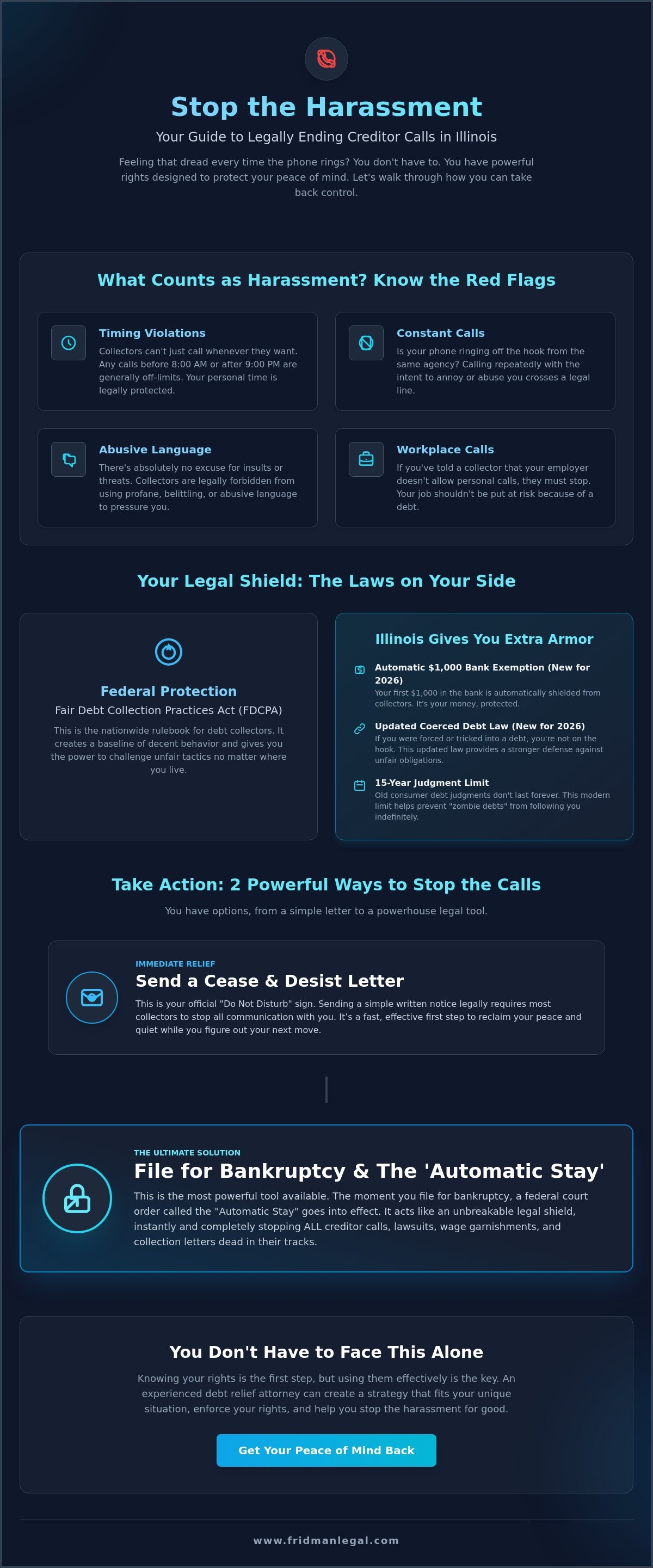
Harassment isn't just a feeling; it's a legal boundary that collectors often cross. In Illinois, specific behaviors are strictly prohibited. For instance, collectors cannot call you repeatedly with the intent to annoy or abuse you. If your phone is ringing ten times a day from the same agency, that likely crosses the line. Other red flags include:
- Abusive Language: Collectors are never allowed to use profane, insulting, or belittling language to pressure you into a payment.
- Timing: Calls made at unusual times, specifically before 8:00 AM or after 9:00 PM, are generally considered a violation of your rights.
- Workplace Calls: If you've informed a collector that your employer prohibits personal calls, they must stop contacting you at your place of business immediately.
Why Collectors Use These High-Pressure Tactics
It's helpful to understand that debt collection is a business built on psychological pressure. Most collectors rely on the fact that the average person doesn't know the specifics of stopping creditor harassment calls legally in Illinois. They use a fear factor to create a sense of panic, hoping you'll prioritize their payment over your rent or groceries. They might imply that a lawsuit is imminent or that your wages will be garnished tomorrow, even when they haven't started the legal process. When you recognize these tactics as a strategy rather than a certainty, you can start to change the conversation and stand your ground with confidence.
The Laws That Protect Illinois Residents from Harassment
When you're dealing with aggressive collectors, it's helpful to view the law as a set of rules that creditors must follow, rather than just a list of things you can't do. In Illinois, you aren't just relying on one single law; you have a multi layered shield of federal and state protections. These rules exist to ensure that even if a debt is valid, the process of collecting it remains civil and transparent. If a collector steps out of line, they aren't just being rude; they are potentially breaking the law, which gives you significant leverage in stopping creditor harassment calls legally in Illinois.
The foundation of your protection is the Fair Debt Collection Practices Act (FDCPA). This federal law is essentially a code of conduct for anyone trying to collect a debt on behalf of someone else. It's quite specific about what they can and cannot do. For a more detailed look at your rights on a national level, you can explore the CFPB's consumer guide to debt collection. In addition to federal rules, the Illinois Consumer Fraud and Deceptive Business Practices Act offers another level of defense by prohibiting unfair or misleading tactics in the marketplace. The Illinois Attorney General’s office also plays a vital role here, as they actively monitor collection agencies to ensure they comply with state standards.
Federal vs. State Protections: What You Need to Know
Federal law sets the baseline for your protection, ensuring a minimum standard of behavior across the country. However, Illinois often goes a step further. For example, as of January 1, 2026, Illinois law now recognizes "coerced debt," allowing residents to halt collection activities if a debt was incurred through fraud or duress. The FDCPA serves as your primary defense against third-party bullying. State laws like the Illinois Collection Agency Act, which was recently updated and preserved for 2026, ensure that agencies operating within our borders are licensed and held accountable to local standards.
Who Is Subject to These Rules?
It's important to distinguish between "debt buyers" or collection agencies and "original creditors" like your local bank or credit card issuer. The FDCPA primarily targets third-party collectors. Original creditors are generally governed by different, yet equally strict, state and federal banking regulations. One of the most effective ways to change the dynamic is by securing professional legal guidance. Once you hire an attorney, the law dictates that collectors must stop calling you directly and instead communicate only with your legal representative. In the busy courtrooms of Cook County, local judges are very familiar with these boundaries and expect collectors to respect them without exception.
Practical Steps to Handle Collection Calls Today
When your phone rings and a collector is on the other end, it's easy to feel like you're on the defensive. However, you have the right to control that dialogue from the very first second. You don't need to be an expert in the law to protect yourself, you just need a plan. The most important rule is to keep the conversation extremely short. You aren't required to explain your financial situation, and you certainly don't have to tolerate a collector's aggressive tone. By following a few specific steps, you can begin stopping creditor harassment calls legally in Illinois without escalating the stress of the situation.
If you decide to answer, use a simple script. You might say: "I am exercising my right to request that you stop calling me at this number. Please send all future correspondence regarding this matter in writing to my home address." Once you've said this, hang up. There is no need to wait for a response or a rebuttal. During these calls, never provide personal information like your Social Security number or your workplace details, and never admit that you owe the debt. Admitting to a debt or promising a small payment can sometimes restart the clock on the statute of limitations, which is currently five years for credit card debt in Illinois.
You should also start a harassment log immediately. Use a simple notebook to record the date, the exact time of the call, the number displayed on your caller ID, and the name of the agent. If the caller was rude, used profane language, or threatened you with immediate arrest, write those details down exactly as they happened. This log serves as vital evidence if you later need to demonstrate a pattern of illegal behavior in court.
The Power of the Written Request
While a verbal request is a good start, a written Cease and Desist letter is far more effective for stopping creditor harassment calls legally in Illinois. You should send this letter via Certified Mail with a "Return Receipt Requested." The small green card you receive back is your proof that the agency received your demand. Once they have this notice, they are generally prohibited from calling you again, except to confirm they are stopping contact or to notify you of a specific legal action, such as a lawsuit.
Handling Calls at the Workplace
Collectors often call your place of employment because they know it creates a sense of urgency and embarrassment. You can stop this immediately by telling the collector that your employer prohibits you from receiving personal calls at work. Under federal law, once a collector is aware of this policy, they must stop calling your office. Document the date and time you gave this notice. If the calls continue, they are in direct violation of consumer protection rules, and your documentation will be essential for holding them accountable.
The Ultimate Solution: How Bankruptcy Stops Harassment Cold
While scripts and letters are effective starting points, they can feel like a temporary fix against a persistent agency. If you want a definitive, permanent end to the pressure, the legal system provides a much more powerful option. Filing for Chapter 7 bankruptcy triggers a federal court order known as the Automatic Stay. This isn't just a request for silence; it's a legal injunction that instantly halts all collection activities. It provides an immediate breathing room that other methods simply can't match.
The Automatic Stay is the most definitive method for stopping creditor harassment calls legally in Illinois because it carries the weight of a federal court order. From the moment your case is filed, creditors are strictly barred from calling you, sending demand letters, or pursuing lawsuits. This protection even extends to active wage garnishments and foreclosure proceedings. It's helpful to view this process as a strategic financial tool designed to provide a fresh start rather than a personal failure. In 2026, many residents in the Chicago area use this path to reset their financial trajectory and protect their future earnings.
How the Automatic Stay Works in Illinois Courts
The mechanics of the stay are straightforward but incredibly effective for your protection. Once your petition is filed, the bankruptcy court issues a notice to every creditor listed in your filing. If a collector ignores this notice and continues their attempts at contact, they are in direct violation of a federal court order. Collectors who knowingly violate the stay can face severe penalties, including fines and the requirement to pay your legal fees. For a deeper look at how this process unfolds locally, you can consult our Chapter 7 Guide.
Chapter 7 vs. Chapter 13: Which Ends the Noise Faster?
If you're looking for immediate silence, both filing options are equally effective. Both paths are highly reliable for stopping creditor harassment calls legally in Illinois right away. Chapter 7 is often preferred for its speed in wiping away unsecured debts like credit cards and medical bills, usually within a few months. Chapter 13 allows you to reorganize debt over a three to five year period, which is often better for those looking to save a home from foreclosure. You can read more about these differences in our Chapter 13 vs Chapter 7 comparison.
If you're ready to put a permanent end to the phone calls and garnishments, contact our office to discuss which legal shield is right for your specific situation.
Why Partnering with a Northbrook Debt Relief Attorney Matters
Facing a mountain of debt often feels isolating, but you don't have to carry that weight by yourself. While the legal steps we've discussed are powerful, applying them correctly requires a level of precision that can be difficult to manage when you're already stressed. This is where the value of a professional advocate becomes clear. O. Allan Fridman provides a personalized, human touch to what often feels like a cold and clinical process. Having a dedicated partner means you aren't just another case number; you're a person who deserves a clear path back to financial stability.
One of the most immediate benefits of legal representation is the shift in communication. There is a profound sense of peace that comes from finally being able to tell a persistent collector, "Talk to my lawyer." Once you have formal representation, federal law dictates that creditors must stop contacting you and direct all inquiries to our office. This effectively ends the daily barrage of phone calls and letters. By choosing a local Northbrook office for face-to-face support, you gain the advantage of a strategist who is accessible and deeply invested in stopping creditor harassment calls legally in Illinois for your specific household.
From Harassment to a Fresh Start
Fridman Legal handles the heavy lifting of creditor communication so you can focus on your life and your family. We prioritize a long term strategic plan over the "quick fix" debt settlement schemes that often leave consumers in a worse position later on. Our goal is to provide a comprehensive solution that addresses the root of the problem. We encourage you to reach out for a conversation to explore your options in a low pressure environment where your interests always come first.
Navigating Cook County Debt Collection Rules
The local court systems in Chicago and the surrounding suburbs have their own unique dynamics and procedural nuances. An attorney who regularly navigates the courtrooms of Cook County understands how local judges view collector behavior and what evidence they require to dismiss a claim. This local expertise is invaluable when resolving complex debt settlement issues or challenging a collector's standing to sue. Knowing the local landscape ensures that your defense is built on a solid foundation. You can rest assured that the calls will stop, the pressure will fade, and your life will eventually return to a state of normalcy.
Take the Final Step Toward a Quieter Future
The constant buzz of your phone doesn't have to be the soundtrack of your life. By now, you've seen that Illinois laws and federal protections like the FDCPA are designed to keep collectors in check. Whether you choose to use a cease and desist letter or decide that a bankruptcy filing is the right strategic move to trigger an Automatic Stay, you have real options for stopping creditor harassment calls legally in Illinois. You don't have to guess which step to take next or navigate the complexities of the Cook County court system on your own.
With nearly 20 years of local legal experience, O. Allan Fridman offers the personalized guidance you need to handle these challenges with confidence. We focus on providing human-centric support that prioritizes your long term stability over temporary fixes. It's time to put an end to the anxiety and start working toward a fresh start. Talk to O. Allan Fridman today and make the calls stop for good. You've already taken the first step by learning about your rights; now, let's make that silence permanent.
Common Questions About Debt Collection in Illinois
Can a debt collector call me at work in Illinois?
Yes, they can call you at work, but they must stop the moment you inform them that your employer doesn't allow such calls. It's helpful to document the date and time you gave this notice over the phone. If they continue after that, they're violating federal law. This is a simple but effective way of stopping creditor harassment calls legally in Illinois within a professional setting.
What is the "Automatic Stay" and how does it stop calls?
The Automatic Stay is a powerful federal injunction that starts the second your bankruptcy case is filed. It acts as a legal shield that forbids creditors from pursuing any collection efforts. This includes everything from annoying phone calls and letters to more serious actions like wage garnishments or foreclosure sales. It provides the immediate breathing room you need to organize your finances without outside pressure.
Is it illegal for a creditor to call my family or friends?
Debt collectors are strictly limited in how they can contact your friends or family. They can only reach out to these third parties once to confirm your address or phone number. They are legally prohibited from revealing that you owe a debt or calling them repeatedly. If a collector is contacting your relatives to pressure or embarrass you, they're likely violating consumer protection laws and your right to privacy.
Do I have to pay a debt collector if the debt is very old?
You generally don't have a legal obligation to pay if the statute of limitations has expired. In Illinois, the limit is five years for credit card debt and ten years for written contracts. However, you should be extremely cautious. Making a partial payment or even promising to pay an old debt can restart the entire timeline, giving the collector a brand new window to take legal action against you.
How do I legally tell a creditor to stop calling me?
The most effective way is to send a written cease and desist letter through certified mail. While you can tell them to stop during a call, a letter with a return receipt provides undeniable proof that they received your request. After they get the notice, they can only contact you to say they're stopping contact or to inform you of a specific legal action like a lawsuit.
Can I sue a debt collector for harassment in Illinois?
You certainly can pursue legal action if a collector's behavior violates the Fair Debt Collection Practices Act. If you have evidence of threats, profane language, or calls at prohibited hours, you may be able to recover statutory damages. This is why keeping a harassment log with dates and times is so important. It turns your experience into concrete evidence that a judge can review in court.
Will filing for bankruptcy stop all my creditor calls immediately?
Yes, the relief is immediate. The moment your bankruptcy petition is electronically filed with the court, the Automatic Stay goes into effect. This is a federal order that stops all collection activity in its tracks. It's often the quickest way of stopping creditor harassment calls legally in Illinois because it doesn't rely on the collector's cooperation; it's a mandatory requirement they must follow under threat of court sanctions.
What happens if a creditor keeps calling after I file for bankruptcy?
You should provide the caller with your bankruptcy case number and your attorney's contact information. If they continue to call after being notified, they are in willful violation of a federal court order. You should report these calls to your lawyer immediately so they can take action. The court has the power to sanction these creditors and may even require them to pay you for the violation.

Article by
O. Allan Fridman
O. Allan Fridman has been practicing law since 2001. His practice is unique in that he does not view himself as a litigation attorney or transactional attorney. Rather, he views each area of law as a tool to pursue the best results for his clients. By practicing in both areas of law, he is able to take a 360-degree view of law. This enables the firm to catch potential drawbacks that are readily identifiable.
By practicing in litigation and transactional law and taking a holistic approach in dealing with our clients, he doesn’t put clients in box — rather, as we are all individuals, so too are the legal services we may require.
Whether it is bankruptcy or litigation or transactional, each client brings challenges and does not fit in any one box. Often times, bankruptcy clients end up not filing bankruptcy because we can achieve a better result through litigation or through an out-of-court resolution with the lender, or through a real estate sale. On the other end of the spectrum, a litigation client with multiple issues and lawsuit may fare better in a bankruptcy.
Since 2001, Allan has practiced in states and federal court, and he is a member of the trial bar of the Northern District of Illinois and admitted in the Northern District of Indiana.
We are a debt relief agency. We help people file for bankruptcy relief under the Bankruptcy Code
The materials on this site are for informational purposes only and do not constitute legal advice. Viewing this site or contacting us does not create an attorney–client relationship, and you should not act or refrain from acting based on any information here without seeking professional legal counsel.


