

In the Illinois construction industry, a handshake doesn't mean much once the 90-day clock starts ticking on your right to get paid. Waiting for a prime contractor to process your invoice while your own bills pile up isn't just frustrating; it's a direct threat to your business. If you're struggling with getting paid as a subcontractor in Illinois, you aren't just at the mercy of someone else's schedule. You have powerful statutory tools like the Mechanics Lien Act and the Prompt Payment Act specifically designed to ensure you receive the compensation you've earned.
It's a common concern that the legal process is too complex or that filing a notice might damage a professional relationship, but securing your cash flow is a matter of professional integrity. This guide explains exactly how to use these laws to your advantage. You'll learn how to manage the strict 90-day notice requirement and how to claim the interest you're legally owed, which can reach 10% annually on private projects or 2% per month on public works. We'll provide the clarity you need to protect your bottom line and help you decide when a Cook County construction attorney should step in to handle the heavy lifting of litigation.
Key Takeaways
- Understand the difference between "Pay-if-Paid" and "Pay-when-Paid" clauses so you aren't caught off guard by contract language that delays your check.
- Act quickly to meet the strict 90-day notice deadline required by the Illinois Mechanics Lien Act to secure your right to payment against the property itself.
- Use the Prompt Payment Act to claim the statutory interest you're owed, which can be as high as 2% per month depending on the type of project.
- Follow a proactive workflow for getting paid as a subcontractor in Illinois that keeps your records clean and your legal standing strong when disputes arise.
- Leverage the expertise of a local construction attorney to handle high-stakes litigation and demand letters when standard collection efforts fail.
The Payment Reality for Illinois Subcontractors in 2026
In the world of Illinois construction, the distance between finishing a job and actually seeing the funds in your account can feel like an eternity. The reality of getting paid as a subcontractor in Illinois often involves navigating a complex chain where cash flow can be throttled at any level. While you're focusing on the quality of your trade, the prime contractor or the owner might be focused on their own bottom line, leading to delays that put your business at risk. Understanding your position in this hierarchy isn't just about business; it's about survival in a competitive market.
Illinois law provides several safety nets, but they aren't automatic. You have to be proactive. Whether you're working on a high-rise in Chicago or a residential development in Northbrook, the rules for securing your money are strict. The most significant hurdle isn't usually a lack of funds at the top of the chain, but rather the administrative and legal games played in the middle. If you don't know the difference between a contract clause and a statutory right, you're essentially working on credit without a guarantee.
The Hierarchy of Construction Payment
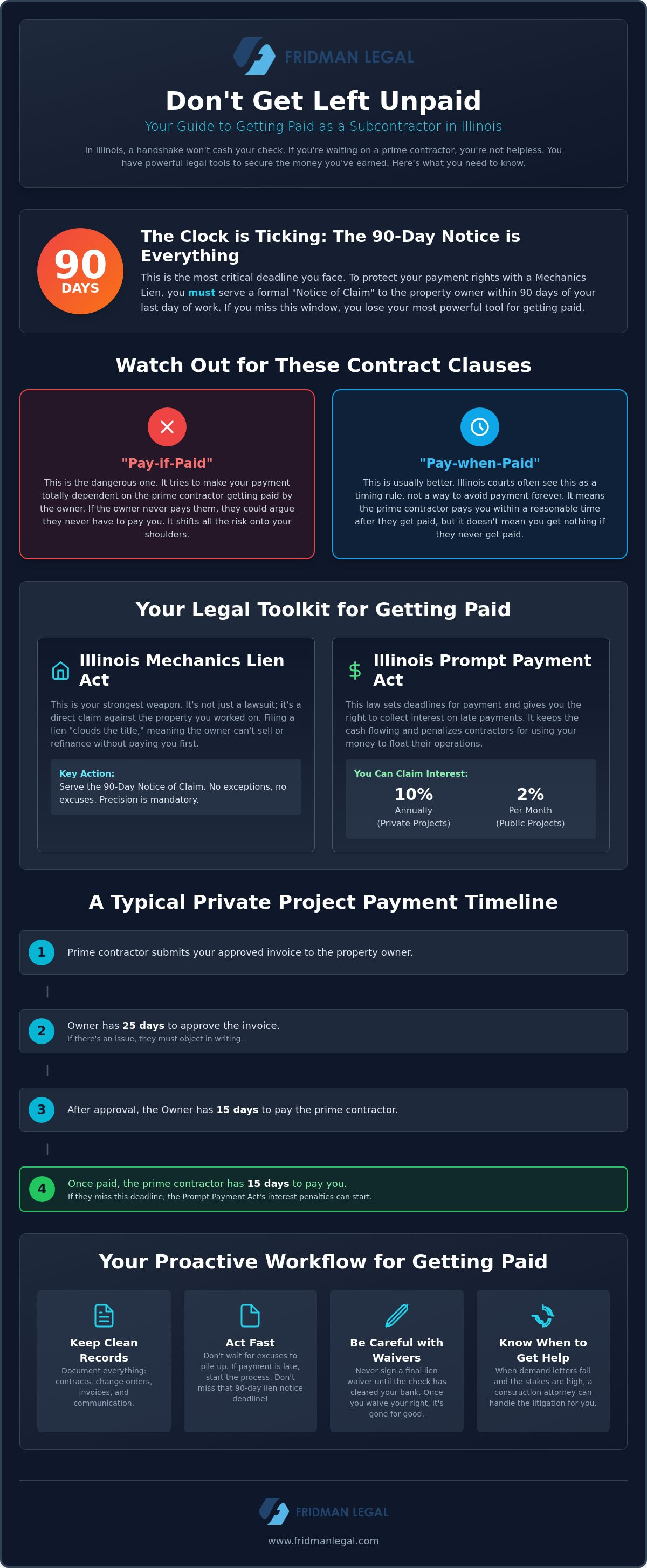
Owners hold the purse strings, but prime contractors manage the flow. Problems usually start when the prime contractor uses your funds to float another project or cover their own overhead. It's vital to recognize how your contract language impacts your leverage. "Pay-if-paid" clauses are particularly dangerous because they attempt to shift the risk of owner non-payment entirely onto you. In contrast, "pay-when-paid" clauses are generally viewed by Illinois courts as timing mechanisms rather than absolute bars to recovery. One of the biggest traps in Cook County is the premature signing of lien waivers. You should never sign a final waiver until the check has actually cleared your bank. Once you waive that right, you lose the protection of the Mechanics Lien Act, which is your most effective tool for forcing a payment.
Common Excuses for Non-Payment
You've likely heard them all. "The owner hasn't released the funds yet" is the most common stalling tactic. However, under the Prompt Payment Act, private owners generally have 25 days to approve an invoice and another 15 days to pay the prime contractor. Once that prime contractor is paid, they have a 15-day window to pay you. If they miss these deadlines, they may owe you 10% annual interest on private jobs or up to 2% monthly interest on public projects. Another tactic is the "defective work" claim, where a minor punch-list item is used to justify withholding a massive payment. When these excuses become a pattern, it's no longer a simple misunderstanding. It's a dispute that requires civil litigation representation to resolve. Waiting too long to act is the number one mistake subcontractors make. If you miss the 90-day notice deadline for a lien, you're trading a secured legal right for a hopeful phone call.
Leveraging the Illinois Mechanics Lien Act
If you're struggling with getting paid as a subcontractor in Illinois, the most potent weapon in your arsenal is the Illinois Mechanics Lien Act. This statute doesn't just give you a right to sue for breach of contract; it gives you a direct claim against the real estate you improved. By filing a lien, you effectively "cloud the title" of the property. This means the owner cannot sell, refinance, or sometimes even draw further construction loans without addressing your debt first. It's a high-leverage move that forces the owner to take notice, even if the prime contractor has been ignoring your calls.
However, this power comes with a cost: absolute precision. Illinois courts view mechanics liens as a "statutory derogation of common law," which is a fancy way of saying they'll look for any technical excuse to throw your claim out. You don't have the luxury of being "close enough" with your deadlines or your paperwork. You have to follow the rules to the letter to ensure your claim is perfected.
The 90-Day Subcontractor Notice Requirement
The first and most critical hurdle is the 90-day notice. You must serve a formal "Notice of Claim" to the property owner and any lending institution within 90 days of your last day of work on the project. This notice has to include specific details: the amount you're owed, a description of the work you provided, and a clear identification of the property. In 2026, the standard for service remains strict. You should always use certified mail with a return receipt requested. This provides a paper trail that no one can dispute in court. If you miss this 90-day window, you've likely lost your lien rights forever, even if the work you did was flawless.
Filing and Recording the Lien in Cook County
Sending the notice is only the beginning. To fully protect your interests against everyone, including future buyers or other creditors, you must record your lien with the Cook County Recorder of Deeds within four months of your last day of work. This is what's known as "perfecting" the lien. While the 90-day notice alerts the owner, the four-month recording deadline alerts the world. A lien is a claim against the property itself, not just the contractor. If you find yourself tangled in the paperwork, seeking professional construction law services is a smart way to ensure your filing is bulletproof. Once recorded, you generally have two years from your last day of work to file a lawsuit to "foreclose" on that lien and force a sale of the property to pay your debt.
Mechanics Liens vs. The Illinois Prompt Payment Act
While a mechanics lien is a heavy hammer, it isn't the only tool available for getting paid as a subcontractor in Illinois. In many cases, the threat of a lien is enough to start a conversation, but the Illinois Contractor Prompt Payment Act provides a different kind of leverage focusing on cash and interest rather than property title. Where a lien secures your debt against the land, the Prompt Payment Act creates a statutory obligation for the contractor to move money quickly once they've received it from the owner. It's about maintaining the velocity of capital in a project.
The beauty of these two laws is that you don't have to choose just one. You can file a lien to protect your interest in the property and simultaneously pursue a claim under the Prompt Payment Act to recover the funds and accrued interest. Perhaps the most significant advantage of the Prompt Payment Act is that it allows for the recovery of reasonable attorney fees if you're forced to litigate. This levels the playing field, ensuring that a large prime contractor can't simply outspend you in court to avoid a legitimate debt.
Understanding the Prompt Payment Act
The core of this law is the 15-day rule. On private projects, once a prime contractor receives payment from the owner, they have exactly 15 days to pay you. If they fail to meet this deadline, the clock starts ticking on interest penalties. For private projects, that rate is a fixed 10% per year. On public works projects, the penalties are even steeper for subcontractors. While a prime contractor might only see 1% interest, subcontractors and lower tiers are entitled to 2% per month on late payments. Sending a formal demand letter that explicitly references these statutory penalties often resolves "slow pay" issues without ever stepping into a courtroom.
Choosing the Right Strategy for Your Situation
Deciding which path to take depends on the specifics of your dispute. A lien strategy is often best for high-value projects where the owner is solvent and you want to ensure your claim is secured against the asset. However, if you've missed that strict 90-day notice window we discussed earlier, the Prompt Payment Act remains a viable path to collect what's owed. For smaller disputes where the cost of a full foreclosure suit might be prohibitive, the threat of 10% interest and paying your legal fees is often enough to make a contractor find the money. If you're unsure which path fits your current project, a Fridman Legal Construction Law Services strategy consultation can help you map out the most efficient way to secure your revenue.
What to Do When the Check Does Not Arrive
When an invoice passes its due date, your focus must shift immediately from project management to asset protection. The process of getting paid as a subcontractor in Illinois is a race against a very short clock. Your first priority is maintaining "clean hands." In the eyes of an Illinois judge, this means you've fulfilled every minute detail of your contract. If your documentation is messy, the prime contractor will likely use those gaps to justify withholding your funds. You need a robust archive of daily logs, progress photos with metadata, and every single email exchange regarding the scope of work.
Documentation isn't just about proving you did the work; it's about neutralizing excuses. If a contractor claims your work was defective to stall a payment, your dated photos and signed inspection reports become your primary evidence. You're building a case for Civil Litigation Representation long before you ever step into a courtroom. Being proactive now saves thousands in legal fees later by making your claim indisputable from the start.
Step 1: The Soft Approach and Documentation
Start with a formal "Past Due" notice. It should be firm, professional, and devoid of emotional language. This letter serves as a marker in your timeline. While you wait for a response, gather all signed change orders and delivery receipts. In the Illinois construction market, a verbal agreement for extra work is a significant risk. If you performed work outside the original contract without a signature, try to get a written acknowledgement via email immediately. A paper trail that proves you fulfilled your end of the bargain is the only way to ensure the law remains on your side.
Step 2: The Formal Notice of Intent
If the soft approach doesn't produce a check within a few days, you must move to the 90-day notice required by the Mechanics Lien Act. This is a technical document that identifies the parties, the property, and the exact balance due. You must serve this notice to the owner and their lending institution via certified mail with a return receipt requested. Proper service is the cornerstone of a valid Illinois lien. If you fail to serve the correct parties or use the wrong mailing method, your lien rights can be extinguished entirely, regardless of how much money you're owed.
Step 3: Escalating to Civil Litigation
There comes a point where letters and notices no longer suffice. When the 90-day window is closing or the contractor is ghosting your inquiries, it's time to involve a civil litigation lawyer. This escalation involves filing a formal lawsuit for breach of contract or a lien foreclosure action. A foreclosure action is a powerful move where you ask the court to sell the property to pay your debt. Additionally, under the Prompt Payment Act, you may have the right to suspend work on private projects after giving a 7-day written notice. Stopping work is a high-stakes decision that should only be made after a professional review of your contract to avoid a "wrongful abandonment" claim. If your cash flow is under pressure, you can consult with Fridman Legal to determine the most effective path toward recovery.
How Fridman Legal Resolves Subcontractor Disputes
Getting paid as a subcontractor in Illinois shouldn't feel like a gamble. When your own collection efforts stall, the conversation needs to change from a request to a demand. At Fridman Legal, we don't just send more invoices. We apply targeted legal pressure that forces prime contractors and owners to prioritize your debt. Our approach in Northbrook and throughout the Chicago suburbs is built on nearly twenty years of civil litigation experience. We understand the specific nuances of Cook County courts, where a single filing error can derail a legitimate claim. We're here to ensure that doesn't happen to you.
Having an attorney draft your demand letter does more than just outline the debt. It signals to the other party that the time for excuses has passed. We explicitly reference the statutory penalties they face, such as the 10% annual interest on private projects or the potential for them to pay your legal fees under the Prompt Payment Act. This often leads to a settlement before a lawsuit is even filed because the cost of fighting a perfected lien is simply too high. We aim to resolve these disputes efficiently so you can focus on your next project rather than chasing old money.
A Strategic Partner for Northbrook Businesses
O. Allan Fridman provides the high-level strategy required to navigate complex construction disputes without exhausting your company's resources. We don't believe in litigation for the sake of litigation; we focus on the most direct path to recovering your funds. By acting as your strategic partner, we ensure your legal rights are protected while you maintain your operational focus. Our goal is to provide results-driven solutions that stabilize your cash flow. If you're facing a non-payment issue right now, you can Contact Fridman Legal to begin a professional review of your case.
Taking the Next Step Toward Recovery
When you come in for a consultation, bring your signed contracts, any change orders, and proof of the 90-day notice if you've already sent it. We'll look at the timeline of your work and the specific language of your agreement to determine the strongest path forward. Whether it's perfecting a lien or filing a breach of contract suit, we handle the heavy lifting of the legal process. We'll evaluate the strength of your claim and help you decide if pursuing interest and fees is the right move for your business. Don't let the 90-day clock run out on your hard-earned money. The sooner we review your documentation, the better we can secure your position in the payment chain.
Secure Your Revenue and Protect Your Business
Securing your cash flow isn't just a matter of persistence; it's a matter of legal precision. As we've discussed, getting paid as a subcontractor in Illinois depends on your ability to hit strict statutory deadlines, particularly the 90-day notice requirement. Whether you're relying on the security of a mechanics lien or the interest penalties provided by the Prompt Payment Act, these tools only work if you use them correctly and quickly. Waiting for a contractor to "do the right thing" often leads to lost leverage and unpaid invoices.
Fridman Legal brings nearly twenty years of experience to Cook County construction law disputes, providing the personalized, results-driven representation needed to force a resolution. We understand that your business can't afford to have capital tied up in old projects. By taking the heavy lifting of litigation off your plate, we allow you to focus on your next contract while we work to recover every dollar you're owed. Don't let your hard-earned fees vanish because of a missed deadline.
Schedule a consultation with Fridman Legal to recover your unpaid subcontractor fees. Your work has value, and the law is there to ensure that value is realized.
Frequently Asked Questions
How long does a subcontractor have to file a lien in Illinois?
You have exactly four months from your last day of work to record a lien that is effective against all parties, including subsequent buyers. However, you must first serve a formal 90-day notice to the owner and their lender. Missing these specific deadlines is the most common reason for losing your claim. It's always best to start the process as soon as a payment becomes overdue to avoid a last-minute rush.
Can I file a lien if I don't have a written contract?
Yes, Illinois law recognizes oral contracts as a valid basis for a mechanics lien. While a written agreement is much easier to prove in court, you can still secure your rights by providing evidence of the work you performed and the price that was agreed upon. Getting paid as a subcontractor in Illinois often involves using invoices, site logs, and emails to prove the value you added to the property.
What is the 90-day notice for subcontractors in Illinois?
The 90-day notice is a formal document you must serve to the property owner and their lending institution within 90 days of your last day on the job. This notice alerts the owner that you haven't been paid and that you intend to hold the property as security for the debt. Without this specific step, your lien rights against the owner's property are typically void under the law.
Does a mechanics lien expire in Illinois?
Yes, a mechanics lien is not a permanent fixture and will eventually expire if you don't act. You must file a lawsuit to foreclose on the lien within two years of your last day of work. If you don't take this legal action within that window, the lien becomes unenforceable and will no longer cloud the property's title. It's a "use it or lose it" scenario for your security interest.
Can I sue for attorney fees in a construction payment dispute?
You can often recover attorney fees if you prevail in a claim under the Illinois Prompt Payment Act. Additionally, many construction contracts include clauses that award fees to the prevailing party in a dispute. This is a crucial tool for subcontractors. It prevents general contractors from using the high cost of litigation as a way to force you into an unfair or low settlement.
What happens if a general contractor files for bankruptcy?
If a general contractor files for bankruptcy, your direct claim against them is usually paused by an automatic stay from the court. However, your mechanics lien is a claim against the property owner and the real estate itself, not just the contractor. This means you may still be able to recover your funds from the owner or the property's value despite the contractor's personal financial collapse.
Can I stop working if I haven’t been paid?
You generally have the right to suspend work on private projects if you haven't been paid according to the Prompt Payment Act. Getting paid as a subcontractor in Illinois is protected by your right to provide a 7-day written notice before walking off the site. This is a high-stakes move, so you should ensure your contract doesn't contain specific clauses that would put you in breach for stopping work.
Does a lien guarantee that I will get paid?
A lien provides powerful security, but it doesn't guarantee an immediate check in every situation. If the property has little equity or if there are many prior liens, like a large mortgage, your recovery might be limited. However, a lien is usually enough to stop a property sale or refinance. This forces the owner to resolve the debt so they can clear their title and move forward.

Article by
O. Allan Fridman
O. Allan Fridman has been practicing law since 2001. His practice is unique in that he does not view himself as a litigation attorney or transactional attorney. Rather, he views each area of law as a tool to pursue the best results for his clients. By practicing in both areas of law, he is able to take a 360-degree view of law. This enables the firm to catch potential drawbacks that are readily identifiable.
By practicing in litigation and transactional law and taking a holistic approach in dealing with our clients, he doesn’t put clients in box — rather, as we are all individuals, so too are the legal services we may require.
Whether it is bankruptcy or litigation or transactional, each client brings challenges and does not fit in any one box. Often times, bankruptcy clients end up not filing bankruptcy because we can achieve a better result through litigation or through an out-of-court resolution with the lender, or through a real estate sale. On the other end of the spectrum, a litigation client with multiple issues and lawsuit may fare better in a bankruptcy.
Since 2001, Allan has practiced in states and federal court, and he is a member of the trial bar of the Northern District of Illinois and admitted in the Northern District of Indiana.
We are a debt relief agency. We help people file for bankruptcy relief under the Bankruptcy Code
The materials on this site are for informational purposes only and do not constitute legal advice. Viewing this site or contacting us does not create an attorney–client relationship, and you should not act or refrain from acting based on any information here without seeking professional legal counsel.