

What if the number you see on a generic chapter 13 payment plan calculator Illinois isn't actually what you'll end up paying each month? It's completely normal to feel a sense of dread when you look at mounting bills or worry that a court-ordered budget will be too restrictive. The math behind bankruptcy often feels like a complex puzzle; it's especially stressful when your family's home is on the line and you simply want the collections to stop.
You deserve to know exactly how the Illinois courts determine your disposable income and how the significant exemption increases in 2026 can work in your favor. We'll show you how to use these legal rules to protect your assets and regain your financial footing. We're going to break down the specific rules for 2026, including the new $50,000 homestead protection and updated income thresholds, so you can move from uncertainty to a clear, actionable plan for debt relief. This isn't just about a calculator; it's about understanding the framework that allows you to keep what you've worked for while settling your obligations on your own terms.
Key Takeaways
- While a chapter 13 payment plan calculator Illinois gives you a baseline, you'll see why the real math involves 2026's updated income thresholds and local court rules.
- Learn how the significant jump in homestead and vehicle exemptions allows you to keep your property while reorganizing your debt into one manageable monthly payment.
- We'll explain the difference between priority and secured debts so you can prioritize what's necessary to protect your home and car from creditors.
- Discover how to properly document your living costs to ensure your repayment plan fits your actual budget, not just a theoretical formula.
- Understand why a professional review is crucial for navigating the specific preferences of Illinois bankruptcy trustees and securing a plan that actually works for you.
What Exactly is a Chapter 13 Payment Plan in Illinois?
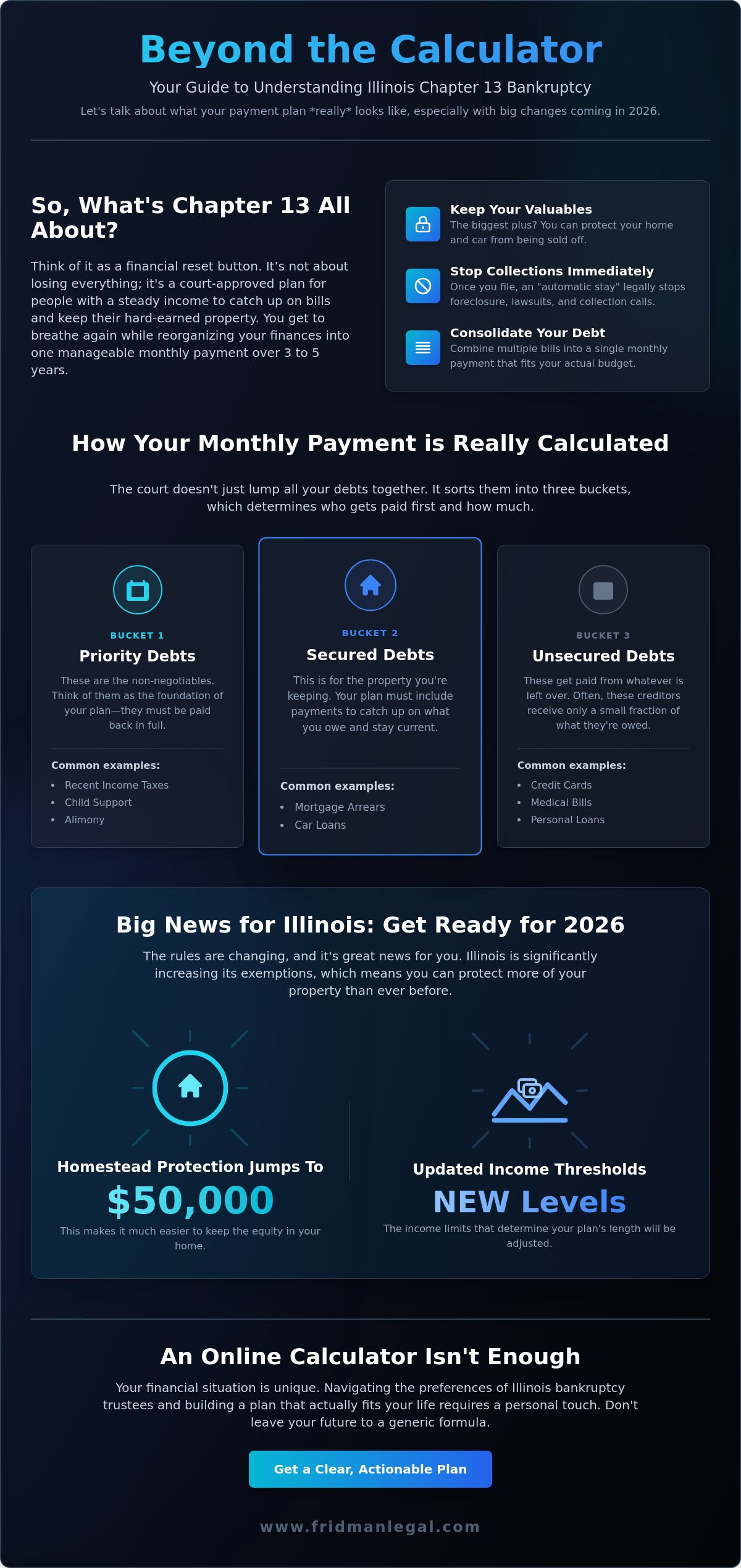
Think of Chapter 13 as a financial reset button. It's specifically designed for individuals who have a steady income but have fallen behind on significant obligations like a mortgage or car payments. Unlike Chapter 7, where you might have to give up certain assets to wipe the slate clean, Chapter 13 allows you to keep your property while you work through a court-approved repayment plan. This process is governed by Chapter 13 of the United States Bankruptcy Code, which provides a legal framework for individuals to reorganize their finances without losing the things they've worked hard to build.
When you use a chapter 13 payment plan calculator Illinois, you're getting a rough estimate of what your monthly commitment might look like over the next few years. It's a helpful tool for initial planning, but it isn't a final court order. In reality, your actual payment is a precise calculation based on your specific income, your essential living expenses, and the types of debt you owe. In Illinois, these plans are structured to last between 36 and 60 months. The duration depends largely on your income relative to the state median; if your income is higher, you'll likely be on a five-year track, while lower-income filers might finish in three.
The Goal of Your Repayment Plan
The primary objective of this structure is stability. For many of our clients in Chicago or Northbrook, the most immediate benefit is the power to stop a foreclosure in its tracks. Once you file, an automatic stay goes into effect. This legally prevents creditors from continuing collection efforts, including phone calls, lawsuits, or seizing your home. Beyond that, the plan focuses on several key outcomes:
- Consolidating high-interest debt: You'll combine various bills into one monthly chunk that actually fits your budget.
- Catching up on arrears: You can pay back missed mortgage or car payments over the life of the plan rather than all at once.
- Protecting co-signers: If you're paying the debt through your plan, creditors generally can't go after your family members for that same money.
Who is Chapter 13 Actually For?
This path is tailored for individuals who have something to lose. If you're a homeowner with significant equity, Chapter 13 is often the best way to protect that investment from being liquidated. It's also ideal for people who have a reliable income but were hit by a temporary setback, such as a medical emergency or a brief period of unemployment. Even business owners in Illinois use this structure to keep their operations running while they catch up on taxes or other business-related debts. If you want to explore how this might apply to your specific situation, you can review our bankruptcy services for a deeper dive into the options available to you.
The Three Main Factors That Determine Your Monthly Payment
Getting a handle on your future finances starts with understanding how the court categorizes what you owe. While a generic chapter 13 payment plan calculator Illinois might give you a ballpark figure, the real strategy lies in how your specific debts are prioritized. The court doesn't treat a missed mortgage payment the same way it treats an old credit card bill. Instead, it sorts your obligations into three distinct buckets that dictate exactly where your money goes each month.
First, we have priority debts. These are the obligations that the law says you must pay in full. Typical examples include recent income taxes, child support, or alimony. You can't negotiate these down; they're the non-negotiable foundation of your plan. Next are secured debts, which are tied to property you want to keep. If you're determined to stay in your home or keep your car, your plan must include a way to stay current on these payments and catch up on any past-due amounts. Finally, there's unsecured debt. According to the U.S. Courts, unsecured creditors like medical providers or credit card companies only get paid if there's money left over after your priority and secured debts are handled. In many Illinois cases, these creditors receive only a small percentage of the total balance.
It's also vital to remember the Chapter 13 Trustee. This court-appointed official manages your payments and distributes them to your creditors. They don't work for free; in Illinois, the trustee fee typically ranges from 8.1% to 10.0% of your monthly payment. This percentage is factored into your total monthly obligation, so it's a key piece of the mathematical puzzle that any reliable chapter 13 payment plan calculator Illinois must account for.
Understanding Your Disposable Income
The court determines your payment by looking at your disposable income. This isn't just what's left in your bank account at the end of the month. It's a formal calculation where your gross income is reduced by allowable expenses. The court uses specific standards to decide what you need for housing, food, and transportation. If you live in an area with a higher cost of living, like Northbrook or certain parts of Chicago, your allowable expenses might be higher than the national average. This ensures your budget is realistic for your specific location.
Secured Debt and the Cramdown Strategy
One of the most effective ways to lower a monthly payment is through a strategy known as a cramdown. A cramdown is a way to reduce a loan balance to the fair market value of the collateral. This is particularly useful for car loans where you owe significantly more than the vehicle is worth. Instead of paying the full loan balance, you might only pay the current value of the car through your plan. While you can't use this for your primary home, it can drastically reduce the cost of keeping other assets. If you're looking for a way to reorganize your finances while protecting what you own, you might want to explore our bankruptcy filing services to see which tools apply to your situation.
Illinois-Specific Rules That Impact Your Chapter 13 Calculation
National online tools often miss the mark because they don't factor in the strict local standards of the Northern District of Illinois. When you're using a chapter 13 payment plan calculator Illinois, the result is only as good as the state-specific data feeding into it. Local rules, specifically the 2026 income thresholds and the recently updated exemption amounts, are the real drivers behind your monthly obligation. These aren't just suggestions; they're the legal benchmarks the court uses to decide if your plan is fair to both you and your creditors.
Illinois Median Income for 2026
The length of your plan is largely dictated by where your household income falls in relation to the Illinois median. For cases filed on or after April 1, 2026, these figures have been adjusted to reflect current economic conditions. If you're a single earner, the threshold is now $73,180. For a household of two, it's $93,934, and for a family of four, it reaches $137,902. If your income is below these amounts, your plan will likely last thirty-six months. However, if you're above the median, the court generally expects a sixty-month commitment. Illinois Legal Aid Online explains that these mechanics are designed to ensure you're contributing your "projected disposable income" throughout the life of the plan.
It's also essential to consider the 2026 updates to Illinois bankruptcy exemptions. As of January 1, 2026, the homestead exemption has increased to $50,000 per person, which means a married couple filing jointly can protect up to $100,000 in home equity. This is a significant shift that allows more families to keep their homes while reorganizing debt. Your vehicle is also better protected now, with the motor vehicle exemption increased to $3,600. These protections are vital because they can lower your required payment by shielding assets that might otherwise have to be "paid for" through your plan to satisfy the Best Interests of Creditors test.
Cook County and Suburban Trustee Fees
In Cook County and the surrounding suburbs, the Chapter 13 Trustee is the one who handles the logistics of your case. They don't just watch over the process; they take a percentage fee to manage your payments and distribute them to creditors. In Illinois, this fee currently sits between 8.1% and 10.0%. When you see a total on a chapter 13 payment plan calculator Illinois, this fee is already baked into that monthly number. It's a mandatory cost of the process that ensures your payments are tracked and applied correctly. Navigating these percentages and the "Best Interests" test requires a precise approach, which is why Fridman Legal Bankruptcy services focuses on building plans that maximize your exemptions while meeting all local court requirements. We ensure that every dollar is accounted for, from the wildcard exemption of $4,000 to the new $1,000 automatic bank account protection, so your plan is as lean as possible.
How to Lower Your Chapter 13 Payment Plan (and Mistakes to Avoid)
A common misconception is that the result from a chapter 13 payment plan calculator Illinois is a final, unchangeable verdict. In reality, that number is often just the starting point for a high-stakes negotiation. The court operates on a "good faith" requirement, which simply means you must be honest about your income and assets. However, being honest doesn't mean you have to be frugal to the point of hardship. You're legally allowed to maintain a reasonable standard of living while you repay your debts, and our job is to ensure the court recognizes what "reasonable" looks like for your family.
The most powerful tool at your disposal for lowering a payment is "Schedule J," the formal document where you list your monthly expenses. If you leave money on the table here, you're essentially giving it away to your creditors. We work with you to ensure that every real-world cost is documented, from your basic groceries to the specific, rising costs of maintaining a household in 2026. This isn't about hiding money; it's about making sure the court's math matches your actual life.
Common Mistakes That Drive Up Your Payment
Many filers fall into the trap of using "average" numbers that don't reflect the specific reality of living in the Midwest. Forgetting to account for the seasonal spike in Illinois winter heating bills is a classic mistake that can leave you short on cash in February. You also need to look at the horizon. If you know your car will need significant repairs in six months or you have an upcoming medical procedure with a high co-pay, those costs must be factored into your budget from day one. Underestimating the value of your property is another risk. If the trustee determines your assets are worth more than you claimed, your monthly payment could increase to satisfy the "liquidation" test, which ensures creditors don't get less than they would in a Chapter 7 case.
The Role of Your Attorney in Negotiation
Attempting to file "Pro Se," or without a lawyer, is often a recipe for an overinflated payment plan. Trustees are professional auditors; their primary goal is to ensure creditors receive the maximum amount allowed by law. We serve as your buffer in this process. We argue with the trustee when they claim a specific expense is "unreasonable," defending your right to a budget that actually functions in the real world.
We also look for creative structures like "Step Plans." These are particularly helpful if you're currently in a transition period, such as expecting a future raise or knowing that a large expense, like a child's tuition, is set to end in a year. This allows your payment to start lower and increase only when you can afford it. Before we file, we perform a thorough Illinois Chapter 7 vs 13 comparison to confirm that Chapter 13 is truly your most efficient path to relief. Unlike an online algorithm, we consider the human elements of your case. If you want a plan designed for your real life rather than a generic formula, reach out to us today to discuss your options.
Beyond the Calculator: Why You Need an Illinois Bankruptcy Attorney
A chapter 13 payment plan calculator Illinois is a helpful starting point, but it's important to remember that it's just a rough draft. It can't predict how a specific judge in Chicago will interpret your unique financial situation or how a trustee might challenge your reported expenses during a meeting of creditors. Bankruptcy is a legal proceeding, not just a mathematical exercise. Having a plan that looks reasonable on a spreadsheet is one thing; having a plan that is "confirmable" by the court is what actually provides the debt relief you're looking for. We bring over 20 years of experience in the Illinois court system to your case, ensuring your plan is built on a foundation of local legal knowledge rather than generic algorithms.
The real value of an attorney lies in the peace of mind that comes from knowing your plan is sustainable. We've seen how different trustees in the Northern District of Illinois view "disposable income" and what they consider a "reasonable" expense. This insight allows us to proactively address potential issues before they become roadblocks. Our goal is to create a strategy that protects your assets while ensuring your monthly payment is something you can actually live with for the next three to five years.
The Confirmation Hearing: Where the Math Becomes Law
The confirmation hearing is the pivotal moment where your proposed math becomes a binding court order. During this hearing, the judge reviews your plan to ensure it meets every strict legal requirement, including the various tests and exemptions we’ve covered. It's quite common for creditors to raise objections at this stage. They might argue they deserve a higher payout or challenge the valuation of a vehicle. We handle these negotiations and objections directly, so you don't have to face aggressive creditors or complex legal arguments on your own. A professional filing has a much higher success rate because we ensure every document is accurate and every local rule is followed to the letter.
Getting Started with Fridman Legal
We've spent two decades helping families in Northbrook and Chicago find their way out of debt and back to financial stability. If you're ready to move beyond computer guesses and get a real-world calculation, we're here to help. To make the most of our time together, try to gather your last six months of pay stubs, your most recent tax returns, and a clear list of who you owe. This allows us to build a precise plan tailored to your actual life. You don't have to carry the weight of this uncertainty by yourself. When you're ready to take the next step, Contact Fridman Legal to discuss your options and start building a plan that works for you.
Secure Your Financial Future with a Sustainable Plan
Navigating the path to debt relief is about more than just numbers on a page; it's about reclaiming your life and protecting your family's home. You've seen how the 2026 exemption updates and local trustee fees can significantly change your monthly obligation. While a chapter 13 payment plan calculator Illinois can point you in the right direction, the nuances of your specific case require a professional touch to ensure your plan is actually confirmable by the court.
With nearly 20 years of Illinois bankruptcy experience, O. Allan Fridman provides the personalized attention necessary to navigate the specific preferences of Chicago-area judges and trustees. From our Northbrook office, we serve clients throughout the Chicago suburbs, helping them move from financial anxiety to a place of stability and confidence. Don't leave your financial recovery to a computer algorithm when you can have a strategy built on decades of local expertise.
Get a Professional Chapter 13 Evaluation from Fridman Legal
You don't have to face this process alone. Taking this first step is the most important part of your journey toward a debt-free future.
Frequently Asked Questions
How much is the average Chapter 13 payment in Illinois?
There isn't a single average payment because the amount is entirely dependent on your unique financial profile. Your monthly obligation is calculated by taking your gross income and subtracting allowable living expenses as defined by the court. While a chapter 13 payment plan calculator Illinois can offer a rough baseline, your actual payment will depend on your specific mix of priority debts, secured loans, and what you can afford to pay unsecured creditors.
Can I change my Chapter 13 payment if my income drops?
You can absolutely request a modification to your repayment plan if you experience a significant drop in income or an unexpected financial hardship. The court understands that your circumstances might change over a three to five year period. We can file a formal motion to adjust your payments to a level that matches your new financial reality, which helps you avoid a default and keeps your case on track for a successful discharge.
What happens if I miss a Chapter 13 payment?
Missing a payment puts your case at risk of being dismissed by the trustee, which would immediately remove the legal protections stopping your creditors. If you realize you won't be able to make a scheduled payment, you should reach out to your attorney right away. We can often work with the trustee or file for a temporary suspension of payments to keep your case active and ensure your home and car remain protected from repossession or foreclosure.
Does Chapter 13 stop a wage garnishment in Illinois immediately?
Filing for Chapter 13 triggers an automatic stay that stops almost all collection actions, including wage garnishments, the moment your case is filed. Once the court issues this stay, your employer is legally required to stop diverting a portion of your paycheck to your creditors. This provides immediate relief and allows you to use your full income to cover your essential living costs and your new court-approved repayment plan.
Will I lose my tax refund while in a Chapter 13 plan?
In many Illinois cases, the trustee expects you to turn over your federal tax refunds because they're considered part of your "projected disposable income." However, this isn't an absolute rule. We can sometimes argue that you should be allowed to keep your refund if you have a specific, necessary expense, such as a major home repair or an upcoming medical procedure. It's a matter of demonstrating to the court that the money is required for your basic needs.
How much does a Chapter 13 lawyer cost in Northbrook?
Bankruptcy attorney fees in Illinois are generally reviewed and approved by the bankruptcy court to ensure they're reasonable. A significant advantage of Chapter 13 is that a large portion of these legal fees is often paid through your monthly plan rather than as an upfront cost. You should check with local practitioners in the Northbrook or Chicago area to see how their specific fee structures are integrated into a court-approved budget.
Can I keep my credit cards during Chapter 13?
You generally cannot keep your existing credit cards when you file for Chapter 13. The law requires you to list all of your creditors in your filing, and most issuers will automatically close your accounts once they receive notice of the bankruptcy. The entire goal of the reorganization process is to help you move away from high-interest debt and learn to live within a sustainable budget based on your actual monthly income.
What is the "Means Test" and does it apply to Chapter 13?
The Means Test is a calculation that compares your household income to the Illinois median to determine the required length of your plan. If your income is above the median, the court typically requires a five-year commitment; if it's below, a three-year plan is often possible. Using a chapter 13 payment plan calculator Illinois that factors in the updated 2026 median income thresholds is the most accurate way to predict your timeline.

Article by
O. Allan Fridman
O. Allan Fridman has been practicing law since 2001. His practice is unique in that he does not view himself as a litigation attorney or transactional attorney. Rather, he views each area of law as a tool to pursue the best results for his clients. By practicing in both areas of law, he is able to take a 360-degree view of law. This enables the firm to catch potential drawbacks that are readily identifiable.
By practicing in litigation and transactional law and taking a holistic approach in dealing with our clients, he doesn’t put clients in box — rather, as we are all individuals, so too are the legal services we may require.
Whether it is bankruptcy or litigation or transactional, each client brings challenges and does not fit in any one box. Often times, bankruptcy clients end up not filing bankruptcy because we can achieve a better result through litigation or through an out-of-court resolution with the lender, or through a real estate sale. On the other end of the spectrum, a litigation client with multiple issues and lawsuit may fare better in a bankruptcy.
Since 2001, Allan has practiced in states and federal court, and he is a member of the trial bar of the Northern District of Illinois and admitted in the Northern District of Indiana.
We are a debt relief agency. We help people file for bankruptcy relief under the Bankruptcy Code
The materials on this site are for informational purposes only and do not constitute legal advice. Viewing this site or contacting us does not create an attorney–client relationship, and you should not act or refrain from acting based on any information here without seeking professional legal counsel.


