
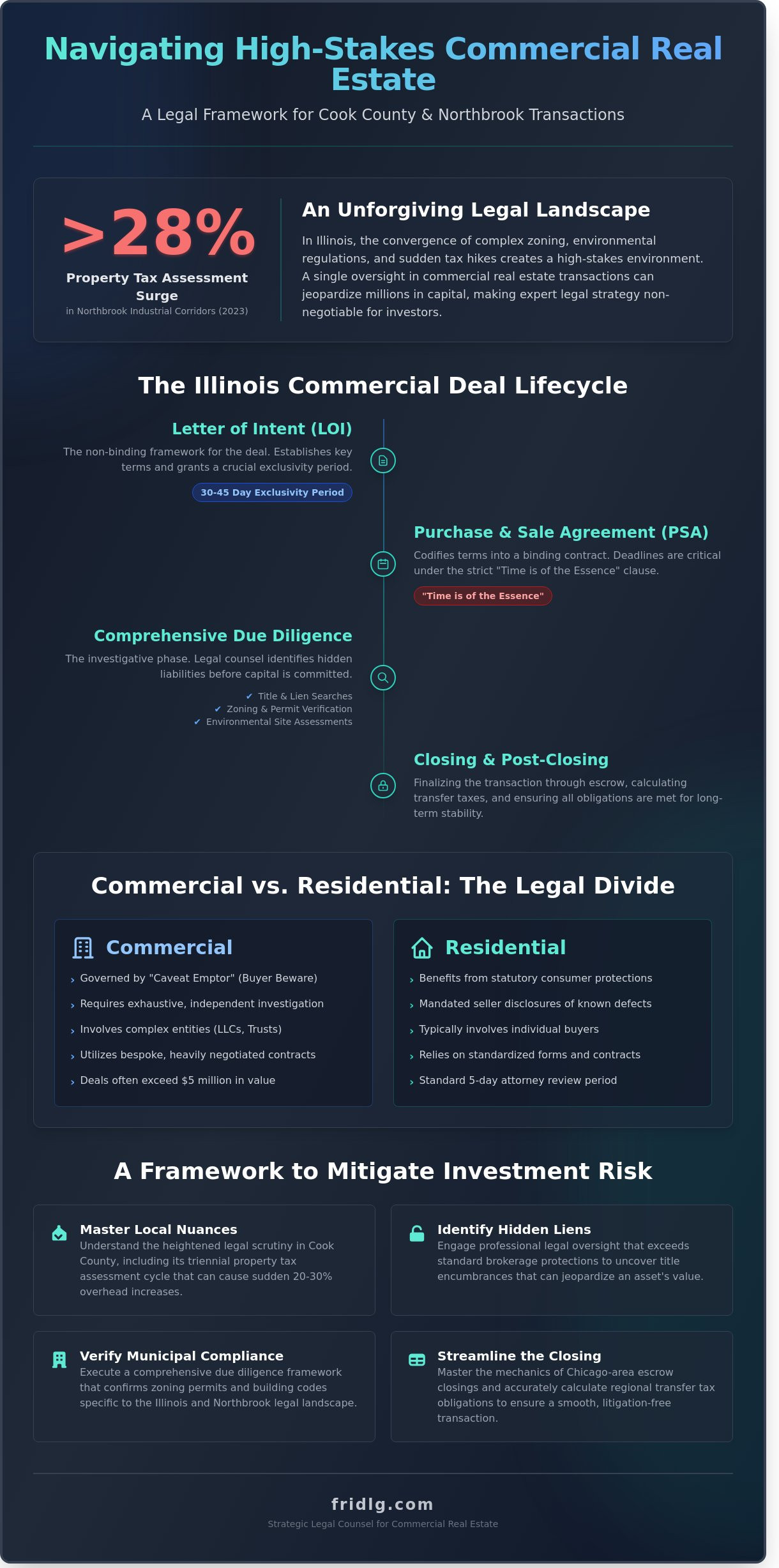
In 2023, Cook County property tax assessments in specific Northbrook industrial corridors surged by more than 28%, a shift that compromised the projected yields of many unprepared institutional investors. You likely recognize that the legal landscape in Illinois is increasingly unforgiving. The convergence of local zoning restrictions and intricate environmental regulations creates a high-stakes environment where a single oversight during commercial real estate transactions can jeopardize millions in capital. Precision in these matters is not a luxury; it's the essential foundation of a viable investment strategy.
Success requires a process that prioritizes professional integrity and strategic foresight over administrative haste. This guide provides the necessary legal framework to secure your interests through rigorous due diligence, municipal compliance, and structured closing protocols. We'll examine the methodologies for identifying hidden liabilities and managing the specific regulatory demands of the Chicago market. This analysis offers a clear roadmap for achieving a smooth, litigation-free closing that ensures your asset's long-term stability and value.
Key Takeaways
- Understand the heightened legal scrutiny required for Northbrook and Cook County property deals compared to standard residential sales.
- Navigate the critical transition from a Letter of Intent to a Purchase and Sale Agreement while managing strict "Time is of the Essence" contractual clauses.
- Mitigate investment risk by identifying hidden liens and title encumbrances through professional legal oversight that exceeds standard brokerage protections.
- Execute a comprehensive due diligence framework by verifying zoning permits and municipal building code compliance specific to the Illinois legal landscape.
- Streamline your commercial real estate transactions by mastering the mechanics of Chicago-area escrow closings and calculating regional transfer tax obligations.
Understanding Commercial Real Estate Transactions in the Chicago Suburbs
Within the Illinois legal framework, Understanding Commercial Real Estate involves the transfer of property used exclusively for business purposes rather than primary residence. In Northbrook and the broader Cook County area, commercial real estate transactions are governed by a complex interplay of state statutes and municipal ordinances that demand rigorous due diligence. These deals often exceed $5 million in value, requiring a level of legal scrutiny that standard residential closings don't encounter. While a broker identifies the asset and negotiates the purchase price, the attorney functions as the lead strategist. They manage the structural integrity of the deal, ensuring that zoning, environmental liabilities, and title encumbrances don't compromise the client's capital.
The scope of these transactions in Lake and Cook County includes diverse asset classes that require specialized contractual protections:
- Industrial: Warehouses and distribution centers along the I-294 corridor.
- Office: Class A spaces in Northbrook's corporate centers and suburban satellite hubs.
- Retail: Shopping centers and mixed-use developments subject to complex tenant lease structures.
- Multi-family: Residential buildings with 5 or more dwellings, which Illinois law classifies as commercial assets.
Commercial vs. Residential: The Legal Divide
Legal protections differ significantly between these two sectors. Residential buyers benefit from statutory disclosures and standard consumer protection laws. In contrast, Illinois commercial law leans heavily on the principle of "Caveat Emptor," or buyer beware. Sophisticated parties are expected to conduct their own exhaustive investigations. Transactions frequently involve complex entity ownership, such as LLCs or Land Trusts, which necessitates precise verification of signing authority and liability shielding. Mistakes in these early stages can lead to litigation that stalls a project for years.
The Strategic Importance of Local Northbrook Expertise
Success in these deals depends on more than just state-level knowledge. Northbrook’s Municipal Code imposes specific requirements on business licensing and signage that differ from Chicago's regulations. Cook County uses a triennial assessment cycle for property taxes. This can lead to sudden 20% or 30% increases in overhead if the attorney doesn't account for the next reassessment date during the commercial real estate transactions phase. Proximity to Chicago creates a regulatory spillover effect, where suburban zoning trends often mirror city developments, requiring a lawyer who understands the regional economic landscape.
The Lifecycle of an Illinois Commercial Real Estate Deal
Successful commercial real estate transactions require a disciplined approach to the timeline, starting long before any formal deed is recorded. The transition from the Letter of Intent (LOI) to the Purchase and Sale Agreement (PSA) represents the most critical juncture in the acquisition lifecycle. It codifies verbal agreements into binding legal obligations. In Illinois, the "Time is of the Essence" clause is not a mere formality; missing a deadline by 24 hours can constitute a material breach, potentially resulting in the forfeiture of earnest money or the loss of the asset. Unlike residential deals that often rely on a standard five-day attorney review period, commercial contracts are bespoke instruments where the review period is negotiated and often expires once the PSA is signed.
The Letter of Intent (LOI) and Pre-Contract Phase
In the Northbrook market, an LOI serves as the skeletal framework for the deal. While most provisions remain non-binding, specific clauses regarding confidentiality and exclusivity must be legally enforceable. A clearly defined exclusivity period, typically ranging from 30 to 45 days, is essential to prevent "gazumping" by other Chicago investors who might attempt to outbid the current party. Identifying deal-breakers during this phase saves significant capital before entering the intensive due diligence process. This preliminary stage allows the firm to provide strategic transactional support, ensuring that the buyer's interests are protected before the expensive legal drafting begins.
Drafting the Purchase and Sale Agreement (PSA)
The drafting of the PSA shifts the focus to risk allocation. Negotiating robust representations and warranties is paramount to protect the buyer against undisclosed environmental liabilities or zoning violations. In Illinois, "AS-IS" clauses are generally enforceable provided the seller has not engaged in active fraud or concealment of latent defects. To mitigate risk, legal counsel must define liquidated damages with precision; these are often capped at 2% to 3% of the purchase price to limit a buyer's financial exposure in the event of a default. Specific performance remains a vital remedy for buyers, ensuring they can compel the transfer of the property if the seller attempts to withdraw from the deal without cause.
Securing financing introduces additional legal layers, particularly when dealing with commercial mortgages or SBA 504 loans. These instruments require:
- Strict compliance with the lender's environmental and survey requirements.
- Legal opinions regarding the borrower's corporate authority and standing.
- Verification of rent rolls and estoppel certificates from existing tenants.
- Adherence to the 10% minimum equity requirements often mandated by SBA guidelines.
The complexity of commercial real estate transactions in the Chicago area demands a meticulous eye for detail. Every clause serves a specific function in the broader strategic objective of the client. By maintaining a structured approach to the deal lifecycle, investors can navigate the transition from initial interest to final closing with the necessary legal certainty.
Mitigating Risk: Why Legal Oversight is Non-Negotiable
Many investors mistakenly believe a broker's standard form provides sufficient coverage. It doesn't. Brokers facilitate the meeting of minds; they don't insulate you from $500,000 in undisclosed mechanic's liens or complex litigation. Legal oversight serves as the necessary friction to ensure commercial real estate transactions don't collapse post-closing due to avoidable disputes. While a broker focuses on the commission, a legal team focuses on the 20 percent of hidden encumbrances that a preliminary title report might overlook.
Specific risks in the Chicago and Northbrook markets require specialized bankruptcy expertise. If a seller is insolvent, a transaction can be clawed back as a "fraudulent transfer" under Section 548 of the Bankruptcy Code. Fridman Legal utilizes bankruptcy litigation data from 2023 to identify these red flags before the closing date. This proactive approach manages civil litigation risks arising from contract disputes or construction defects that often surface within the first 18 months of ownership.
Title Insurance and Survey Review
A standard residential survey lacks the precision required for high-stakes commercial real estate transactions. Following the Best Practices for ALTA Surveys is essential for identifying underground utilities or encroachments that a basic boundary survey ignores. We negotiate specific endorsements, such as Zoning 3.1 for land use or Environmental Lien protection, to provide a layer of indemnity that protects the asset's long-term valuation. These details prevent easements from the 1970s from limiting your future property development.
Environmental Liabilities and the IPRTA
Industrial properties in Northbrook frequently carry legacy contamination risks. The Illinois Responsible Property Transfer Act (IPRTA), established in 1989, requires specific disclosures that can lead to strict liability for the buyer if mishandled. Completing a Phase I Environmental Site Assessment (ESA) according to ASTM E1527-21 standards is the only way to establish the "Innocent Landowner" defense. Without this rigorous legal due diligence, a new owner could be held responsible for 100 percent of remediation costs, regardless of who caused the original spill.
Effective risk mitigation isn't about avoiding deals. It's about structuring them so that every contingency is accounted for in the closing documents. We ensure that your capital is protected through every phase of the acquisition.
The Due Diligence Framework: Zoning and Municipal Compliance
Precise due diligence is the bedrock of successful commercial real estate transactions. It's a phase where legal abstraction meets physical reality; where the intended use of a property must align perfectly with municipal constraints. Investors who overlook the granular details of local ordinances often face significant financial setbacks or stalled operations shortly after closing.
Navigating Northbrook Zoning and Land Use
The Northbrook Department of Development and Planning operates under a strict Zoning Code, which saw major administrative updates in 2023. We distinguish between "Permitted Use," which allows for immediate operation, and "Special Use Permits," which require a formal public hearing and Village Board approval. A critical risk factor is the "Non-Conforming Use" status. If a property with this designation remains vacant for more than 180 days, it loses its grandfathered status; this effectively prevents the new owner from continuing the previous business model without a costly rezoning process.
Building code compliance requires a forensic review of the Village of Northbrook’s records to identify outstanding violations or unpermitted work. Recent data suggests that roughly 12% of commercial properties in the Chicago suburbs carry legacy permit issues that can delay title transfers. Beyond local codes, evaluating compliance with the 2010 ADA Standards for Accessible Design is mandatory. Retrofitting a single non-compliant commercial restroom or entrance ramp often exceeds $15,000; these costs must be factored into the final purchase price negotiations to protect the buyer's internal rate of return.
Lease Audit and Tenant Estoppels
For income-producing assets, the Estoppel Certificate is the primary tool for risk mitigation. It's a legally binding document where tenants confirm the current terms of their lease, ensuring no undisclosed defaults or side agreements exist. We also scrutinize Subordination, Non-Disturbance, and Attornment (SNDA) agreements to verify that the buyer's financing won't inadvertently terminate valuable leases. In many triple-net (NNN) leases, hidden landlord obligations for roof and structure maintenance can erode the projected Net Operating Income by 4% to 8% if the lease language isn't strictly interpreted during the audit.
The complexity of commercial real estate transactions in the Chicago area demands a disciplined approach to municipal verification. Every document, from the plat of survey to the latest fire inspection report, contributes to the overall risk profile of the investment. Strategic counsel ensures these variables are managed before capital is committed.
Securing your investment requires more than a surface-level review. Professionals looking to solidify their position should seek expert transactional support to navigate the intricacies of municipal compliance and lease auditing.
The Closing Process and Post-Closing Obligations
The finalization of the ALTA settlement statement is the technical heart of the closing. This document accounts for every dollar in the transaction, including loan payoffs, brokerage commissions, and title fees. If you don't scrutinize these figures, small errors in proration can result in thousands of dollars in lost value. Post-closing, the legal work continues with the following essential tasks:
- Recording: Filing the Special Warranty Deed and any mortgage documents with the Cook County Clerk.
- Tax Filings: Completing the MyDec (PTAX-203) Illinois Real Estate Transfer Declarations.
- Tenant Transitions: Delivering formal notices to tenants and transferring security deposits into buyer-controlled accounts.
- Utility Finalization: Confirming that final readings for water and sewer are completed to prevent municipal liens.
Cook County Transfer Taxes and Prorations
Financial accuracy at the closing table depends on understanding regional tax structures. In Cook County, the combined State and County transfer tax rate is $0.75 per $500 of the purchase price. While Chicago imposes a heavy municipal tax, Northbrook currently doesn't levy a local transfer tax. However, parties must still obtain a Northbrook transfer stamp, which requires a final water bill payment and a "No-Lien" certificate from the village.
The Illinois property tax "arrears" system creates a unique challenge for commercial real estate transactions. Because 2023 taxes aren't paid until 2024, sellers must provide a credit to buyers for the period they owned the property. It's standard practice to calculate this credit at 105% to 110% of the last known full year tax bill to protect the buyer against future assessment increases.
Partnering with Fridman Legal for Your Next Transaction
Securing a favorable outcome in complex suburban closings requires more than just a signature. O. Allan Fridman leverages 20 years of experience to identify potential title defects and prorate liabilities with surgical precision. Our boutique model ensures you work directly with the principal attorney, avoiding the communication gaps common in larger firms. We manage the entire lifecycle of the deal, from the initial LOI to the final recording of the deed. To protect your investment and ensure a seamless handover, schedule a consultation for your Northbrook commercial transaction today.
Strategic Oversight for Your Illinois Property Investments
Navigating the intricate landscape of Northbrook and Chicago property law requires more than a standard checklist. It demands a rigorous approach to municipal compliance and a proactive strategy for risk mitigation. Successfully managing commercial real estate transactions hinges on identifying structural or legal liabilities before they jeopardize your capital. Principal attorney O. Allan Fridman leverages nearly 20 years of Illinois legal experience to provide this essential clarity. By integrating expertise in both transaction law and civil litigation, he ensures your interests are shielded from the initial letter of intent through the final closing. You'll benefit from a boutique approach that prioritizes precision over volume. This level of professional scrutiny transforms complex legal hurdles into manageable business steps. It's time to move forward with the certainty that your assets are protected by a seasoned strategist. Every detail in the closing process matters, and having a dedicated advocate ensures no obligation is overlooked. Your success in the Chicago market depends on this foundation of stability and legal integrity.
Secure your commercial investment with a professional legal review
Your vision for growth deserves a foundation built on expert legal precision and unwavering professional support.
Frequently Asked Questions
What is the typical timeline for a commercial real estate transaction in Illinois?
Most commercial real estate transactions in Illinois require 60 to 120 days from the signed letter of intent to the final closing. This period accounts for a 30 day due diligence window and a 45 day financing contingency common in Cook County contracts. Complex multi-tenant acquisitions or those involving zoning changes can extend this timeline to 180 days or more.
How much are the commercial real estate attorney fees for a closing in Northbrook?
Legal fees for a Northbrook commercial closing typically range from $3,000 to $15,000 depending on the transaction's complexity and asset class. While some firms offer flat rates for simple warehouse transfers, most bill between $400 and $650 per hour for bespoke contract drafting. These costs represent approximately 0.5% to 1.5% of the total purchase price for mid-market assets.
Do I need a Phase I Environmental Assessment for an office building purchase?
You must obtain a Phase I Environmental Site Assessment (ESA) to qualify for "innocent landowner" protections under the Comprehensive Environmental Response, Compensation, and Liability Act (CERCLA). Lenders financing Northbrook office properties almost always mandate an ASTM E1527-21 compliant report before issuing a commitment letter. This assessment identifies recognized environmental conditions that could result in multi-million dollar remediation liabilities.
What is a tenant estoppel certificate and why is it required for my transaction?
A tenant estoppel certificate is a legally binding document where a tenant certifies the current status of their lease terms and rent payments. It prevents the tenant from later claiming different terms, such as an undisclosed rent credit or a verbal lease extension. Lenders typically require signed estoppels from 100% of major tenants and 75% of smaller occupants before funding a commercial acquisition.
How are property taxes prorated in a Cook County commercial deal?
Property taxes in Cook County are prorated at 105% to 110% of the most recent full year tax bill because Illinois taxes are paid in arrears. Since the second installment of 2023 taxes isn't due until late 2024, the seller provides a credit to the buyer based on these estimated figures. This ensures the buyer has sufficient funds when the actual, often higher, tax bill arrives from the Cook County Treasurer.
Can I use a residential real estate lawyer for a commercial property transaction?
While legally permitted, using a residential practitioner for commercial real estate transactions often leads to overlooked liabilities regarding environmental indemnities and complex title endorsements. Commercial deals lack the consumer protection statutes found in residential law, meaning the principle of caveat emptor applies more strictly. Expert counsel ensures that intricate ALTA surveys and UCC filings are handled with the precision required for business assets.
What happens if a seller defaults on a commercial purchase agreement in Illinois?
If a seller defaults, the buyer can sue for specific performance to force the sale or seek the return of their earnest money plus actual damages. Most Illinois commercial contracts limit the buyer's remedies to these two options, often excluding consequential damages. If the buyer chooses litigation, they'll typically record a lis pendens against the property to prevent any other sale while the case is pending.
Are Northbrook municipal inspections required before a commercial property transfer?
The Village of Northbrook requires a Certificate of Compliance inspection for most commercial property transfers under local municipal codes. This process involves inspectors from the building, fire, and health departments evaluating the premises for life-safety violations. The seller must apply for this inspection at least 21 days before the scheduled closing to ensure all identified code issues are remediated or escrowed appropriately.

Article by
O. Allan Fridman
O. Allan Fridman has been practicing law since 2001. His practice is unique in that he does not view himself as a litigation attorney or transactional attorney. Rather, he views each area of law as a tool to pursue the best results for his clients. By practicing in both areas of law, he is able to take a 360-degree view of law. This enables the firm to catch potential drawbacks that are readily identifiable.
By practicing in litigation and transactional law and taking a holistic approach in dealing with our clients, he doesn’t put clients in box — rather, as we are all individuals, so too are the legal services we may require.
Whether it is bankruptcy or litigation or transactional, each client brings challenges and does not fit in any one box. Often times, bankruptcy clients end up not filing bankruptcy because we can achieve a better result through litigation or through an out-of-court resolution with the lender, or through a real estate sale. On the other end of the spectrum, a litigation client with multiple issues and lawsuit may fare better in a bankruptcy.
Since 2001, Allan has practiced in states and federal court, and he is a member of the trial bar of the Northern District of Illinois and admitted in the Northern District of Indiana.
We are a debt relief agency. We help people file for bankruptcy relief under the Bankruptcy Code
The materials on this site are for informational purposes only and do not constitute legal advice. Viewing this site or contacting us does not create an attorney–client relationship, and you should not act or refrain from acting based on any information here without seeking professional legal counsel.