

The mere existence of an outstanding balance doesn't grant a creditor an eternal right to litigate within the Illinois judicial system. The law has limits. In Northbrook and across Cook County, the law imposes strict boundaries on how long a collector can wait before their legal standing to sue expires. You've likely experienced the calculated harassment of collectors who attempt to revive accounts that reached their statutory expiration as far back as 2018. This guide provides a precise analysis of the debt collection statute limitation under Illinois law, ensuring you understand exactly when a debt becomes time-barred and unenforceable in court.
We'll clarify the critical distinction between the seven year credit reporting window and the specific five or ten year legal filing deadlines that dictate your liability. You'll learn how to stop collection calls through formal channels and evaluate whether a permanent solution, such as a strategic bankruptcy filing, is the most effective way to secure your assets. By the end of this analysis, you'll possess the legal clarity needed to dismiss "zombie" debt claims with confidence and protect your financial future from aggressive litigation tactics.
Key Takeaways
- Distinguish between a creditor's persistent right to request payment and the strict legal expiration date that prevents them from successfully pursuing a lawsuit in court.
- Identify the specific category of your financial obligations to accurately determine the applicable debt collection statute limitation and its corresponding legal duration.
- Understand the strategic risks associated with "zombie debt" and how minor interactions with debt buyers can inadvertently restart the legal timeline for expired claims.
- Learn the critical importance of raising an affirmative defense in Cook or Lake County courts to effectively dismiss legal actions brought on time-barred debts.
- Evaluate how strategic bankruptcy filings provide a definitive resolution and an immediate "Automatic Stay" when the statute of limitations offers insufficient protection.
What is the Debt Collection Statute of Limitations in Illinois?
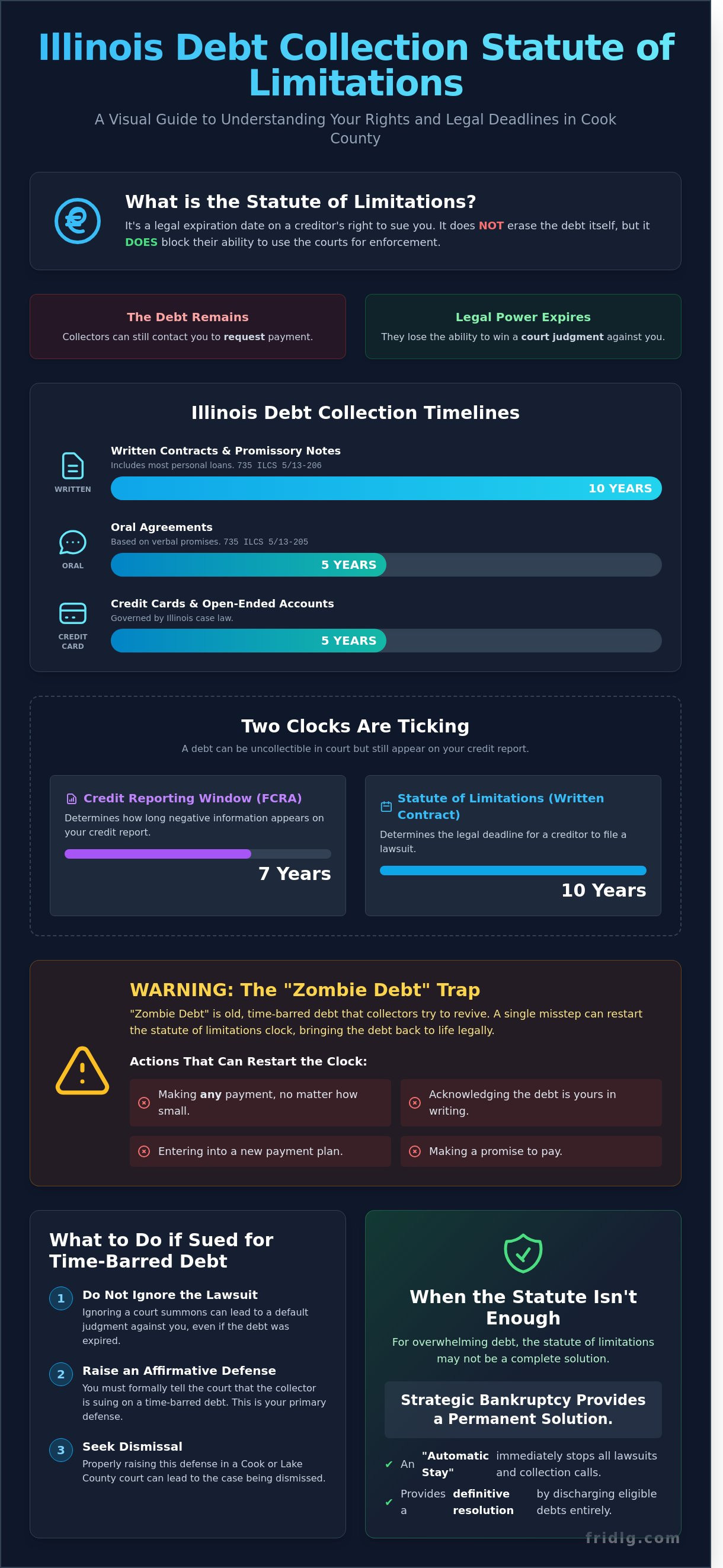
Under Illinois law, the Statute of Limitations serves as a rigid expiration date for a creditor's power to initiate a lawsuit. It doesn't extinguish the underlying financial obligation; rather, it removes the legal mechanism for judicial enforcement. Northbrook residents often mistake a debt's age for its disappearance. This is a critical error. While a debt collector might still contact you, they lose the right to obtain a court-ordered judgment once the clock runs out. The debt remains, but the court's door is effectively locked.
The debt collection statute limitation in Illinois typically follows strict timelines dictated by the nature of the agreement. For Northbrook consumers, these timelines are found within the Illinois Code of Civil Procedure. The Fair Debt Collection Practices Act (FDCPA) provides an additional layer of protection by prohibiting collectors from using deceptive tactics or threatening legal action on accounts that have surpassed these dates. Understanding these boundaries is essential for strategic financial defense.
- Oral Agreements: 5 years from the date of the last payment or promise to pay.
- Written Contracts: 10 years under 735 ILCS 5/13-206, covering most personal loans.
- Promissory Notes: 10 years from the maturity date.
Time-Barred Debt vs. Credit Reporting
A common misconception involves the 7 year reporting window established by the Fair Credit Reporting Act (FCRA). Your credit report may stop showing a debt after 2,555 days, but the legal right to sue might persist for 3,650 days under a 10 year written contract. Conversely, a debt can be legally unenforceable in court while still appearing on your credit file.
Why Local Jurisdiction Matters in Cook County
Northbrook falls under the jurisdiction of the Circuit Court of Cook County. While federal laws provide a baseline, the Illinois Code of Civil Procedure dictates the specific tolling rules and evidentiary requirements for local cases. Creditors must produce specific documentation, such as the original contract or a clear chain of title, to prove their standing. If a collector can't produce the underlying agreement for a 10 year contract, they may face immediate procedural challenges. These state-level mandates ensure that residents aren't subjected to arbitrary or undocumented claims.
Illinois Debt Timelines: How Long Do Collectors Have?
The legal framework governing debt recovery in Illinois is defined by the Illinois Code of Civil Procedure, specifically under 735 ILCS 5/. This statutory authority dictates the precise window within which a creditor may initiate a lawsuit. Identifying the specific nature of a debt is not merely a formality; it is a strategic necessity. The debt collection statute limitation acts as a definitive expiration date on the judicial enforceability of a claim. Once this period elapses, the debt remains, but the collector loses the legal power to compel payment through the court system.
| Debt Category | Statutory Period | Relevant Authority |
|---|---|---|
| Oral Contracts | 5 Years | 735 ILCS 5/13-205 |
| Written Contracts | 10 Years | 735 ILCS 5/13-206 |
| Open-Ended / Credit Cards | 5 Years | Illinois Case Law |
The 5-Year vs. 10-Year Rule
Illinois distinguishes between agreements based on their documentation. Oral contracts, governed by 735 ILCS 5/13-205, carry a 5-year limit. These unwritten agreements rely on verbal testimony, which the law recognizes as prone to degradation over time. Conversely, formal written contracts and promissory notes benefit from a 10-year window under 735 ILCS 5/13-206. This extended duration reflects the evidentiary weight of a signed, physical document. While state law provides the primary defense, understanding your rights under federal law ensures a comprehensive approach to managing collector interactions during these periods.
Credit Card Debt and Open-Ended Accounts
Credit card obligations occupy a specific niche in Illinois jurisprudence. Although a physical card exists, courts generally classify these as "open-ended accounts" rather than traditional written contracts. Between 2009 and 2015, various Illinois appellate rulings solidified the 5-year debt collection statute limitation for most credit card accounts. This distinction is vital for Northbrook residents who may be facing litigation on accounts that are six or seven years old. For those managing high-value claims, securing strategic legal counsel can prevent procedural oversights that might inadvertently reset these statutory clocks. If a debtor moves into Illinois from a state with a shorter limit, complex "borrowing statutes" may apply, though the 5-year standard remains the baseline for local filings.
The "Zombie Debt" Trap: How to Avoid Restarting the Clock
Debt buyers in the Northbrook area frequently acquire portfolios of delinquent accounts for less than 5% of their face value. These "zombie debts" are often past the legal timeframe for collection; however, collectors utilize specific tactics to revive them. If a resident inadvertently acknowledges the obligation, the debt collection statute limitation clock resets to zero. This legal mechanism, known as "revival," transforms an unenforceable claim into a fresh, actionable lawsuit in the Cook County or Lake County court systems.
Precision is vital when communicating with these entities. A single misstep can nullify years of elapsed time. The Illinois statute of limitations for debt generally expires after 5 years for oral contracts and 10 years for written contracts. Once this period passes, the debt is "time-barred." Collectors cannot legally sue you, but they can still attempt to contact you. They rely on your lack of awareness to trick you into a "voluntary" payment or admission.
Common Mistakes That Reset the Statute
- The $5 Trap: Making a nominal "good faith" payment of even $5 or $10 constitutes an admission of the debt's validity. This action restarts the entire 5 or 10-year statutory period immediately.
- Settlement Signatures: Signing a new payment plan or a proposed settlement agreement creates a new written contract. This effectively waives your previous statute of limitations defense.
- Verbal Admissions: Admitting the debt is yours during a recorded call provides the collector with evidence. While Illinois law requires written acknowledgment for some resets, verbal statements complicate your defense in court.
Protecting Yourself During Collection Calls
Northbrook residents must adopt a "Verify, Don't Admit" strategy. Don't confirm your identity or the debt's amount over the phone. Instead, demand a formal debt validation letter. This document must arrive within 5 days of their initial contact. It forces the collector to prove they own the debt and that the amount is accurate without you admitting liability. Any payment on a time-barred debt in Illinois may legally restart the statute of limitations. This single financial decision can expose your assets to garnishment or liens that were previously legally unreachable.
What to Do if Sued for Time-Barred Debt in Northbrook
Receiving a summons from the Circuit Court of Cook County or Lake County demands immediate, calculated action. Discarding these documents is a tactical error that leads to a default judgment. Under Illinois Supreme Court Rule 113, a creditor can secure a judgment within 30 days if you fail to appear. This legal mechanism allows the plaintiff to pursue aggressive collection tactics, including freezing your liquid assets or placing liens on Northbrook real estate. A default judgment effectively validates a debt that might have otherwise been unenforceable.
The debt collection statute limitation functions as an affirmative defense. It's not a self-executing shield. The court won't dismiss a case simply because the debt is old; you must explicitly raise the defense in your responsive pleadings. If this defense isn't asserted, the right to use it's waived permanently. A Northbrook debt defense attorney provides the strategic oversight required to file a Motion to Dismiss under Section 2-619 of the Illinois Code of Civil Procedure, effectively terminating the litigation before it reaches a costly trial phase.
Responding to a Cook County Summons
In Illinois courts, you typically have 30 days from the date of service to file a formal appearance and a written answer. Your response must clearly state that the debt collection statute limitation has expired. Failing to meet this deadline allows the creditor to obtain a default judgment. This often leads to a wage deduction order, where up to 25% of your disposable earnings are diverted to the creditor under 735 ILCS 5/12-803. Rapid intervention is the only way to maintain control over your professional income.
Evidence Needed to Win Your Case
Success depends on establishing the "date of last activity" on the account with mathematical certainty. This is usually the date of your final payment or the date the debt was formally charged off. You should secure the following documentation to build your defense:
- Bank statements from the last 10 years showing the final transaction date.
- Certified credit reports from Equifax or TransUnion detailing the account’s delinquency timeline.
- Original contract copies to determine if the 5-year oral or 10-year written limit applies.
Once you provide prima facie evidence that the debt is time-barred, the burden of proof shifts. The plaintiff must then produce records proving the action was filed within the legal window. If they can't produce a signed contract or payment ledger, the case often collapses. If you're facing a lawsuit in the Cook County or Lake County court systems, secure a strategic legal consultation to protect your financial interests.
When the Statute is Not Enough: Bankruptcy as a Permanent Solution
Relying solely on the debt collection statute limitation is a passive strategy that often fails when creditors become aggressive. In Illinois, creditors have up to 10 years to initiate a lawsuit on written contracts. If a collector files a summons before this decade-long window closes, the clock stops; your financial liability remains active and enforceable. For Northbrook residents facing immediate litigation or wage garnishment, bankruptcy offers a proactive legal shield that waiting cannot provide.
- The Automatic Stay: Filing a bankruptcy petition triggers an immediate federal injunction under 11 U.S.C. § 362. This stops all collection activities, including phone calls, letters, and pending lawsuits, within minutes of the filing.
- Certainty vs. Risk: A 10-year statute of limitations creates a long period of uncertainty. Chapter 7 bankruptcy provides a definitive court order discharging qualifying debts, ensuring they can't be collected at any point in the future.
- Comprehensive Relief: While the debt collection statute limitation applies to individual debts based on their specific last-activity dates, bankruptcy addresses your entire financial profile. It provides a unified solution for multiple creditors simultaneously.
Chapter 7 vs. Debt Settlement
Debt settlement involves high-stakes negotiations that don't always result in a full release of liability. Creditors aren't legally required to settle, and forgiven debt often triggers a 1099-C tax liability. Bankruptcy is a structured legal process that legally eliminates the debt through a court discharge. At Fridman Legal, we use the Illinois Means Test to determine if your household income falls below the state median, which was approximately $71,000 for a single-person household in late 2023. Most Chapter 7 cases reach a final discharge in just 4 to 6 months. This offers a significantly faster resolution than waiting out a 10-year statutory period.
Consulting with a Northbrook Bankruptcy Expert
Strategic debt management requires an analytical approach to your specific financial timeline. O. Allan Fridman applies 20 years of specialized experience to evaluate whether your debt is still within the actionable window or if a bankruptcy filing is the most prudent path forward. We operate on a flat-fee basis, ensuring you have predictable legal costs without the surprise of hourly billing during a financial crisis. Schedule a consultation with Fridman Legal to evaluate your debt defense options and secure a predictable financial future through expert representation.
Strategic Management of Your Illinois Debt Obligations
Navigating the complexities of the Illinois Code of Civil Procedure requires a disciplined approach to protect your financial interests. Illinois law strictly enforces a 5-year limit on oral agreements and a 10-year limit on written contracts per 735 ILCS 5/13-205 and 13-206. You must remain vigilant against collectors who attempt to revive "zombie debt" through strategic payment solicitations designed to restart these legal clocks. While the debt collection statute limitation serves as a powerful affirmative defense in Northbrook courtrooms, it doesn't automatically extinguish the underlying debt or stop persistent collection efforts. Bankruptcy provides the only permanent resolution by legally discharging these obligations under federal law. Our firm leverages nearly 20 years of Illinois bankruptcy experience to provide the precise, strategic counsel you need. We maintain a convenient Northbrook office on Skokie Blvd and offer transparent flat-fee structures for Chapter 7 filings to ensure your path to recovery is clear and predictable. Contact Fridman Legal today for a free evaluation of your debt relief options in Northbrook. You can secure a stable financial future with the right professional expertise behind you.
Frequently Asked Questions
Is the statute of limitations for debt in Illinois 5 or 10 years?
Illinois law distinguishes between contract types to determine the applicable timeframe for legal action. Under 735 ILCS 5/13-205, oral agreements carry a 5 year limit, while 735 ILCS 5/13-206 establishes a 10 year period for written instruments. Creditors must initiate legal action within these specific windows to maintain their right to judicial enforcement. Precision in identifying the contract's nature is vital for a successful defense strategy.
Can a debt collector still call me if the statute of limitations has expired in Illinois?
Collectors retain the right to contact you for payment after the debt collection statute limitation expires, though their legal recourse is extinguished. They're prohibited from threatening litigation on time-barred debts under the Fair Debt Collection Practices Act. You can terminate these communications by sending a formal cease and desist letter via certified mail to their primary place of business. This action forces the agency to stop all non-legal contact.
Does making a payment on an old debt restart the statute of limitations in Cook County?
A single payment of $1 or more effectively restarts the statutory clock for the entire balance. This principle, known as tolling, applies across Cook County and the state of Illinois. Acknowledging the debt in writing or making a partial payment resets the 5 or 10 year period, granting the creditor a fresh window for legal enforcement. It's a critical point where many debtors inadvertently waive their legal protections.
What is the statute of limitations on credit card debt in Illinois?
Credit card debt generally falls under the 5 year statute of limitations established for unwritten contracts and open-ended accounts. Illinois courts typically apply 735 ILCS 5/13-205 to these balances because the specific terms often rely on revolving credit rather than a single fixed instrument. This 60 month window begins from the date of your last payment or activity. Identifying the exact date of default is essential for calculating this period.
Can I be sued for a 20-year-old debt in Illinois?
You can be sued for a 20 year old debt, but the statute of limitations provides an absolute affirmative defense to dismiss the case. While the court system won't automatically block a filing, you're required to raise the time-barred status in your initial response. Failing to assert this defense may result in a default judgment despite the age of the obligation. Legal vigilance is necessary to prevent the revival of ancient claims.
How do I stop a debt collector from suing me for a time-barred debt?
You should issue a written notice via certified mail stating that the debt is time-barred and requesting that all collection efforts cease. If a lawsuit is filed in the 19th Judicial Circuit Court, you must file a formal appearance and a motion to dismiss based on the expired debt collection statute limitation. Proper documentation of the last payment date is critical for this strategic defense. Silence is rarely an effective legal strategy.
What happens if a debt collector wins a judgment after the statute of limitations expires?
A judgment remains legally binding and enforceable for 7 years if you fail to raise the statute of limitations defense during the trial. These judgments can be renewed for an additional 7 year term, totaling 14 years of potential wage garnishment or asset liens. Once the court enters a final order, the original statute of limitations no longer applies to the collection of that specific judgment. Professional intervention is required before the ruling.
Is there a statute of limitations on medical debt in Illinois?
Illinois law classifies medical debt as an unwritten contract, which limits the recovery period to 5 years under 735 ILCS 5/13-205. This 1,825 day countdown starts on the date the medical service was provided or the date of the last partial payment. Healthcare providers lose their right to seek a judicial remedy once this specific timeframe concludes without a filed complaint. Accurate record-keeping of medical billing dates ensures your protection under this statute.

Article by
O. Allan Fridman
O. Allan Fridman has been practicing law since 2001. His practice is unique in that he does not view himself as a litigation attorney or transactional attorney. Rather, he views each area of law as a tool to pursue the best results for his clients. By practicing in both areas of law, he is able to take a 360-degree view of law. This enables the firm to catch potential drawbacks that are readily identifiable.
By practicing in litigation and transactional law and taking a holistic approach in dealing with our clients, he doesn’t put clients in box — rather, as we are all individuals, so too are the legal services we may require.
Whether it is bankruptcy or litigation or transactional, each client brings challenges and does not fit in any one box. Often times, bankruptcy clients end up not filing bankruptcy because we can achieve a better result through litigation or through an out-of-court resolution with the lender, or through a real estate sale. On the other end of the spectrum, a litigation client with multiple issues and lawsuit may fare better in a bankruptcy.
Since 2001, Allan has practiced in states and federal court, and he is a member of the trial bar of the Northern District of Illinois and admitted in the Northern District of Indiana.
We are a debt relief agency. We help people file for bankruptcy relief under the Bankruptcy Code
The materials on this site are for informational purposes only and do not constitute legal advice. Viewing this site or contacting us does not create an attorney–client relationship, and you should not act or refrain from acting based on any information here without seeking professional legal counsel.