

What if the most stressful part of your move wasn't the actual packing, but the surprise bill you receive after you've already handed over the keys? It's a common fear for anyone buying or selling property in the city, especially when you're trying to figure out real estate closing attorney fees Chicago providers charge. You want to know exactly what you're paying for before you sign on the dotted line.
I understand the frustration. Between dealing with specific Cook County transfer tax requirements and the updated 2026 disclosure laws, there's a lot to keep track of. You shouldn't have to worry about a clock ticking every time you call your lawyer for a quick update. You're looking for a smooth property transfer where your interests are protected by a local expert who treats you like a person, not just another file number.
This article shows you how flat-fee legal services take the guesswork out of your closing so you can focus on your new home, not your bill. I'll explain how predictable pricing works and why professional contract review is the best way to ensure your 2026 move goes exactly as planned.
Key Takeaways
- You'll learn how a flat fee model replaces unpredictable hourly billing with one clear price so you aren't charged for every quick question.
- Discover what's actually included in real estate closing attorney fees Chicago lawyers charge, from protecting your earnest money to handling the intense attorney review period.
- We break down the specific local hurdles you'll face, like getting your Chicago Water Department certification and managing Cook County transfer taxes.
- Find out why a flat fee aligns your lawyer's interests with yours, ensuring the focus stays on closing your deal quickly and correctly.
- Learn how to spot the signs that a standard flat fee might not cover your specific needs, such as in cases involving complex litigation or disputes.
What is a Flat Fee Real Estate Closing Lawyer?
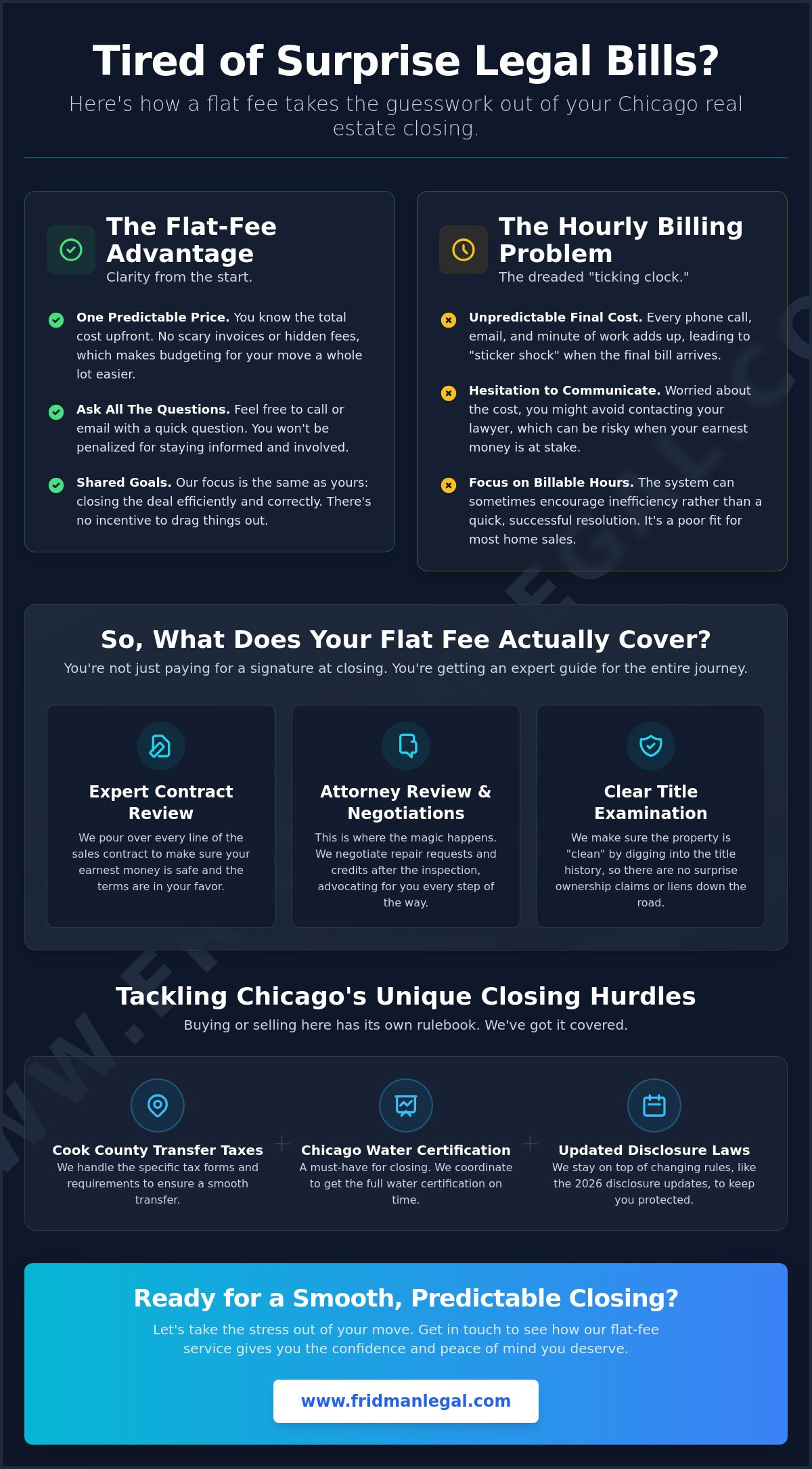
Think of a flat fee as a single, upfront price for everything your lawyer does to get you from an accepted offer to the moment you get your keys. It's a straightforward agreement where you pay one set amount for a specific bundle of legal services. This is a big shift from the old way of doing things, where lawyers tracked every six minute increment of their day and billed you for it later. When you're looking at real estate closing attorney fees Chicago firms offer, the flat fee model is becoming the preferred choice for homeowners who want to avoid the stress of "the ticking clock."
Most standard residential moves follow a similar path. Because the steps are predictable for an experienced professional, there's no reason to keep you in the dark about the cost. The psychological benefit is huge. Moving is expensive and full of tiny, hidden costs that add up quickly. Knowing your legal bill is a fixed line item allows you to budget for your movers, your new furniture, and your down payment with total confidence. You get to focus on the real estate closing process itself, rather than wondering if every email update is adding another fifty dollars to your final invoice.
The Problem with Hourly Billing in Real Estate
Hourly billing works well for long, unpredictable court cases, but it's often a poor fit for buying or selling a home. If you have a simple question about a repair credit or a concern about a title finding, you should feel free to pick up the phone. Under an hourly model, those small questions often turn into large, unexpected legal invoices that arrive weeks later. This system can actually discourage you from talking to your lawyer, which is the last thing you want when your earnest money is on the line. Real estate transactions are uniquely suited for a flat rate because the milestones are well defined. We know exactly what needs to happen to get the deal done.
Transparency as a Standard, Not an Extra
When a law firm operates on a flat fee basis, it forces them to be incredibly efficient and organized. There's no incentive to drag things out or make processes more complicated than they need to be. At Fridman Legal, we see this as a way to align our goals with yours. We both want a smooth, fast, and successful closing. Having a predictable fee on your final closing disclosure means there are no arguments or "sticker shock" at the end of the transaction. We prioritize setting these clear expectations from your very first consultation, ensuring that our partnership is built on trust and professional integrity from day one.
What Does Your Flat Fee Actually Cover?
When you look into the real estate closing attorney fees Chicago firms offer, you're usually buying peace of mind. It isn't just about a lawyer showing up at a title company for an hour. It's about the weeks of work that happen before you ever sit down to sign. A flat fee covers a comprehensive suite of services designed to move your property transfer from "under contract" to "closed" without any legal loose ends. While real estate attorney fees can vary based on the complexity of the deal, a standard residential flat fee typically includes several non-negotiable tasks.
- Contract Review: We examine every line of your sales contract to make sure your earnest money is protected and the terms are fair.
- Attorney Review Period: This is the window where we negotiate the finer points of the deal with the other party's counsel.
- Document Preparation: We draft the essential legal instruments, including the Deed, Bill of Sale, and various affidavits required by Illinois law.
- Lender Coordination: We work directly with your mortgage company and the title agency to align the numbers and the paperwork.
- Title Examination: We dig into the title commitment to ensure you're getting a "clean" property with no surprise liens or ownership disputes.
The Attorney Review and Inspection Phase
In Chicago, the first five business days after a contract is signed are the most critical. This is the attorney review and inspection period, and it's where most deals are either solidified or fall apart. We don't just read the fine print; we act as your advocate when the home inspection reveals issues. If the roof is leaking or the furnace is ancient, we handle the repair requests and credit negotiations. We explain these complex legal riders to you in plain English, so you aren't left guessing about what you're actually agreeing to. If you're feeling overwhelmed by a new contract, a quick consultation can help you understand your rights during this window.
Title Examination and Clearing Liens
Clearing title is the invisible part of the job, but it's vital for your mortgage approval. We review the title search to find old mortgages that weren't properly released or ancient property tax liens that could stall your closing. Our team handles the behind-the-scenes work of ordering payoff letters and the necessary municipal certificates. We make sure that when you take ownership, you're doing so with a clear title and no lingering debts from the previous owner. This proactive approach keeps the process moving and prevents last-minute surprises at the closing table.
Flat Fee vs. Hourly Rates: Making the Right Choice
Choosing between a flat fee and an hourly rate often comes down to how much financial risk you're willing to carry. For the vast majority of residential transactions, real estate closing attorney fees Chicago firms charge as a flat rate offer the best balance of value and protection. Hourly rates, which can range from $150 to $500 per hour in Illinois, generally make more sense when you're heading into a courtroom or a messy dispute where nobody knows how long the resolution will take. But for a standard move? You shouldn't have to pay for your lawyer's learning curve or administrative overhead.
There's a common myth that choosing a flat fee means you're getting a "discount" service or that your file will be handled with less care. In reality, it's quite the opposite. A fixed fee incentivizes your legal team to be proactive and highly organized. We want to identify title issues and inspection hurdles as early as possible because that's how we ensure a smooth path to the finish line for everyone involved. It transforms the lawyer into a strategic partner in your success rather than just a service provider billing for time.
The Predictability Factor for Home Buyers
If you're a buyer, especially a first-timer, your "cash-to-close" is the most important number on your radar. You've likely spent months saving for a down payment and calculating every cent to make the numbers work. The last thing you need is a fluctuating legal fee that changes your final balance at the eleventh hour. A flat fee covers the entire journey. It gives you a solid, immovable number to plug into your budget so you can focus on the logistics of your move rather than your lawyer's invoice.
Why Sellers Benefit from Fixed Pricing
Sellers have their own set of calculations to worry about, primarily their net proceeds after the sale. When you're already paying for municipal stamps, title insurance, and commissions, you want to know exactly what your "take-home" amount will be. Using a fixed pricing model helps you avoid that frustrating feeling of being nickeled and dimed for every document prep fee or short phone call. It keeps the professional relationship focused on the objective: a clean, successful transfer of property. For a deeper look at how this works in the local market, you can explore our real estate lawyer for closing guide. This approach ensures your interests are guarded without the anxiety of an open-ended bill.
Navigating Chicago and Cook County Specific Closing Hurdles
Every city has its own set of administrative quirks, but Chicago takes things to a different level of complexity. When you're comparing real estate closing attorney fees Chicago providers offer, you aren't just paying for a signature. You're paying for someone to handle the specific, often frustrating, red tape that is unique to Cook County and the City of Chicago. These local requirements can easily derail a closing if they aren't started weeks in advance. Our team specializes in managing these moving parts so they don't become 11th hour obstacles for your move.
Zoning and Water: The Chicago Red Tape
The City of Chicago requires a Full Payment Certificate (FPC) from the Water Department for every single property sale. This isn't just a quick online form. It's a formal process to prove that all water and sewer bills are paid in full. Without this certificate, the city won't issue the necessary transfer stamps, and you can't close. If you're selling a multi unit property, the city also requires a zoning certificate to verify the legal number of units. My best advice? Don't wait until the last week to start these requests. The city's timeline is often unpredictable, and we make it a priority to initiate these searches as soon as your contract is solidified.
Cook County Transfer Taxes and Stamps
Understanding who pays what in taxes is vital for your final budget. In Chicago, the total transfer tax rate is $5.25 per $500 of the sale price. This is split between the parties: the buyer is responsible for $3.75, while the seller pays $1.50. On top of that, Cook County charges a transfer tax of $0.50 per $1,000, and the State of Illinois adds another $1.00 per $1,000, both of which are traditionally seller costs. We calculate these numbers down to the penny so there are no surprises when you're sitting at the closing table. Our deep roots in Cook County and our proximity to Northbrook mean we know exactly how to navigate these municipal requirements efficiently. If you want to ensure your local taxes and certificates are handled with professional precision, you can learn more about our approach at Fridman Legal.
Managing these hurdles is part of the standard service we provide. By handling the water certifications, zoning checks, and transfer stamp applications, we allow you to focus on the logistics of your move. We believe that professional integrity means anticipating these local requirements before they have a chance to stall your transaction. It's about providing a smooth, predictable path from the initial offer to the final handshake.
Closing with Confidence: The Fridman Legal Advantage
Choosing a legal partner for your move is about more than just checking a box. It's about finding someone who has seen every possible curveball the Cook County market can throw at you. O. Allan Fridman brings nearly two decades of local Illinois legal experience to your transaction. While many firms treat you like a case number, we focus on providing a human-centric experience. We believe that real estate closing attorney fees Chicago homeowners pay should reflect not just the paperwork, but the strategic advocacy required to protect your biggest investment.
Our background is unique because we don't just handle standard closings. We also specialize in bankruptcy and complex financial restructuring. This gives us a distinct advantage if your sale involves a short sale, a foreclosure defense, or complicated lien issues that would stump a traditional real estate lawyer. We look at the whole picture to ensure your financial health is protected long after the closing date. We want you to walk away from the table feeling secure, not just finished.
A Personalized Approach to Every Transaction
We know that buying or selling a home is a major life milestone. It's often the culmination of years of saving and planning. Because of that, we don't believe in the "factory" model of law. You'll have direct access to our team throughout the process. Whether you have a quick question about your inspection credits or a concern about the title report, we stay accessible via phone and email. Best of all, because we use a flat-fee model, you don't have to worry about a surprise bill for every interaction. If you're ready to discuss your 2026 move, you can reach out through our contact page for a quick consultation.
Beyond the Closing Table
Our relationship with our clients often extends far beyond the day they get their keys. Once you're settled into your new home, it's the perfect time to think about the future. We frequently help our clients with estate planning to ensure their new asset is protected for the next generation. If life takes an unexpected turn, we're also here to help with debt settlement or other financial challenges. Our goal is to be your long-term strategic partner in the Chicago area. Contact us today to get a predictable, professional quote for your upcoming closing and experience the difference that true local expertise makes.
Secure Your Move with Professional Certainty
Navigating the Chicago property market in 2026 requires more than just a standard contract review. You need a partner who understands the granular details of Cook County transfer taxes and the specific hurdles of city water certifications. We have seen how a transparent, fixed-rate structure provides the peace of mind necessary to focus on your transition rather than your legal bill. By choosing a model that prioritizes efficiency and clear communication, you ensure that your earnest money is protected and your interests remain the top priority throughout the entire transaction.
When you work with Fridman Legal, you aren't handed off to a junior associate. Principal attorney O. Allan Fridman leads every representation, bringing nearly 20 years of specialized Illinois legal experience to the table. We believe that real estate closing attorney fees Chicago homeowners pay should be as predictable as the quality of the service provided. If you are ready to eliminate the guesswork from your upcoming transaction, take the first step toward a smooth transfer today. Contact Fridman Legal for a Flat Fee Closing Quote and move into your new home with total confidence.
Frequently Asked Questions
What is included in a typical flat fee for a real estate closing?
A standard flat fee covers the full scope of legal work from the moment your contract is accepted until the keys are handed over. This includes reviewing and negotiating the sales contract, handling the attorney review period, and examining the title commitment for liens. Your lawyer also prepares the Deed and Bill of Sale while coordinating with your lender and the title company to ensure all numbers align on the final settlement statement.
Are there any hidden costs that a flat fee lawyer won’t cover?
While the legal fee itself is fixed, you'll still be responsible for third-party costs like municipal transfer stamps, recording fees, and property surveys. These are considered separate from your lawyer's professional services. It's helpful to ask for a list of these expected out-of-pocket expenses early on so you can factor them into your overall moving budget without any last-minute surprises.
Do I really need a lawyer for a real estate closing in Chicago?
Illinois is a state that requires attorney representation for real estate closings to ensure all legal requirements are met. Beyond just following the law, having a local expert is vital for navigating the city's complex red tape, such as the Chicago Water Department's certification process. Your lawyer acts as a safeguard, protecting your earnest money and ensuring the property title is clear of any lingering debts or disputes.
How much are the typical attorney fees for a home sale in Illinois?
When researching real estate closing attorney fees Chicago homeowners typically find that prices vary based on the firm's experience and the complexity of the deal. Most residential lawyers in the area offer a flat-rate model for standard sales and purchases. This approach is generally more cost-effective than hourly billing, as it prevents your legal costs from escalating if a minor dispute arises during the inspection or appraisal phase.
What happens if my real estate deal falls through-do I still pay the flat fee?
Most firms have a specific policy regarding transactions that don't reach the closing table, often involving a reduced fee for the work performed up to that point. This "kill fee" covers the time spent on contract review and initial negotiations. It's a fair way to compensate the legal team for their effort while acknowledging that the full scope of the closing services wasn't required.
Can a flat fee lawyer help with both residential and commercial closings?
Many real estate lawyers handle both types of transactions, though commercial closings are significantly more complex and often require different fee structures. Commercial deals involve deeper due diligence, such as environmental reports and complex lease reviews, which may not fit into a standard residential flat-fee model. It's best to discuss the specific needs of your business property to determine the most appropriate billing method for your situation.
How soon should I contact a real estate lawyer after my offer is accepted?
You should contact your lawyer as soon as your offer is accepted, as the critical five-day attorney review period begins immediately. In some cases, it's even better to have a lawyer lined up before you submit an offer, especially in a fast-moving market. Early involvement allows your legal team to review the contract terms before the clock starts ticking on your inspection and financing contingencies.
Does the flat fee include the cost of title insurance?
Title insurance is a separate cost from your legal fee and is typically paid as a one-time premium at the time of closing. While your lawyer reviews the title commitment and works to clear any liens, they don't set the price for the insurance policy itself. In a standard Illinois sale, the seller usually pays for the buyer's owner's policy, while the buyer pays for their own lender's policy.

Article by
O. Allan Fridman
O. Allan Fridman has been practicing law since 2001. His practice is unique in that he does not view himself as a litigation attorney or transactional attorney. Rather, he views each area of law as a tool to pursue the best results for his clients. By practicing in both areas of law, he is able to take a 360-degree view of law. This enables the firm to catch potential drawbacks that are readily identifiable.
By practicing in litigation and transactional law and taking a holistic approach in dealing with our clients, he doesn’t put clients in box — rather, as we are all individuals, so too are the legal services we may require.
Whether it is bankruptcy or litigation or transactional, each client brings challenges and does not fit in any one box. Often times, bankruptcy clients end up not filing bankruptcy because we can achieve a better result through litigation or through an out-of-court resolution with the lender, or through a real estate sale. On the other end of the spectrum, a litigation client with multiple issues and lawsuit may fare better in a bankruptcy.
Since 2001, Allan has practiced in states and federal court, and he is a member of the trial bar of the Northern District of Illinois and admitted in the Northern District of Indiana.
We are a debt relief agency. We help people file for bankruptcy relief under the Bankruptcy Code
The materials on this site are for informational purposes only and do not constitute legal advice. Viewing this site or contacting us does not create an attorney–client relationship, and you should not act or refrain from acting based on any information here without seeking professional legal counsel.


