
What if the legal notice delivered to your Northbrook or Chicago doorstep isn't the final word on your property's future, but rather the opening for a sophisticated legal counter-offensive? Receiving a Summons and Complaint from Cook or Lake County courts often triggers a sense of inevitable loss. You likely feel that the momentum of a major lending institution is impossible to halt once the judicial process begins. However, a robust foreclosure defense isn't merely a delay tactic; it's a strategic assertion of your rights under the Illinois Mortgage Foreclosure Law.
We recognize that the complexity of these proceedings, coupled with debts that often exceed the original principal, creates an environment of profound instability. This guide outlines the specific legal strategies and procedural defenses available to Illinois homeowners to challenge lenders and prevent foreclosure in 2026. You'll gain a clear understanding of the 210-day average timeline for judicial sales and the pathways toward a dismissed case or a successful loan modification. We'll examine how precise legal intervention transforms a period of uncertainty into a structured path toward financial recovery.
Key Takeaways
- Understand why Illinois’ judicial foreclosure requirement provides homeowners with superior procedural protections and more opportunities to challenge lender claims.
- Identify critical legal strategies, such as contesting a lender’s standing or service of process errors, to build a sophisticated foreclosure defense.
- Evaluate the strategic differences between procedural litigation and Chapter 13 bankruptcy to determine the most effective method for curing mortgage defaults.
- Recognize the vital procedural milestones, including the 90-day pre-foreclosure period and the strict 30-day window for filing a formal response to a summons.
- Learn how a disciplined, results-oriented legal approach provides the transparency and strategic oversight necessary to navigate complex litigation in Northbrook.
What is Foreclosure Defense in the Illinois Judicial System?
Foreclosure defense represents a methodical legal framework designed to scrutinize a lender's authority to reclaim a residential property. It isn't merely a request for leniency; it's a rigorous examination of whether the financial institution has adhered to every statutory requirement. To understand the gravity of these proceedings, one should first establish a clear baseline of What is Foreclosure? within a legal context. In Illinois, this process is governed by the Illinois Mortgage Foreclosure Law (IMFL), specifically 735 ILCS 5/15-1101, which mandates a judicial path for every case.
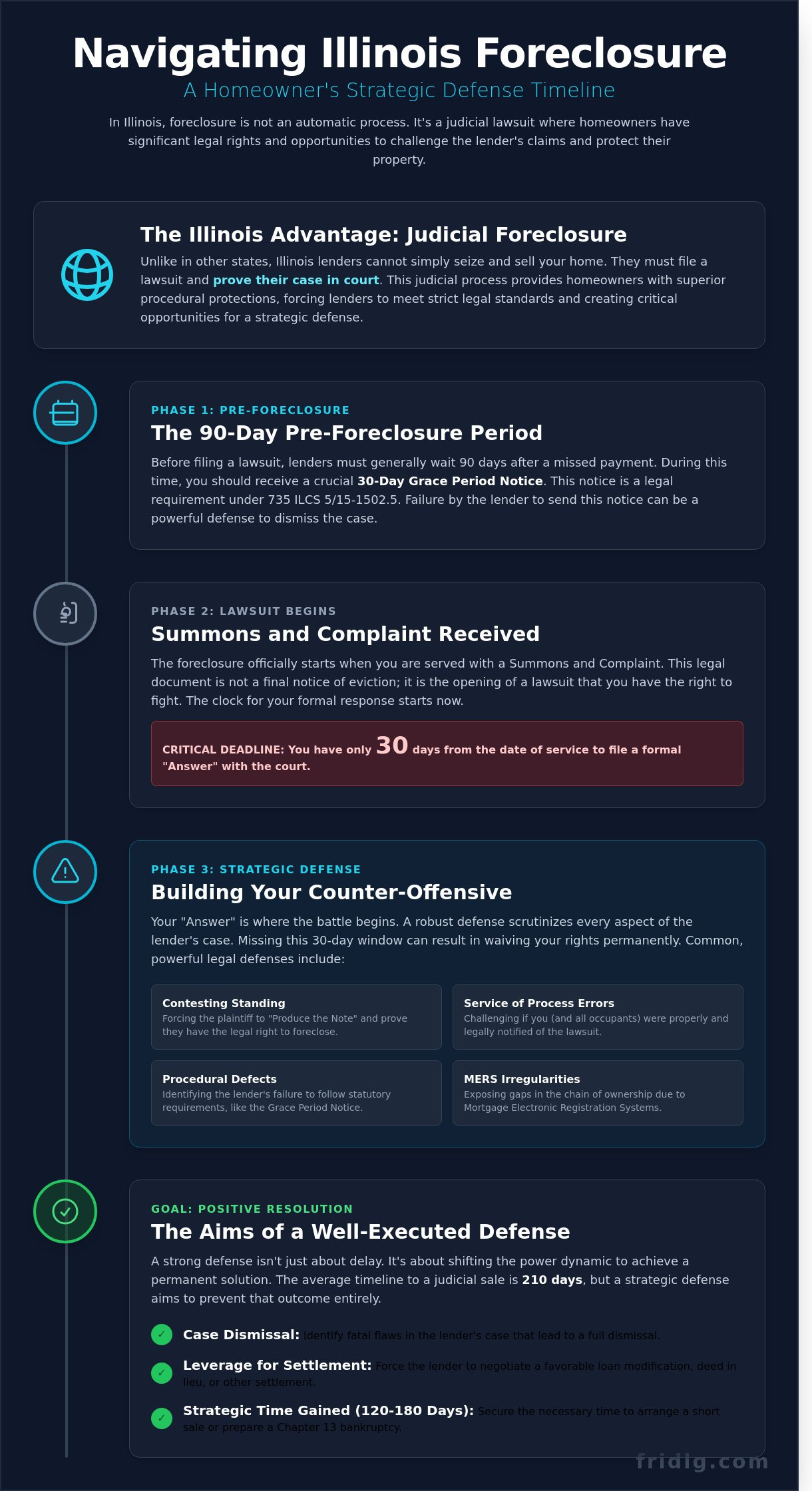
The distinction between a temporary delay and a permanent resolution is central to a sophisticated foreclosure defense. While some homeowners seek only to buy time, a professional defense focuses on identifying "Affirmative Defenses." These are legal arguments that, if proven, can invalidate the lender's claim entirely. In the courtrooms of Cook County and Lake County, the defense begins with the "Answer." This formal response to the summons must be filed within 30 days of service. It serves as the primary mechanism to challenge the lender's standing, such as their inability to produce the original promissory note or their failure to comply with federal loss mitigation requirements.
Why Illinois Homeowners Have a Fighting Chance
Illinois is a judicial foreclosure state, which provides a significant layer of protection compared to non-judicial states. Lenders can't simply sell a home at auction without a judge's oversight. They must prove their case through evidence that meets strict evidentiary standards. In 2023, Chicago courts continued to enforce high benchmarks for "service of process," dismissing cases where lenders failed to properly notify all occupants. Additionally, the Cook County Mandatory Foreclosure Mediation Program offers a structured environment where homeowners can engage in face-to-face negotiations with lender representatives, a process that often yields results that wouldn't be possible through automated servicer portals.
The Goal of a Strategic Defense
A well-executed foreclosure defense aims to shift the power dynamic between the homeowner and the institutional lender. By exposing servicer errors, such as misapplied payments or escrow inaccuracies, we create the necessary leverage for a favorable loan modification. This strategy often targets the following outcomes:
- Leverage for Settlement: Forcing the lender to consider a "deed in lieu" or "cash for keys" agreement to avoid prolonged litigation.
- Case Dismissal: Identifying procedural defects, like a failure to send the 30-day Grace Period Notice required under 735 ILCS 5/15-1502.5, which can lead to a dismissal of the complaint.
- Strategic Timing: Securing the 120 to 180 days often required to facilitate a short sale or to prepare a Chapter 13 bankruptcy filing for debt reorganization.
Precision in these filings is vital. A single oversight in the "Answer" can result in the waiver of rights that are impossible to reclaim later in the litigation cycle.
Common Legal Defenses to Challenge a Foreclosure Action
A foreclosure action isn't an inevitable conclusion; it's a formal litigation process where the burden of proof rests entirely on the plaintiff. Strategic foreclosure defense involves a meticulous audit of the lender's documentation and procedural history. If a lender fails to comply with the Illinois Code of Civil Procedure or federal mandates, the court may dismiss the case or force a significant settlement. Defenses often center on the lender's failure to follow strict legal protocols during the initiation of the lawsuit.
The 'Produce the Note' Defense
Standing is the legal requirement for a plaintiff to show they are the proper party to bring a suit. In the complex landscape of modern finance, mortgages are frequently bundled into mortgage-backed securities, often obscuring the clear chain of title required by law. The 2010 robo-signing scandal revealed that many financial institutions filed affidavits without verifying the underlying data. Challenging the role of Mortgage Electronic Registration Systems (MERS) can expose critical gaps in ownership records. If the plaintiff cannot prove they held the original promissory note at the moment the complaint was filed, their right to foreclose evaporates. This defense requires the lender to provide the original, wet-ink note to the court, a hurdle many institutions fail to clear due to administrative negligence.
Mortgage Servicing Errors and Federal Law
Federal protections provide robust mechanisms for homeowners to challenge servicer misconduct. The Real Estate Settlement Procedures Act (RESPA) allows for "Qualified Written Requests" to force a servicer to correct account errors. Under Regulation X, specifically 12 CFR § 1024.41, servicers are prohibited from "dual tracking," which is the practice of pursuing foreclosure while a loss mitigation application is pending. This protection is vital for homeowners in Northbrook and Chicago who are actively seeking modifications.
The Truth in Lending Act (TILA) offers additional leverage, particularly regarding the right to rescind loans that failed to provide accurate disclosures at the time of signing. These defenses often hinge on documenting misapplied payments, where a servicer fails to credit a monthly installment correctly, leading to an artificial default. Understanding the Illinois foreclosure process is essential for identifying these technical breaches and asserting your rights. For those facing these complexities, securing strategic legal counsel ensures that every procedural error becomes a shield for your assets.
- Service of Process Errors: If the plaintiff fails to serve the summons and complaint in strict accordance with 735 ILCS 5/2-203, the court lacks personal jurisdiction.
- Unfair and Deceptive Practices: Predatory lending or equity stripping can be challenged under the Illinois Consumer Fraud and Deceptive Business Practices Act.
- Escrow Mismanagement: Errors in calculating tax or insurance disbursements can invalidate the alleged default amount.
When a homeowner employs a targeted foreclosure defense, they shift the dynamic from passive loss to active litigation. This approach forces lenders to account for every dollar and every document, often revealing that the legal basis for the foreclosure is fundamentally flawed.
Defense vs. Bankruptcy: Comparing Your Debt Relief Paths
Choosing between litigation and insolvency proceedings requires a calculated assessment of your financial objectives. Foreclosure defense focuses on the procedural integrity of the lender's actions, identifying errors in the chain of title or violations of the Illinois Mortgage Foreclosure Law. Bankruptcy, however, shifts the battleground to federal court, where the focus moves from the lender's mistakes to your overall debt structure. Both paths offer protection, but they serve different tactical purposes in a comprehensive strategy.
- Foreclosure Defense: Targets legal standing and document veracity to dismiss the case or force a favorable settlement.
- Chapter 7: A liquidation process that discharges unsecured debts while providing a brief pause on property auctions.
- Chapter 13: A reorganization that allows homeowners to pay back mortgage arrears over a precise 36 to 60 month period.
Strategic integration often yields the best results for Chicago homeowners. We frequently use foreclosure defense to challenge the lender's claims, which buys critical months of time. This window allows for the preparation of a bankruptcy filing that provides a sustainable fresh start. Instead of reacting to the lender's timeline, you're dictating the pace of the legal process.
When Chapter 13 is the Superior Strategy
Chapter 13 provides a level of control that traditional negotiations rarely offer. It empowers you to force a lender into a repayment schedule they previously rejected during private loan modification attempts. This federal mandate is particularly effective for protecting equity in a Northbrook residence. Property values in the 60062 zip code have seen steady appreciation, and a Chapter 13 filing preserves that wealth from being liquidated in a sheriff's sale. The court-approved plan ensures that as long as you make your monthly payments, the lender can't resume the foreclosure process.
The Automatic Stay: Your Most Powerful Tool
The moment a bankruptcy petition is filed, a legal shield known as the automatic stay descends. Under 11 U.S.C. § 362, all collection actions, including scheduled foreclosure sales and harassing phone calls, must cease immediately. This isn't a request; it's a federal injunction that carries heavy penalties for lenders who ignore it. The psychological relief of this sudden silence allows for clear-headed strategic planning. The automatic stay remains in effect until the bankruptcy case is closed or the court grants 'relief from stay' to the lender through a formal motion and hearing. This protection is absolute and immediate, regardless of how close the property is to a final sale date.
The Illinois Foreclosure Timeline: Windows of Opportunity
The Illinois foreclosure process follows a strict judicial mandate. It's a structured timeline where every delay or action carries specific legal weight. The journey starts with the 120-day pre-foreclosure period. Federal regulations under 12 CFR § 1024.41 prevent lenders from filing a lawsuit until the account is four months past due. This window represents your primary opportunity for a non-litigious resolution. Strategic foreclosure defense often begins here, focusing on loss mitigation applications or loan modification requests before the court docket becomes involved. Once the lender files the complaint, the sheriff or a private process server delivers the summons. You have exactly 30 days to respond. This isn't a suggestion; it's a hard deadline. If you fail to file a formal Appearance and Answer within this timeframe, the court can enter a default judgment. This effectively strips you of your right to contest the lender's claims.Navigating the Cook and Lake County Courts
Procedural nuances vary significantly between the Daley Center in Chicago and the Lake County Courthouse in Waukegan. In the Cook County Chancery Division, the sheer volume of cases requires a disciplined approach to motion practice. Local Northbrook residents often find themselves caught between these two jurisdictions. Success depends on understanding the specific predilections of Lake County judges regarding prove-up affidavits. Mandatory mediation sessions are a critical component of the process. These sessions provide a court-sanctioned forum to negotiate with the lender's counsel under the supervision of a neutral mediator. Skipping these meetings is a tactical error that courts rarely forgive.
Critical Deadlines You Cannot Miss
- The 30-Day Answer: Your first and most vital defense against a default judgment.
- Reinstatement Period: Under 735 ILCS 5/15-1602, you have 90 days from the date of service to pay the past-due amount and costs to stop the case entirely.
- Redemption Period: This usually expires seven months after service or three months after the judgment date. It's the final date to pay the full loan balance to retain the property.
The process concludes with the judicial sale and the subsequent Order of Possession. Even after the gavel falls, the law typically provides a 30-day stay before you must vacate. Effective foreclosure defense ensures you utilize every hour of this timeline to protect your equity or secure a graceful transition. Our firm provides the strategic oversight needed to manage these complex judicial milestones with precision and authority.
Professional Representation for Northbrook Homeowners
Securing a home's future requires more than reactive measures; it demands a methodology rooted in precision and discretion. The Fridman Legal approach prioritizes results-driven litigation designed to protect high-value assets in the Northbrook and Chicago markets. We don't view a case as a mere file. It's a strategic operation where every motion and negotiation is calculated to maximize the homeowner's leverage against institutional lenders.
Financial transparency is foundational to our professional relationship. Homeowners facing a crisis don't need the added stress of unpredictable legal costs. Our firm utilizes flat-fee or structured hourly arrangements to provide a clear roadmap of expenses from the initial filing. This structure allows clients to focus on their financial recovery rather than billable hour fluctuations. Beyond the courtroom, we provide sophisticated debt negotiation and settlement services. We engage with creditors from a position of legal strength, often resolving disputes through restructuring before they reach a final judgment.
Why Experience Matters in Foreclosure Defense
Attorney O. Allan Fridman has practiced Illinois debt law since 2005, bringing nearly twenty years of specialized experience to the table. This tenure provides a distinct advantage in navigating the complexities of foreclosure defense. His deep understanding of both real estate transactions and bankruptcy law allows for a holistic strategy that "foreclosure mills" cannot replicate. While large firms often rely on automated processes and junior associates, our boutique firm provides the personalized attention required for complex litigation. We meticulously analyze the chain of title and servicing history of your loan to identify actionable lender errors that others might overlook.
Securing Your Financial Future in Illinois
Effective representation moves you from immediate crisis management toward a sustainable, long-term plan for financial stability. We act as your professional advocate, managing all formal communications with lenders and their legal counsel. This buffer provides the peace of mind necessary to make informed decisions about your property without the pressure of constant creditor harassment. Taking the first step with a professional consultation in Northbrook can shift your trajectory from uncertainty to a defined path of resolution. Contact Fridman Legal today for a strategic foreclosure defense consultation in Northbrook.
Our commitment to your case is absolute. We combine conservative legal values with a modern, strategic approach to debt resolution. By choosing a firm that understands the local Northbrook landscape and the nuances of Illinois courtrooms, you're investing in a defense that prioritizes your home and your dignity.
Securing Your Property Through Strategic Legal Intervention
Navigating the Illinois judicial system requires a precise understanding of the statutory timelines that govern your property rights. Whether you're identifying procedural errors by a lender or evaluating the relative benefits of bankruptcy versus a vigorous foreclosure defense, your strategy must be both calculated and timely. Homeowners in Northbrook, Cook County, and Lake County face a structured legal process where every filing deadline dictates the potential for a successful outcome. Procrastination often results in the loss of critical procedural leverage that cannot be recovered later.
Fridman Legal brings nearly 20 years of Illinois legal experience to these complex matters, integrating specialized knowledge in both real estate law and bankruptcy. This dual expertise ensures that your home isn't just a case file, but the focus of a comprehensive asset protection plan. Our Northbrook-based firm provides the disciplined, professional representation necessary to challenge institutional actions and preserve your equity. You don't have to navigate these windows of opportunity alone. Schedule a Strategic Foreclosure Defense Consultation with Fridman Legal to define your path forward and regain control of your financial future. Taking the first step today transforms a legal threat into a manageable, strategic process.
Frequently Asked Questions
Can I stop a foreclosure in Illinois after the lawsuit has already started?
You can stop a foreclosure in Illinois after a lawsuit begins through several legal mechanisms including reinstatement or redemption. Illinois law provides homeowners a 90 day window after service to reinstate the mortgage by paying the past due balance. If this window passes, the redemption period generally extends to 7 months after service or 3 months after the court enters a judgment of foreclosure. Strategic intervention ensures these timelines are utilized effectively to protect your property rights.
How long does the foreclosure process take in Cook County?
The foreclosure process in Cook County currently averages between 630 and 850 days from the initial filing to the final judicial sale. This timeline fluctuates based on the court's docket volume and the complexity of the legal challenges presented. While the Illinois Mortgage Foreclosure Law sets the framework, local procedural requirements in the Circuit Court of Cook County often extend the duration compared to neighboring collar counties.
What is the difference between a loan modification and foreclosure defense?
A loan modification is a permanent restructuring of your mortgage terms, while foreclosure defense involves asserting legal arguments to contest the lender's right to foreclose. Modification focuses on adjusting interest rates or extending loan terms to achieve a sustainable monthly payment. Conversely, defense strategies examine procedural errors, such as lack of standing or violations of the Truth in Lending Act, to dismiss or delay the proceedings entirely.
Can filing for bankruptcy really stop a foreclosure sale date?
Filing for Chapter 7 or Chapter 13 bankruptcy triggers an automatic stay under Section 362 of the U.S. Bankruptcy Code, which immediately halts a scheduled foreclosure sale. This federal injunction remains in effect until the bankruptcy case is resolved or the lender successfully petitions the court to lift the stay. Statistics indicate that approximately 15% of homeowners in the Chicago area utilize bankruptcy as a measure to preserve equity and restructure debt.
Do I have to move out of my house as soon as I receive a foreclosure notice?
You aren't required to vacate your residence upon receiving a foreclosure notice or even after the judicial sale occurs. In Illinois, you retain legal possession until the court enters an order confirming the sale and granting possession to the new owner. This confirmation hearing typically takes place 30 to 60 days after the auction. The sheriff's office won't execute an eviction until the 30 day stay of the possession order expires.
What happens if my lender cannot find the original promissory note?
If a lender cannot produce the original promissory note, they must provide a lost note affidavit as required by Section 3-309 of the Uniform Commercial Code. This document must prove the lender's right to enforce the instrument and explain the circumstances of the loss. Failure to provide sufficient evidence of standing often leads to a dismissal of the case, as the plaintiff must demonstrate they held the note when the lawsuit was filed.
Is it possible to win a foreclosure case without going to trial?
It's possible to prevail in a foreclosure action without a full trial by successfully arguing a Motion for Summary Judgment or a Motion to Dismiss. If the evidence shows there's no genuine issue of material fact, the judge can rule in your favor based on the written pleadings. Approximately 70% of successful foreclosure defense outcomes are achieved through these pre-trial motions or through negotiated settlements that occur during the discovery phase.
How much does a foreclosure defense attorney cost in the Chicago area?
Foreclosure defense attorneys in the Chicago metropolitan area typically charge an initial retainer fee ranging from $2,500 to $7,500 depending on the case's complexity. Many firms then transition to a monthly flat fee model, usually between $600 and $1,200, to cover ongoing litigation and negotiations. These costs are structured to provide predictable legal expenses while ensuring your defense is managed with the necessary technical precision and strategic oversight.

Article by
O. Allan Fridman
O. Allan Fridman has been practicing law since 2001. His practice is unique in that he does not view himself as a litigation attorney or transactional attorney. Rather, he views each area of law as a tool to pursue the best results for his clients. By practicing in both areas of law, he is able to take a 360-degree view of law. This enables the firm to catch potential drawbacks that are readily identifiable.
By practicing in litigation and transactional law and taking a holistic approach in dealing with our clients, he doesn’t put clients in box — rather, as we are all individuals, so too are the legal services we may require.
Whether it is bankruptcy or litigation or transactional, each client brings challenges and does not fit in any one box. Often times, bankruptcy clients end up not filing bankruptcy because we can achieve a better result through litigation or through an out-of-court resolution with the lender, or through a real estate sale. On the other end of the spectrum, a litigation client with multiple issues and lawsuit may fare better in a bankruptcy.
Since 2001, Allan has practiced in states and federal court, and he is a member of the trial bar of the Northern District of Illinois and admitted in the Northern District of Indiana.
We are a debt relief agency. We help people file for bankruptcy relief under the Bankruptcy Code
The materials on this site are for informational purposes only and do not constitute legal advice. Viewing this site or contacting us does not create an attorney–client relationship, and you should not act or refrain from acting based on any information here without seeking professional legal counsel.