

The Illinois home closing is a 45-day relay race where the first five days determine the finish line. While signing the contract feels like a victory, the home closing process timeline Illinois is actually just entering its most critical phase. It's natural to feel a sense of urgency mixed with a bit of anxiety about financing or potential title issues surfacing at the last minute. You want to know your interests are protected without getting lost in a paperwork storm.
We understand that the weeks between an accepted offer and getting your keys can feel unpredictable. This guide provides a clear and professional breakdown of exactly how long the process takes in 2026 and what you should expect at every stage. We'll explore the nuances of the attorney review period, the impact of current mortgage rates hovering around 6.625 percent, and the specific steps required to ensure your move-in day goes exactly as planned. With a predictable schedule in hand, you can focus on your move with total confidence.
Key Takeaways
- Most closings take 30 to 60 days, so we'll explain why the "effective date" is the single most important day for your moving schedule.
- You'll see how to use the first five days for inspections and attorney review to fix contract gaps before they become permanent.
- Get a clear breakdown of the home closing process timeline Illinois so you aren't left wondering what's happening during those seemingly quiet middle weeks.
- We'll walk through the mandatory 72-hour disclosure rule and the final walkthrough steps that ensure you're getting the home in the condition you expected.
- Learn how a litigation-minded legal review identifies and prevents common mistakes that could otherwise derail your financing or lead to future disputes.
What is the Typical Home Closing Process Timeline in Illinois?
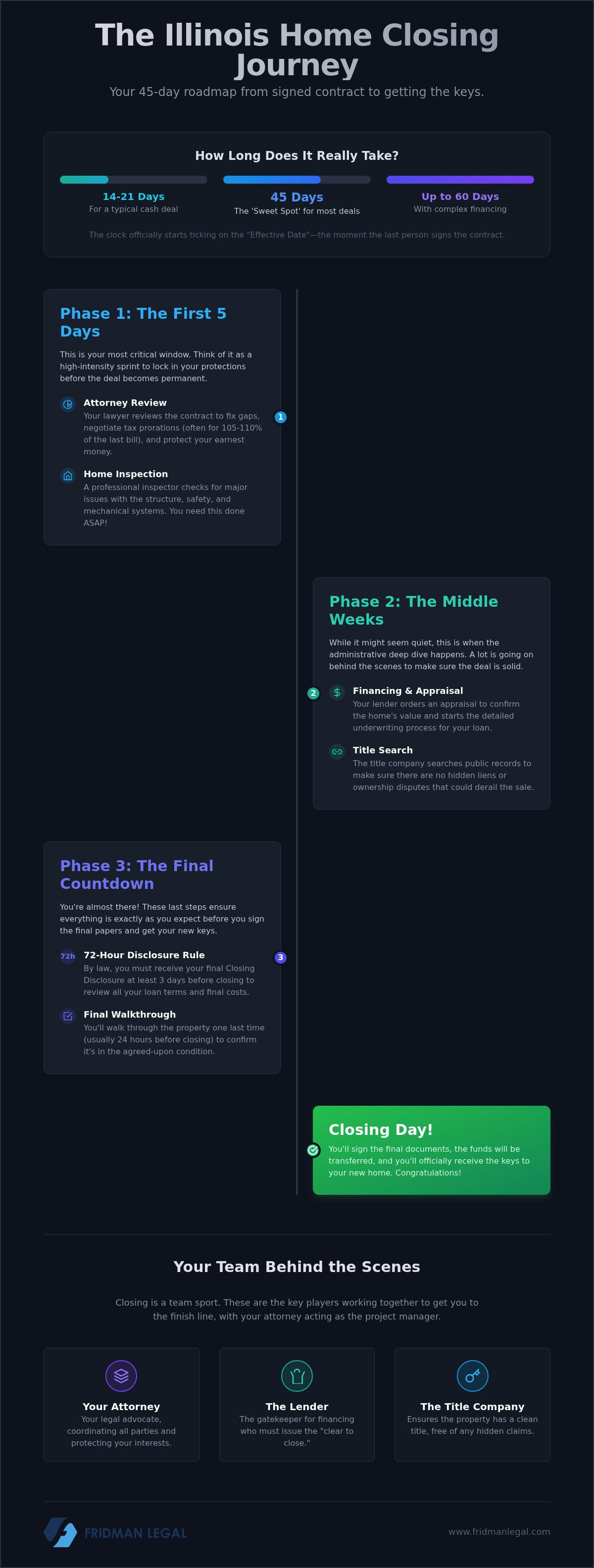
Most people expect the real estate closing process to be a quick sprint, but it's actually a structured sequence that usually spans 30 to 60 days. In areas like Northbrook and the surrounding Cook County suburbs, the home closing process timeline Illinois officially begins on the "effective date." This isn't just the day you made the offer; it's the specific moment when the last party signs the contract and every term is finalized. From this timestamp, every legal deadline starts ticking, and the clock won't stop until the keys change hands.
You can generally divide these weeks into four distinct phases that move the deal from a handshake to a legal transfer of property:
- Phase 1: The high-intensity window of attorney review and home inspections.
- Phase 2: The administrative deep dive involving the appraisal and title search.
- Phase 3: The financing marathon where lenders conduct final loan underwriting.
- Phase 4: The final countdown, including the walkthrough and document signing.
While some cash deals can wrap up in as little as two weeks, most transactions involve a mortgage, which adds layers of verification that naturally extend the calendar. Local factors in Cook County, such as the speed of property tax processing or title search backlogs, can also play a role in how fast you reach the finish line.
Why the 45-Day Mark is the 'Sweet Spot'
Lenders and title companies often aim for a 45-day window because it provides enough cushion for the unexpected. With 30-year fixed mortgage rates in Illinois currently averaging about 6.625 percent in 2026, banks are being particularly thorough with their underwriting. If your deal involves complex financing or significant repair negotiations after the inspection, you'll likely drift toward the 60-day mark. If you're paying cash, you can skip the appraisal and loan approval hurdles, often closing in 14 to 21 days.
Key Players Who Control the Clock
Several professionals work behind the scenes to control the pace of your closing. The lender is the primary gatekeeper during the final 14 days, as they must issue the "clear to close" before the title company can schedule the signing. Meanwhile, the title company works to ensure no hidden liens or ownership disputes exist. Your real estate attorney acts as the project manager for this entire timeline, coordinating between the buyer, seller, and bank. In a busy market like Northbrook, having a lawyer who understands local filing speeds can be the difference between a smooth move and a delayed truck.
The First Five Days: Attorney Review and Inspection
The first five business days after your contract is signed are arguably the most intense part of the home closing process timeline Illinois. Most transactions in the Chicago suburbs utilize the Multi-Board Residential Real Estate Purchase and Sale Agreement 7.0. This standard form includes a critical provision known as Paragraph 10, which triggers a five-day window for both the buyer's and seller's attorneys to review the terms. It's not just a formality; it's your primary chance to adjust the legal language to better protect your interests before the deal becomes set in stone.
Decoding the Attorney Review Period
During these five days, your lawyer isn't just checking for typos. They're looking at tax prorations, which are particularly complex in Cook County because property taxes are paid in arrears. Your attorney will negotiate whether you get a credit of 105 percent, 110 percent, or more to cover future tax bills you'll inherit. This is also the window where we ensure your earnest money is fully protected by specific contingencies. Common modifications in Northbrook often include clarifying who is responsible for local village inspections or adjusting the closing date to align with a move-out schedule. If you find a deal-breaker during this time, your lawyer can use this window to propose modifications or, if necessary, exit the contract entirely.
The Inspection Contingency Sprint
Parallel to the legal review, you must complete your professional home inspection. Don't wait until day three to call an inspector; you need them on-site within 48 hours to allow time for the written report. We focus on the "Big Three": structural integrity, safety hazards, and major mechanical systems. While you might be tempted to skip this in a competitive market, it's a massive risk. The CFPB's Home Buying Guide highlights why understanding these physical risks is as important as the financial ones. You can't fix a foundation issue as easily as you can repaint a wall.
Once the report is in hand, your attorney translates your concerns into a formal "Notice" or addendum. In Illinois, we generally recommend asking for repair credits rather than demanding actual repairs. Credits at closing are often cleaner and ensure you can hire your own contractors to do the work correctly after you own the home. If you're feeling overwhelmed by the technicalities, having an experienced residential real estate attorney can help you distinguish between a minor cosmetic fix and a genuine deal-killer. This notice process keeps the negotiation professional and ensures the deal stays alive while protecting your right to walk away if the seller won't budge on major safety issues.
The 'Quiet' Weeks: Financing, Title, and Appraisal
After you've cleared the high-intensity hurdle of attorney review and inspection, the pace of the home closing process timeline Illinois seems to shift. Many buyers call this the "waiting game," but don't let the lack of daily phone calls fool you. While you're busy packing boxes, your lender, title company, and attorney are deep in the administrative weeds. This phase is about verifying every claim made in the contract, from the home's actual market value to the cleanliness of its legal history. It's a period of high-activity for the professionals that ensures no surprises await you at the finish line.
The appraisal is usually the first major milestone in this window. A third-party appraiser evaluates the property to ensure its value matches your purchase price. If the value comes in lower than expected, it can trigger a new round of negotiations. You might need to bridge the "appraisal gap" with extra cash, or the seller might need to drop their price to keep the lender on board. This is where having a lawyer with litigation experience is invaluable, as they can help navigate these high-stakes pivots without the deal collapsing.
Managing the Mortgage Maze
During these middle weeks, your lender moves from "conditional approval" to "final approval." It's a sensitive time for your credit profile. We always advise clients to avoid large purchases, like a new car or expensive furniture, and to stay put in their current jobs. Even a small change in your debt-to-income ratio can derail your mortgage commitment. If you're looking for guidance on how to manage these moving parts, Fridman Legal's Real Estate Services provides the oversight needed to keep your financing on track. You haven't crossed the finish line until you receive that "clear to close" notification, which usually happens just a few days before the actual signing.
Title Searches and the Cook County Recorder
While the bank looks at your finances, your attorney looks at the property's history. We perform a deep dive into the Cook County Recorder's files to uncover any "clouds" on the title. This might include unpaid utility bills, old mortgages that weren't properly released, or even contractor liens from a kitchen remodel ten years ago. The Illinois State Bar Association's Home Buying Guide emphasizes that clearing these issues is essential for a "merchantable" title. In Northbrook and the Chicago suburbs, we also have to account for unique property tax prorations. Since Illinois taxes are paid a year behind, we calculate credits to ensure the seller pays for the time they actually lived in the home. Title insurance serves as your ultimate safety net, protecting you from any ownership disputes that might surface after you've already moved in.
The Final Countdown: Walkthrough and Closing Day
The finish line is finally within reach. After weeks of administrative checks and financial underwriting, you've arrived at the final stage of the home closing process timeline Illinois. This phase is defined by two critical events: the receipt of your final numbers and the physical verification of the property. While the heavy lifting of negotiation is behind you, this is the time for extreme attention to detail to ensure the house you're buying is exactly the house you're getting.
Everything starts with the "Clear to Close" from your lender. This isn't just a status update; it's the green light that triggers the 3-Day Rule. Federal law requires you to receive your Closing Disclosure (CD) at least 72 hours before you sign. This document outlines your final loan terms, monthly payments, and exactly how much cash you need to bring to the table. It's the perfect time to compare these numbers against your original Loan Estimate. You'll likely see the Illinois state transfer tax of $0.75 per $500 and the Cook County portion of $0.25 per $500 reflected here. If you're feeling uncertain about these final figures, it's wise to reach out for a final document review to ensure every credit is properly applied.
Before you head to the title company, you'll perform the final walkthrough. This usually happens 24 hours before the closing. You aren't looking for new defects here; you're verifying that the seller hasn't caused new damage during their move and that all agreed-upon repairs were completed. Check that the seller didn't take the chandeliers you negotiated for or leave a garage full of debris. If something is amiss, your attorney can often negotiate a "holdback" of funds at the closing table to cover the costs of fixing the issue.
The Closing Table Experience
In the Northbrook area, closings typically take place at a local title company office. You'll need to bring a valid government-issued ID and your "tired signing hand," as there are dozens of pages to initial. Most importantly, you'll need certified funds or a confirmed wire transfer for your closing costs, which in Illinois average about 3.1 percent of the purchase price. Your attorney will be there to explain every document, from the mortgage note to the deed, ensuring you understand the legal obligations you're assuming.
Post-Closing: Recording and Moving In
Once the last signature is dry and the lender funds the loan, you'll get the keys. However, the legal work continues behind the scenes. The title company will handle the recording of the deed with the Cook County Recorder of Deeds to officially put the world on notice that you are the owner. For a deeper look at what to expect during this meeting, see our Real Estate Lawyer for Closing Guide. After that, it's simply a matter of transferring the utilities into your name and changing the locks on your new front door.
How Fridman Legal Streamlines Your Illinois Closing
The home closing process timeline Illinois is often presented as a simple chronological checklist, but anyone who has navigated a suburban real estate deal knows that reality is rarely that linear. Unexpected title clouds, financing hiccups, or inspection disputes can easily turn a 45-day plan into a 90-day headache. This is where the value of nearly 20 years of experience becomes clear. At Fridman Legal, we don't just witness your closing; we actively manage the variables to ensure the finish line stays exactly where it was promised on day one.
O. Allan Fridman serves as the calm guide through the inevitable paperwork storm. Because our firm also handles civil litigation, we bring a unique perspective to contract review that many traditional real estate firms lack. We don't just look for typos or check boxes. We analyze your contract with a litigation-minded eye, identifying vague clauses or missing contingencies that could lead to future disputes or financial loss. By anticipating how a judge might interpret a term, we can tighten the language during the initial five-day review period, preventing "deal-killer" mistakes before they have a chance to manifest.
Personalized Representation in Northbrook
We've intentionally built a practice that prioritizes personalized, results-driven solutions over high-volume file processing. Your home purchase isn't just another number on a spreadsheet; it's a significant financial milestone that requires a proactive, not reactive, approach. In the Northbrook and Chicago markets, we frequently navigate complex scenarios that generic guides don't cover, such as estate-owned property sales or resolving historic liens that the title search unearths. If you're ready to move forward with a team that understands the local nuances of Cook County, you can contact Fridman Legal to schedule your contract review.
Beyond the Closing Table
Our expertise extends beyond the immediate transaction. Because we also specialize in debt relief and estate planning, we provide a holistic view of your financial health. A home is often a family's largest asset, and protecting it involves more than just a successful closing. We help our clients consider how their new property fits into their long-term legacy. For those looking to secure their future, our guide on Estate Planning in Northbrook offers essential insights into protecting your home for the next generation. Our goal is to provide the stability and predictability you need to move into your new home with total confidence.
Taking the Next Step Toward Your New Home
Understanding the home closing process timeline Illinois is the first step toward a stress-free move. We've explored how the high-stakes window of attorney review sets the foundation for your legal protection, while the middle weeks of financing and title searches ensure your investment is fundamentally sound. By the time you reach the final walkthrough, every detail should be accounted for, allowing you to focus on your future rather than the paperwork storm. The journey from an accepted offer to a handed-over key is a structured sequence that rewards those who are prepared.
With nearly 20 years of experience serving Northbrook, Chicago, and the surrounding suburbs, O. Allan Fridman provides the personalized oversight needed to navigate these complex moving parts. We handle the administrative heavy lifting so you can approach your closing day with total confidence and clarity. If you're ready to protect your interests and ensure a smooth transition, you can secure your home closing with Fridman Legal today. Your new front door is just a few weeks away, and we're here to help you cross the threshold with peace of mind.
Frequently Asked Questions
How long does the attorney review period last in Illinois?
The attorney review period typically spans five business days after the contract's effective date. During this window, your lawyer can propose modifications to the legal language or address issues like tax prorations and contingencies. If both parties can't reach an agreement on these changes within this timeframe, the contract may be terminated without penalty to either side.
Can I cancel a real estate contract during the inspection period?
Yes, you can generally cancel the deal if the professional home inspection reveals significant structural, safety, or mechanical defects. While minor cosmetic issues aren't usually grounds for termination, major problems like foundation cracks or a failing roof allow you to walk away. Your attorney will use the inspection report to either negotiate repair credits or formally notify the seller of your intent to cancel.
What are the typical closing costs for a buyer in Cook County?
In Illinois, buyers should expect closing costs to average approximately 3.1 percent of the home's purchase price. In Cook County, this includes the state transfer tax of $0.75 per $500 and the county's portion of $0.25 per $500 of value. These costs are on top of your down payment, so it's vital to factor them into your overall home closing process timeline Illinois budget early on.
Do I really need a lawyer for a home closing in Illinois?
Illinois is an "attorney state," which means a lawyer is almost always required to handle the closing process. Beyond custom, lenders and title companies rely on attorneys to review the deed, clear title issues, and ensure the legal transfer of property is flawless. Having professional representation protects your interests in a complex regulatory environment where a single paperwork error can lead to years of litigation.
What happens if the appraisal comes in lower than the purchase price?
A low appraisal creates an "appraisal gap" that must be resolved before the lender will fund the loan. You generally have three options: the seller can lower the price to match the appraisal, you can pay the difference in cash, or you can cancel the deal if your contract includes an appraisal contingency. Your attorney will help you navigate these negotiations to ensure you don't overpay for the property.
How much earnest money is standard in the Chicago suburbs?
Earnest money deposits in competitive markets like Northbrook and the Chicago suburbs typically range from 1 to 3 percent of the purchase price. This money is held in an escrow account and serves as a "good faith" deposit that is applied to your down payment at closing. It's a critical component of the home closing process timeline Illinois because it secures your position while you complete inspections and financing.
What is the 'clear to close' and when does it happen?
The 'clear to close' is the lender's final green light, indicating that all your financial conditions have been met and the loan is ready for funding. This milestone usually occurs three to seven days before the actual closing date. Once you receive this status, the lender will issue your Closing Disclosure, which triggers the mandatory 72-hour waiting period before you can legally sign the final documents.
Can a closing happen remotely in Illinois?
Yes, remote closings are possible through "mail-away" packages or by using a Power of Attorney (POA) for one of the parties. While some parts of the process are becoming more digital, Illinois still requires certain documents to be signed in the presence of a notary. If you can't attend the title company office in person, you must coordinate these alternative arrangements with your attorney and lender well in advance.

Article by
O. Allan Fridman
O. Allan Fridman has been practicing law since 2001. His practice is unique in that he does not view himself as a litigation attorney or transactional attorney. Rather, he views each area of law as a tool to pursue the best results for his clients. By practicing in both areas of law, he is able to take a 360-degree view of law. This enables the firm to catch potential drawbacks that are readily identifiable.
By practicing in litigation and transactional law and taking a holistic approach in dealing with our clients, he doesn’t put clients in box — rather, as we are all individuals, so too are the legal services we may require.
Whether it is bankruptcy or litigation or transactional, each client brings challenges and does not fit in any one box. Often times, bankruptcy clients end up not filing bankruptcy because we can achieve a better result through litigation or through an out-of-court resolution with the lender, or through a real estate sale. On the other end of the spectrum, a litigation client with multiple issues and lawsuit may fare better in a bankruptcy.
Since 2001, Allan has practiced in states and federal court, and he is a member of the trial bar of the Northern District of Illinois and admitted in the Northern District of Indiana.
We are a debt relief agency. We help people file for bankruptcy relief under the Bankruptcy Code
The materials on this site are for informational purposes only and do not constitute legal advice. Viewing this site or contacting us does not create an attorney–client relationship, and you should not act or refrain from acting based on any information here without seeking professional legal counsel.


