

Imagine walking into your HR office in Northbrook or Chicago only to find out that a creditor is legally entitled to take a chunk of your paycheck before you even touch it. It's a gut-punch that leaves you wondering how you'll cover a $1,500 rent payment or buy groceries for the week. You probably feel blindsided by the math and frustrated that your private financial business is now company knowledge. It's an exhausting cycle, but it's one that can be broken with the right legal strategy.
Consulting with a stop wage garnishment Illinois lawyer is the first step toward reclaiming your financial privacy and stability. You'll discover the exact legal mechanisms to halt these deductions and protect your income through strategic Illinois debt relief. We'll walk through the 2026 updates from Public Act 104-0898, including the new $1,000 automatic bank account exemption and why at least $675 of your weekly earnings is strictly off-limits to creditors. From filing a $338 Chapter 7 petition to navigating Cook or Lake County court proceedings, you're about to learn how to turn this legal trigger into a long-term plan for debt elimination.
Key Takeaways
- Get the facts on the 15% gross income cap and the 2026 exemption laws to find out exactly how much of your pay is legally off-limits to debt collectors.
- Discover how a stop wage garnishment Illinois lawyer uses a "Suggestion of Bankruptcy" to force an immediate freeze on all payroll deductions.
- Weigh the pros and cons of Chapter 7 versus debt negotiation to decide which strategy will actually clear your underlying debt for good.
- Learn the specific steps for reviewing a "Notice of Wage Interception" and how to handle the sensitive conversation with your employer's HR department.
- See why a boutique firm's 20 years of experience in Illinois courts offers a more reliable path to financial recovery than a generic high-volume agency.
Understanding Wage Garnishment Laws in Illinois (2026)
A Wage Deduction Order isn't just an aggressive collection letter; it's a formal court mandate that turns your employer into a collection agent for your creditors. In the Illinois legal system, this process typically begins after a creditor wins a lawsuit and files a "Memorandum of Judgment" with the county recorder. This document acts as a public lien, signaling that the creditor now has the legal right to pursue your assets, including the money you haven't even received yet. If you're currently seeing a portion of your check disappear, speaking with a stop wage garnishment Illinois lawyer can help you determine if the creditor followed these strict procedural steps correctly.
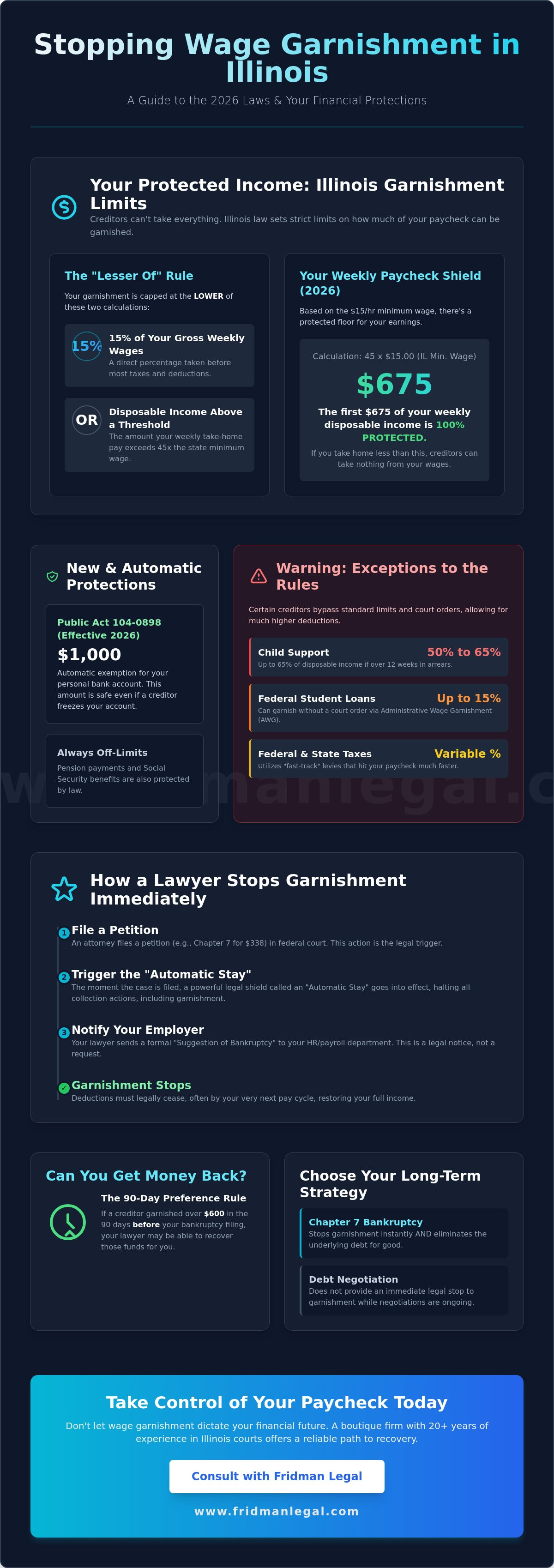
The math behind these deductions is often where the most confusion happens. A foundational part of Understanding Wage Garnishment involves the "lesser of" rule. Illinois law restricts garnishments to either 15% of your gross weekly wages or the amount by which your weekly disposable income exceeds 45 times the state minimum wage. The court is required to apply whichever number results in a lower deduction for you. It's a built-in protection designed to ensure you don't fall below a basic subsistence level, though it rarely feels like enough when you're trying to manage a household in Northbrook.
Illinois Garnishment Limits and Protected Income
With the Illinois state minimum wage set at $15.00 per hour for 2026, the math provides a specific safety net. At least $675.00 of your weekly disposable earnings is strictly protected from most consumer creditors ($15.00 multiplied by 45). If your take-home pay is less than this amount, the creditor shouldn't be able to take anything at all. Additionally, Public Act 104-0898, which took effect on January 1, 2026, introduced an automatic $1,000 exemption for personal bank accounts. This means even if a creditor tries to freeze your account after your check is deposited, that first $1,000 remains yours to keep. Pension payments and Social Security benefits also remain off-limits under these statutory exemptions.
Creditors That Bypass the Court Judgment Requirement
It's vital to recognize that not every creditor has to wait for a judge's permission. Certain governmental claims use Administrative Wage Garnishment (AWG) to bypass the traditional court system entirely. For instance, the U.S. Department of Education can garnish up to 15% of your pay for defaulted federal student loans without a prior court order. Unpaid federal or state taxes can lead to similar "fast-track" levies that hit your paycheck much faster than a credit card company could.
Child support is another unique category in Illinois. Depending on whether you're supporting another spouse or child, up to 50% or 60% of your disposable earnings can be withheld. If you're more than 12 weeks behind, that number can even climb to 65%. Because these deductions don't require the same lengthy court process, your window to seek counsel and stop wage garnishment Illinois lawyer intervention is significantly smaller. Acting before the first deduction occurs is the only way to maintain control over your monthly budget.
How an Illinois Lawyer Stops Wage Garnishment Immediately
When your paycheck is on the line, you don't have weeks to wait for a solution. A stop wage garnishment Illinois lawyer typically uses the federal court system to pull the emergency brake on collection efforts. By filing a petition in the Northern District of Illinois, your attorney triggers a legal shield that works instantly. Once that case number is generated, your lawyer sends a formal "Suggestion of Bankruptcy" to your employer's payroll or HR department. This isn't just a polite request; it's a legal notification that the garnishment must stop. If you're working in Northbrook or the surrounding suburbs, your HR manager might not be familiar with every nuance of the Federal Wage Garnishment Law, so having a professional handle this communication ensures the deductions end by your next pay cycle.
There's also a high probability of getting some of your money back. Under the 90-day preference rule, if a creditor has seized more than $600 in the 90 days before your filing, your lawyer may be able to recover those funds. This is a technical process, but it's often the only way to claw back income that was seized just before you sought help. Many people assume that money is gone forever, but federal law provides this specific window to restore your liquidity. If you're curious about whether your recent deductions qualify for recovery, you can reach out for a professional review of your case details.
The Power of the Automatic Stay in Bankruptcy
The moment your case is filed, 11 U.S.C. § 362 goes into effect. This federal injunction, known as the "Automatic Stay," halts every single collection action against you. In Cook County, creditors who ignore this stay face severe penalties, including paying for your legal fees and additional damages. It's much more powerful than a standard court appeal because it doesn't require a judge's signature for every single creditor; it's a blanket protection that starts the second your lawyer hits "submit" on the filing.
Challenging Garnishments in Cook and Lake County Courts
Not every situation requires bankruptcy. If there were procedural errors, like a creditor failing to serve you properly with the Wage Deduction Summons, your lawyer can file a Motion to Vacate Judgment. For Northbrook residents, this usually means appearing at the Skokie courthouse or the Daley Center in Chicago. If you're further north in Lake County, these battles happen at the Waukegan courthouse. Identifying these technical flaws can often dismantle the creditor's entire case and stop the deduction without a federal filing.
Bankruptcy vs. Debt Negotiation for Garnishment Relief
Deciding how to handle a garnishment often comes down to one question: are you trying to save this month's paycheck, or are you trying to save your entire financial future? While both bankruptcy and debt negotiation can halt a deduction, they work in very different ways. For many households in Northbrook, where the cost of living is significantly higher than the state average, a 15% loss in gross income can be the difference between making a mortgage payment and facing foreclosure. Choosing a stop wage garnishment Illinois lawyer who understands these local pressures is vital for making a strategic choice that actually sticks.
Bankruptcy offers a clean break, but negotiation might be better if you only have one or two specific debts. The timing matters more than anything else. If a creditor hasn't secured a judgment yet, you have much more leverage to settle for a lower amount. Once they've already started taking money from your check, their incentive to settle for less than the full amount drops significantly. You also have to consider the cost of the fix itself. Most bankruptcy filings are handled on a flat-fee basis, which is often more predictable than the hourly rates associated with long-term litigation or complex settlement talks.
When Chapter 7 is the Strategic Choice
Chapter 7 is often the most efficient path for wiping out unsecured debt like credit cards or medical bills. To qualify in 2026, you'll need to pass the Illinois Means Test, which compares your household income against the state's median for a family of your size. It's a structured process that leads to a full discharge of most debts within about four to six months. For a deeper look at this process, check out our guide on Chapter 7 Bankruptcy in Northbrook, IL: A Strategic Guide to Debt Relief. It's the most powerful tool available to stop a deduction immediately and permanently.
Alternatives to Bankruptcy: Strategic Debt Settlement
If you have access to a lump sum of cash, debt settlement might be a viable alternative. This involves negotiating with the creditor to accept a percentage of the total debt, often between 40% and 60%, in exchange for releasing the Wage Deduction Order. However, doing this without professional help is risky. Creditors often use high-pressure tactics to get you to sign agreements that don't actually resolve the underlying judgment or remove the lien. You can learn more about this approach in our article on Debt Settlement Lawyer in Northbrook, IL: A Strategic Guide to Debt Relief. A stop wage garnishment Illinois lawyer can ensure any settlement you reach is legally binding and permanently ends the creditor's claim.
Steps to Take When Your Paycheck is Threatened in Northbrook
Receiving a "Notice of Wage Interception" is often the first moment the reality of a judgment truly sets in. It's a stressful document to read, but you need to check it for accuracy immediately. Errors in the amount claimed or even the identity of the creditor happen more often than you'd think. Once you've verified the document, your next stop should be the HR department. While it feels embarrassing, being proactive with your employer's payroll team is essential. Tell them you're in the process of seeking legal counsel to resolve the matter. This won't stop the legal requirement for them to withhold funds yet, but it sets the stage for when your stop wage garnishment Illinois lawyer sends over the formal stay or dismissal.
Before you sit down with an attorney, take an hour to map out your essential living expenses. In Northbrook or Chicago, "essential" looks different than it might in other parts of the country. List your rent, utilities, transportation, and healthcare costs. Proving that a deduction will cause an immediate inability to pay for basic necessities is a key part of building a hardship defense in the local courts. It's much easier to stop a deduction before the first one occurs than it is to claw back money that's already been sent to a creditor.
Documenting the Garnishment Order
Look closely at the paperwork to find the case number and the court of origin. If you're in Northbrook, the case might be filed in the Skokie branch of the Cook County Circuit Court or in Lake County's Waukegan courthouse. You'll also want to see if this is a "zombie debt", which is an old debt sold to a collector years ago, or a recent judgment. Requesting a copy of the "Affidavit for Wage Deduction Order" from your employer is a vital step in understanding exactly who is taking your money and why. This document contains the legal foundation the creditor is using to intercept your income.
Preparing for Your Initial Legal Consultation
To get the most out of your meeting, you'll need to be organized. Bring your last six months of pay stubs; this is a non-negotiable requirement for the Illinois Means Test if you're considering bankruptcy as a solution. Don't just focus on the one creditor garnishing you. List every debt you owe, from credit cards to personal loans. Your attorney needs the full picture to decide if you need a temporary fix or a total debt elimination strategy. If you're ready to take this step and protect your income, you can schedule a consultation with a stop wage garnishment Illinois lawyer to begin the process of reclaiming your financial stability.
Strategic Debt Relief with Fridman Legal in Northbrook
If your paycheck is being hit by a deduction, you don't just need someone to fill out forms. You need an advocate who actually knows the local judges and how they handle these cases. O. Allan Fridman has spent 20 years navigating the Illinois bankruptcy courts, and that experience is exactly what you want in your corner. We stay away from the "bankruptcy mill" model where you're just a case number. Instead, we offer a boutique experience where your financial stability is the priority. When you work with a stop wage garnishment Illinois lawyer at our firm, you're getting a strategy tailored to your specific situation, not a one-size-fits-all solution.
Integrity and transparency are vital when you're already feeling the pressure of debt. We use flat-fee structures for our Chapter 7 and Chapter 13 filings so you don't have to worry about surprise bills while you're trying to get back on your feet. Our commitment is to your long-term success, not just a quick fix that leaves you struggling again in six months. By focusing on professional integrity, we ensure that every petition we file is accurate, thorough, and designed to provide the maximum protection allowed under the 2026 Illinois legal guidelines.
Why Local Experience in Chicago Suburbs Matters
Dealing with courts in the Chicago suburbs requires a specific kind of local knowledge. The trustees and judges in the Northern District have their own ways of handling proceedings, and being familiar with those nuances matters. Since our office is right here in Northbrook, we're conveniently located for residents who don't want to trek into the city for every meeting. Whether your case ends up in the Daley Center or at the Lake County courthouse in Waukegan, having a stop wage garnishment Illinois lawyer who understands the local business climate gives you a distinct advantage.
Getting Started: Your Path to Financial Stability
Getting started is a straightforward process. It begins with a confidential strategy session where we look at your income, your debts, and your goals. We'll explain exactly what to expect when we prepare your petition and how the automatic stay will protect you from further collection efforts. If you're still researching, you might find our guide on Strategic Bankruptcy Lawyer in Chicago: Navigating Debt Relief in 2026 helpful for understanding the bigger picture. When you're ready to move forward, we're here to help you find your path back to financial stability.
Reclaim Your Financial Future Today
Facing a paycheck deduction is overwhelming, but you've seen that the 2026 Illinois legal updates provide specific shields to protect your livelihood. Between the new $1,000 automatic bank account exemption and the $675 weekly wage protection, you have legal rights that creditors cannot simply ignore. Whether you choose a strategic Chapter 7 filing to trigger an immediate federal stay or pursue a negotiated settlement, the most important step is acting before the next pay cycle hits your account. Waiting only gives creditors more time to intercept the income you need for rent and groceries.
Working with a stop wage garnishment Illinois lawyer ensures you aren't just reacting to a crisis but following a precise plan to eliminate the underlying debt. With nearly 20 years of experience in Cook and Lake County courts, our Northbrook based team provides the personalized representation you need to find stability. We offer flat-fee bankruptcy filing services so you know exactly what to expect from the start. Schedule a Strategic Debt Relief Consultation with Fridman Legal to stop the deductions and start fresh. You don't have to navigate these courtrooms alone; a clear path to recovery is within reach.
Frequently Asked Questions
Can an Illinois lawyer stop wage garnishment immediately?
Yes, a stop wage garnishment Illinois lawyer can halt deductions almost instantly by filing a federal bankruptcy petition. This action triggers the "automatic stay," which is a court order that stops all collection activities the moment your case is filed. Once your attorney provides the case number to your employer's payroll department, they're legally required to stop taking money from your check, often before your next pay date.
What is the maximum amount that can be garnished from my paycheck in Illinois?
In 2026, the maximum deduction is the lesser of 15% of your gross weekly wages or the amount by which your weekly disposable income exceeds $675.00. This $675.00 figure is calculated based on the Illinois minimum wage of $15.00 per hour multiplied by 45. These limits are designed to ensure you keep enough of your paycheck to cover basic necessities like rent and groceries.
Can I be fired in Illinois because my wages are being garnished?
No, your employer can't fire you simply because your wages are being garnished for a single debt. Federal law protects employees from termination for one garnishment, though these protections don't always apply if you have multiple garnishments from different creditors. It's often helpful to have your lawyer speak with your HR department to ensure they understand your rights and the steps you're taking to resolve the situation.
Will filing for bankruptcy stop a garnishment that has already started?
Filing for bankruptcy stops ongoing garnishments the moment the case is filed with the court. It doesn't matter if the creditor has already been taking money for months; the automatic stay forces them to stop immediately. In many cases, a stop wage garnishment Illinois lawyer can even help you recover funds that were seized in the 90 days leading up to your filing if the total amount exceeds $600.
How long does a wage garnishment last in Illinois if I do nothing?
A wage deduction order stays in effect until the entire judgment, including post-judgment interest and court costs, is paid in full. Because Illinois judgments carry significant interest rates, a debt that started at $5,000 can take much longer to pay off than you'd expect. Doing nothing usually results in losing thousands of dollars in extra interest payments over several years.
Can a creditor garnish my bank account and my wages at the same time in Illinois?
Yes, creditors can pursue both your wages and your bank accounts simultaneously, but new laws for 2026 provide better protection. Under Public Act 104-0898, the first $1,000 in your personal bank account is now automatically exempt from collection. This is a critical safety net that prevents a creditor from leaving you with a zero balance while they're also taking 15% of your paycheck.
How much does it cost to hire a lawyer to stop wage garnishment?
Most bankruptcy attorneys in the Chicago area use a flat-fee structure for Chapter 7 or Chapter 13 cases rather than billing by the hour. You'll also need to account for the $338 federal filing fee required by the court system. Investing in professional representation usually pays for itself by stopping the immediate loss of income and wiping out the underlying debt that caused the garnishment in the first place.
What debts cannot be stopped by filing for bankruptcy in Illinois?
Bankruptcy won't stop garnishments for domestic support obligations like child support or alimony. It also generally doesn't discharge recent tax debts or most federal student loans unless you can prove undue hardship in a separate proceeding. However, filing can still be a strategic move because it wipes out other debts, like credit cards, leaving you with more income to pay the obligations that can't be discharged.

Article by
O. Allan Fridman
O. Allan Fridman has been practicing law since 2001. His practice is unique in that he does not view himself as a litigation attorney or transactional attorney. Rather, he views each area of law as a tool to pursue the best results for his clients. By practicing in both areas of law, he is able to take a 360-degree view of law. This enables the firm to catch potential drawbacks that are readily identifiable.
By practicing in litigation and transactional law and taking a holistic approach in dealing with our clients, he doesn’t put clients in box — rather, as we are all individuals, so too are the legal services we may require.
Whether it is bankruptcy or litigation or transactional, each client brings challenges and does not fit in any one box. Often times, bankruptcy clients end up not filing bankruptcy because we can achieve a better result through litigation or through an out-of-court resolution with the lender, or through a real estate sale. On the other end of the spectrum, a litigation client with multiple issues and lawsuit may fare better in a bankruptcy.
Since 2001, Allan has practiced in states and federal court, and he is a member of the trial bar of the Northern District of Illinois and admitted in the Northern District of Indiana.
We are a debt relief agency. We help people file for bankruptcy relief under the Bankruptcy Code
The materials on this site are for informational purposes only and do not constitute legal advice. Viewing this site or contacting us does not create an attorney–client relationship, and you should not act or refrain from acting based on any information here without seeking professional legal counsel.


