

What if the 15% deduction appearing on your next paycheck isn't a clerical error, but the beginning of a multi-year legal seizure under Illinois law? For many residents in Chicago and Northbrook, receiving a notice from the Cook County Circuit Court feels like a sudden loss of control over their professional earnings. You've worked hard to build your career, and the prospect of a wage garnishment illinois order shouldn't be the final word on your financial future. It's understandable to feel that the legal system is working against you when your take-home pay is abruptly reduced without your consent.
We're committed to providing the precise legal intelligence you need to protect your assets and restore your financial stability. This 2026 guide outlines the strategic paths available to you, including how to verify that creditors haven't exceeded the 15% statutory cap or ignored valid exemptions. You'll discover how specific legal actions, such as a strategic bankruptcy filing, can immediately halt the garnishment process and restore your financial integrity. We'll examine the specific court procedures in the 1st Municipal District and the suburban Northbrook courthouse to ensure you're prepared for every stage of this challenge.
Key Takeaways
- Gain a precise understanding of the legal framework governing wage deductions and the specific roles of judgment creditors and garnishees under Illinois law.
- Learn to calculate the 15% cap on disposable earnings, a critical statutory limit that offers more robust protection for your income than federal regulations.
- Identify the specific categories of exempt income, such as public assistance and disability benefits, that are legally protected from creditor reach.
- Assess strategic defenses, including improper service or expired statutes of limitations, to effectively contest a wage garnishment illinois action.
- Discover how the federal automatic stay provides an immediate injunction against collection efforts, offering a permanent path to discharging underlying debt.
Understanding Wage Garnishment in Illinois and Cook County
Wage garnishment in Illinois is a court-ordered deduction that requires an employer to withhold earnings. Under the Illinois Code of Civil Procedure, specifically 735 ILCS 5/12-705, this mechanism allows a party who has secured a legal victory, known as the Judgment Creditor, to collect outstanding debts directly from your compensation. The entity tasked with the actual withholding of these funds is your employer, whom the law defines as the Garnishee. Understanding Wage Garnishment in Illinois is a prerequisite for any professional navigating debt recovery because the process isn't instantaneous; it demands a formal judgment from a court of competent jurisdiction before any capital is diverted.
The sequence leading to a wage garnishment illinois order typically starts when a resident fails to meet a financial obligation to a credit card issuer, medical provider, or local lender. If the delinquency persists, the creditor initiates a lawsuit within the Cook County Circuit Court system. It's critical to distinguish this procedure from a non-wage garnishment. While a wage deduction targets your recurring income over time, a non-wage garnishment, often called a bank levy, permits a creditor to seize the entire balance of a checking or savings account in one discrete action.
The Legal Timeline in the Chicago Suburbs
Creditors must adhere to a rigid procedural schedule before a Northbrook employer can legally withhold pay. You'll receive a summons followed by a notice of judgment. Subsequently, the creditor must file an Affidavit for Wage Deduction Order. This sworn statement confirms the precise balance due and initiates the mailing of a Wage Deduction Notice. In the 2025 fiscal year, Cook County recorded a high volume of these filings, reflecting a strict approach by regional financial institutions toward debt enforcement.
Your Rights as a Resident of Northbrook
Illinois statutes offer robust protections to ensure that a wage garnishment illinois doesn't result in total financial insolvency or job loss. Employers are legally prohibited from terminating your employment because of a single garnishment order. You've also got the right to a formal hearing to contest the deduction's validity or the specific math used to calculate the amount. If the deduction exceeds 15% of your gross wages or leaves you with less than 45 times the state minimum wage, you can petition the court for a stay or an adjustment based on established hardship exemptions.
The 15% Rule: Illinois Wage Deduction Limits and Calculations
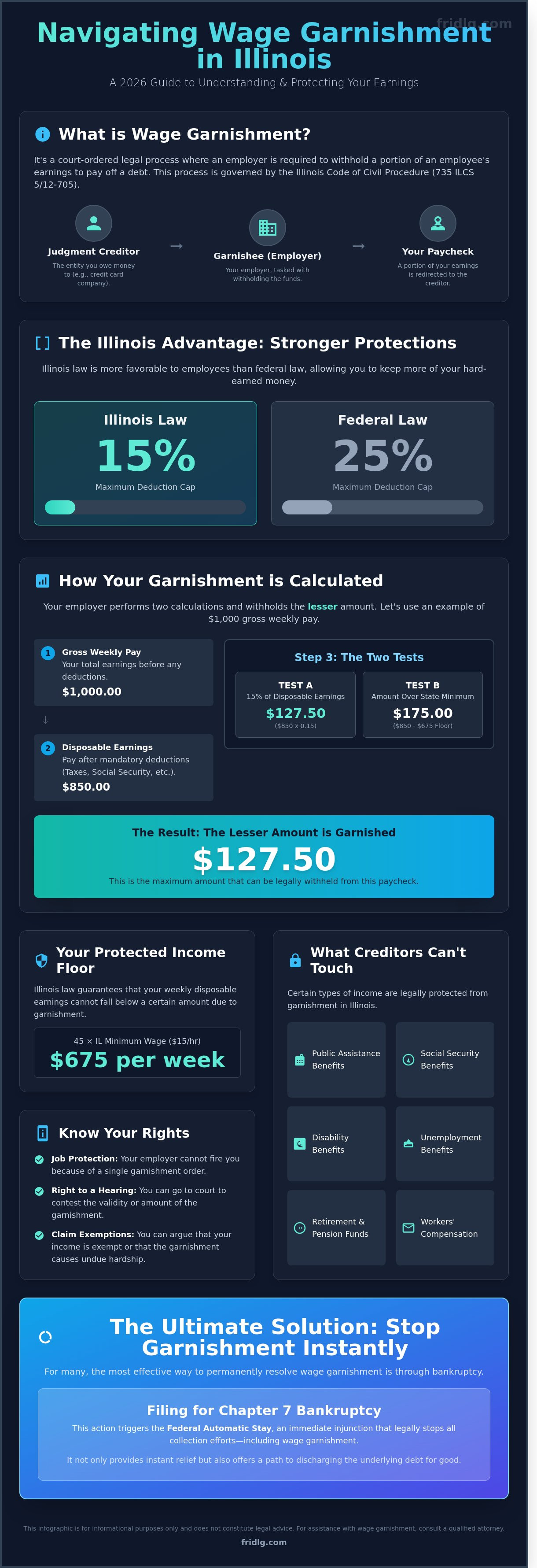
Illinois statutes provide a more robust shield for workers than federal standards. While federal law allows creditors to seize up to 25% of weekly earnings, Illinois wage garnishment laws strictly limit this to 15%. This cap represents the maximum aggregate amount that can be withheld. Even if a resident faces multiple judgment creditors, those creditors must wait in a chronological queue. They cannot stack their claims to bypass the 15% ceiling. This structure ensures that debt recovery efforts don't render a household insolvent.
The calculation hinges on "disposable earnings" rather than gross or net pay. Disposable earnings include the compensation remaining after legally mandated deductions. These mandatory subtractions include federal, state, and local taxes, along with Social Security and Medicare. Voluntary contributions, such as 401(k) deferrals, private health insurance premiums, or union dues, aren't subtracted when determining the disposable income base. Consequently, your actual take-home pay might be lower than the "disposable" figure the court uses.
Calculating Your Take-Home Pay Under Garnishment
To understand the impact in 2026, consider a Northbrook employee earning $1,000 in gross weekly wages. After mandatory tax withholdings, assume the disposable income is $850. The payroll department must perform two calculations to find the legal withholding limit. First, they calculate 15% of the $850, which equals $127.50. Second, they apply the Illinois minimum wage floor. State law protects an amount equal to 45 times the state minimum wage. With the Illinois minimum wage at $15.00 as of 2025, the protected weekly floor is $675. The employer subtracts this $675 floor from the $850 disposable income, leaving $175. The law requires the employer to withhold the lesser of the two results. In this specific scenario, the worker loses $127.50 per week.
Exceptions to the 15% Cap
Standard consumer debts like credit cards or medical bills adhere to the 15% limit, but specific obligations carry higher thresholds. Child support and alimony orders are significantly more aggressive; they can claim up to 50% or 60% of disposable earnings. Federal student loans generally follow a 15% limit but utilize administrative processes that bypass the need for a traditional lawsuit. Government entities acting as "super creditors" for unpaid taxes possess the broadest powers. The IRS uses internal tables that often leave debtors with only a minimal subsistence allowance. Understanding these distinctions is critical for effective strategic debt management and long-term financial stability.
Statutory Exemptions and Protecting Your Assets
Illinois law provides specific safeguards to ensure that debtors retain sufficient resources for basic subsistence. These protections, known as statutory exemptions, prevent creditors from seizing 100 percent of your assets during a wage garnishment illinois proceeding. Identifying which funds are "exempt" remains a critical first step in asset preservation.
Certain income streams remain entirely beyond the reach of judgment creditors. Under 735 ILCS 5/12-1001, the following benefits are protected:
- Social Security and SSI: Federal law prohibits the garnishment of these funds for most consumer debts.
- Public Assistance: Benefits such as TANF or SNAP are fully exempt from collection.
- Disability and Unemployment: Payments intended to replace lost income due to injury or job loss receive robust protection.
- Retirement Accounts: ERISA-qualified plans, including 401(k)s and most IRAs, are generally shielded from creditor claims to secure your future financial stability.
Beyond specific income types, the "Wildcard Exemption" serves as a versatile tool for residents. It allows for the protection of $4,000 in value for any personal property. This often applies to cash held in bank accounts that would otherwise be vulnerable to a third-party citation to discover assets.
Filing a Motion to Claim Exemption in Cook County
Protection isn't automatic; you must assert your rights through formal legal channels. Once you receive a notice of garnishment, the procedural clock begins. You have a narrow window, typically 20 to 30 days, to file a Motion to Claim Exemption with the Clerk of the Circuit Court of Cook County. Failing to meet this deadline often results in a waiver of your rights. Northbrook legal counsel plays a pivotal role here, ensuring that motions are drafted with the technical precision required to survive judicial scrutiny and successfully stop wage garnishment in Illinois before assets are liquidated.
Common Misconceptions About Exemptions
Strategic asset protection requires transparency. Hiding money by transferring it to relatives or offshore accounts is an ineffective and dangerous strategy that can lead to fraudulent transfer litigation. It's also vital to understand that Illinois residents must use state exemptions rather than federal ones, as Illinois has opted out of the federal exemption scheme. The Illinois wildcard exemption allows debtors to protect up to $4,000 of any personal property. Professional guidance ensures you leverage these rules legally rather than relying on hearsay or outdated online advice.
Legal Defenses: How to Stop or Challenge a Garnishment
A wage garnishment in Illinois isn't an irreversible mandate. It's a legal procedure subject to strict statutory scrutiny. Under 735 ILCS 5/2-203, service of process must be executed with absolute precision. If the original summons wasn't delivered correctly, the underlying judgment is void. We've audited cases where a 2019 judgment was based on service to an abandoned Northbrook address while the defendant lived in Chicago, rendering the current garnishment unenforceable. Illinois law also dictates a 10 year statute of limitations for judgment enforcement. If a creditor attempts to collect on an 11 year old debt without a formal revival, the action lacks legal standing. Residents often confuse Illinois law with other jurisdictions regarding the Head of Household exemption. Illinois doesn't provide this specific protection. You're instead limited to the statutory 15% cap or 45 times the federal minimum wage, whichever protects more of your income.
Strategic Debt Negotiation
Fridman Legal initiates contact with creditors to intercept a wage garnishment illinois before it reaches a payroll department. Creditors often prefer a 55% or 60% lump-sum settlement over a five-year collection cycle. This preference stems from the time value of money and the administrative burden of monthly tracking. Voluntary payment agreements offer more control than court-ordered deductions, though they require rigid adherence to prevent the immediate filing of a Wage Deduction Summons. Our firm analyzes the creditor's specific litigation history to determine their threshold for compromise.
Contesting the Garnishment Amount
Proving undue hardship requires more than a general claim of financial distress. In the Illinois court system, you must present a verified accounting of essential living expenses. This includes rent, non-discretionary utilities, and documented medical costs. A judge possesses the discretion to reduce the 15% deduction if it prevents you from maintaining basic necessities. Professional representation is vital in these civil litigation matters. Pro se litigants often fail to meet evidentiary standards, resulting in denied motions. Documenting these costs with 100% accuracy can mean the difference between financial stability and insolvency.
If you're facing an active deduction, proactive legal intervention is the only way to preserve your liquidity. Consult with our strategic litigation team to evaluate your defense options today.
The Ultimate Solution: How Chapter 7 Stops Garnishment Instantly
Filing for Chapter 7 bankruptcy provides an immediate legal barrier against creditors. This mechanism, known as the Automatic Stay, functions as a federal injunction under 11 U.S.C. § 362. It halts all collection efforts, including wage garnishment illinois proceedings, the moment your case is filed with the court. The relief isn't delayed; it's a decisive termination of the creditor's access to your payroll.
Speed is the most critical factor when your take-home pay is at risk. Our firm can often trigger the Automatic Stay within 24 hours of receiving your completed documentation. Beyond stopping the immediate loss of income, Chapter 7 serves to discharge the underlying debt entirely. This legal process permanently removes your obligation to pay the balance. In specific cases, we may recover funds seized within the 90 days preceding your filing. If the total garnished amount exceeds $600 during that period, federal law may allow us to return those funds to your pocket through specific exemptions.
Why Bankruptcy is Often the Most Cost-Effective Path
Mathematical reality often dictates that bankruptcy is the most conservative financial choice. A Northbrook resident earning a $70,000 annual salary faces a loss of $10,500 per year under a 15% garnishment order. Over two years, this loss totals $21,000. Comparing this to a one-time legal fee reveals a clear path to capital preservation. Fridman Legal operates on a flat-fee model for Chapter 7 filings, ensuring you understand the total investment required to secure your "Fresh Start." This philosophy focuses on long-term solvency rather than temporary fixes.
Taking the First Step with Fridman Legal
Preparation is the foundation of a successful filing. To begin the process of protecting your income, please bring the following items to your initial consultation in Northbrook:
- Pay stubs covering the last six months of employment.
- Tax returns from the previous two years.
- A comprehensive list of all outstanding debts and creditors.
- Any court documents related to current wage garnishment illinois orders.
O. Allan Fridman utilizes 20 years of specialized experience to navigate these complex federal filings. His approach combines technical precision with a strategic focus on asset protection. Schedule a consultation with Fridman Legal to stop your wage garnishment today.
Take Decisive Action to Protect Your Earnings
Navigating the complexities of wage garnishment illinois statutes requires a precise understanding of the 15% gross income deduction limit and the specific exemptions available under 2026 regulations. While state laws provide a baseline of protection, these statutory safeguards often fail to address the underlying cause of financial distress. Chapter 7 bankruptcy remains the most effective federal mechanism to trigger an automatic stay, which halts creditor collection efforts immediately upon the filing of your petition.
Fridman Legal provides strategic counsel backed by nearly 20 years of bankruptcy experience in the Northbrook and Chicago areas. Our local expertise allows us to offer transparent, flat-fee debt relief options that eliminate the financial ambiguity often associated with legal costs. We don't just provide basic information; we implement structured legal solutions designed to protect your earned income and restore your professional stability. If you're facing a court-ordered deduction in Cook County, it's time to assert your rights through a strategic defense or a comprehensive federal filing. You can regain control of your paycheck and move toward a predictable, debt-free future.
Stop Wage Garnishment Now - Contact Fridman Legal
Frequently Asked Questions
Can my employer fire me for having a wage garnishment in Illinois?
Illinois law and the Federal Consumer Credit Protection Act prohibit your employer from terminating your employment because of a single wage garnishment. This protection's designed to ensure that a single debt doesn't cost a worker their entire livelihood. However, these legal safeguards often vanish if you incur a second or third garnishment for different debts. Employers find the administrative burden of managing multiple court orders taxing, so maintaining a clear dialogue with your payroll department remains a strategic necessity.
How long does a wage garnishment stay in effect in Cook County?
A wage garnishment order in Cook County remains in effect until the judgment debt, including the statutory 9% annual interest rate, is fully satisfied. The Illinois Code of Civil Procedure ensures the deduction continues across pay periods without the creditor needing to refile monthly paperwork. If you change employers, the creditor's required to initiate a new proceeding to attach the order to your new source of income. It won't simply expire after a set number of months.
What is the maximum amount that can be garnished in Illinois in 2026?
The maximum wage garnishment illinois allows in 2026 is the lesser of 15% of your gross weekly wages or the amount by which your disposable income exceeds 45 times the state minimum wage. Since the Illinois minimum wage reached $15.00 per hour on January 1, 2025, the protected weekly threshold sits at $675.00. Calculations must strictly adhere to these statutory limits to prevent over-collection by judgment creditors. Accurate payroll accounting is vital to ensure these thresholds aren't breached.
Can I stop a wage garnishment without filing for bankruptcy?
You can stop a wage deduction without filing for bankruptcy by negotiating a lump-sum settlement or a voluntary payment plan directly with the creditor's counsel. Another viable path involves filing a Motion to Vacate Judgment under Section 2-1401 of the Code of Civil Procedure if you weren't properly served with the original lawsuit. Success in these maneuvers requires precise timing and a thorough understanding of Cook County procedural rules. It's often possible to reach an agreement that satisfies both parties.
Is Social Security income subject to wage garnishment in Illinois?
Social Security benefits are generally exempt from wage garnishment illinois proceedings under Section 207 of the Social Security Act. Creditors can't legally attach these federal funds for consumer debts like credit cards or medical bills. However, the government may still garnish these benefits for specific obligations including delinquent federal taxes or court-ordered child support payments. If your bank account contains commingled funds, you'll need to file an exemption claim to protect the Social Security portion from freezing.
What happens if I have multiple creditors trying to garnish my wages at once?
Illinois follows a first-in-time priority system where the first creditor to serve a wage deduction summons receives payment until their debt's cleared. Subsequent creditors must wait in a queue because the total deduction can't exceed the 15% statutory cap. This structured hierarchy prevents multiple collectors from simultaneously depleting your entire paycheck, ensuring you maintain the legally mandated minimum subsistence level. Once the first judgment's paid, the next creditor in line automatically begins receiving the deduction.
How quickly can an attorney stop an active wage deduction?
An attorney can often halt an active wage deduction within 24 to 48 hours by filing an emergency motion or a bankruptcy petition. The moment a case number's generated, the automatic stay or a court stay order takes effect, legally requiring the employer to cease all withholdings. Rapid intervention's critical because recovered funds already sent to a creditor are significantly harder to claw back. We focus on immediate communication with the creditor's law firm to ensure the payroll department's notified instantly.
Can a creditor garnish my bank account and my wages at the same time?
A creditor can legally pursue a wage deduction and a bank account garnishment, known as a non-wage garnishment, simultaneously. While the wage deduction targets your future earnings, the bank garnishment freezes assets already held in your accounts. Illinois law provides a $4,000 wildcard exemption that you can use to protect cash or personal property from such aggressive collection tactics. Utilizing this exemption requires filing a formal schedule with the court within the strict 21-day window after service.

Article by
O. Allan Fridman
O. Allan Fridman has been practicing law since 2001. His practice is unique in that he does not view himself as a litigation attorney or transactional attorney. Rather, he views each area of law as a tool to pursue the best results for his clients. By practicing in both areas of law, he is able to take a 360-degree view of law. This enables the firm to catch potential drawbacks that are readily identifiable.
By practicing in litigation and transactional law and taking a holistic approach in dealing with our clients, he doesn’t put clients in box — rather, as we are all individuals, so too are the legal services we may require.
Whether it is bankruptcy or litigation or transactional, each client brings challenges and does not fit in any one box. Often times, bankruptcy clients end up not filing bankruptcy because we can achieve a better result through litigation or through an out-of-court resolution with the lender, or through a real estate sale. On the other end of the spectrum, a litigation client with multiple issues and lawsuit may fare better in a bankruptcy.
Since 2001, Allan has practiced in states and federal court, and he is a member of the trial bar of the Northern District of Illinois and admitted in the Northern District of Indiana.
We are a debt relief agency. We help people file for bankruptcy relief under the Bankruptcy Code
The materials on this site are for informational purposes only and do not constitute legal advice. Viewing this site or contacting us does not create an attorney–client relationship, and you should not act or refrain from acting based on any information here without seeking professional legal counsel.