

A six-figure household income in Northbrook doesn't automatically disqualify you from a total liquidation of your unsecured debts. Many residents facing aggressive collection actions in Cook County assume their earnings are too high for relief, but federal law provides specific allowances for high-cost regions like the Chicago suburbs. If you've felt the pressure of mounting liabilities, you've likely asked, what is the means test for chapter 7, and whether your specific expenses can bridge the gap to eligibility.
It's understandable to feel overwhelmed by the technicality of federal bankruptcy forms or the fear of being pushed into a restrictive five-year repayment plan. This guide explains how the 2026 Illinois median income levels and local cost-of-living standards directly impact your ability to secure a full discharge. We'll analyze the strategic application of IRS local standards to ensure your filing is handled with the precision and professional integrity your financial situation demands.
Key Takeaways
- Understand the precise financial metrics used by the bankruptcy system to determine your eligibility for a complete debt discharge.
- Learn exactly what is the means test for chapter 7 and how your average income from the previous six months dictates your filing strategy.
- Discover why a high salary in Cook County does not automatically disqualify you, provided you utilize specific secured debt deductions like mortgages and auto loans.
- Stay informed on the 2026 Illinois median income thresholds and how biannual Census Bureau updates influence your household’s qualification status.
- Identify the strategic advantages of professional legal oversight in Northbrook to ensure your petition is meticulously optimized for court approval.
Understanding the Chapter 7 Means Test in Illinois
The means test serves as a statutory filter designed to ensure that the bankruptcy system remains a resource for those in genuine financial distress. Since the implementation of the Bankruptcy Abuse Prevention and Consumer Protection Act of 2005, this calculation has acted as a gatekeeper. It prevents what the court defines as "abuse" by identifying individuals who possess sufficient disposable income to repay a portion of their obligations. Understanding what is the means test for chapter 7 is essential for any Northbrook resident considering a fresh start through liquidation rather than a multi-year repayment plan.
For debtors with primarily consumer debt, the test is a mandatory procedural step. It creates a clear boundary between two distinct legal paths:
- Chapter 7 Discharge: A process that typically concludes within 120 days, resulting in the elimination of most unsecured debts.
- Chapter 13 Reorganization: A court-mandated repayment schedule lasting between 36 and 60 months, based on the debtor's projected earnings.
The legal framework assumes that if your income exceeds certain benchmarks, you should be redirected toward Chapter 13 to protect the interests of creditors. This objective assessment removes much of the judicial discretion that existed prior to 2005, replacing it with a rigid mathematical formula.
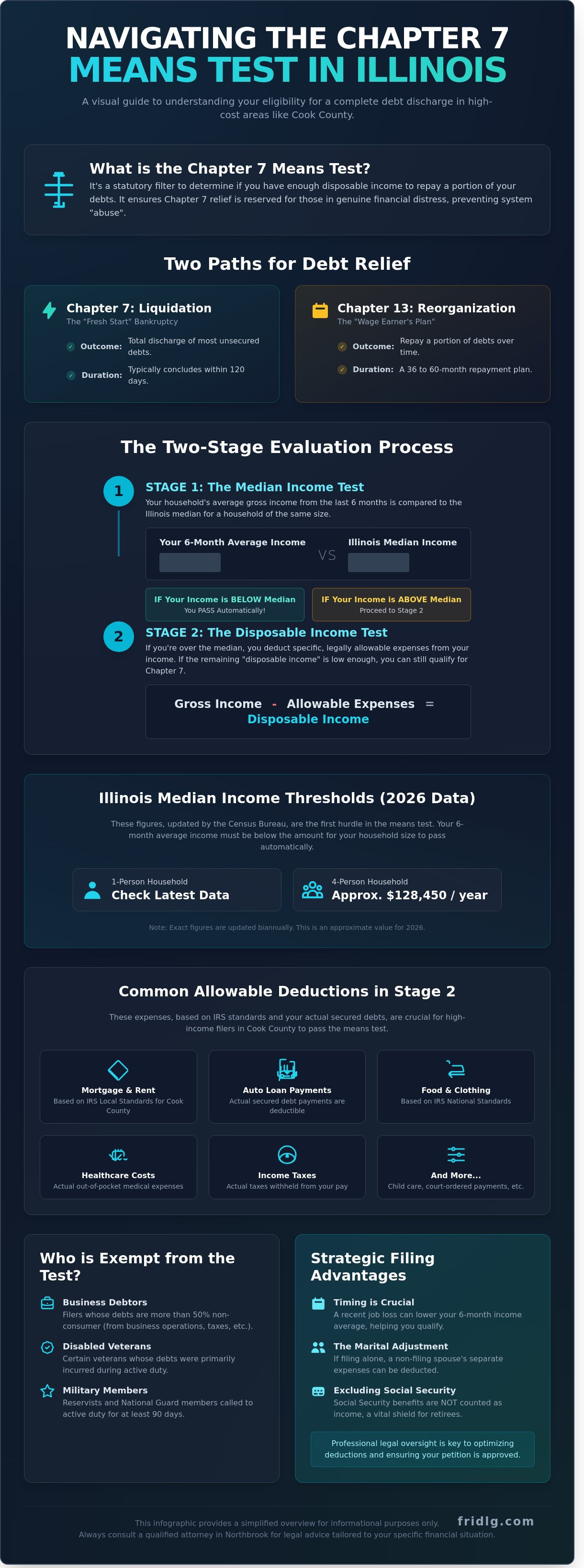
The Two Stages of the Means Test
The evaluation begins with Stage 1, where your average gross income from the six months preceding your filing is compared to the Illinois median. As of the most recent 2025 and early 2026 data, the median income for a single-person household in Illinois reflects the rising cost of living in the Chicago metropolitan area. If your income is below this median, you pass automatically; no further calculations are required. Stage 2 is only triggered if you exceed the median. In this phase, you must subtract IRS-approved living expenses from your gross income to determine "disposable income." If this final figure is negligible, you remain eligible for Chapter 7.
Who is Exempt from the Means Test?
Specific categories of filers are legally excused from these calculations. Disabled veterans whose debts were incurred primarily during active duty or while performing homeland defense activities are exempt. Furthermore, Northbrook entrepreneurs benefit from the "non-consumer debt" exception. If more than 50% of your total liabilities stem from business operations, taxes, or professional litigation, the means test doesn't apply to your case. Members of the National Guard and Military Reserve also receive exemptions if they were called to active duty for at least 90 days within a specific window before filing. These exceptions acknowledge that certain financial burdens fall outside the standard consumer bankruptcy profile.
How the Means Test Calculation Works: Income vs. Expenses
The calculation functions as a rigorous financial audit designed to determine if a debtor possesses the "means" to repay a portion of their obligations through a Chapter 13 reorganization instead of seeking a total discharge. To understand what is the means test for chapter 7, one must view it as a two-stage mathematical gatekeeper. The first stage aggregates your Current Monthly Income (CMI) over a precise 180-day look-back period. This figure is then compared against the Illinois median income for a household of your specific size.
In Northbrook, where the cost of living often deviates from state averages, the household size plays a pivotal role. As of 2026, the median income for a family of four in Illinois is approximately $128,450. If your CMI falls below this threshold, you typically qualify for Chapter 7 without further complex calculations. The CMI includes almost all revenue streams: gross wages, business income, rental income, and even financial contributions from non-filing household members. Notably, Social Security benefits are strictly excluded from this calculation under federal law, providing a vital shield for retirees in the 60062 and 60065 ZIP codes.
Calculating Your Current Monthly Income (CMI)
The timing of your filing is a strategic variable. Because the CMI is an average of the last six months, a sudden job loss or a period of reduced business revenue can lower your average enough to meet eligibility requirements. For married individuals filing alone, the "marital adjustment" allows for the deduction of the non-filing spouse's personal expenses, such as student loan payments or separate credit card debts. This ensures the calculation reflects the actual disposable income available to the filer. Precise reporting is mandatory; misrepresenting seasonal bonuses or fluctuating commissions can lead to a presumption of abuse by the U.S. Trustee.
IRS National and Local Standards
If your income exceeds the median, the second stage of the test applies. This involves deducting "allowable" expenses from your CMI to determine your disposable income. The IRS provides National Standards for food, clothing, and healthcare, but housing and transportation costs are calculated using local Northbrook standards. Given that Cook County property taxes and housing costs are 12% higher than the national average, these local multipliers are essential for a fair assessment. Effectively leveraging these deductions requires strategic tranzakciós támogatás to ensure every legitimate expense is accounted for within the legal framework.
- National Standards: Fixed allowances for food, apparel, and personal care based on family size.
- Local Housing Standards: Specific allowances for Cook County that reflect the premium cost of Northbrook real estate.
- Actual Expenses: Deductions for mandatory costs like taxes, insurance, and secured debt payments for homes or vehicles.
The final result of this calculation determines if your monthly disposable income is low enough to proceed. If the remaining amount is less than $160 per month, you generally pass. If it exceeds $265, a Chapter 7 filing is usually prohibited, necessitating a different debt relief strategy.
Common Deductions that Help Chicago Homeowners Pass
Earning a six-figure salary in Northbrook doesn't necessarily preclude you from debt relief. The calculation behind what is the means test for chapter 7 focuses on disposable income rather than gross earnings. In Cook County, where the cost of living remains 22% higher than the national average as of 2026, the IRS allows for significant adjustments that lower your "presumptive" ability to pay creditors. These deductions bridge the gap between a high top-line income and the reality of monthly financial obligations.
Housing and Transportation Deductions
Homeowners often find that their actual mortgage payment exceeds the standard IRS local housing allowance for Cook County. When calculating what is the means test for chapter 7, you can often deduct the full amount of your secured mortgage and property tax payments. This represents a critical advantage for Northbrook residents facing high local assessments. Similarly, transportation math includes both ownership and operating costs. If you commute via the Metra Union Pacific North line, those specific monthly transit costs are factored into your necessary expenditures. Car owners deduct standard operating costs plus actual loan or lease payments, which directly reduces the income considered available for unsecured creditors.
Other Necessary Expenses
Mandatory payroll deductions represent a non-negotiable reduction in your monthly cash flow. You'll account for federal and state income taxes, FICA contributions, and mandatory retirement payments required by your employer. Beyond taxes, the legal framework recognizes several essential costs that protect your family's stability:
- Court-Ordered Payments: Every dollar paid for child support or alimony is fully deductible from your means test income.
- Health Costs: Monthly premiums for health, dental, and vision insurance, along with documented out-of-pocket medical expenses, are subtracted.
- Special Circumstances: If you're providing care for an elderly relative or managing a chronic health condition, these documented "special circumstances" allow for deviations from standard IRS math.
The 2026 standards permit families to include charitable contributions up to 15% of their gross income. If you have a disabled child requiring specialized education services in the Northbrook School District 28 area, those tuition costs may also qualify. These granular adjustments ensure the test reflects your actual financial capacity rather than a theoretical average. This precision is why a high gross salary rarely tells the whole story in a Chapter 7 filing.
Illinois Income Thresholds and Local Standards for 2026
The first stage of determining what is the means test for chapter 7 involves a direct comparison of your gross household income against the Illinois median. These figures aren't static. The Census Bureau updates these benchmarks twice per year, usually in May and November, to reflect shifting economic conditions. For a Northbrook resident, the timing of your filing determines which specific data set the court applies to your case. If your income falls below the state median for your household size, you typically pass the test without further calculation.
2026 Median Income Estimates for Illinois
As of the first half of 2026, the following thresholds serve as the primary benchmarks for Illinois households. These figures represent a 3.4% increase from the previous year, reflecting regional wage adjustments in the Chicago metropolitan area.
| Household Size | Annual Income Limit (Estimated) |
|---|---|
| 1 Person | $72,140 |
| 2 People | $94,850 |
| 3 People | $112,200 |
| 4 People | $135,600 |
Exceeding these limits by even a small margin, such as $100, triggers the second, more complex phase of the means test. This stage requires a detailed analysis of your "disposable income" after accounting for specific allowable expenses. It's a strategic calculation where precision is mandatory. You don't automatically lose eligibility just because your salary is high; you simply face a stricter scrutiny of your actual ability to repay creditors.
Local Standards for Cook and Lake Counties
Northbrook's location spanning Cook and Lake Counties provides a unique advantage during the expense deduction phase. The IRS Local Standards recognize that housing and transportation costs in the Northern District of Illinois are substantially higher than in downstate regions. In 2026, the housing allowance for a family in Cook County remains approximately 42% higher than the allowance for similar households in rural Illinois counties. This adjustment allows you to justify a higher cost of living without it being labeled as "unreasonable" by the trustee.
Utility and heating costs are also factored into these local standards. Illinois winters necessitate specific allowances for climate-related expenses. When calculating what is the means test for chapter 7, we incorporate these regional variances to protect your standard of living. The court looks at the last six months of your financial history to ensure the budget is sustainable. For high-income earners in the 60062 zip code, these local standard deductions are often the deciding factor in achieving a successful filing.
To ensure your household data aligns with current judicial expectations, you should seek a strategic insolvency analysis to confirm your eligibility before submitting documentation to the court.
Navigating Your Bankruptcy Filing in Northbrook and Cook County
Filing a Chapter 7 petition in the Northern District of Illinois requires more than just completing paperwork. It demands a strategic understanding of how local trustees interpret financial data. Attempting a "pro se" filing often leads to procedural dismissal. Statistics from the Administrative Office of the U.S. Courts consistently show that self-represented debtors face a significantly higher risk of case failure compared to those with professional counsel. An experienced Northbrook attorney ensures your petition reflects your true financial reality by identifying every allowable deduction under the law.
The U.S. Trustee Program monitors all filings in Cook County to identify potential fraud or "substantial abuse." They specifically scrutinize your Form 122A-2 to determine if your disposable income exceeds the threshold for liquidation. If the math isn't perfect, you might face a motion to dismiss. Preparation for the Meeting of Creditors, also known as the 341 Meeting, is equally vital. While these meetings are often conducted via teleconference or Zoom in 2026, the legal scrutiny remains intense. You'll need to testify under oath regarding your assets and the accuracy of your means test calculations before a trustee in Chicago.
Why Precision Matters in Form 122A
A "presumption of abuse" occurs when the initial calculation suggests you have the capacity to repay a portion of your debt. This finding can stall your case or force a conversion to Chapter 13. Understanding what is the means test for chapter 7 involves knowing how to rebut this presumption through "special circumstances." O. Allan Fridman utilizes a meticulous approach to these calculations, accounting for non-obvious expenses like high-cost health insurance premiums or specific Cook County cost-of-living adjustments that less rigorous firms might overlook. We focus on protecting your eligibility through precise legal arguments and strategic documentation.
Next Steps for Debt Relief in the Chicago Suburbs
Achieving a successful discharge starts with organized documentation. You must gather your pay stubs from the last six months and your federal tax returns for 2024 and 2025. These records form the foundation of your filing. Once your records are compiled, we recommend scheduling a professional strategy session to review your specific figures. This ensures that when we file, the U.S. Trustee sees a clear, defensible picture of your financial hardship. Accuracy at this stage prevents delays in the 2026 filing cycle.
Take the first step toward financial stability today. Contact Fridman Legal for a Chapter 7 Evaluation and ensure your petition meets the highest standards of legal precision.
Strategize Your Path to Financial Recovery
Successfully navigating the 2026 Illinois income thresholds requires a precise analysis of your specific financial data. While the basic calculation compares your earnings against the state median, the real complexity lies in applying local Cook County standards and IRS-approved deductions. Understanding what is the means test for chapter 7 is only the first step in a strategic bankruptcy filing. Attorney O. Allan Fridman utilizes nearly 20 years of experience in Illinois law to identify every applicable deduction, ensuring your petition remains compliant and effective. We provide personalized representation and offer flat-fee options to maintain total transparency throughout your legal journey.
You don't have to manage these complex federal requirements alone. By choosing a boutique firm that prioritizes precision and strategic planning, you're securing a path toward long-term stability. Our team focuses on the technical details so you can focus on your future. Take the first step toward a fresh start by speaking with a professional who understands the local Northbrook landscape and the nuances of the 2026 regulations. Schedule a Consultation with a Northbrook Bankruptcy Attorney to discuss your options today. You're closer to a solution than you think.
Frequently Asked Questions
What happens if I fail the Chapter 7 means test in Illinois?
Failing the means test creates a presumption of abuse under Section 707(b) of the Bankruptcy Code. This doesn't mean you're denied relief; it simply redirects you toward a Chapter 13 repayment plan. In the Northern District of Illinois, approximately 30% of filers choose Chapter 13 to protect assets or because their disposable income exceeds the threshold. You'll need to prove special circumstances to overcome this presumption.
Can I still file for bankruptcy if my income is above the Illinois median?
You can still qualify for Chapter 7 even if your gross income exceeds the Illinois median by applying specific statutory deductions. The second part of the what is the means test for chapter 7 calculation incorporates IRS National Standards and local housing costs for Cook County. If your mandatory expenses, like high mortgage payments or tax debts, reduce your disposable income below $10,250 over five years, you'll pass.
Does Social Security income count toward the means test calculation?
Social Security benefits are strictly excluded from the current monthly income calculation according to the Social Security Act, 42 U.S.C. § 407. This exclusion applies to retirement, disability, and survivor benefits. While this income is invisible for the means test, it's still disclosed on Schedule I to show your actual budget. This distinction helps many Northbrook seniors qualify for debt discharge despite having stable monthly checks.
How often are the Illinois median income limits updated?
The U.S. Census Bureau updates Illinois median income figures twice annually, specifically on April 1 and November 1. These adjustments reflect changes in the Consumer Price Index and regional economic shifts. For a household of four in Illinois, the median income limit often fluctuates by $2,000 to $4,000 during these updates. It's vital to use the figures active on your specific filing date to ensure legal accuracy.
Are business debts treated differently in the Chapter 7 means test?
You're exempt from the means test if more than 50.1% of your total debt is classified as non-consumer or business debt. This business debt exception allows entrepreneurs to bypass income restrictions entirely. We analyze your credit report to categorize every liability, from commercial leases to personal guarantees. If your business-related obligations represent the majority of your debt, your income level won't prevent a Chapter 7 discharge.
What expenses are most likely to be challenged by the U.S. Trustee in Chicago?
The Region 11 U.S. Trustee in Chicago frequently scrutinizes private school tuition and vehicle ownership costs that exceed IRS Local Standards. If your housing expenses in Northbrook are 15% higher than the county average, you'll need documented proof of necessity. Expenses for luxury items or non-essential life insurance are also common targets for objection. Precise documentation is the only way to defend these items.
How does my spouse's income affect the means test if I file alone?
Your spouse's gross income is included in the initial calculation even if you're filing an individual petition. However, you can subtract your spouse's personal expenses, like their separate credit card payments or cell phone bills, through the marital adjustment. This ensures only income actually contributing to your household support affects the what is the means test for chapter 7 outcome. It prevents unfair disqualification.
Do I have to take the means test if I am filing for Chapter 13?
Chapter 13 filers must complete a version of the means test to determine the required length of their repayment plan. If your income is above the Illinois median, you're committed to a 60-month commitment period rather than 36 months. This calculation also dictates the minimum amount you must pay to unsecured creditors. It functions as a mathematical floor for your reorganization plan rather than a barrier to entry.

Article by
O. Allan Fridman
O. Allan Fridman has been practicing law since 2001. His practice is unique in that he does not view himself as a litigation attorney or transactional attorney. Rather, he views each area of law as a tool to pursue the best results for his clients. By practicing in both areas of law, he is able to take a 360-degree view of law. This enables the firm to catch potential drawbacks that are readily identifiable.
By practicing in litigation and transactional law and taking a holistic approach in dealing with our clients, he doesn’t put clients in box — rather, as we are all individuals, so too are the legal services we may require.
Whether it is bankruptcy or litigation or transactional, each client brings challenges and does not fit in any one box. Often times, bankruptcy clients end up not filing bankruptcy because we can achieve a better result through litigation or through an out-of-court resolution with the lender, or through a real estate sale. On the other end of the spectrum, a litigation client with multiple issues and lawsuit may fare better in a bankruptcy.
Since 2001, Allan has practiced in states and federal court, and he is a member of the trial bar of the Northern District of Illinois and admitted in the Northern District of Indiana.
We are a debt relief agency. We help people file for bankruptcy relief under the Bankruptcy Code
The materials on this site are for informational purposes only and do not constitute legal advice. Viewing this site or contacting us does not create an attorney–client relationship, and you should not act or refrain from acting based on any information here without seeking professional legal counsel.