

What if the legal process you've been taught to fear is actually the most sophisticated tool available to keep your doors open? For many local entrepreneurs, the idea of filing for chapter 11 for small business Chicago feels like a public admission of defeat. It's understandable to feel that way when you're facing crushing merchant cash advance payments or the sudden threat of a bank account freeze. You've built something valuable, and the mounting pressure of the city's new 15% lease transaction tax shouldn't be the reason your legacy disappears.
We understand that you need a strategy that prioritizes your company's survival without the staggering costs of traditional corporate restructuring. This guide explores how Subchapter V has turned Chapter 11 into a streamlined, affordable rescue mission for businesses like yours. You'll discover how to navigate the 2026 regulatory landscape, protect your assets from lawsuits, and emerge with a leaner, more profitable operation. Let's look at how this specialized legal framework provides the breathing room you need to thrive in a challenging economy.
Key Takeaways
- Learn why Subchapter V is a game-changer for businesses with debt up to $7.5 million, offering a much faster path to stability than traditional filings.
- Understand why chapter 11 for small business Chicago is often the only viable path for LLCs and corporations to stay operational while restructuring debt.
- Discover how the automatic stay provides immediate relief by halting lawsuits, bank freezes, and aggressive creditor collections the moment you file.
- See how Chapter 11 differs from other options like Chapter 7 or 13, so you're sure you've chosen the right legal tool for your specific company structure.
- Find out how local, personalized guidance from a Northbrook attorney helps you navigate the Chicago bankruptcy court with a plan tailored to your long-term goals.
What Is Chapter 11 for Small Businesses in Chicago?
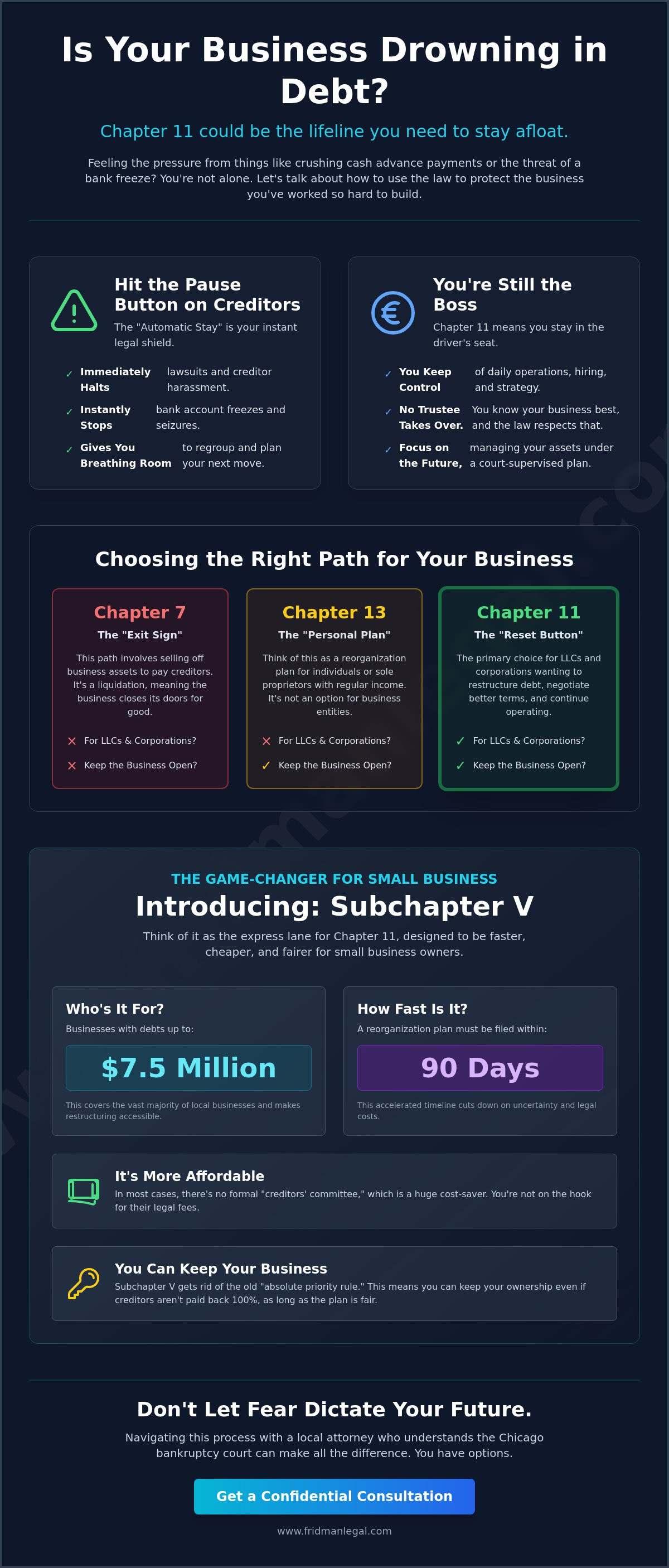
Think of Chapter 11 as a corporate reset button rather than an exit sign. While Chapter 7 is about selling off assets to pay what you can, Chapter 11 of the United States Bankruptcy Code is designed for businesses that have a future but need to fix their past debts. If you run an LLC or a corporation in the city, you've probably realized that Chapter 13 isn't an option for your business entity. That makes chapter 11 for small business Chicago the primary legal path if you want to keep your staff employed and your equipment in place while you negotiate better terms with your lenders. It's the difference between closing the doors and renovating the foundation.
The core concept is simple: you keep operating while we work out a new deal with your creditors. Unlike the "fresh start" of a Chapter 7 filing, where the business essentially ceases to exist, Chapter 11 allows you to restructure. You might reduce the principal on certain loans, lower your interest rates, or extend your payment timelines. It's a proactive way to handle crushing debt without losing the brand you've spent years building. If you're exploring these options, it's helpful to review our bankruptcy filing services to understand how different chapters might apply to your specific entity.
The Debtor in Possession: You Stay in the Driver’s Seat
One of the biggest misconceptions about this process is that a court-appointed official comes in and takes over your desk. That's not how it works. In a Chapter 11 case, you're usually designated as a "debtor in possession." This means you're still the one making the calls on hiring, inventory, and daily strategy. The court acts as a supervisor to ensure the plan remains fair to everyone involved, but they don't want to run your shop. You know your business better than any judge does, and the law respects that expertise. You maintain the authority to manage your assets and continue business as usual, provided you stay within the guidelines of the reorganization plan we create.
The Automatic Stay: Instant Breathing Room
The moment we file your petition, an "automatic stay" goes into effect, serving as an immediate legal shield for your company. This powerful legal tool stops lawsuits, harassing collection calls, and bank account freezes in Chicago instantly. This pause button gives us the necessary time to breathe and build a sustainable plan without the constant fear that a creditor will seize your operating capital tomorrow morning. It effectively freezes all collection actions in their tracks, allowing you to focus on the future of your company instead of fighting fires from the past.
The Subchapter V Advantage: Faster and More Affordable
Historically, corporate restructuring was a tool reserved for major airlines and retail giants with massive legal budgets. For a local entrepreneur, the process was often too slow and prohibitively expensive. This changed with the implementation of The Small Business Reorganization Act (SBRA), which introduced Subchapter V. This specialized path is redefining chapter 11 for small business Chicago by removing the most significant barriers to entry. In February 2026, Subchapter V filings saw a 91% year over year increase, proving that more owners are recognizing this as a viable lifeline.
One of the most critical shifts is the elimination of the "absolute priority rule." In a standard filing, business owners often lost their equity unless they paid every creditor in full; a requirement that was impossible for most. Subchapter V allows you to keep your ownership interest even if creditors aren't paid 100%, provided your reorganization plan is fair and equitable. If you're considering a strategic Chapter 11 bankruptcy filing, it's vital to know that the current debt limit for eligibility is approximately $3.42 million. While there's bipartisan support for a permanent $7.5 million limit, the current framework already covers the majority of local enterprises.
Cutting the Red Tape and the Costs
Speed is essential when your cash flow is under pressure. Subchapter V accelerates the timeline, requiring you to file a plan within 90 days of the initial petition. You also don't have to deal with a formal "creditors' committee" in most cases. This is a massive win for your bottom line because, in traditional cases, the debtor is often responsible for paying the legal fees of that committee. By removing this layer of bureaucracy, you significantly reduce administrative headaches and keep more capital inside your business. If you're unsure about your eligibility, speaking with a professional about debt negotiation and settlement can clarify your best path forward.
The Role of the Subchapter V Trustee
Unlike a traditional trustee who might focus solely on liquidation, a Subchapter V trustee acts more like a mediator. Their primary objective is to help you and your creditors reach a consensual plan. They aren't there to shut you down; they're there to facilitate a deal that works for everyone. This collaborative approach makes the process feel less like a courtroom battle and more like a structured business negotiation. It's a supportive framework designed to ensure your company survives the restructuring and emerges stronger on the other side.
Chapter 11 vs. Other Debt Relief Options
Choosing the right path for your company requires a clear understanding of how different legal frameworks function. While Chapter 13 is a common choice for individuals with a steady income, it generally isn't available to business entities like LLCs or corporations. For these structures, the primary choice is between liquidation and reorganization. If your goal is to keep the lights on and preserve your brand, chapter 11 for small business Chicago is the most effective tool in your arsenal. According to this United States Courts explanation of Chapter 11, the process is specifically designed to allow a business to continue operating while it pays its creditors over time through a court-approved plan. This is a far cry from the finality of other chapters. It's about finding a sustainable middle ground where you can fulfill your obligations without destroying the enterprise you've built. It's also important to distinguish between corporate debt and the personal guarantees you may have signed, as these require different defensive strategies during the restructuring process.
When Chapter 7 Makes More Sense
Sometimes the math just doesn't work anymore. If the market has shifted or the debt has grown so large that even a restructure wouldn't make the company profitable, Chapter 7 might be the cleaner exit. It provides an orderly way to wind down operations and sell off assets under court supervision. This helps protect owners from certain personal liabilities that arise during a chaotic closure. You can learn more in our Chapter 7 bankruptcy in Northbrook guide.
The Limits of Informal Debt Settlement
Many owners try to avoid the courtroom by negotiating with lenders on their own. However, without a court order, creditors aren't required to stop lawsuits or bank freezes. They can simply refuse to play ball. Chapter 11 changes that dynamic by forcing everyone to the table on your terms. If you aren't ready for a formal filing, consulting a debt settlement lawyer can offer a non-bankruptcy path to manage your liabilities.
The Filing Process in the Chicago Bankruptcy Court
Taking the first step toward chapter 11 for small business Chicago starts with an emergency petition. This immediate action requires a $1,738 filing fee in the Northern District of Illinois and is what officially triggers the protective legal shield that stops creditors in their tracks. Once we've secured that initial protection, the focus shifts to transparency. You'll need to gather comprehensive financial records, including detailed income statements, monthly expense reports, and an exhaustive list of every creditor. This data acts as the foundation for your Plan of Reorganization, which is essentially a new, court-sanctioned contract between you and your lenders.
The Plan of Reorganization is the heart of your case. It outlines exactly how you intend to restructure your debt and what your business will look like moving forward. After we've drafted this plan, it must be approved during a Confirmation Hearing. During this session, a judge reviews the proposal to ensure it's feasible and fair. If you're feeling overwhelmed by the paperwork, you can contact our team for a professional case review to ensure your filing is handled with the precision it requires.
Filing in the Northern District of Illinois
Your case will be handled within the Northern District of Illinois, which operates out of court locations in Chicago and Rockford. Shortly after filing, you'll attend a "Meeting of Creditors," also known as a 341 meeting. This is a standard procedure where the trustee and any interested creditors can ask questions about your financial affairs. Having an attorney with deep local experience is vital here. We understand the specific expectations of Chicago-area trustees and how they interpret local business conditions, which helps prevent unnecessary delays or complications in your restructuring process.
Living Under a Reorganization Plan
Once the judge confirms your plan, you'll begin a performance period that typically lasts between 3 and 5 years. During this time, you'll make manageable payments based on what your business can actually afford after operating expenses. It's a structured environment that allows you to rebuild your company's credit and reputation simultaneously. When you successfully complete the payment term, you receive a "discharge." This is the final legal order that wipes away the remainder of the debts covered in the plan, providing the definitive fresh start you need to move your business into its next chapter of growth.
Why a Local Northbrook Attorney Makes the Difference
When you're searching for help with chapter 11 for small business Chicago, you'll likely find plenty of large firms downtown. While they have significant resources, their approach can often feel clinical and detached from the daily realities of a local shop owner. We believe you deserve more than just a file number. O. Allan Fridman brings over 20 years of specialized experience to the table, whether that table is in a corporate boardroom or your own kitchen. This isn't just about filing papers; it's about having a partner who truly understands the Chicago business climate and the specific pressures you're facing. If you're feeling the weight of these decisions, we invite you to contact us for a low-pressure chat about your next steps.
A Conversational Approach to Complex Law
Most business owners don't want a lecture on the finer points of the bankruptcy code. They want to know how to keep their employees paid and their equipment running. That's why we strip away the dense legalese and focus on clear, actionable steps for your company. We handle the mountain of paperwork and the intricate court filings so you can keep your energy focused on running your business. To provide total peace of mind, we prioritize a transparent hourly or flat-fee structure. You'll never have to guess what your legal costs look like while you're trying to fix your balance sheet.
Taking the First Step Toward Stability
Remember that exploring your options isn't the same thing as a commitment to file. Many of the most successful businesses in our city have hit a rough patch at some point. Our office is a no-judgment zone where we focus on solutions rather than past mistakes. Whether you're dealing with the new 15% lease transaction tax or the rising costs of merchant cash advances, we're here to help you find the most strategic path forward. You can learn more about our bankruptcy services to see which path aligns with your long-term vision for your company. Taking action now is often the most effective way to ensure your business thrives for years to come.
Securing Your Business Legacy in Chicago
You've invested years into building your company, and a temporary financial setback shouldn't be the reason you lose it all. We've seen how Subchapter V has transformed the landscape, offering a faster and far more affordable way to restructure debt without the traditional corporate red tape. By maintaining control of your operations and utilizing the immediate protection of the automatic stay, you can focus on restoring your cash flow. Exploring chapter 11 for small business Chicago is a strategic move that prioritizes your company's survival and future growth.
Navigating these legal waters requires a partner who understands the local court system and the unique challenges of the city's economy. O. Allan Fridman brings over 20 years of local bankruptcy experience to every case, providing the personalized guidance your business deserves. As Subchapter V specialists, we're committed to helping you emerge from this process with a leaner, more stable operation. Take the first step toward a fresh start today. Schedule a friendly, confidential consultation with Fridman Legal and let's build a plan that keeps your doors open.
Frequently Asked Questions
Can I keep my business open while in Chapter 11?
Yes, you can absolutely keep your doors open and maintain your daily operations throughout the entire process. The primary goal of chapter 11 for small business Chicago is to allow you to restructure while continuing to serve your customers. You remain in control of your company as a "debtor in possession," making the strategic decisions needed to guide your business back to long term profitability.
What is the debt limit for a Small Business Subchapter V filing in 2026?
As of June 2026, the debt limit to qualify for a Subchapter V filing is approximately $3.42 million. There's currently bipartisan support for the "Bankruptcy Threshold Adjustment Act of 2026," which seeks to permanently set this limit at $7.5 million. It's important to verify the status of this legislation at the time of your filing to determine which threshold applies to your specific financial situation.
How much does it cost to file Chapter 11 for a small business in Chicago?
The initial filing fee for a Chapter 11 petition in the Northern District of Illinois is $1,738. While this is the fixed court cost, you should also account for administrative expenses and professional fees associated with drafting your reorganization plan. Because Subchapter V eliminates the need for a creditors' committee in most cases, the overall administrative costs are significantly lower than traditional corporate bankruptcy filings.
Will I lose my personal assets if my business files for Chapter 11?
Generally, your personal assets are separate from the business entity's assets, especially if your company is structured as an LLC or a corporation. However, if you've signed personal guarantees for business loans or credit lines, those creditors could still pursue your individual property. We work to address these guarantees within the context of your reorganization plan to protect your personal stability and home.
How long does a typical Subchapter V case take in the Chicago courts?
Subchapter V cases are designed to move much faster than standard filings, with a requirement to file a reorganization plan within 90 days of the initial petition. Most small businesses in the Chicago courts can reach the confirmation stage within just a few months. This accelerated timeline is a major advantage, as it minimizes the time your company spends under court supervision and reduces administrative legal expenses.
Can Chapter 11 stop a landlord from evicting my business?
Filing for Chapter 11 triggers an automatic stay that immediately halts any pending eviction proceedings. This gives you a critical window of time to decide whether you want to keep or cancel the lease. If the location is vital to your survival, you can catch up on past due rent over time, though you'll need to stay current on all new lease payments moving forward from the filing date.
What is the difference between Chapter 11 and Chapter 13 for a business owner?
Chapter 13 is strictly for individuals with a regular income, whereas chapter 11 for small business Chicago is the only restructuring option available to corporations and LLCs. Even for sole proprietors, Chapter 11 often provides more flexibility because it doesn't have the same strict debt ceilings found in Chapter 13. It's the most powerful tool for any business entity that needs to reorganize while staying in business.
Do I need my creditors to agree to my Chapter 11 plan?
Under Subchapter V, you don't necessarily need every creditor to vote in favor of your plan for the judge to confirm it. If the court finds your plan is fair, equitable, and doesn't discriminate against certain creditors, the judge can approve it through a process known as a "cramdown." This prevents a single disgruntled lender from blocking a reorganization that's in the best interest of the company and its employees.

Article by
O. Allan Fridman
O. Allan Fridman has been practicing law since 2001. His practice is unique in that he does not view himself as a litigation attorney or transactional attorney. Rather, he views each area of law as a tool to pursue the best results for his clients. By practicing in both areas of law, he is able to take a 360-degree view of law. This enables the firm to catch potential drawbacks that are readily identifiable.
By practicing in litigation and transactional law and taking a holistic approach in dealing with our clients, he doesn’t put clients in box — rather, as we are all individuals, so too are the legal services we may require.
Whether it is bankruptcy or litigation or transactional, each client brings challenges and does not fit in any one box. Often times, bankruptcy clients end up not filing bankruptcy because we can achieve a better result through litigation or through an out-of-court resolution with the lender, or through a real estate sale. On the other end of the spectrum, a litigation client with multiple issues and lawsuit may fare better in a bankruptcy.
Since 2001, Allan has practiced in states and federal court, and he is a member of the trial bar of the Northern District of Illinois and admitted in the Northern District of Indiana.
We are a debt relief agency. We help people file for bankruptcy relief under the Bankruptcy Code
The materials on this site are for informational purposes only and do not constitute legal advice. Viewing this site or contacting us does not create an attorney–client relationship, and you should not act or refrain from acting based on any information here without seeking professional legal counsel.


