
Did you know that Cook County saw a nearly 40% surge in new case filings in 2024 alone? If you're currently facing a legal dispute, that statistic likely adds to the weight of an already overwhelming situation. Getting the civil litigation process in Illinois explained shouldn't feel like you're trying to solve a puzzle in the dark. We know that the fear of the unknown, combined with concerns over legal costs and strict court procedures, can make anyone feel uneasy about their future.
We agree that the legal system often feels like a black hole of paperwork and rigid deadlines. That's why we've created this guide to serve as your clear, human-centered roadmap, giving you the confidence to navigate the Cook County court system with ease. We'll break down everything you need to know for 2026, from the impact of the new remote appearance rules under Amended Rule 45 to the strategic discovery and motion phases that happen long before a trial ever begins.
Key Takeaways
- Learn how to determine if your legal claim is actually viable under Illinois law and why a strategic demand letter can often resolve disputes before they even reach a courtroom.
- Get the civil litigation process in Illinois explained through a step-by-step roadmap that covers everything from filing your initial complaint to receiving a final judgment.
- Understand the discovery phase's timeline so you aren't caught off guard by the months of document requests and questions that form the backbone of your case.
- Discover how pre-trial motions can serve as a shortcut to winning or dismissing a case, potentially saving you the time and expense of a full trial.
- Gain the clarity you need to handle strict court deadlines and procedures with confidence, ensuring your case stays on track in the Cook County system.
The Starting Line: Assessing Your Claim and the Illinois "Clock"
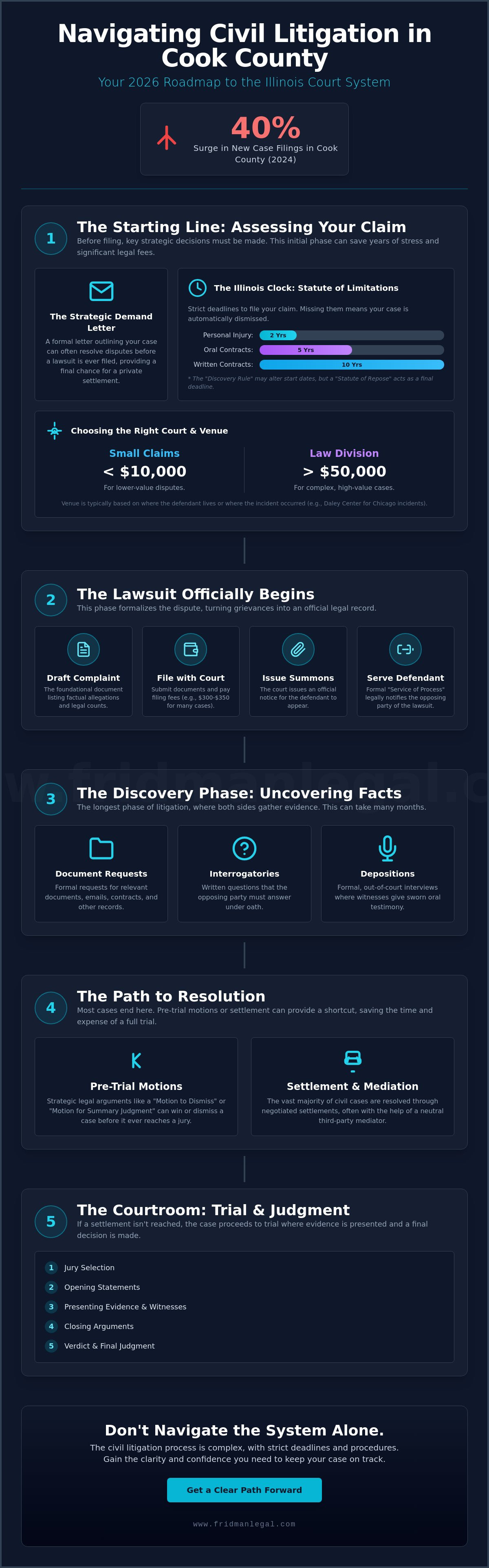
Before you ever set foot in a courtroom, you have to determine if your grievance actually meets the legal threshold for a lawsuit. In the civil litigation process in Illinois explained simply, a "viable" claim means you've suffered a specific, compensable loss caused by someone else's breach of duty. We often find that the most professional way to handle a dispute isn't an immediate lawsuit, but a well-crafted demand letter. This formal document outlines your position and gives the other party a final opportunity to settle the matter privately. It's a strategic move that can save you years of stress and significant legal fees, especially since civil case filings in Illinois rose to 390,887 in 2024. If the demand letter doesn't work, then we look toward the court system.
The Statute of Limitations in Illinois
Time is your biggest enemy in the Illinois court system. If you wait too long, the law essentially wipes your claim away, regardless of how much evidence you have. The state follows specific rules that govern civil actions, including strict deadlines known as the statute of limitations. For a personal injury case, you generally have 2 years from the date of the injury to file. If your dispute involves an oral contract, you have 5 years, while written contracts allow for a 10-year window.
Illinois also uses the "Discovery Rule," which means the clock might not start ticking until you actually discovered, or reasonably should've discovered, that you were injured. However, don't rely on this as a safety net. There's also a four-year statute of repose for many cases, which acts as an absolute deadline regardless of when you found the injury. Missing these dates is an automatic "game over" for your case, so checking the calendar is the first thing we do during a consultation.
Choosing the Right Court and Venue
Where you file is just as important as what you file. You can't just pick a court because it's close to your house. In the civil litigation process in Illinois explained to new litigants, "venue" usually refers to the county where the defendant lives or where the incident took place. If your dispute happened in Chicago, you'll likely be at the Daley Center in Cook County. If it happened in Wheaton, you're looking at DuPage County.
The dollar amount of your claim also dictates your path. Small claims court handles cases under $10,000, while the Law Division manages complex cases where damages exceed $50,000. Choosing the wrong division or county can lead to your case being transferred or dismissed, adding unnecessary costs and delays to your journey. We make sure your case starts in the right building from day one.
Pleadings and Service: How the Lawsuit Officially Begins
Once you've decided to move forward, the case formally enters the system through a phase known as pleadings. This is where the abstract dispute becomes a concrete legal record. While the previous section focused on preparation, this stage is about formalizing your grievances and ensuring the other party is legally aware of the claims against them. In the civil litigation process in Illinois explained to those outside the legal field, this is the moment the "gears of justice" actually start turning. If you don't get the paperwork right here, the court might dismiss your case before a judge ever hears the facts.
Drafting the Complaint and Summons
A Complaint is the foundational document in Illinois civil litigation that sets the stage for everything that follows. It isn't just a story; it's a structured list of factual allegations and legal counts that prove you're entitled to relief. Within this document, the "Prayer for Relief" is perhaps the most vital part. This is where you clearly state what you want the court to do, such as awarding damages for a contract breach or ordering a specific action in a real estate dispute.
Filing these documents isn't free, and costs vary significantly by location. For instance, as of January 12, 2026, filing for arbitration in DuPage County for a claim between $15,000 and $50,000 costs $350.00. In Champaign County, a similar filing was ordained at $306 as of December 19, 2025. If these costs are prohibitive, Illinois does allow for fee waivers, but you must prove financial hardship to the court's satisfaction. Getting these initial documents drafted with precision is a core part of our civil litigation representation, as it prevents the defense from finding easy loopholes to exploit.
Serving the Defendant
You can't just mail a complaint to your opponent and call it a day. Illinois law requires "Service of Process," which is the formal delivery of the summons and complaint to the defendant. This ensures their constitutional right to due process is protected. In the Chicago area, you'll often choose between using the County Sheriff or a licensed special process server. While the Sheriff is the traditional route, private servers are often faster and more persistent when a defendant is actively avoiding service.
According to this summary of the major issues in state practice, proper service is what triggers the defendant’s clock. Once they're served, the defendant typically has a 30-day window to file an Appearance and an Answer. If they choose to ignore the summons, you can ask the judge for a Default Judgment. This essentially means you win the case because the other side failed to show up, though the court still requires you to prove your damages before awarding a final sum.
The Discovery Phase: Uncovering the Facts
After the initial paperwork is filed and the defendant has answered, we move into the discovery phase. This is where the real work happens. If you've watched legal dramas, you might expect a surprise witness to appear at the last second, but the civil litigation process in Illinois explained is designed to prevent exactly that. Discovery is almost always the longest part of a lawsuit; it's a marathon that lasts months, not a sprint. For many of our clients, this phase represents the bulk of the legal journey and requires the most focus.
Interrogatories and Document Requests
The first step usually involves written discovery. This starts with Interrogatories, which are formal, written questions that must be answered under oath. These aren't just casual inquiries; they're legal testimony. Under Illinois Supreme Court Rule 213, both sides must disclose their witnesses and the substance of their testimony early on. If a witness isn't disclosed during this stage, they likely won't be allowed to testify at trial. It's a strict system that rewards transparency and preparation.
Alongside these questions, we exchange Requests for Production. This is where we dig into the paper trail. We see a significant trend in data-related litigation lately, meaning "ESI" or electronically stored information is now a standard part of the process. Common items we request or provide include:
- Internal emails and text messages regarding the dispute.
- Signed contracts and original financial ledgers.
- Maintenance records or safety logs in construction law services.
- Metadata from digital files to prove when a document was actually created.
Depositions: The High-Stakes Q&A
Once the documents are reviewed, we move to oral discovery, better known as depositions. This is a face-to-face meeting, often in a Chicago law office, where a lawyer asks a witness questions under oath with a court reporter present. It's a high-stakes environment because these transcripts are permanent. If a witness changes their story during a trial, the opposing lawyer will use the deposition transcript to "impeach" them, showing the jury they aren't reliable. It's one of the most effective tools we have in civil litigation representation.
Our role during a deposition is to act as a shield. We ensure the questions stay within legal bounds and protect you from aggressive or unfair tactics. It's also during this time that we might bring in expert witnesses. Whether we need a forensic accountant for a complex business deal or a specialist to explain structural failures, these experts provide the professional analysis needed to support your claims. Since the number of medical malpractice cases in Illinois has decreased by 39% since 2003, the quality of expert testimony has become even more critical in the cases that do move forward.
Pre-Trial Motions and the Settlement Shortcut
Not every case needs a jury to reach a resolution. In fact, many disputes are decided in the quiet of a judge's chambers rather than the drama of a courtroom. As the civil litigation process in Illinois explained so far shows, discovery unearths the facts, but pre-trial motions are what we use to apply the law to those facts before a trial even begins. These motions serve as critical checkpoints that can potentially end the litigation early, saving you from the exhaustion of a multi-day trial. With civil appellate filings rising to 2,934 in 2024, avoiding the risk of a trial and a subsequent lengthy appeal is often the most pragmatic path forward.
Motions that Can End the Case
A Motion for Summary Judgment argues there are no "genuine issues of material fact" left to decide, essentially asking the judge to rule on the case immediately because the evidence is so one-sided. If the judge agrees that no reasonable jury could find for the other side based on the evidence gathered in discovery, the case ends right there. Earlier in the process, we might also use a Motion to Dismiss to challenge the legal sufficiency of the complaint. This argues that even if everything the other side says is true, it still doesn't add up to a legal violation. These procedural tools are vital because they cut through the noise and focus strictly on the legal merits. Often, the judge will hold a "Pre-Trial Conference" as a final check-in, where they might candidly discuss the weaknesses of each side’s position to encourage a resolution.
Mediation and Settlement in Illinois
Cook County judges frequently encourage Alternative Dispute Resolution (ADR), specifically mediation. This is a private process where a neutral third party, often a retired judge or senior attorney, helps both sides find a middle ground without the unpredictability of a public verdict. Settling a case offers a level of certainty and privacy that a trial simply cannot provide. It also stops the clock on mounting legal fees and court costs, which is a major concern for most litigants.
For many of our clients, debt settlement is a primary strategic goal, allowing for a controlled exit from a difficult financial situation. Whether we're negotiating a complex commercial contract or a property dispute, the goal is always to maximize your advantage through calculated pressure. If you're looking for a way to resolve your dispute without the stress of a courtroom, you can reach out for civil litigation representation that focuses on efficient, strategic outcomes.
Trial and the Final Judgment: What Happens in the Courtroom
If your dispute hasn't been resolved through the strategic motions or mediation we've covered in previous sections, your journey leads to a trial. This is the climax of the legal story, where all the evidence gathered during discovery is finally presented for a decision. Having the civil litigation process in Illinois explained means understanding that trials are actually quite rare; most cases settle long before this point. However, when a trial is necessary, it's either a bench trial, where a judge decides the outcome, or a jury trial, where a group of your peers makes the final call. We help you weigh the pros and cons of each, as the decision often depends on the complexity of the legal issues involved.
The Trial Process Step-by-Step
The rhythm of a trial is highly structured to ensure fairness for both sides. It begins with opening statements, followed by the presentation of evidence and the cross-examination of witnesses. Unlike criminal cases where the standard is "beyond a reasonable doubt," civil cases in Illinois use a lower burden of proof called a "preponderance of the evidence." This simply means you must prove your version of events is more likely than not to be true. It's a subtle but vital distinction that changes how we present your story to the court.
During these proceedings, the judge acts as a gatekeeper, deciding which pieces of evidence or witness testimony are legally allowed to be heard. While television makes trials look like they last weeks, an average Illinois civil trial usually wraps up within 2 to 5 days. It's a fast-paced, intense environment where the preparation from the previous months finally pays off. Once both sides finish, the judge or jury deliberates and delivers the verdict, which is then recorded as a formal judgment.
After the Verdict: Getting Paid
Once the judge or jury delivers a verdict, the court enters a final judgment. It's a common misconception that the court hands you a check the moment you win. In reality, winning the case is only half the battle; collecting the money is the other half. If the losing party doesn't pay voluntarily, we may need to pursue supplementary proceedings, such as wage garnishments or asset seizures, to satisfy the judgment. This is where the "paper win" becomes actual compensation.
In some instances, a significant judgment can push a business toward a Chapter 11 bankruptcy as a way to reorganize their debts and manage the fallout of the loss. If either side believes a legal error occurred during the trial, they have a strict 30-day window from the date of the final judgment to file a Notice of Appeal. This moves the case to the Illinois Appellate Court, which saw 2,934 new civil filings in 2024. If you're ready to secure your interests, you can contact our team to discuss a tailored strategy for your case.
Securing Your Interests in the Illinois Court System
Having the civil litigation process in Illinois explained gives you a significant advantage, but knowledge is most effective when paired with a proactive strategy. You've seen how the journey moves from the initial demand letter through discovery and pre-trial motions; each phase offers a distinct opportunity to resolve the matter in your favor. It's clear that missing a deadline or mishandling a deposition can derail even the strongest claims, which is why having a steady hand at the wheel is so important for your peace of mind.
With nearly 20 years of experience in Illinois courts, our team provides personalized legal solutions for Northbrook and Chicago clients. We take a strategic approach to business and construction disputes, focusing on efficient outcomes that protect your long term interests. You don't have to face the complexities of the Daley Center or collar county courts alone. Contact Fridman Legal today for a consultation on your Illinois litigation matter and let's start building your roadmap to success. You've got the facts, and we're here to help you use them effectively.
Frequently Asked Questions
How long does a typical civil lawsuit take in Illinois?
A typical civil lawsuit in Illinois can take anywhere from 12 months to three years to reach a final resolution. While small claims cases often move through the system in less than six months, complex litigation involving extensive discovery and multiple expert witnesses naturally takes much longer. The timeline is largely dictated by the court's calendar and the volume of motions filed by both sides during the pre-trial phase.
Can I sue someone in Illinois without a lawyer?
Yes, you have the legal right to represent yourself "pro se" in the Illinois court system. However, doing so is extremely risky because the court expects you to follow the same complex rules of evidence and procedure as a licensed attorney. Given that the civil litigation process in Illinois explained in this guide involves strict deadlines and technical filings, most self-represented litigants struggle to overcome aggressive procedural motions from the opposing side.
What is the difference between a civil case and a criminal case in Illinois?
The primary difference lies in the objective and the burden of proof required to win. Civil cases involve private disputes between individuals or businesses seeking money or specific actions, while criminal cases are brought by the state to punish a violation of the law. In a civil matter, you only need to prove your case by a "preponderance of the evidence," meaning it's more likely than not that your version is true.
How much does it cost to file a lawsuit in Cook County?
Filing fees vary by county and the amount of money you are seeking in the dispute. While specific Cook County fees are updated regularly, nearby DuPage County's fee schedule as of January 12, 2026, lists arbitration filings between $15,000 and $50,000 at $350.00. You should also account for a $225.00 appearance fee and costs for a jury demand, which can range from $106.25 to $212.50 depending on the jury size.
What happens if I am served with a lawsuit and I ignore it?
Ignoring a lawsuit will almost certainly result in a default judgment being entered against you. This means the judge grants the plaintiff exactly what they asked for because you failed to present a defense. Once this judgment is signed, the plaintiff can begin seizing your assets or garnishing your wages. It's much harder to "undo" a default judgment than it is to file an initial response within the standard 30-day window.
Can I settle my case even after the trial has started?
You can settle your legal dispute at any point until the judge or jury delivers a final verdict. It's quite common for parties to reach an agreement "on the courthouse steps" or even after a few days of testimony when the strengths and weaknesses of each side become undeniable. Settling during a trial still offers the benefit of certainty, allowing both parties to avoid the risk of an unpredictable jury decision.
What is "Discovery" and why is it so expensive?
Discovery is the formal process of exchanging evidence, and it's expensive because it's the most labor-intensive phase for any legal team. The civil litigation process in Illinois explained to most clients highlights the high costs of court reporters for depositions and the time required to review thousands of digital documents. With the 2026 focus on electronically stored information, the technical work of gathering metadata and internal emails adds another layer of professional expense.
Do I have to go to court for a civil lawsuit?
You don't always have to physically go to the courthouse, especially with the recent updates to remote appearance rules. Amended Rule 45, which went into effect on March 1, 2026, has expanded the use of remote appearances for many circuit court proceedings. While trials and certain evidentiary hearings might still require your physical presence, many routine status calls and motion hearings are now handled via video conference to save time and travel costs.

Article by
O. Allan Fridman
O. Allan Fridman has been practicing law since 2001. His practice is unique in that he does not view himself as a litigation attorney or transactional attorney. Rather, he views each area of law as a tool to pursue the best results for his clients. By practicing in both areas of law, he is able to take a 360-degree view of law. This enables the firm to catch potential drawbacks that are readily identifiable.
By practicing in litigation and transactional law and taking a holistic approach in dealing with our clients, he doesn’t put clients in box — rather, as we are all individuals, so too are the legal services we may require.
Whether it is bankruptcy or litigation or transactional, each client brings challenges and does not fit in any one box. Often times, bankruptcy clients end up not filing bankruptcy because we can achieve a better result through litigation or through an out-of-court resolution with the lender, or through a real estate sale. On the other end of the spectrum, a litigation client with multiple issues and lawsuit may fare better in a bankruptcy.
Since 2001, Allan has practiced in states and federal court, and he is a member of the trial bar of the Northern District of Illinois and admitted in the Northern District of Indiana.
We are a debt relief agency. We help people file for bankruptcy relief under the Bankruptcy Code
The materials on this site are for informational purposes only and do not constitute legal advice. Viewing this site or contacting us does not create an attorney–client relationship, and you should not act or refrain from acting based on any information here without seeking professional legal counsel.