

What if the most powerful tool to save your home isn't a pile of cash, but simply knowing which legal lever to pull before the sheriff arrives? It's easy to feel like you're losing control when aggressive mortgage servicers won't stop calling and the fear of being kicked out onto the street keeps you up at night. You probably feel like the system is rigged against you, especially with Illinois mortgage rates hovering around 6.59% as of May 2026. However, it's important to remember that foreclosure in Cook County is a legal marathon, not a sprint.
If you're wondering how to stop foreclosure on my home in Skokie, you actually have several "emergency stop" buttons available to you right now. This guide breaks down the specific 2026 legal steps and local resources, such as the Illinois Hardest Hit Fund which offers up to $35,000 in assistance, designed to keep you in your home. We'll explore how to navigate the new Illinois Receivership Act, utilize the Cook County Mortgage Foreclosure Mediation Program, and potentially lower your monthly payments. You'll learn exactly how to halt the sale immediately and secure a fresh start for your family.
Key Takeaways
- You'll learn why the judicial nature of Illinois law means the bank has to sue you first, which buys you valuable time to plan your next move.
- We'll walk you through how to stop foreclosure on my home in Skokie by filing a proper legal response and utilizing the Cook County mediation program.
- Discover the difference between loan modifications and forbearance, and find out which one might actually lower your monthly payments for the long haul.
- Find out how filing for Chapter 13 bankruptcy triggers an "Automatic Stay" that legally freezes the foreclosure process in its tracks.
- Understand the importance of local expertise in Cook County courts, where knowing the specific rules and judges can change the outcome of your case.
Understanding the Foreclosure Timeline in Skokie and Cook County
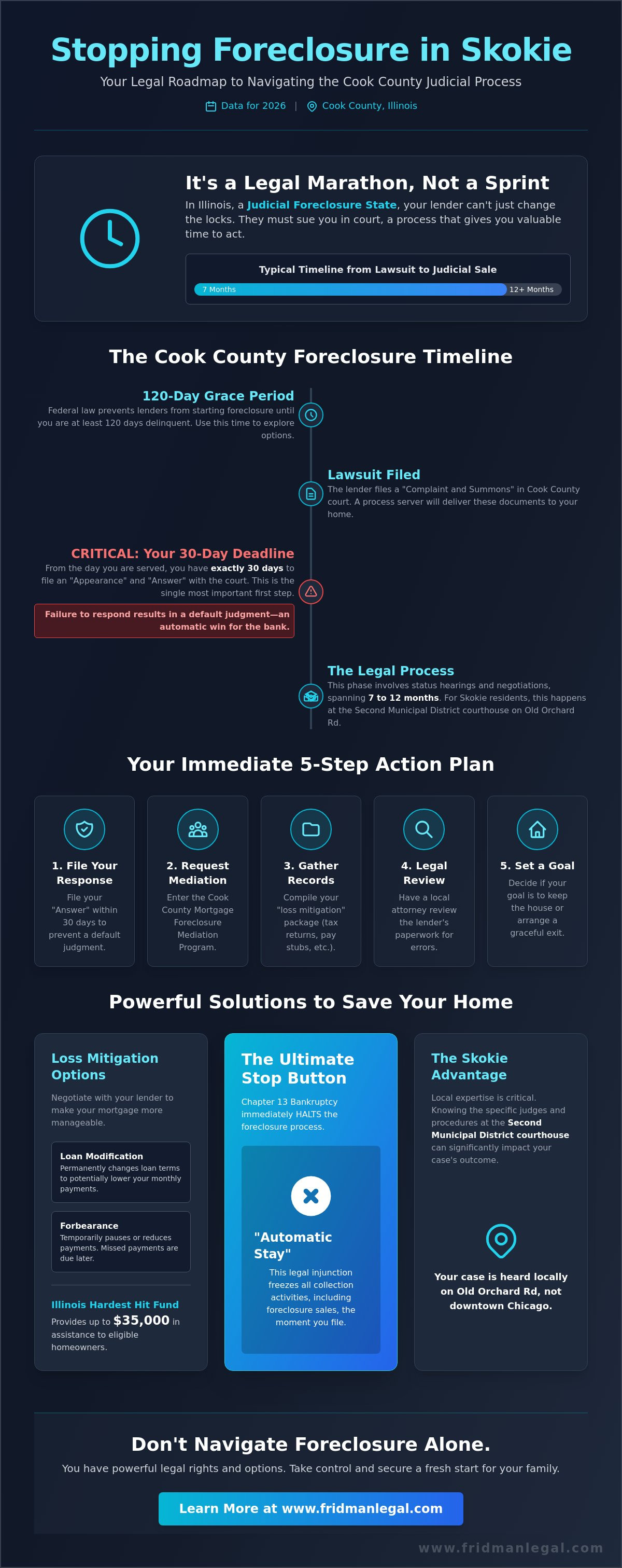
If you're four months behind on your mortgage, you might feel like the clock is ticking faster than you can keep up with. Federal law generally prevents mortgage servicers from starting the legal process until you're at least 120 days delinquent. This gives you a small window to breathe, but once that period passes, the bank won't hesitate to move forward. In Illinois, they can't just change the locks on a whim. We live in a judicial foreclosure state, which means your lender has to sue you in a court of law to take possession of the property.
Judicial Foreclosure is a court-monitored process that ensures homeowners have a chance to defend their rights. For those living in Skokie, your legal battle will likely take place at the Second Municipal District courthouse on Old Orchard Road. Having a local venue means you won't have to navigate the chaos of the downtown Chicago courts for every minor hearing. Understanding the foreclosure process is the first step in reclaiming your peace of mind and protecting your equity.
What Happens When You Get a Summons?
The "Complaint and Summons" is the official start of the legal clock. When a process server arrives at your door, it's easy to want to hide the papers in a drawer and forget they exist. That's the single biggest mistake you can make. In Cook County, you have exactly 30 days from the date you're served to file an "Appearance" and an "Answer" with the court. If you're looking for how to stop foreclosure on my home in Skokie, this is your first real opportunity to speak up. Filing these documents prevents the bank from getting a default judgment, which is essentially an automatic win for them because you didn't show up to fight.
The Role of the Cook County Circuit Court
The Cook County court system manages a high volume of cases, which actually works in your favor by providing more time to negotiate. You'll likely have to attend status hearings where the judge checks on the progress of the case. These aren't just formalities; they're moments where you can show the court you're actively seeking a solution. From the day the bank files the lawsuit to the actual judicial sale, the timeline usually spans at least seven to twelve months. Finding out how to stop foreclosure on my home in Skokie starts with respecting these deadlines. This period is crucial for exploring foreclosure defense options and finding a way to stay in your home without the constant stress of the unknown.
Immediate Steps to Halt the Process: Mediation and Response
Once you've been served with a summons, the legal clock starts ticking fast. You don't have the luxury of waiting to see what happens next. The most effective way to protect your rights is to take immediate, structured action. If you're looking for how to stop foreclosure on my home in Skokie, your first priority must be preventing the bank from winning by default. This involves a series of specific steps that move your case from a "losing battle" to an active negotiation. By engaging with the court system correctly, you can often buy yourself the time needed to find a permanent solution.
To stay on track, follow this immediate action plan:
- File your Answer: You have 30 days from service to file this document. It prevents the bank from getting an automatic judgment against you.
- Request Mediation: Formally ask to enter the Cook County Mortgage Foreclosure Mediation Program as soon as possible.
- Gather your Records: Pull together a "loss mitigation" package that includes your last two years of tax returns, recent pay stubs, and bank statements.
- Legal Document Review: Have a local attorney scan the bank's filings for errors. Lenders often miss key details that can give you leverage.
- Set a Goal: Decide before your first meeting if you want to keep the house through a modification or arrange a graceful exit.
It's vital to stay organized during this phase. Having your financial documents ready isn't just about being tidy; it's about proving to the court and the lender that you're a serious candidate for a workout plan. Understanding the foreclosure timeline in Illinois helps you see that while the process is slow, every deadline matters. Missing a single filing can result in losing your home much faster than necessary.
The Cook County Mediation Program
This program is a free resource designed to bring you and the bank to the same table. Often, mortgage servicers are like giant machines that don't listen to reason. A mediator acts as a neutral third party to facilitate a real conversation that the bank might otherwise avoid. While the program is free, going in alone is a significant risk. Having Fridman Legal review your documents before the session can completely change the dynamic. We help you walk into that room with a clear strategy, ensuring the bank takes your proposal seriously rather than just checking a box.
Don't Fall for Foreclosure Scams
When you're in a tough spot, you'll likely get "offers" in the mail from companies promising to save your home for an upfront fee. Be extremely careful. Real help doesn't come from "foreclosure rescue" companies that ask for thousands of dollars before they've done a single thing. Another massive red flag is anyone asking you to sign over your deed to "save" your credit. In the Skokie area, you can verify a service's legitimacy through the Better Business Bureau or local legal bars. If an offer sounds too good to be true, it's almost certainly a trap. If you're feeling overwhelmed by these predatory calls, it might be time to speak with a professional who actually understands the local court rules.
Exploring Loss Mitigation: Can You Keep the House?
When you're staring down a lawsuit, the question isn't just about legal defense; it's about finding a practical way to make the numbers work. Loss mitigation is the umbrella term lenders use for various programs designed to avoid a full foreclosure sale. If you're researching how to stop foreclosure on my home in Skokie, you've likely come across the concept of a loan modification. This is where the bank agrees to change your original mortgage terms, perhaps by lowering the interest rate or extending the loan life to 40 years, to bring your monthly payment down to a manageable level. It's a powerful tool, but it's far from the only option on the table.
For those facing a shorter-term hurdle, a forbearance agreement might be the right fit. This allows you to temporarily pause or reduce your payments while you get back on your feet. On the other hand, reinstatement is the most direct path if you've suddenly come into some cash; it involves paying the entire past-due balance plus fees in one lump sum to "cure" the default. While you're weighing these paths, looking into foreclosure assistance programs in Illinois can provide additional layers of support and information that aren't always publicized by the banks.
The Reality of Loan Modifications
Banks don't grant modifications out of the goodness of their hearts. They do it because of a "Net Present Value" (NPV) calculation. Essentially, the bank's computers decide if they'll make more money by keeping you in the home with a modified payment than by selling the property at a sheriff's sale. If your application is rejected, it's usually because your debt-to-income ratio didn't hit their specific target. You have the right to appeal these decisions, but you need to present a compelling financial case. For those dealing with multiple types of debt, consulting a Debt Settlement Lawyer in Northbrook, IL can help you clean up your overall financial profile to make a modification more likely.
Short Sales vs. Foreclosure
Sometimes, the smartest financial move is to let the property go, but on your own terms. If your home is worth less than what you owe, a short sale allows you to sell the house with the bank's permission for the current market value. This is significantly less damaging to your credit score than a foreclosure judgment. The most critical element here is the "deficiency waiver." Without this specific legal clause, the bank could still sue you for the remaining balance after the sale. This is exactly why you need an experienced real estate lawyer to handle the closing details. We make sure the bank walks away for good, which is a vital part of the strategy for how to stop foreclosure on my home in Skokie without leaving yourself open to future lawsuits.
The 'Ultimate Stop Button': Using Bankruptcy to Save Your Home
When you're facing a sheriff's sale scheduled for next week, you might feel like you've run out of road. But federal law provides a powerful mechanism that overrides state court proceedings. This is where bankruptcy comes in. When people ask how to stop foreclosure on my home in Skokie at the very last minute, the answer is often the "Automatic Stay." This is a federal injunction that goes into effect the second your petition is filed. It legally forbids the bank from moving forward with a sale, even if the auction is scheduled for tomorrow morning. It's a total freeze on all collection actions, giving you the breathing room you need to think clearly again.
There are two main paths for homeowners, and the right one depends on whether you want to keep the house or just delay the inevitable. Chapter 13 is usually the preferred choice for those who want to stay put. It allows you to "catch up" on missed payments over a three-to-five-year plan. Chapter 7, while it won't let you catch up on payments in the same way, can still be a strategic move. It wipes out unsecured debt like credit cards or medical bills, which frees up your income to handle the mortgage. If you're looking for a Chapter 7 Bankruptcy in Northbrook, IL, you'll see it's about clearing the deck for a fresh start.
If you're in a high-stakes moment, a lawyer can file what's called a "skeleton" petition. This is an emergency filing that includes only the most basic information required to trigger the stay. It stops the sale immediately and gives you an extra 14 days to file the rest of your paperwork. It's the ultimate "stop button" for homeowners in crisis. If you're ready to see if this is the right move for your situation, you can explore your bankruptcy options with a professional who knows the local Cook County rules.
Chapter 13: The Homeowner's Best Friend
In a Chapter 13 plan, you don't have to pay that $30,000 in back payments all at once. You spread that "arrearage" out over 36 to 60 months. However, there's a catch: you must keep making your regular current mortgage payments from the day you file. If you miss a payment during the plan, the bank can ask the court to lift the stay. It's a disciplined path, but for many, it's the only way to save the family home after a major financial setback.
Will I Lose My Belongings?
One of the biggest fears is that filing for bankruptcy means losing everything you own. That simply isn't true. Illinois has specific exemptions that protect your car, clothes, and personal property up to certain values. The goal of bankruptcy is a "fresh start," not total asset liquidation. You aren't being punished; you're being given a legal path to stability. By protecting your assets while stopping the bank, you can focus on rebuilding your life instead of worrying about where you'll sleep next month.
Why a Local Skokie Foreclosure Defense Matters
Cook County isn't just another jurisdiction; it's a unique legal ecosystem with its own set of rules and procedural nuances. If you're trying to figure out how to stop foreclosure on my home in Skokie, you need to realize that the atmosphere at the Second Municipal District courthouse on Old Orchard Road is very specific. A local attorney doesn't just understand the statutes; they understand the people involved in the process. They've stood before the same judges and negotiated with the same bank lawyers for years. This level of familiarity allows for a more nuanced strategy that a national firm or a DIY approach simply can't provide.
Every county handles the volume of these cases differently, and Cook County offers specific protections that you won't find elsewhere. For example, the local court's approach to the $538.00 filing fee for foreclosure cases and the mandatory mediation requirements creates specific windows of opportunity for homeowners. Navigating these windows requires a professional who is physically present in the local legal community. This isn't just about filing paperwork; it's about knowing when to push and when to negotiate based on the local court's current climate.
Personalized Strategy Over 'One-Size-Fits-All'
Representing yourself "pro se" is a gamble that rarely pays off when your family home is at stake. Foreclosure defense is a complex field where a single missed deadline or an improperly filed "Answer" can end your chances of a modification. O. Allan Fridman uses over 20 years of legal experience to find the specific leverage point in your case. Whether it's identifying a flaw in how the bank handled the 2026 Illinois Receivership Act or finding a mistake in their original complaint, the goal is to create a custom path forward. For many families, a flat-fee bankruptcy service provides much-needed predictability. You won't have to worry about escalating hourly costs while you're already trying to manage a financial crisis.
Ready to Take Control of Your Future?
You don't have to wait for the sheriff to knock on your door to start making a plan. In fact, the more time you have, the more "stop buttons" we can push. When you're searching for how to stop foreclosure on my home in Skokie, the first consultation is often the moment the weight starts to lift. To prepare for your meeting, bring your most recent mortgage statement, any summons you've received, and your basic income details. This allows us to quickly see if you're a candidate for a loan modification or a Chapter 13 filing. Reach out to Fridman Legal today to discuss your Skokie home and find the professional support you need to stay put.
Take the First Step Toward Saving Your Skokie Home
You now have a clearer picture of the legal landscape in Cook County. From utilizing the local mediation program to triggering the federal automatic stay through bankruptcy, the law provides several paths to stay in your house. The most important thing is to act before the bank reaches the finish line. Waiting for the sheriff to arrive limits your options, while starting early opens doors to loan modifications and structured repayment plans.
If you're still wondering about the best strategy for how to stop foreclosure on my home in Skokie, it's time to get professional clarity. With nearly 20 years of Illinois legal experience, O. Allan Fridman provides the strategic, personalized guidance you need during this high-stakes time. You'll get direct access to the principal attorney and benefit from transparent, flat-fee pricing for bankruptcy services so there are no surprises. Don't wait until the sale date; schedule a confidential consultation with Fridman Legal to explore your options in Skokie. You've worked hard for your home, and there's a way to protect it.
Frequently Asked Questions
How long can I stay in my house after a foreclosure is filed in Skokie?
You can typically remain in your home for seven to twelve months after the initial filing. Because Illinois requires a court order for every step, the process moves slowly through the Cook County Circuit Court. Even after a judge enters a judgment of foreclosure, there is a statutory redemption period of at least 90 days. You don't have to leave until the judge confirms the sale and the sheriff arrives to enforce the eviction.
Can I stop a foreclosure sale at the last minute?
Yes, you can halt a foreclosure sale right up until the auction begins. Filing an emergency bankruptcy petition triggers an immediate federal injunction that stops the bank. Alternatively, a lawyer might file a motion to stay the sale if there was a procedural error or if you have a pending loan modification application. If you need to know how to stop foreclosure on my home in Skokie at the eleventh hour, these are your primary tools.
Is it possible to get a loan modification after the bank has already sued me?
It is absolutely possible to secure a loan modification after the lawsuit has started. In fact, many lenders are more willing to negotiate once they see you've filed a formal legal answer. The Cook County mediation program is specifically designed to facilitate these conversations while the case is active. You just need to submit a complete loss mitigation package to the servicer before the court's final deadline.
What is the 'Automatic Stay' and how does it work in Illinois?
The Automatic Stay is a federal injunction that freezes all collection activities, including foreclosure sales, the moment you file for bankruptcy. In Illinois, this stay effectively strips the state court of its power to move forward with your case. It provides an immediate shield against the bank, giving you months to reorganize your finances or catch up on payments through a Chapter 13 plan. It's the most powerful legal tool for homeowners in crisis.
Do I need a lawyer for the Cook County foreclosure mediation program?
You aren't legally required to have an attorney for the Cook County foreclosure mediation program, but going alone is a significant risk. The bank will have its own legal team present; they aren't there to look out for your best interests. A lawyer ensures your financial documents are presented correctly and helps you push for a modification that actually fits your budget. Professional representation often makes the difference between a rejection and an approval.
Will filing for bankruptcy ruin my credit forever?
Bankruptcy won't ruin your credit forever; it's actually the first step toward rebuilding your financial life. While the filing stays on your report for seven to ten years, many people see their scores start to climb within 12 to 24 months. By wiping out old debts, you improve your debt to income ratio. This makes you a more attractive borrower for future loans once you've established a new history of on time payments.
What happens if I just move out and leave the house to the bank?
Moving out and leaving the keys behind is rarely the best move for your financial future. You remain the legal owner and are responsible for property taxes, insurance, and maintenance until the deed is officially transferred. If the house sells for less than you owe, you could also be hit with a deficiency judgment. If you're wondering how to stop foreclosure on my home in Skokie, exploring a deed in lieu is a much safer alternative.
Can the bank still sue me for money after they take my house?
The bank can sue you for the remaining balance if the sale price doesn't cover your total debt. This is called a deficiency judgment. However, in 2026, many Cook County judges are hesitant to grant these if you've shown a good faith effort to resolve the case. A lawyer can often negotiate a waiver of this deficiency as part of a settlement or through a bankruptcy filing to protect your future wages.

Article by
O. Allan Fridman
O. Allan Fridman has been practicing law since 2001. His practice is unique in that he does not view himself as a litigation attorney or transactional attorney. Rather, he views each area of law as a tool to pursue the best results for his clients. By practicing in both areas of law, he is able to take a 360-degree view of law. This enables the firm to catch potential drawbacks that are readily identifiable.
By practicing in litigation and transactional law and taking a holistic approach in dealing with our clients, he doesn’t put clients in box — rather, as we are all individuals, so too are the legal services we may require.
Whether it is bankruptcy or litigation or transactional, each client brings challenges and does not fit in any one box. Often times, bankruptcy clients end up not filing bankruptcy because we can achieve a better result through litigation or through an out-of-court resolution with the lender, or through a real estate sale. On the other end of the spectrum, a litigation client with multiple issues and lawsuit may fare better in a bankruptcy.
Since 2001, Allan has practiced in states and federal court, and he is a member of the trial bar of the Northern District of Illinois and admitted in the Northern District of Indiana.
We are a debt relief agency. We help people file for bankruptcy relief under the Bankruptcy Code
The materials on this site are for informational purposes only and do not constitute legal advice. Viewing this site or contacting us does not create an attorney–client relationship, and you should not act or refrain from acting based on any information here without seeking professional legal counsel.