

Did you know that Illinois households now pay an additional $4,281 every year just to cover the costs created by our state's litigation system? It's a staggering figure that explains why Cook County was recently ranked as the second worst judicial hellhole in the country. If you've just been served, the weight of defending a small business lawsuit in Des Plaines can feel like an overnight threat to your entire livelihood. You're likely worried about $357 hourly legal fees or getting lost in the complex procedures at the Rolling Meadows courthouse. It's a stressful position, but you don't have to face it without a clear strategy.
We believe a lawsuit is a business problem that requires a calculated solution, not just a frantic fight. This guide is designed to help you protect your business and navigate the Cook County system without losing your peace of mind. You'll learn how to evaluate your legal options, leverage the 2026 Justice for Debtor bill that eliminated defendant appearance fees, and keep your assets safe from a judgment. We'll show you exactly how to move toward a dismissed case or a manageable settlement that keeps your doors open and your future secure.
Key Takeaways
- Getting served is a business hurdle rather than a disaster, provided you act quickly to identify your specific "Return Date" and filing deadlines.
- We'll show you how to strip away the legal fluff from a complaint so you can focus on the actual facts when defending a small business lawsuit in Des Plaines.
- You'll learn how to weigh the long term costs of a trial against the immediate benefits of debt negotiation or a strategic settlement.
- Get a clear look at what to expect inside the Rolling Meadows courthouse so you can navigate your hearings with confidence.
- Understand why a local legal partner offers the best strategic value for protecting your business assets without the high costs of a downtown firm.
You’ve Just Been Served: Your First 72 Hours in Des Plaines
Finding a stack of legal papers on your desk is a heart-stopping moment for any business owner. You've spent years building your reputation, and suddenly, a single summons feels like it could pull the rug out from under you. Take a breath. While the situation is serious, it's a business hurdle, not a final judgment on your success. In 2022, Cook County saw civil cases filed at a rate of one for every 94 residents. You're part of a high-volume system, and the key to defending a small business lawsuit in Des Plaines is maintaining your composure while the clock starts ticking.
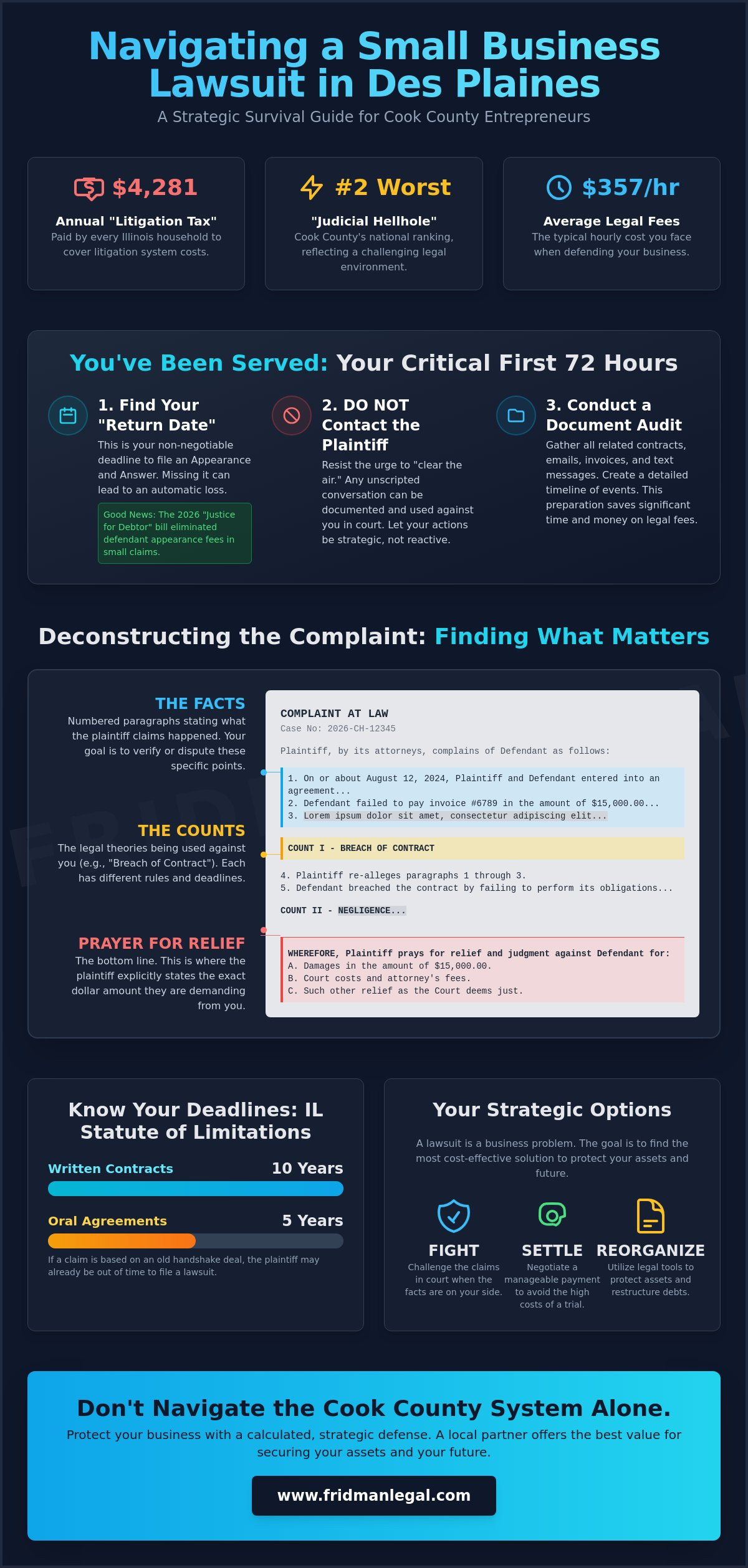
The most critical task in these first few hours is identifying the "Return Date." This isn't just a random calendar entry; it's your deadline to file an Appearance and an Answer. Thanks to the "Justice for Debtor" bill that took effect on January 1, 2026, you no longer have to pay a fee to file your appearance in small claims cases. This small win for small businesses means you can focus your resources on your strategy rather than court administrative costs.
Before you do anything else, resist the urge to call the person or company suing you. It's a natural human instinct to want to "clear the air" or explain your side, but in the legal arena, an unscripted phone call is a liability. Anything you say can be documented and used against you later. Your first 72 hours should be about internal preparation, not external confrontation.
The "No-Panic" Document Audit
Think of this stage as a strategic gathering of intelligence. You need to organize every contract, email, invoice, and text message related to the dispute into a single, secure digital folder. Don't delete anything, even if you think it looks bad for your case. A complete record allows your legal team to build a realistic defense. While the details are still fresh, write down a precise timeline of events. Identify which employees were involved and what they might have witnessed. Having this data ready saves time and reduces the $357 average hourly rate costs you might face when consulting with a professional.
Understanding the Deadline Clock
In Cook County, the court system doesn't offer much leniency for missed dates. If you ignore the summons, the plaintiff can move for a default judgment, which means you lose the case automatically without ever telling your side. understanding the lawsuit process is vital because it reveals that the summons date is simply the start of a structured timeline. Your first strategic move is often "buying time" through a formal request for an extension, which gives you the breathing room to evaluate whether you should fight, settle, or reorganize. In Des Plaines, this process usually begins at the Rolling Meadows courthouse, where procedural precision is the only way to protect your business assets.
Breaking Down the Complaint: What Are They Actually Asking For?
Reading a legal complaint for the first time is often like trying to translate a foreign language while under immense pressure. It's usually filled with repetitive, formal language that seems designed to intimidate you. When you're defending a small business lawsuit in Des Plaines, your first goal is to ignore the "legal fluff" and find the numbered paragraphs that state the actual facts. These facts are what the plaintiff claims happened. If they say you didn't pay an invoice on August 12, 2024, that's a specific fact you can verify against your own records.
Next, look for the headings labeled "Counts." Each count represents a different legal theory the plaintiff is using to sue you. One might be for "Breach of Contract," while another could be "Negligence." Identifying these is vital because each has different rules and deadlines. For instance, in Illinois, a written contract has a 10-year statute of limitations, but an oral agreement only gives the plaintiff 5 years to sue. If the dispute is about a handshake deal from early 2019, they might already be too late to file a claim in 2026.
Finally, flip to the very end of each count to find the "Prayer for Relief." This is the section where the plaintiff stops talking in circles and names their price. It's the exact dollar amount they want the judge to award them. Knowing this number helps you decide if it's worth a long, expensive fight or if a strategic settlement makes more financial sense for your bottom line.
Is the Lawsuit Properly Filed?
Sometimes, a case can be dismissed before it even gets off the ground. You need to check if the plaintiff actually has "standing" to sue you. Did the person who actually signed the contract file the suit, or is it a third party with no legal right to the claim? You should also check for jurisdictional errors. If the incident happened entirely outside of Illinois, Cook County might not be the right place for the trial. Resources like the Cook County Small Business Source can provide guidance on local business standards that may affect your standing in court.
Personal Liability vs. Business Liability
One of the most stressful parts of a lawsuit is wondering if your own home or savings are at risk. You need to see if the complaint names you personally or just your business entity. If you've operated as an LLC or a Corporation, you generally have a "corporate veil" that protects your personal assets from business debts. However, plaintiffs often try to "pierce" this veil by claiming you didn't keep your personal and business finances separate.
As of January 1, 2026, the homestead exemption in Illinois increased to $50,000 for individuals, offering a bit more protection for your primary residence. Even so, ensuring your business structure is respected in court is a top priority. If the paperwork looks like it's targeting your personal bank account, seeking civil litigation representation is a smart way to ensure your personal assets stay off the table.
Your Strategic Options: Fight, Settle, or Reorganize?
When you're defending a small business lawsuit in Des Plaines, you quickly realize it's not just about who is right. It's a strategic math problem. You have to weigh the cost of a long legal battle against the potential damage of a judgment. Litigation in Cook County is rarely fast. A typical case can drag on for 12 to 18 months, and with Illinois business lawyers averaging $357 per hour as of 2026, the bill can easily surpass the original claim. You also have to consider the 9% annual post-judgment interest rate that Illinois law applies to unpaid debts. If you lose, that clock starts ticking immediately.
For many owners, debt negotiation is the most efficient exit. It allows you to settle the dispute for a manageable sum, often pennies on the dollar, without the unpredictability of a trial. It’s about control. By choosing to settle, you eliminate the risk of a "nuclear verdict" and keep your business's financial future in your own hands rather than a stranger's. However, if the claim is completely baseless or threatens your professional reputation, standing your ground is a necessity.
When Litigation Makes Sense
Fighting back is the right move if you have airtight evidence or a strong counterclaim that could actually result in the other side paying you. You should consult the Illinois Courts Small Claims Guide to understand the specific procedural requirements for your response. If the lawsuit is based on a fundamental misunderstanding of your contract, you'll need Civil Litigation Representation to ensure your side of the story is told clearly and forcefully. Protecting your brand's integrity in the Des Plaines community often justifies the effort of a full defense.
Using Bankruptcy as a Defensive Shield
What if this lawsuit is just one of many financial pressures? If your business is struggling under multiple debts, a Chapter 11 Bankruptcy can serve as a powerful defensive tool. The moment you file, the court issues an "Automatic Stay." This is a federal injunction that forces all lawsuits and collection efforts to stop instantly. It’s like a legal pause button that gives you the space to reorganize and save your company. If the business has reached its natural end, a Chapter 7 filing provides a structured and graceful way to liquidate assets and close your doors without the lingering shadow of personal liability.
Navigating the Cook County Court System in Des Plaines
If you're operating out of Des Plaines, your legal journey almost certainly leads to the Third Municipal District courthouse in Rolling Meadows. While the physical building is in a neighboring town, its decisions dictate the future of your Des Plaines storefront or office. This courthouse is the hub for local business disputes, and its halls move with a specific rhythm. Understanding this local environment is a vital part of defending a small business lawsuit in Des Plaines. You aren't just facing a set of laws; you're entering a specific venue with its own set of expectations and procedural quirks.
Most small business owners are surprised by the sheer volume of cases the Cook County system handles. In 2022, civil cases were filed at a rate of one for every 94 residents, making this one of the busiest jurisdictions in the country. Because of this volume, the court uses tools like mandatory arbitration to keep the docket moving. Knowing how these tools work before you step into the courtroom can save you thousands of dollars in unnecessary prep time. If you're feeling overwhelmed by these procedural hurdles, reaching out for Civil Litigation Representation can provide the clarity you need to move forward.
The Mandatory Arbitration Process
In Cook County, most civil cases seeking between $10,000 and $30,000 are funneled into mandatory arbitration. This isn't a full trial with a jury. Instead, you'll present your case to a panel of three attorneys who act as arbitrators. It's a faster, less formal process that usually lasts only a few hours. The panel issues an award, and if both sides accept it, the case ends there. However, you have the right to "reject" the award and head to a full trial if you believe the decision was fundamentally unfair. It's a strategic crossroads where local knowledge of how these panels typically rule becomes your greatest asset.
Electronic Filing and Remote Hearings
The days of driving to the clerk's office with stacks of paper are largely over. Cook County now relies on the Odyssey eFileIL system for almost all submissions. Whether you're filing your initial Answer or a motion to dismiss, it has to happen digitally. Since the updates in early 2026, Zoom hearings have also become the standard for routine status calls and motions. While a remote hearing might feel more casual, the court expects the same level of professionalism as an in-person appearance. You'll need a clean background, a stable connection, and a deep familiarity with your digital evidence folder to make a strong impression on the judge.
Choosing a Local Partner: Why a Northbrook Attorney Fits
When legal trouble lands on your desk, it's tempting to look toward the Chicago skyline for a massive firm with hundreds of associates. However, those big city firms usually come with big city prices and a detached, assembly-line approach to your specific needs. Choosing a local Northbrook partner means working with a team that actually understands the Des Plaines business community. We know the local vendors, the economic climate, and the specific procedural expectations of the Rolling Meadows courthouse. This local insight is a secret weapon when defending a small business lawsuit in Des Plaines, as it allows for a more agile and cost-effective strategy than a downtown firm could ever provide.
There's also the critical matter of who is actually handling your file. In a large firm, your case might be handed off to a junior associate who is still learning the ropes on your dime. At our practice, you work directly with a principal attorney like O. Allan Fridman. This direct access ensures that every strategic decision is filtered through years of high-level experience. We don't view your lawsuit as an isolated event; we see it as a component of your overall business health. Choosing a local partner is the most effective way of defending a small business lawsuit in Des Plaines without exhausting your capital on unnecessary overhead.
A Holistic Approach to Your Business Health
We take a wide-angle view of your situation. Sometimes, the best way to handle a lawsuit isn't a long, drawn-out trial, but a strategic debt settlement that clears your balance sheet and lets you move on. We also help you look at restructuring your operations to build a stronger corporate veil and avoid future disputes before they start. We treat your business with the same level of care and precision we apply to our own firm.
Ready to Talk? Let’s Build Your Defense
The clock is already running. Whether you were served yesterday or your court deadline is looming, the worst thing you can do is wait and hope the problem goes away. We believe in total transparency, which is why we offer both flat-fee and hourly options to fit your company's budget and the complexity of your case. Let's sit down and look at the facts together. Contact us today for a strategic consultation and let's start protecting the business you've worked so hard to build.
Securing Your Business Future in Cook County
A lawsuit doesn't have to be the end of your story. By now, you know that the key to defending a small business lawsuit in Des Plaines is a mix of quick action and long term strategy. Whether you're organizing your first document audit or weighing the benefits of a Chapter 11 reorganization, the goal is to keep your assets safe and your doors open. You've seen how the Rolling Meadows courthouse operates and why the 2026 "Justice for Debtor" bill changed the game for small business defendants by eliminating certain appearance fees.
Success in these cases comes from having a partner who sees the whole picture. With nearly 20 years of local Cook County experience, we specialize in both high stakes litigation and strategic debt relief. Our boutique Northbrook firm provides the kind of personalized service that big downtown offices simply can't match. You don't have to navigate these deadlines alone. Get a strategic consultation for your Des Plaines business lawsuit today. Let's build a defense that protects your livelihood and gives you back your peace of mind. You've worked hard for your success, and we're here to help you keep it.
Frequently Asked Questions
Can I defend my small business lawsuit without a lawyer in Illinois?
In Illinois, sole proprietors can represent themselves, but corporations and LLCs are legally required to have an attorney for most court proceedings. While you can technically file your own appearance without a fee as of January 2026, the complexity of Cook County rules makes self-representation a high-risk gamble. If your business is an entity, the judge will likely order you to find counsel before the case moves forward.
What happens if I ignore a lawsuit summons in Des Plaines?
Ignoring a summons leads to a default judgment, which means you lose the case automatically without ever presenting a defense. Once a judgment is entered, the plaintiff can begin seizing business assets or garnishing accounts. Additionally, Illinois law applies a 9% annual interest rate to unpaid judgments, meaning the amount you owe will grow every month you leave it unaddressed.
How much does it typically cost to defend a business lawsuit in Cook County?
The cost varies based on the case's complexity, but the average hourly rate for an Illinois business lawyer is $357 as of March 2026. You should also account for filing fees, which are $287 for claims under $2,500 and $379 for claims up to $15,000. However, the new "Justice for Debtor" law means you won't pay an appearance fee to start defending a small business lawsuit in Des Plaines.
Can a lawsuit against my LLC affect my personal credit or home?
Generally, your personal assets are protected by the "corporate veil," but this protection isn't absolute. If you personally guaranteed a contract or mixed your personal and business finances, a plaintiff might target your individual property. It's helpful to know that as of January 1, 2026, the Illinois homestead exemption protects up to $50,000 of your home's equity for a single owner, or $100,000 for joint owners.
What is an "Automatic Stay" and how does it help my business?
An Automatic Stay is a powerful federal injunction that stops all collection activities and lawsuits against your business the moment you file for bankruptcy. It acts as a legal shield, pausing every pending case in the Cook County system. This gives you the necessary breathing room to reorganize your finances or negotiate a settlement without the immediate pressure of court appearances or asset seizures.
How long does a typical business lawsuit take to resolve in Des Plaines?
Most business lawsuits in the Third Municipal District take between 12 and 18 months to reach a resolution. The timeline depends heavily on the court's schedule and whether your case qualifies for mandatory arbitration, which is required for claims between $10,000 and $30,000. While some cases settle within months, a full trial often extends into the following calendar year due to the high volume of filings in Cook County.
Should I settle the lawsuit or go to trial?
Deciding between a settlement and a trial is a strategic choice based on the strength of your evidence and the cost of defense. If the legal fees are likely to exceed the settlement offer, an early agreement is often the most logical business decision. However, if the lawsuit is entirely meritless or could set a damaging precedent for your company, taking the case to trial might be necessary to protect your reputation.
Can I sue the person back if they filed a frivolous lawsuit against me?
Yes, you can file a counterclaim if you have a legal basis to seek damages from the person suing you. This is a common tactic when defending a small business lawsuit in Des Plaines, especially if the other party breached their end of a contract first. Filing a counterclaim can change the leverage in negotiations and may even result in the original plaintiff paying you to end the dispute.

Article by
O. Allan Fridman
O. Allan Fridman has been practicing law since 2001. His practice is unique in that he does not view himself as a litigation attorney or transactional attorney. Rather, he views each area of law as a tool to pursue the best results for his clients. By practicing in both areas of law, he is able to take a 360-degree view of law. This enables the firm to catch potential drawbacks that are readily identifiable.
By practicing in litigation and transactional law and taking a holistic approach in dealing with our clients, he doesn’t put clients in box — rather, as we are all individuals, so too are the legal services we may require.
Whether it is bankruptcy or litigation or transactional, each client brings challenges and does not fit in any one box. Often times, bankruptcy clients end up not filing bankruptcy because we can achieve a better result through litigation or through an out-of-court resolution with the lender, or through a real estate sale. On the other end of the spectrum, a litigation client with multiple issues and lawsuit may fare better in a bankruptcy.
Since 2001, Allan has practiced in states and federal court, and he is a member of the trial bar of the Northern District of Illinois and admitted in the Northern District of Indiana.
We are a debt relief agency. We help people file for bankruptcy relief under the Bankruptcy Code
The materials on this site are for informational purposes only and do not constitute legal advice. Viewing this site or contacting us does not create an attorney–client relationship, and you should not act or refrain from acting based on any information here without seeking professional legal counsel.