

What if the aggressive debt collection calls and the looming threat of a Cook County court summons aren't the end of your business, but the start of a manageable legal strategy? Most Northbrook business owners we speak with feel a deep sense of dread when they first face the consequences of business debt default Illinois, often fearing that a single missed payment will lead to an immediate seizure of their personal bank accounts or family home. It's a heavy weight to carry, and the confusion over personal versus business liability only makes the pressure feel more intense.
I'm here to tell you that Illinois law provides specific guardrails and defense options to help you regain control. In this guide, you’ll learn exactly what happens when a default triggers a lawsuit, including how the 9% post-judgment interest rate affects your balance and how the homestead exemption increase to $50,000 per person on January 1, 2026, offers new layers of protection for your primary residence. We'll walk through the typical timeline of a debt lawsuit and explore how strategic legal defense or bankruptcy can settle your obligations and protect your professional and personal assets.
Key Takeaways
- Identify the specific triggers of a default, from material breaches to acceleration clauses, so you're never caught off guard by a sudden demand for payment.
- Understand the legal timeline in Cook County and the real-world consequences of business debt default Illinois before a creditor can move toward a judgment.
- Learn how the "Citation to Discover Assets" works and what you can do to protect your company's bank accounts and equipment from being seized.
- Discover how auditing your loan documents for technical errors or lender liability can provide a powerful defense to challenge a creditor's claims in court.
- Explore how the federal automatic stay can instantly freeze all collection efforts, giving you the necessary space to reorganize or settle your debt.
What Actually Happens Right After a Business Debt Default in Illinois?
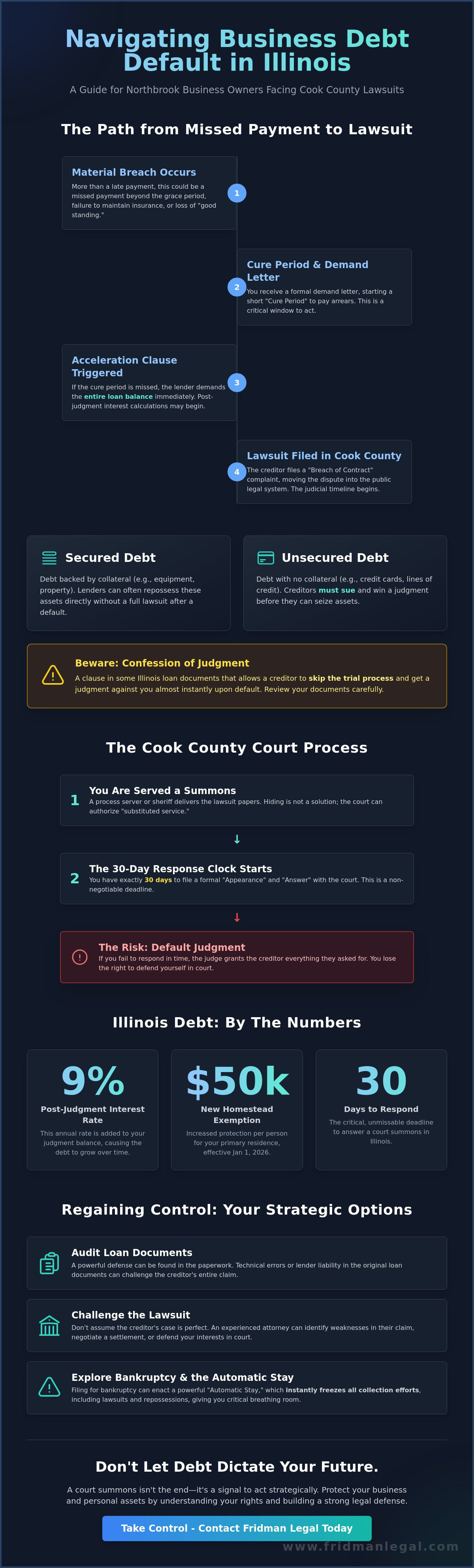
Defaulting on a business loan isn't the same as just being a few days late with a payment. In the eyes of Illinois law, a default occurs when a "material breach" of your contract happens. This usually means you've missed payments for a specific period, but it can also be triggered if you fail to maintain insurance or if your business loses its "good standing" status with the Secretary of State. Understanding the immediate consequences of business debt default Illinois is the first step toward stopping the bleeding and protecting what you've built.
The first 30 days after a missed payment are often the most stressful. You'll likely receive a formal demand letter, which is the creditor's way of putting you on notice that the clock is ticking. For many Northbrook business owners, this window is the last chance to avoid a "confession of judgment." This is a powerful legal tool in Illinois that allows some creditors to skip the usual trial process and get a judgment against you almost instantly. Whether your debt is secured or unsecured also changes the stakes:
- Secured Debt: If you've pledged collateral, like heavy machinery or a commercial property, the lender can often move to repossess those assets without a full-blown lawsuit.
- Unsecured Debt: For things like credit cards or signature lines of credit, the creditor generally has to sue you in a Cook County court and win a judgment before they can touch your assets.
The Transition from Delinquency to Default
Most commercial contracts don't consider you in default the second a payment is missed. Instead, they provide a "Cure Period," which is a short window where you can pay the arrears and keep the contract alive. If you miss that window, the lender will likely trigger the acceleration clause. An acceleration clause is a provision that allows the lender to demand the entire remaining balance of the loan immediately if you fail to meet specific terms. Once this happens, the 9% annual post-judgment interest rate allowed in Illinois starts to look like a very real threat to your company's future.
Initial Creditor Actions in the Chicago Area
Local banks in the Chicago area often start with their internal collection departments, but they don't stay there for long. If the balance is high enough, they’ll quickly hand the file over to a specialized law firm in Cook County. While it's tempting to ignore the phone calls, doing so can actually accelerate the legal process. Sometimes, a short conversation can buy you the time needed to reach out to a legal professional and build a defense strategy before the sheriff shows up with a summons.
The Legal Path: How Illinois Lawsuits Lead to Judgments
When demand letters go unanswered and the cure period expires, the lender’s next step is moving the dispute into the Cook County Circuit Court. This is where the situation shifts from a private disagreement to a public legal record. The creditor files a "Breach of Contract" complaint, and from that moment, your business is on a strict judicial timeline. If you've received a court summons, it’s vital to act quickly; you can contact Fridman Legal to discuss how to structure your formal response before the clock runs out.
A common mistake Northbrook business owners make is attempting to "dodge" the process server or the sheriff. In Illinois, hiding doesn't stop the case. If the creditor can’t reach you personally, they can ask the court for "substituted service" or even service by publication. Once the court determines you’ve been "served," you have exactly 30 days to file an Appearance and an Answer. If you fail to respond within this window, the judge can enter a "Default Judgment." This is among the most severe consequences of business debt default Illinois, as it grants the creditor everything they asked for without you ever getting to tell your side of the story.
Filing a Commercial Collection Suit in Cook County
In the Chicago court system, the value of the claim determines where the case is heard. Cases under $30,000 typically stay in the Municipal Department, while larger commercial disputes go to the Law Division. To win, the creditor must prove under the Illinois Code of Civil Procedure that a valid contract existed, they fulfilled their end of the deal, you breached the agreement, and they suffered specific financial damages as a result. While it sounds straightforward, creditors often make technical errors in their filings that can be challenged by a strategic defense.
Prejudgment Remedies and Asset Freezes
You might worry that a creditor can freeze your bank accounts the moment they file a lawsuit. Thankfully, an "Attachment of Assets" before a trial ends is a high bar to clear in Illinois. A creditor must usually prove that you’re about to flee the state or are actively hiding assets with the intent to defraud them. Prejudgment garnishment, which involves freezing your business assets before a judge has even ruled on the case, is an extraordinary remedy that is rarely granted in Illinois B2B disputes unless there's clear evidence of fraud or an attempt to hide assets. For most businesses, your accounts remain under your control until a final judgment is actually entered.
Understanding the Reach of a Judgment Creditor
Once a judge signs off on a judgment, the creditor’s power shifts from theoretical threats to concrete action. The most aggressive tool they'll use is the "Citation to Discover Assets." Think of this as a mandatory financial "show and tell" where you're legally required to disclose your company’s bank accounts, equipment, and accounts receivable under oath. If you ignore this court order, you risk being held in contempt, which can lead to a warrant for your arrest. This stage is one of the most intrusive consequences of business debt default Illinois, as it gives the creditor a complete roadmap to your company's lifeblood.
Creditors also use third-party citations to catch you off guard. They’ll send a notice directly to your bank or your biggest clients before you even know what’s happening. Your bank is then legally obligated to freeze your funds, often leaving you unable to make payroll or pay vendors. While consumer accounts now have a $1,000 automatic exemption as of February 17, 2026, business accounts generally don't enjoy the same buffer. There’s also the looming threat of "piercing the corporate veil." If a creditor can prove you’ve blurred the lines between your personal and business finances, your personal assets in Northbrook, such as your personal savings, could suddenly be on the table.
Liens on Real Estate and Personal Property
A creditor can also file a "Memorandum of Judgment" with the Cook County Recorder of Deeds. This acts like a financial "leash" on any real estate you own. If you try to sell or refinance your commercial space, that lien must be satisfied first. These judgments typically have a 7-year lifespan in Illinois, but don't assume they'll just disappear. Creditors can "revive" these judgments, extending their reach for up to 20 years in many cases. If you're currently dealing with property liens, understanding how they impact a sale is crucial; you might find our guide on a real estate lawyer for closing in Northbrook helpful for navigating those complexities.
Wage Assignments and Bank Garnishments
If your business is still operating, creditors will likely go after your income streams. They can issue garnishments against your accounts receivable, essentially intercepting payments from your customers before they ever reach your pocket. While Illinois law provides some protections that limit how much can be taken from an individual's paycheck, businesses don't have those same safety nets. Beyond cash, a creditor can also send the sheriff to seize business vehicles or expensive equipment to sell at a public auction. Understanding these consequences of business debt default Illinois is vital for protecting what equity you have left.
Strategic Defenses Against Business Debt Litigation
Receiving a summons can make you feel like the outcome is already decided, but being sued is the beginning of a legal process, not the end of your business. In Illinois, you have the right to challenge the creditor's claims and force them to prove every penny they're demanding. Many business owners don't realize that lenders often make technical errors during the life of a loan that can be used as a defense. By auditing the loan documents for "Lender Liability" or procedural mistakes, you can often shift the leverage back in your favor and mitigate the harshest consequences of business debt default Illinois.
One of the first things we look at is whether the creditor even has the right to sue. If your debt was sold to a third-party buyer, they must provide a clear "chain of title" showing they actually own the account. If they can't produce the original signed contract or accurate payment ledgers, their case might be built on sand. We also look for affirmative defenses like "Failure of Consideration" or checking if the lawsuit was filed within the Statute of Limitations. In Illinois, creditors generally have 10 years to sue on a written contract, but only 5 years for oral agreements and 4 years for the sale of goods. If they've waited too long, the case could be dismissed entirely.
Challenging the Breach of Contract Claim
A Northbrook lawyer will scrutinize the complaint for holes in the documentation. It's surprisingly common for creditors to lose the original paperwork or fail to account for payments you've already made. If the interest rates or fees don't match the original agreement, that's a point of attack. While you're fighting the case in court, it's also worth exploring out-of-court options. You can read more about these strategies in our guide for a debt settlement lawyer in Northbrook, which covers how to resolve these disputes without a judge's final order.
Negotiating Out-of-Court Settlements
Even if the creditor’s case is strong, they often prefer a guaranteed settlement over a long, expensive trial. You might negotiate a "Workout Agreement" or a "Forbearance," where the lender agrees to pause the lawsuit while you catch up on payments. If you're offering a lump sum, you can often settle for significantly less than the total balance, especially if you use the potential for a bankruptcy filing as leverage. Just make sure that any deal you reach is followed by a "Release and Satisfaction of Judgment" filed with the court. This document is your best friend because it proves the debt is legally dead. If you're facing a lawsuit right now, you should speak with an attorney to see which of these defenses applies to your specific situation.
Using Bankruptcy as a Tool for Business Debt Relief
Sometimes the most professional decision you can make for your business is to recognize when the path forward requires a clean slate. While we’ve explored the various consequences of business debt default Illinois throughout this guide, bankruptcy stands out as the only federal tool capable of halting those consequences instantly. It isn't an admission of defeat; it’s a strategic legal maneuver designed to protect assets and provide a structured exit or a new beginning for the business owner.
One of the most significant advantages of filing is the ability to address personal guarantees. Many Northbrook business owners are personally on the hook for commercial leases or lines of credit. Bankruptcy can often sever that personal liability, ensuring that a business failure doesn't lead to a personal financial catastrophe. This becomes especially relevant when you consider the January 1, 2026, increase in the Illinois homestead exemption to $50,000 per person, which already offers a stronger safety net for your primary residence during these transitions.
The Automatic Stay: Immediate Protection
The moment a bankruptcy petition is filed, a federal injunction known as the Automatic Stay goes into effect. This powerful law stops a Cook County sheriff's sale or a bank levy in its tracks, even if the seizure process has already begun. Any pending lawsuits in the Illinois court system are frozen, and creditors are legally barred from contacting you or attempting to collect. If you're facing an imminent asset seizure or a frozen bank account, exploring Bankruptcy Services at Fridman Legal can provide the breathing room you need to evaluate your next move without the constant pressure of collection calls.
Chapter 7 vs. Chapter 11 for Illinois Companies
Deciding which chapter to file depends entirely on your goals and the current viability of your company. Chapter 7 is often referred to as the "clean break." It’s intended for businesses that can no longer operate profitably and need an orderly way to liquidate assets and shut down while resolving creditor claims. On the other hand, Chapter 11 is the "strategic pivot." This option allows Northbrook businesses with a future to reorganize their debts, renegotiate unfavorable contracts, and continue operations under court protection. For a deeper look at how this works in our local market, you can review our guide on a Strategic Chapter 11 Bankruptcy Filing. Both paths offer a way to manage debt professionally while shielding you from the most aggressive collection tactics allowed under Illinois law.
Take the Next Step Toward Financial Stability
Navigating the consequences of business debt default Illinois requires a proactive stance rather than a reactive one. We've explored how the legal timeline in Cook County provides specific windows to challenge creditor claims and how federal protections like the automatic stay can instantly halt collection efforts. Whether your goal is to reorganize your operations or facilitate an orderly exit, the law provides the tools necessary to protect your personal and professional future.
O. Allan Fridman brings nearly 20 years of Illinois bankruptcy and litigation experience to every case, offering the kind of personalized, results-driven representation that Northbrook business owners deserve. We provide flat-fee options for bankruptcy filings to ensure you have financial predictability during an uncertain time. You've worked hard to build your company; you deserve a strategy that respects that effort while providing a clear way out of a debt crisis.
Facing a business debt crisis in Northbrook or Chicago? Schedule a confidential consultation with O. Allan Fridman today. It’s time to move from uncertainty to a concrete plan for your recovery.
Frequently Asked Questions
Can a business creditor sue me personally for a business debt in Illinois?
Yes, a creditor can target your personal assets if you signed a personal guarantee, which is a standard requirement for most Northbrook commercial leases and SBA loans. If you didn't sign a guarantee, they can only reach you personally by "piercing the corporate veil." This happens if a court finds you didn't keep your personal and business finances separate, such as using a business account to pay for your personal mortgage.
How long does a creditor have to collect a business debt judgment in Illinois?
In Illinois, a judgment is generally enforceable for seven years, but a creditor can revive it to extend its life for up to 20 years. It's a common misconception that these debts just expire. For consumer judgments entered after January 1, 2026, the law limits enforceability to 15 years total with no revival, but most commercial and business debts still follow the longer 20-year timeline.
Can an Illinois creditor seize my business bank account without a court order?
No, a third-party creditor cannot freeze or seize your business bank account until they have won a lawsuit and obtained a formal judgment. The only major exception is if you owe money to the same bank where you hold your deposits. In that case, the bank might use a "right of set-off" to take funds directly from your account to cover a defaulted loan without going to court first.
What is a 'Citation to Discover Assets' and do I have to attend?
A Citation to Discover Assets is a court order that forces you to disclose your company's financial records, bank accounts, and property under oath. You are legally required to attend this hearing. If you ignore it, the judge can hold you in contempt and issue a "body attachment," which is a warrant for your arrest. It's the primary tool creditors use to find where you're hiding equipment or cash.
Will defaulting on business debt affect my personal credit score in Illinois?
Your personal credit score is only at risk if you're personally liable for the debt as a guarantor or if you're a sole proprietor. If the debt is strictly in the name of a corporation or LLC and you never signed a personal guarantee, it won't appear on your personal credit report. However, because almost all small business lenders require a personal signature, most defaults eventually impact your individual credit standing.
Can I stop an Illinois business debt lawsuit by filing for bankruptcy?
Filing for bankruptcy triggers an "automatic stay" that immediately stops all state court lawsuits and collection actions. This is a powerful way to manage the consequences of business debt default Illinois because it prevents creditors from moving forward with a judgment or a bank levy. Whether you're looking to reorganize under Chapter 11 or liquidate through Chapter 7, the stay provides instant relief from the litigation process.
What assets are exempt from creditors in an Illinois business debt judgment?
While business entities have almost no exemptions, your personal assets have specific protections if you're held liable for the debt. As of January 1, 2026, the homestead exemption protects $50,000 of equity in your home per person. You also have a $4,000 "wildcard" exemption for any personal property and a new $1,000 automatic exemption for consumer bank accounts that went into effect on February 17, 2026.
What happens if my business closes while I still owe creditors in Illinois?
Closing your business doesn't erase the debt if you've signed a personal guarantee or if the business still owns valuable assets like machinery or vehicles. Creditors can still sue the defunct entity to seize its remaining property or pursue you personally for the balance. Navigating the consequences of business debt default Illinois often requires a formal dissolution or a bankruptcy filing to ensure that the debt is legally discharged and won't follow you into your next professional chapter.

Article by
O. Allan Fridman
O. Allan Fridman has been practicing law since 2001. His practice is unique in that he does not view himself as a litigation attorney or transactional attorney. Rather, he views each area of law as a tool to pursue the best results for his clients. By practicing in both areas of law, he is able to take a 360-degree view of law. This enables the firm to catch potential drawbacks that are readily identifiable.
By practicing in litigation and transactional law and taking a holistic approach in dealing with our clients, he doesn’t put clients in box — rather, as we are all individuals, so too are the legal services we may require.
Whether it is bankruptcy or litigation or transactional, each client brings challenges and does not fit in any one box. Often times, bankruptcy clients end up not filing bankruptcy because we can achieve a better result through litigation or through an out-of-court resolution with the lender, or through a real estate sale. On the other end of the spectrum, a litigation client with multiple issues and lawsuit may fare better in a bankruptcy.
Since 2001, Allan has practiced in states and federal court, and he is a member of the trial bar of the Northern District of Illinois and admitted in the Northern District of Indiana.
We are a debt relief agency. We help people file for bankruptcy relief under the Bankruptcy Code
The materials on this site are for informational purposes only and do not constitute legal advice. Viewing this site or contacting us does not create an attorney–client relationship, and you should not act or refrain from acting based on any information here without seeking professional legal counsel.


