

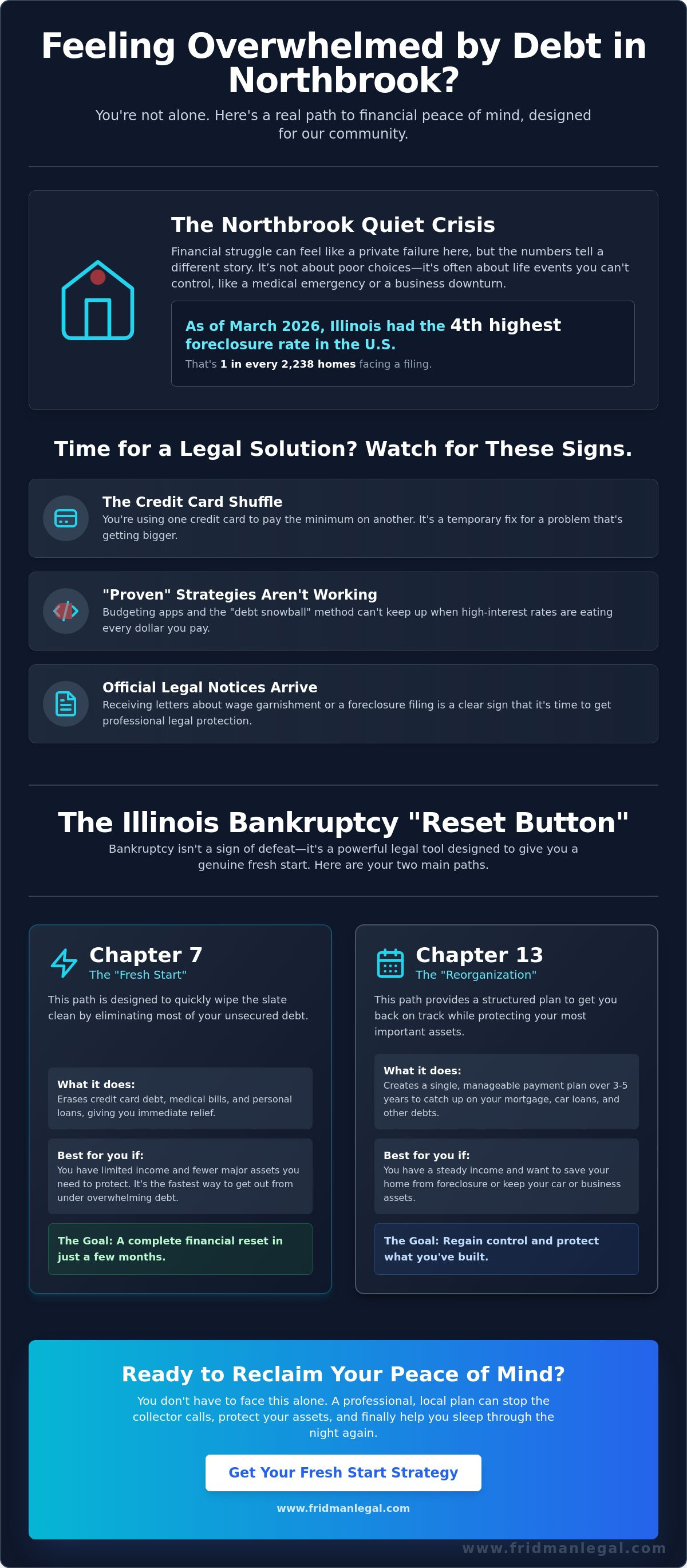
Did you know that by March 2026, Illinois reached the fourth highest foreclosure rate in the country, with one in every 2,238 homes facing a filing? If you're currently feeling overwhelmed by debt help Northbrook strategies can provide the clarity you need to stop the collector calls and protect your assets. It's exhausting to live with the constant fear of losing your home or your car. You've worked incredibly hard to build your life here, and it's natural to feel paralyzed when the financial pressure becomes too much to handle alone.
You deserve a professional plan that offers more than just temporary fixes. This guide will show you how to move from high-stakes stress to a genuine fresh start using local legal frameworks that actually work. We'll explore the updated 2026 Illinois bankruptcy exemptions, explain the real-world differences between debt negotiation and filing for Chapter 7 or Chapter 13, and provide the insights you need to reclaim your peace of mind and finally sleep through the night.
Key Takeaways
- Understand why Northbrook's high cost of living often makes traditional budgeting impossible and when it’s time to look at professional legal solutions.
- If you’re feeling overwhelmed by debt help Northbrook experts can explain how debt negotiation and settlement work to provide a path forward that doesn't involve more high-interest loans.
- Learn how to choose between a Chapter 7 "fresh start" and a Chapter 13 reorganization plan to protect your home and your business assets.
- Get a realistic look at the documentation you'll need and the step-by-step process of working through the legal system to stop collector harassment.
- Discover how to rebuild your financial life and credit score in the twelve months following your debt relief journey.
Why Feeling Overwhelmed by Debt in Northbrook is More Common Than You Think
Living in Northbrook often carries the weight of high expectations. We live in a community where success is visible, which can make financial struggle feel like a private failure. But behind the quiet streets and manicured lawns, a "quiet crisis" is unfolding for many families. If you are currently feeling overwhelmed by debt help Northbrook residents can rely on often starts with the simple realization that you aren't alone in this. The 2026 economic landscape has been challenging, with Illinois seeing a significant rise in per capita debt and maintaining the fourth-worst foreclosure rate in the nation as of March 2026.
Debt doesn't usually happen because of poor choices. In our area, it’s often triggered by events entirely outside of your control. We see families struggling after a sudden medical emergency that insurance didn't cover, or business owners facing a downturn that their cash reserves couldn't bridge. Even shifts in the local real estate market can leave homeowners in a bind. You might be "debt overwhelmed" if your minimum monthly payments exceed your disposable income after basic necessities are met. When you're choosing between the mortgage and the grocery bill, the math has stopped working in your favor.
The U.S. bankruptcy system exists specifically to provide a release valve for these high-pressure situations. It isn't a sign of defeat; it’s a legal tool designed to restore balance to your life and the broader economy.
The Mental Toll of Financial Stress
Chronic debt anxiety is more than just a bad mood. It’s a physiological weight that affects your sleep, your health, and your relationships with your spouse and children. There’s often a deep sense of shame attached to financial trouble, especially in Northbrook, which prevents people from seeking professional legal guidance early on. This delay is risky. Waiting until a crisis hits often makes legal options more difficult to execute, as assets might be seized or income requirements for certain filings might change.
Signs You Need Professional Legal Help
It’s time to stop trying to "budget" your way out of a structural financial problem if you notice these red flags:
- The Credit Card Shuffle: You’re using one credit card to pay the minimum balance on another just to keep things afloat.
- Legal Notices: You’ve received official letters regarding wage garnishment, or worse, a foreclosure filing on your Northbrook home.
- Ineffective Tools: Budgeting apps and "proven strategies" like the debt snowball aren't making a dent because interest rates are eating every dollar you pay.
If these scenarios sound familiar, the most professional step you can take is to stop the bleeding and look at a legal solution that actually protects your future.
When "Proven Strategies" Aren’t Enough: The Legal Side of Debt Relief
Many financial blogs suggest the "Snowball Method" or the "Avalanche Method" as the ultimate cure for debt. These strategies work fine if you have a minor spending problem and plenty of extra income to spare. However, they're often mathematically impossible once interest rates on credit cards or personal loans hit double digits. If you're feeling overwhelmed by debt help Northbrook residents can actually use needs to address the predatory nature of current interest rates. When your principal balance isn't moving despite your best efforts, you aren't dealing with a budgeting issue. You're dealing with a structural one that requires a legal response.
Unlike a bank or a budgeting app, the law provides a specific set of protections that creditors cannot ignore. For a detailed overview of how these protections function, you can review the Bankruptcy Basics provided by the federal courts. These rules are designed to protect your Northbrook assets, like your home equity or your vehicle, before collectors have the chance to initiate a seizure or a lawsuit. Choosing debt negotiation and settlement or a formal bankruptcy filing creates a legal barrier that simple consolidation loans can't match.
The Reality of Debt Consolidation Loans
Debt consolidation sounds appealing because it promises a single, manageable payment. But for many, it’s a trap. These loans often come with hidden fees and interest rates that aren't actually lower in the long run. Even worse, if you don't address the underlying financial structure, you might end up with a consolidation loan and a fresh set of maxed-out credit cards. A legal consultation is a much safer path than calling a "debt relief" call center. These centers often don't have your best interests at heart and can't offer the same asset protection that a licensed attorney can provide.
Stopping the Harassment: The Automatic Stay
One of the most powerful tools in the legal arsenal is the "Automatic Stay." The moment a bankruptcy petition is filed, a federal injunction goes into effect. It's an immediate stop sign for every creditor. This means the phone stops ringing, the lawsuits are paused, and the threat of wage garnishment vanishes. It’s the only way to truly stop the bleeding. Having a lawyer handle all future communication with your creditors provides the mental space you need to focus on rebuilding. If you're feeling overwhelmed by debt help Northbrook services should prioritize this immediate relief to give you back your peace of mind.
If you're tired of the endless cycle of interest, looking into legal debt relief options might be the most strategic move you can make this year.
The Illinois Bankruptcy "Reset Button": Chapter 7 vs. Chapter 13
Bankruptcy isn't a one-size-fits-all solution. In Illinois, the path you take depends largely on your income and what you’re trying to protect. If you're currently feeling overwhelmed by debt help Northbrook legal advisors provide often begins with the "Means Test." This is a calculation used to determine if your income is below the state median. As of November 1, 2025, the income limit for a one-person household in Illinois is $71,304, while a four-person household can earn up to $134,366. If your income falls below these thresholds, Chapter 7 bankruptcy is typically the most direct route. If you earn more, Chapter 13 provides a structured, court-protected way to manage your obligations.
Chapter 7: A Total Financial Reset
Chapter 7 is what most people think of as a "straight" bankruptcy. It’s designed to wipe out unsecured debts like credit cards, medical bills, and personal loans. The process is remarkably fast; most people receive their discharge within four to six months. It’s the most efficient way to stop the bleeding and start over. While there is a $338 filing fee in 2026, the long-term relief from eliminating years of high-interest debt is substantial. It’s a powerful tool for those who don't have significant assets to lose but need to clear the slate completely.
Chapter 13: Protecting Your Home and Assets
For many Northbrook homeowners, Chapter 13 is the preferred strategy. It’s often called a "wage earner’s plan" because it allows you to keep your property while paying off a portion of your debt over three to five years. This is especially helpful if you’ve fallen behind on your mortgage and want to prevent foreclosure. It allows you to catch up on missed payments over time while the "Automatic Stay" keeps your bank from taking further action. It also protects assets like a vehicle with more than $3,600 in equity, which might be at risk in a Chapter 7 liquidation.
A common fear is that you'll lose everything you own. That's simply not true under the 2026 Illinois exemptions. You can protect up to $50,000 of equity in your home ($100,000 for joint owners) and use a $4,000 "wildcard" exemption for any personal property. Even your bank account has an automatic $1,000 protection. These laws are specifically designed to leave you with the tools you need to live, not to leave you destitute. If you're feeling overwhelmed by debt help Northbrook professionals can help you map these exemptions to your specific situation to ensure you keep what matters most.
Navigating the Process: Your Local Northbrook Legal Journey
Starting the legal process isn't about admitting defeat. It’s about taking control of a situation that has grown too large for one person to manage. If you're currently feeling overwhelmed by debt help Northbrook firms offer begins with a detailed, confidential review of your financial portfolio. We don't just look at what you owe; we look at the whole picture, from your income to your long-term goals for your home and family. You'll need to gather a few essential items to get started, including your last two years of tax returns, pay stubs from the past six months, and a complete list of your creditors. It feels like a mountain of paperwork at first, but it’s the necessary foundation for your fresh start.
Once your petition is filed with the court, you'll attend what is known as the Meeting of Creditors, or a 341 meeting. Despite the name, it’s rarely a room full of angry lenders. In most cases, it’s a brief, professional meeting where a court-appointed trustee asks a few clarifying questions about your filing. Your attorney is there to guide you through every question, ensuring the process remains predictable and calm. When you're feeling overwhelmed by debt help Northbrook legal strategies provide the only guaranteed way to stop lawsuits and garnishments in their tracks through this formal court oversight.
The Importance of Local Expertise
Choosing a firm that understands the specific nuances of the Cook County court system is vital. A Northbrook-based attorney knows the local real estate market and the cost of living in our specific zip codes, which matters when calculating your disposable income for the Means Test. We navigate the requirements of the Bankruptcy Court for the Northern District of Illinois daily. Having a representative who is accessible right here in your neighborhood means you aren't just a case number in a massive downtown firm; you have a partner who understands the local environment.
What Happens After You File?
The relief is almost instantaneous. As we mentioned, the Automatic Stay takes effect the second your case is filed, legally prohibiting creditors from contacting you or continuing collection actions. But the journey doesn't end with the filing. After your discharge, your credit score often begins to rebuild faster than you might expect. By removing the high debt-to-income ratio that was dragging your score down, you create space for new, healthy credit habits. Most people find that within a year of their discharge, they are in a much stronger position to apply for traditional financing again.
If you're ready to stop the cycle and start your recovery, the first step is to reach out for a professional case evaluation.
Finding Your Way Back to Financial Stability
The first twelve months after a debt discharge often feel like a period of rediscovery. For the first time in years, your income belongs to you again, not to a collection agency or a credit card issuer. If you've been feeling overwhelmed by debt help Northbrook families can count on should include a roadmap for what happens next. Rebuilding your credit isn't an overnight process, but it’s much faster than most people realize. By removing the high debt-to-income ratio that was suppressing your score, you've already taken the biggest step toward a healthy financial profile.
Strategic credit rebuilding involves managing small, manageable lines of credit and ensuring every payment is made on time. Many of our clients see their credit scores climb back into a respectable range within a year of their filing. At Fridman Legal, we believe in a personalized, results-driven approach. We don't just file your paperwork and walk away. We help you understand the structural changes needed to maintain your stability in the long term. Our flat-fee model ensures that your costs remain predictable, which is essential when you're focusing on rebuilding your reserves.
Choosing a Partner, Not Just a Lawyer
When you're looking for a way out, it’s tempting to choose the first high-volume "bankruptcy mill" you see on a billboard. However, these firms often lack the personalized attention required to protect complex assets like a Northbrook business or a family home. With over 20 years of experience in Illinois bankruptcy law, we understand the specific nuances of our local courts. We take the time to map out a solution that fits your life, rather than forcing your situation into a pre-set template. If you're feeling overwhelmed by debt help Northbrook legal experts provide should always start with a confidential, one-on-one strategy session.
Ready to Breathe Again?
The most important thing to remember is that you have options. Financial trouble isn't a character flaw; it’s a legal problem that has a clear, professional solution. You don't have to spend another night staring at the ceiling and worrying about the morning mail. Fridman Legal is located right here in Northbrook, and we're ready to stand in your corner. We've helped countless neighbors reclaim their lives from impossible debt, and we can help you do the same. Take the first step toward a future where you can breathe again and reach out for a confidential consultation today. Your fresh start is closer than it feels.
Take the First Step Toward Your Financial Recovery
The cycle of debt often feels like an endless loop, but it is a legal challenge with a definitive exit. We've explored how local bankruptcy protections and strategic debt negotiation can shield your Northbrook home and assets from collectors. If you're currently feeling overwhelmed by debt help Northbrook residents can rely on involves moving past the shame and focusing on a concrete recovery plan. Rebuilding your credit and your peace of mind starts the moment you decide to stop managing a crisis and start executing a professional solution. It's about more than just clearing balances; it's about reclaiming your future.
With nearly 20 years of local legal experience, O. Allan Fridman provides the personalized representation necessary to navigate the Cook County courts effectively. We prioritize transparency through flat-fee bankruptcy filing services, so you know exactly what to expect from the very beginning. You don't have to face this burden alone. Get a Fresh Start: Schedule Your Confidential Debt Consultation with Fridman Legal. Your path back to stability is ready when you are.
Common Questions About Debt Relief in Northbrook
Will I lose my home in Northbrook if I file for bankruptcy?
Most people are able to keep their primary residence through the 2026 Illinois homestead exemption. This law allows you to protect up to $50,000 in home equity as an individual or $100,000 if you own the property jointly with a spouse. If you've fallen behind on your mortgage, filing for Chapter 13 is often the most strategic way to stop a foreclosure and catch up on missed payments over a three to five year period.
How much does it cost to hire a bankruptcy lawyer in Illinois?
While attorney fees vary based on the complexity of your financial situation, the court filing fees are standardized across the state. In 2026, the filing fee for a Chapter 7 case is $338, while a Chapter 13 case requires a $313 filing fee. It’s best to discuss your specific needs during a consultation to understand the total investment required for your fresh start.
What is the Illinois "Means Test" and do I have to take it?
The Means Test is a calculation used to determine if your income is low enough to qualify for a Chapter 7 discharge. As of late 2025, a one-person household in Illinois can earn up to $71,304 and still qualify automatically. For a family of four, that limit increases to $134,366. If you're feeling overwhelmed by debt help Northbrook legal experts provide will include a detailed analysis of your income to see which chapter fits your goals.
Can bankruptcy stop my wages from being garnished right away?
Yes, the moment your attorney files your bankruptcy petition, a legal protection called the "Automatic Stay" goes into effect. This federal injunction immediately halts all collection activities, including active wage garnishments, bank account freezes, and pending lawsuits. It provides the immediate breathing room you need to reorganize your finances without the constant pressure of shrinking paychecks.
Will my employer or neighbors find out that I filed for bankruptcy?
While bankruptcy is a matter of public record, it isn't publicized in local newspapers or announced to your employer. Neighbors would generally only find out if they actively searched the federal court database, which is uncommon. Your employer typically only becomes aware of the filing if we need to stop a wage garnishment or if you choose to have your Chapter 13 plan payments deducted directly from your payroll for convenience.
Can I get rid of medical debt through bankruptcy in Northbrook?
Medical debt is considered "unsecured" debt, which means it can be completely wiped out in a Chapter 7 filing. There is no limit to the amount of medical debt you can discharge. If you're feeling overwhelmed by debt help Northbrook professionals can help you ensure these bills are properly listed so you never have to pay another dollar toward them after your case is finalized.
How long does the Chapter 7 bankruptcy process take in Cook County?
The typical Chapter 7 case moves quite quickly, usually taking between four and six months from the date of filing to the final discharge. You'll only need to attend one brief meeting of creditors, which is currently handled via telephone or video conference in many cases. Once the court issues the discharge order, your eligible debts are legally forgiven forever.
What is the difference between debt settlement and filing for bankruptcy?
Debt settlement is a voluntary negotiation where you ask creditors to accept less than what you owe, but they aren't legally required to participate. Bankruptcy is a federal court process that forces creditors to stop all collection actions and follow a court-ordered discharge or payment plan. Bankruptcy offers a level of certainty and asset protection that informal negotiations simply cannot provide.

Article by
O. Allan Fridman
O. Allan Fridman has been practicing law since 2001. His practice is unique in that he does not view himself as a litigation attorney or transactional attorney. Rather, he views each area of law as a tool to pursue the best results for his clients. By practicing in both areas of law, he is able to take a 360-degree view of law. This enables the firm to catch potential drawbacks that are readily identifiable.
By practicing in litigation and transactional law and taking a holistic approach in dealing with our clients, he doesn’t put clients in box — rather, as we are all individuals, so too are the legal services we may require.
Whether it is bankruptcy or litigation or transactional, each client brings challenges and does not fit in any one box. Often times, bankruptcy clients end up not filing bankruptcy because we can achieve a better result through litigation or through an out-of-court resolution with the lender, or through a real estate sale. On the other end of the spectrum, a litigation client with multiple issues and lawsuit may fare better in a bankruptcy.
Since 2001, Allan has practiced in states and federal court, and he is a member of the trial bar of the Northern District of Illinois and admitted in the Northern District of Indiana.
We are a debt relief agency. We help people file for bankruptcy relief under the Bankruptcy Code
The materials on this site are for informational purposes only and do not constitute legal advice. Viewing this site or contacting us does not create an attorney–client relationship, and you should not act or refrain from acting based on any information here without seeking professional legal counsel.