

What if those court papers from Waukegan aren't an eviction notice, but the start of a process where you still have significant legal leverage? It's natural to feel anxious when the phone won't stop ringing or when complex jargon makes it feel like the lender has already won. Many homeowners assume that once a summons arrives, their time in their home is finished. In reality, the legal framework in Illinois provides several avenues for protection. This guide explores the specific foreclosure defense options in Lake County that can help you stay in your home and navigate the court system with professional confidence.
We'll cover the 2026 mediation rules, the critical 30-day response deadline, and how local programs provide the strategic support you need. You'll learn about the $125 mediation fund and how legal strategies like Chapter 13 bankruptcy can provide an immediate shield for your property. You don't have to face the 19th Judicial Circuit Court without a clear plan. There are precise, professional paths available to help you resolve this situation, stop the aggressive calls, and secure your residency for the long term.
Key Takeaways
- You have exactly 30 days to respond to a foreclosure summons in Lake County, so acting quickly is the only way to protect your legal rights.
- Understanding the nuances of loss mitigation can help you negotiate better terms, whether that involves lowering your interest rate or extending your loan's duration.
- Exploring professional foreclosure defense options in Lake County often reveals that a Chapter 13 filing can stop a sale immediately and let you catch up on payments over several years.
- Challenging the bank's "standing" forces the lender to prove they actually own your mortgage before they can proceed with a court case against you.
- A successful strategy avoids generic advice by combining specific real estate litigation with federal bankruptcy protections to create a custom shield for your home.
Understanding the Lake County Foreclosure Timeline: How Much Time Do You Have?
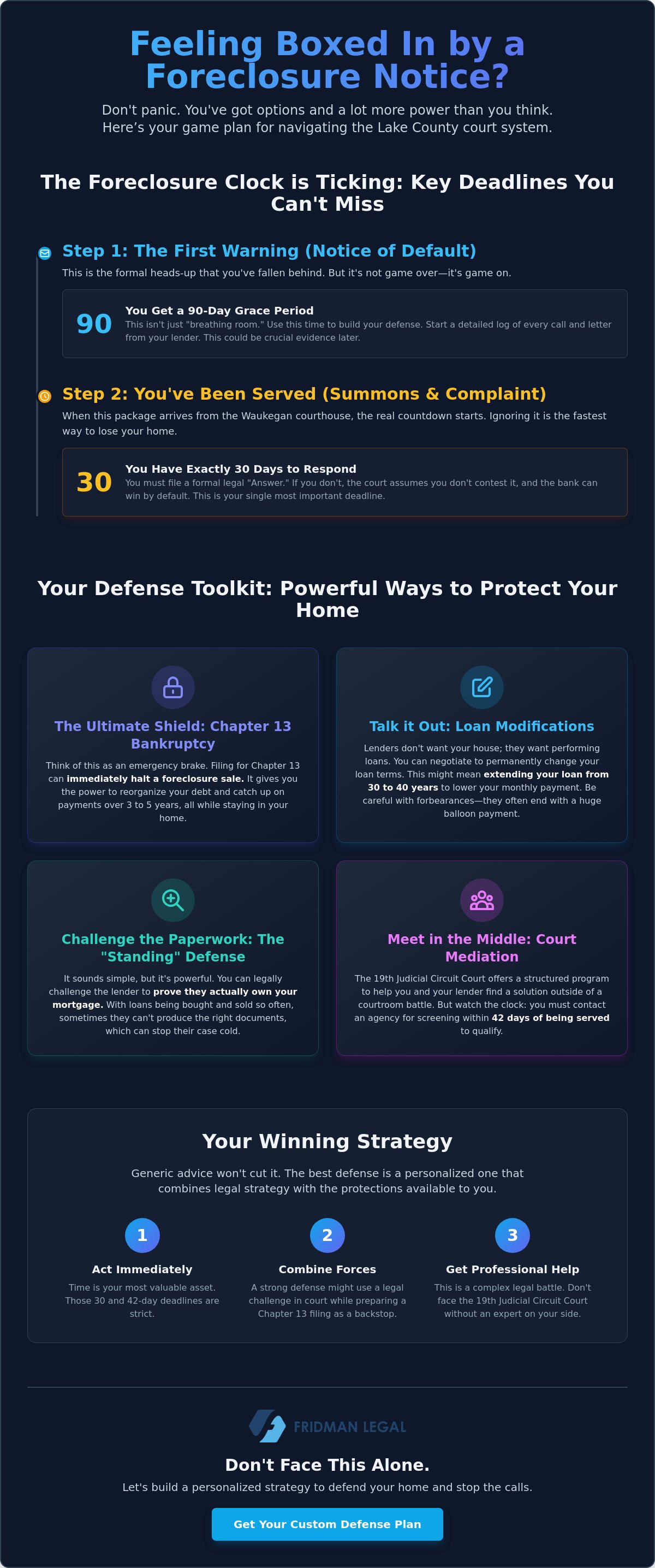
The foreclosure process in Illinois is strictly judicial, which means your lender must navigate the court system to take possession of your property. In Lake County, this process generally begins with a mandatory 90-day grace period. This isn't merely a delay; it's a regulated window of time designed to allow you to seek counseling or negotiate a resolution. While it might feel like "breathing room," it's actually the most critical period to evaluate your foreclosure defense options in Lake County. By the time 2026 arrived, the 19th Judicial Circuit Court in Waukegan expanded its mediation frameworks, making it easier for homeowners to secure a seat at the table before a judge makes a final ruling.
The Pre-Foreclosure Phase and Your Rights
Before a lawsuit is even filed, you'll likely receive a "Notice of Default." This document serves as a formal declaration that you've fallen behind on payments, but it doesn't mean you've lost your home yet. You should use this 90-day window to build a comprehensive defense strategy. One of the simplest but most effective things you can do is keep a detailed log of every single call, email, or letter from your lender. Note the date, the representative's name, and exactly what was discussed. These records can become vital evidence if the lender later claims they offered assistance that they actually didn't, providing a basis for foreclosure defense options in Lake County that rely on lender misconduct.
When the Lawsuit Begins: The Summons and Complaint
If the grace period ends without a resolution, the lender will file a formal complaint at the courthouse in Waukegan. When you receive the summons, the clock starts ticking. You have exactly 30 days to file an "Answer" or a similar legal response. Many people make the mistake of "putting it in a drawer" because the legal jargon feels overwhelming, but that's a guaranteed way to lose by default. Understanding the Foreclosure Process shows that the law is procedural; if you don't show up, you don't get to present your side of the story.
A foreclosure is a civil lawsuit that requires a formal legal response to prevent a default judgment. This means you aren't just "talking it out" with the bank anymore; you're engaging in a litigation process that requires specific filings. In 2026, the court's mediation fund, which is supported by a $125 filing fee on all mortgage cases, provides a structured environment to discuss alternatives. However, you must contact an agency representative for screening within 42 days of being served to participate in this mediation program. Failing to meet these specific Waukegan court deadlines is the primary reason homeowners lose their property unnecessarily.
Loan Modifications and Loss Mitigation: Negotiating with the Bank
The term "loss mitigation" sounds like complex corporate jargon, but it's actually a straightforward concept. It refers to the process where a lender works with a borrower to mitigate, or lessen, the financial loss they'll face if a home goes into foreclosure. Banks are in the business of collecting interest, not managing real estate, so they're often willing to discuss foreclosure defense options in Lake County that keep the loan performing. However, the negotiation process is rarely a simple phone call. It's a high-stakes business transaction that requires precise documentation and a clear understanding of the bank's internal guidelines.
One of the most common outcomes is a loan modification. This isn't a new loan, but a permanent change to your existing mortgage. In the 2026 market, lenders are often more inclined to extend the term of the loan, perhaps moving it from a 30-year to a 40-year mortgage, rather than significantly lowering the interest rate. While this reduces your monthly payment, it increases the total interest you'll pay over time. Forbearance agreements are another tool, though they can be a trap if not handled correctly. A forbearance allows you to pause or reduce payments temporarily, but you must have a plan for the "catch-up" period. Many homeowners are surprised by a massive balloon payment due the moment the forbearance ends.
Common Workout Options in Illinois
If you've suffered a temporary financial setback, a repayment plan might be the most efficient solution. This spreads your missed payments over a period of 6 to 12 months, adding a portion of the arrears to your current monthly bill. Refinancing is a more permanent fix, but it's notoriously difficult once you've missed a payment. In 2026, lenders look at your credit score more critically than ever. Principal reduction, where the bank actually forgives a portion of what you owe, remains rare. It usually only happens when the property is significantly "underwater" and the lender decides that a partial loss is better than the total cost of a foreclosure lawsuit in Waukegan.
The 'Hamp' and Beyond: 2026 Government Programs
While the original HAMP programs are a thing of the past, 2026 has brought updated federal and Illinois-specific initiatives designed to stabilize the housing market. To navigate these safely, you should always start with HUD-approved housing counseling to understand which programs apply to your specific loan type. Be extremely cautious of "foreclosure rescue" companies that ask for upfront fees or promise guaranteed results. These are almost always scams. Authentic help comes through official channels and legal representation that understands how to hold banks accountable when they claim they "lost your paperwork."
Lenders frequently use the "lost paperwork" excuse to delay the process, often pushing a home closer to a sale date while the homeowner thinks a modification is being reviewed. Professional foreclosure defense involves more than just filling out forms; it's about creating a paper trail that the court can't ignore. When a lawyer handles the "runaround," the bank's legal department is forced to provide real answers instead of generic excuses. Having a professional advocate ensures that your application is actually reviewed under the 2026 guidelines instead of sitting in a digital pile.
Bankruptcy as a Foreclosure Shield: Chapter 7 and Chapter 13
Many people view bankruptcy as a sign of defeat, but in the context of foreclosure defense options in Lake County, it's often the most powerful offensive move you can make. While a loan modification depends on the bank's willingness to cooperate, bankruptcy invokes federal law to force the lender to stop. It changes the dynamic from a negotiation into a court-ordered protection. At Fridman Legal, we don't treat this as a last resort; we treat it as a tactical tool to regain control of your financial future and your property.
The Automatic Stay Explained
The moment you file a bankruptcy petition, a federal injunction called the "Automatic Stay" goes into effect. This is an immediate, powerful stop sign for your lender. It halts all collection actions, including the foreclosure sale itself. If there's an ongoing case at the courthouse in Waukegan, that litigation is frozen. The bank's attorneys cannot move forward with a judgment or an auction until the bankruptcy court allows it. This gives you the necessary time to reorganize your finances without the constant threat of losing your home next week.
The bank won't always stay quiet, though. They might file a "Motion for Relief from the Automatic Stay," asking the judge for permission to continue the foreclosure. This usually happens if you aren't making your post-filing mortgage payments or if the property has no equity. Understanding these counter-moves is essential for a successful defense. You need a strategy that doesn't just stop the clock temporarily, but actually addresses the underlying debt problem so you can stay in your home long-term.
Chapter 13: Your 3-to-5 Year Repayment Plan
Chapter 13 is specifically designed for homeowners who have a steady income but have fallen behind on their payments. It allows you to take your arrears, which include back payments, late fees, and interest, and spread them out over a three-to-five-year plan. You don't need the bank's permission to do this. As long as your plan meets the legal requirements, the court can approve it over the lender's objections. This is often the most reliable way to save a home when the bank refuses to offer a reasonable loan modification.
This process also helps you keep your home by discharging other unsecured debts. By eliminating or reducing credit card balances and medical bills, you free up the cash flow necessary to stay current on your mortgage. If you're interested in how this works, you can find more details on Fridman Legal Bankruptcy Services. Sometimes, the issue isn't the mortgage itself, but the mountain of other debt making the mortgage impossible to pay. A Chapter 7 filing can wipe out that unsecured debt in just a few months, providing the fresh start you need to focus your resources entirely on your residency.
Defending the Lawsuit: Procedural and Substantive Defenses
Foreclosure is often viewed as an inevitable administrative event, but it's actually a formal civil lawsuit. In this scenario, the bank is the plaintiff and you are the defendant. To succeed, the lender must adhere strictly to the Illinois Code of Civil Procedure and various federal regulations. If they fail to meet these standards, you have several powerful foreclosure defense options in Lake County that can lead to the case being dismissed or at least significantly delayed. This litigation phase is where your rights as a homeowner are most effectively asserted.
One of the first things we examine is the "Service of Process." Lake County has specific rules about how you must be notified of a lawsuit. If the process server didn't follow these protocols, the court may lack the jurisdiction to hear the case. Even in 2026, we still see instances of "robosigning," where bank employees sign thousands of legal documents without actually verifying the information inside. This lack of professional integrity can be a fatal flaw in the bank's case, as they're required to provide accurate, verified evidence to the 19th Judicial Circuit Court.
Common Legal Defenses in Illinois Foreclosures
A primary defense involves challenging the bank's "standing" to sue. Because mortgages are frequently sold and bundled into securities, the bank filing the lawsuit might not actually possess the original note. If they can't prove a clear chain of title from the original lender to themselves, they don't have the right to take your home. We also look closely at the lender's accounting. It's surprisingly common for banks to misapply payments or charge "corporate advance" fees that aren't authorized by your contract. If you have an FHA-insured loan, the lender must follow specific HUD rules, such as attempting a face-to-face meeting before filing for foreclosure. Failure to do so can be a valid reason for the court to halt the proceedings.
The Discovery Process: Digging for the Truth
Discovery is the phase of litigation where we force the lender to produce evidence. This isn't just about looking at the papers they sent you; it's about demanding their internal payment logs and communication records. We use depositions to put bank representatives under oath and ask the hard questions about how your file was handled. Even if a specific defense seems "weak" at first glance, the process of litigating it can buy you months of extra time to plan your next move. This period is vital for exploring other foreclosure defense options in Lake County, such as a loan modification or a strategic bankruptcy filing. If you believe your lender has cut corners, you should consider a professional review of your case through civil litigation representation to protect your property rights.
Moving Forward: Why a Personalized Strategy is Your Best Defense
Every homeowner's financial journey is distinct, which is why generic advice found on internet forums can be so dangerous. When you're looking for foreclosure defense options in Lake County, you need a strategy that considers your specific income, the equity in your home, and your long-term family goals. Some people just need time to sell their property at a fair price, while others want to stay for another twenty years. We combine deep real estate litigation knowledge with bankruptcy expertise to ensure that every possible legal avenue is explored. This integrated approach is why residents have turned to O. Allan Fridman for decades; it's about having a steady hand to guide you through the complexities of the Waukegan court system.
A personalized plan doesn't just stop the immediate threat; it builds a bridge to future stability. By looking at your entire financial picture, we can determine if a loan modification is actually sustainable or if a different path, like a strategic repayment plan, offers a better outcome. The goal is to move from a defensive posture of fear to an offensive posture of legal control. Having a professional who understands both the local court preferences in Lake County and federal bankruptcy protections ensures that no opportunity for relief is overlooked.
Avoiding Foreclosure Scams
As the foreclosure process becomes more digitized in 2026, "foreclosure rescue" companies have become increasingly sophisticated. They often promise to "stop foreclosure instantly" or "guarantee" a loan modification, usually for a large upfront fee. You should be aware that under Illinois law, it's generally illegal for these companies to charge you before they actually deliver a result. A licensed Illinois attorney is the only professional who can legally represent you in court and provide binding legal advice. You can always verify an attorney's standing through the Illinois Attorney Registration and Disciplinary Commission (ARDC) website to ensure you're working with a legitimate professional who is held to high ethical standards.
Your Next Steps in Northbrook and Lake County
Taking the first step toward a defense often provides immediate psychological relief. Once a professional is handling the aggressive calls and court filings, you can focus on your daily life again. To make your initial strategy session as productive as possible, you should gather your essential financial documents. This includes your last two years of tax returns, your most recent pay stubs, and every piece of correspondence you've received from your lender or the court.
Having these items ready allows for a precise analysis of which foreclosure defense options in Lake County will actually work for your household. Whether we're challenging a lender's standing in court or filing a Chapter 13 plan to save your home, having the right data from the start is crucial. If you're ready to move past the anxiety and toward a concrete plan, you can Contact Fridman Legal to schedule a confidential strategy session. We'll look at the facts of your case and help you decide on the most effective path forward for your home and your future.
Take Control of Your Property's Future Today
The path to saving your home starts with a single, informed decision. We've explored how the Waukegan court process works and why that initial 30-day response window is so vital for your success. You now know that bankruptcy isn't a sign of defeat, but a federal shield, and that challenging a bank's standing can buy you the time you need to reorganize. These foreclosure defense options in Lake County are most effective when they're part of a cohesive, professional strategy tailored to your specific financial situation.
With nearly 20 years of experience in Illinois bankruptcy and real estate law, O. Allan Fridman provides the high-level expertise required to navigate these complex regulations. Whether you need a Chapter 7 filing to wipe out unsecured debt or a Chapter 13 plan to catch up on missed payments, you don't have to manage this burden alone. Professional, results-driven legal solutions are within reach. Talk to O. Allan Fridman about your Lake County foreclosure defense options today. You have the power to change the outcome of your case and secure your residency for years to come.
Frequently Asked Questions
Can I stop a foreclosure sale at the last minute in Lake County?
Yes, you can stop a sale even if it's scheduled for tomorrow by filing a bankruptcy petition. This triggers a federal Automatic Stay that immediately halts all collection activities and prevents the lender from moving forward with the auction. It's one of the most powerful foreclosure defense options in Lake County for homeowners who have run out of time in the state court system.
How long does the foreclosure process take in Illinois from start to finish?
The process typically takes between 12 and 15 months, though it can last much longer if you actively litigate the case. Because Illinois is a judicial state, the lender must go through a series of formal steps in the Waukegan court system before they can take the property. This timeline gives you a significant amount of time to negotiate a modification or prepare a legal defense.
Will filing for bankruptcy ruin my credit forever if I'm trying to save my house?
Bankruptcy is a significant mark on your credit report, but it's not permanent. While it stays on your record for seven to ten years, many people find their scores begin to recover quite quickly once their debt to income ratio improves. Most homeowners are able to rebuild their credit and even qualify for new loans or mortgages within a few years of their discharge.
What is the difference between a judicial and non-judicial foreclosure?
In a judicial state like Illinois, the lender has to sue you in court to take your home. This gives you the right to defend yourself, participate in discovery, and have a judge review the bank's evidence. Non-judicial states allow banks to sell property without ever filing a lawsuit, which offers much fewer protections for the homeowner.
Do I have to move out of my house as soon as I get a foreclosure notice?
No, you don't have to leave your home just because you received a notice or a summons. You remain the legal owner of the property until the court confirms a sale and the deed is transferred, which usually happens many months after the initial paperwork. You have the right to live in your home throughout the entire litigation process.
How much does a foreclosure defense lawyer in Lake County typically cost?
Legal fees vary depending on the complexity of your case and the specific strategies used, such as whether you're pursuing a loan modification or a bankruptcy filing. Because every situation involves different levels of litigation, it's best to discuss fee structures during a confidential consultation. This allows the attorney to evaluate the work required to protect your specific property.
What happens if my house sells for less than I owe at a foreclosure auction?
If the sale price is lower than your debt, the lender might seek a deficiency judgment for the remaining balance. This is a court order that allows them to collect the difference from you through other means, like wage garnishment. However, these judgments can often be negotiated away or completely eliminated through certain foreclosure defense options in Lake County, including bankruptcy.
Can I still sell my house if it's already in foreclosure?
You have the right to sell your property at any point until the court confirms the final auction sale. If the home has equity, you can use the proceeds to pay off the bank and keep the rest. If you owe more than the home's value, you might consider a short sale, where the lender agrees to accept the sale price as full payment of the debt.

Article by
O. Allan Fridman
O. Allan Fridman has been practicing law since 2001. His practice is unique in that he does not view himself as a litigation attorney or transactional attorney. Rather, he views each area of law as a tool to pursue the best results for his clients. By practicing in both areas of law, he is able to take a 360-degree view of law. This enables the firm to catch potential drawbacks that are readily identifiable.
By practicing in litigation and transactional law and taking a holistic approach in dealing with our clients, he doesn’t put clients in box — rather, as we are all individuals, so too are the legal services we may require.
Whether it is bankruptcy or litigation or transactional, each client brings challenges and does not fit in any one box. Often times, bankruptcy clients end up not filing bankruptcy because we can achieve a better result through litigation or through an out-of-court resolution with the lender, or through a real estate sale. On the other end of the spectrum, a litigation client with multiple issues and lawsuit may fare better in a bankruptcy.
Since 2001, Allan has practiced in states and federal court, and he is a member of the trial bar of the Northern District of Illinois and admitted in the Northern District of Indiana.
We are a debt relief agency. We help people file for bankruptcy relief under the Bankruptcy Code
The materials on this site are for informational purposes only and do not constitute legal advice. Viewing this site or contacting us does not create an attorney–client relationship, and you should not act or refrain from acting based on any information here without seeking professional legal counsel.