

A Chapter 13 discharge isn't a financial dead end. It's actually the green light you've been waiting for to finally tap into your home's equity. It's natural to worry that traditional banks will simply see a bankruptcy filing and show you the door. You've worked hard to complete your court-ordered repayment plan, so it's frustrating when the rules for new credit still feel like a moving target. This guide shows you exactly how to navigate the path toward securing a second mortgage after chapter 13 discharge, including the specific timelines you need to know for different loan types.
Having a clear path forward is vital to avoiding the stress of a potential rejection. While you might worry about current rates, like the 7.04% average for HELOCs from June 2026, the reality is that options are available if you know where to look. We'll break down the differences between FHA and conventional requirements, explain why you typically need 15% to 20% equity to qualify, and give you a clear strategy to leverage your home for renovations or debt consolidation. You'll gain a precise timeline and the confidence to approach lenders with a solid plan.
Key Takeaways
- Learn how different loan types, like FHA and Conventional, have unique waiting periods that determine exactly when you can start your application.
- Discover the specific steps to secure a second mortgage after chapter 13 discharge by leveraging your home's equity for debt consolidation or repairs.
- Compare the flexibility of a HELOC against the stability of a home equity loan to see which one fits your long-term financial goals better.
- Find out why maintaining a perfect payment record after your filing is the most powerful way to prove your creditworthiness to skeptical banks.
- Understand how professional legal guidance in Northbrook can help you navigate the complexities of real estate closings after your bankruptcy is closed.
Understanding Your Financial Standing After a Chapter 13 Discharge
Receiving your discharge is a massive milestone. It marks the official conclusion of your court-mandated repayment plan and provides a legal clean slate. Under Chapter 13 of the United States Bankruptcy Code, this discharge serves as a permanent injunction against creditors. They can no longer pursue you for the debts covered in your plan. This transition immediately improves your debt-to-income (DTI) ratio because those old, unsecured balances are legally extinguished. For many homeowners, this is the first real step toward qualifying for a second mortgage after chapter 13 discharge.
A unique aspect of this process involves "lien stripping." In some cases, if your home’s value dropped below the balance of your first mortgage, the court may have stripped your original second mortgage, reclassifying it as unsecured debt. Once you receive your discharge, that old lien is effectively removed from your property. This leaves you with more potential equity to leverage, though you'll still need to navigate the lender's seasoning requirements before you can access it. You can learn more about how these filings work on our bankruptcy services page.
Always keep your Discharge Order in an accessible, secure location. This document is the primary piece of evidence lenders require to confirm your case is officially closed. It proves you've fulfilled every obligation the court set for you and are no longer under the supervision of a trustee. Without this paperwork, most traditional banks won't even begin the underwriting process for a new loan.
Discharge vs. Dismissal: Why the Difference Matters
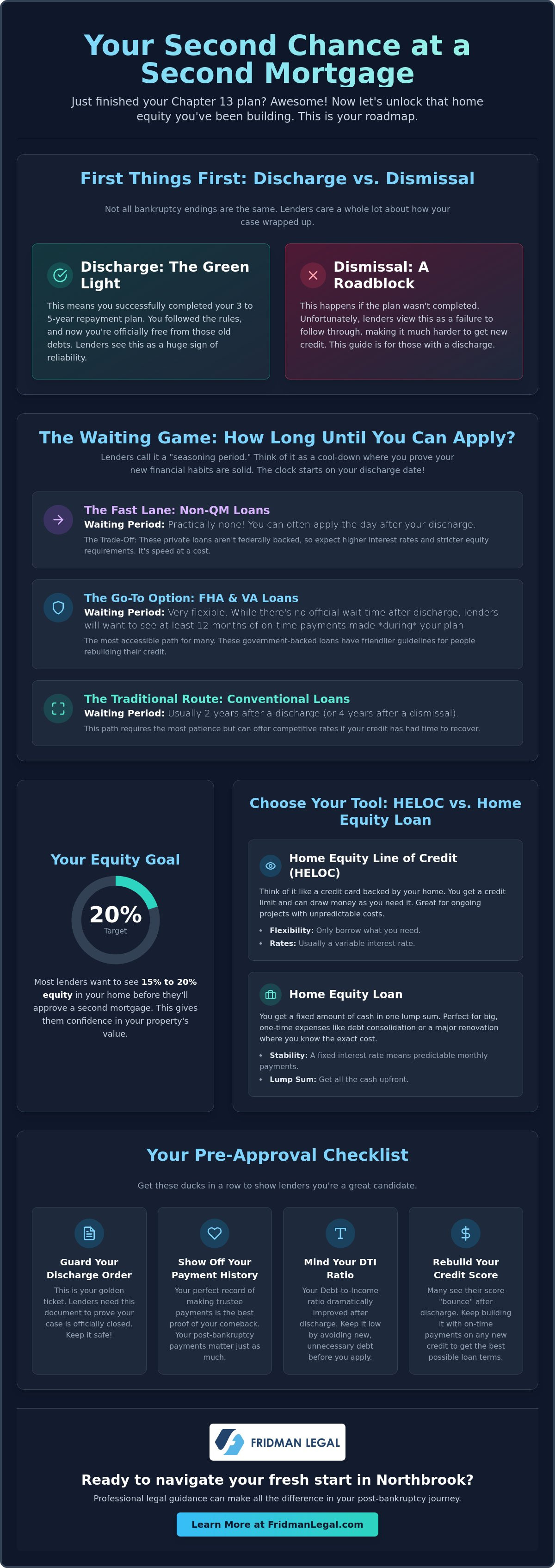
A discharge is the reward for completing your plan successfully. It means you followed every rule for three to five years. A dismissal is different; it happens if payments were missed or the case was thrown out for other reasons. If your case ended in a dismissal rather than a discharge, the path to new credit is much steeper. Lenders view a dismissal as a failure to follow through, whereas a discharge proves you are reliable and have been vetted by the federal court system. Successfully getting a second mortgage after chapter 13 discharge is significantly easier than trying to do so after a dismissal.
The Reality of Your Post-Bankruptcy Credit Score
It's a common myth that bankruptcy destroys your credit for a full decade. While the filing stays on your report, many borrowers see a credit score "bounce" shortly after the discharge. This happens because your debt levels have dropped significantly. Lenders also place heavy weight on your payment history during the repayment plan. If you've spent the last few years making every trustee payment on time, you've already started the rebuilding process. This history is exactly what banks look for when deciding whether to approve a new home equity loan or line of credit.
The Waiting Game: Seasoning Periods for Second Mortgages
Lenders use the term "seasoning" to describe the mandatory waiting period you must observe before applying for new credit after a bankruptcy. Think of this as a cooling-off period where you prove that your financial habits have fundamentally shifted. The starting gun for this timeline is your official discharge date, not the date you originally filed your case. While it might feel like an arbitrary delay, these periods are designed to ensure you've successfully re-established a pattern of reliability. Securing a second mortgage after chapter 13 discharge is entirely possible, but your success depends on matching your goals with the right loan type’s specific timeline.
Some niche lenders offer "no waiting period" products, often referred to as non-qualified mortgages (non-QM). These private institutions don't follow federal backing rules, which gives them the freedom to lend to you the day after your discharge. The trade-off is almost always financial. You'll likely face interest rates that are two to three percentage points higher than market averages, and you might be required to have significantly more equity in your home. For many, waiting an extra year to qualify for a traditional loan is the more cost-effective strategy.
FHA and VA Guidelines for Post-Chapter 13 Loans
Government-backed loans are generally the most accessible path for homeowners who've recently completed a bankruptcy plan. Technically, the FHA doesn't impose a mandatory waiting period once your Chapter 13 case is discharged. However, you'll still encounter "lender overlays," which are internal bank rules that often require a one to two-year wait. VA loans are equally flexible, often providing veterans with the fastest route back into the credit market. If you maintained a perfect payment record during your three to five-year repayment plan, lenders are much more likely to waive these internal waiting periods.
Conventional Loan Requirements and Private Lenders
Conventional loans, governed by Fannie Mae and Freddie Mac, carry stricter standards. For a second mortgage after chapter 13 discharge through these channels, you'll typically need to wait two full years. If you're seeking a HELOC, most lenders look for 12 to 24 months of seasoning and at least 15% to 20% equity in the property. If you find these timelines don't align with your immediate needs, reaching out for a professional review of your discharge papers can help clarify your eligibility. Private lenders remain an option for those who can't wait, provided they have the equity to back the loan.
Exploring Your Options: HELOCs vs. Home Equity Loans
Choosing the right financial instrument is just as critical as meeting the seasoning requirements we discussed earlier. Once your case is closed, you generally have two paths to access your home's value. A Home Equity Line of Credit (HELOC) functions much like a high-limit credit card secured by your property, allowing you to draw funds as needed and pay interest only on what you use. In contrast, a Home Equity Loan provides a one-time lump sum with a fixed interest rate and a predictable monthly payment. For many borrowers, securing a second mortgage after chapter 13 discharge through a fixed-rate loan is often the more straightforward path because it presents a clearer risk profile to the lender.
In the Chicago and Northbrook real estate markets, your "Loan-to-Value" (LTV) ratio will be the deciding factor. Even with a discharge in hand, lenders are conservative with post-bankruptcy applicants. Most institutions require you to maintain at least 15% to 20% equity in the home. This means if your property is valued at $500,000, your combined total debt between your first mortgage and your new second loan typically cannot exceed $400,000 to $425,000. If your home's value hasn't rebounded sufficiently, you may need to wait until your equity grows before an application becomes viable.
Why HELOCs Can Be Harder to Secure
HELOCs are often perceived as higher risk by major national banks. Because these lines of credit carry variable interest rates, a lender might worry about your ability to manage payments if rates spike, such as the 7.04% average seen in June 2026. If a large bank denies your request, don't lose hope. Local credit unions are often more willing to look at the "human" side of your story and your successful completion of a Chapter 13 plan. If a HELOC remains out of reach, a small personal loan or a dedicated home improvement loan might serve as a temporary bridge while you continue to build your credit score.
The Advantages of a Fixed-Rate Second Mortgage
Stability is the primary benefit of a fixed-rate second mortgage. After years of following a strict court-ordered budget, knowing your exact monthly obligation provides significant peace of mind. This option also allows you to keep your original first mortgage intact. This is a major advantage if you secured a very low interest rate several years ago. While a cash-out refinance is an alternative, it would replace your entire first mortgage with a new loan at current market rates, which could significantly increase your overall monthly housing costs.
How to Strengthen Your Application for a Second Mortgage
Lenders aren't just looking at your credit score; they're looking at your financial trajectory. After you've successfully navigated a repayment plan, your primary goal is to prove that the previous financial distress was a one-time event rather than a recurring habit. A perfect payment record since your filing date is absolutely non-negotiable. Even a single late payment on a utility bill or a small credit card can derail your chances of securing a second mortgage after chapter 13 discharge. Banks want to see that you've taken the discipline required by your court-ordered plan and turned it into a permanent lifestyle.
Don't underestimate the power of a well-written "Letter of Explanation." This document is your opportunity to provide human context for the bankruptcy. Whether the filing was triggered by a medical emergency, a sudden job loss, or a divorce, being transparent helps the underwriter see you as a responsible person who hit a rough patch. To further reassure the bank, focus on lowering your Debt-to-Income (DTI) ratio by paying off any small balances you've accrued since the discharge. Providing a larger "equity cushion" by asking for a smaller loan amount can also make a lender much more comfortable with your application.
Gathering the Right Documentation
Organization is your best friend when you're ready to apply. You'll need a much deeper paper trail than a standard applicant to satisfy a cautious underwriter. Be prepared to provide your official Discharge Order, the full Schedule of Debts from your original filing, and your last two years of tax returns. Lenders will also demand proof of on-time payments for your first mortgage for at least the last 12 to 24 months. Make sure to keep your Chapter 13 trustee records organized and accessible throughout the process. If you need assistance ensuring your legal documents are ready for a real estate transaction, our team at Fridman Legal can provide the professional review you need.
Rebuilding Your Credit Profile Proactively
Waiting for your score to recover on its own is a slow strategy. Using a secured credit card or a small credit-builder loan can boost your score significantly in the months following your discharge. The goal is to demonstrate a healthy "credit mix," which shows you can handle different types of debt responsibly. However, you must be careful not to overextend yourself. Taking on a new car loan or opening several store cards right before a mortgage application will spike your DTI and make lenders nervous. Keep your new balances low and your focus on long-term stability.
Navigating Real Estate Law and Your Fresh Start in Northbrook
Getting your discharge papers in the mail is a massive relief, but it's really just the beginning of your next chapter. In Northbrook and across the Chicago suburbs, the ability to sell or refinance your home depends heavily on how clean your legal record looks to a title company. While you've been focused on your credit score, the local real estate market has been shifting. Your home's value is the engine that drives your ability to get a second mortgage after chapter 13 discharge. If property values in your specific neighborhood have stayed strong, you'll have a much easier time meeting the equity requirements that lenders demand. Since most banks in the Chicago area cap your total debt at 80% to 85% of the home's value, local market trends are just as important as your credit history.
Ensuring Your Title is Clear
One of the biggest hurdles homeowners face after bankruptcy is the "zombie lien." These are old debts that were technically discharged in court but were never properly released by the creditor in the Cook County Recorder of Deeds office. If these aren't cleared, they'll pop up during a title search and stall your loan application immediately. At Fridman Legal, we specialize in identifying these recording errors and ensuring your title is actually as clear as the court says it is. Cook County has very specific recording requirements for discharge notices; missing a single step in this administrative process can lead to months of delays when you're trying to secure new financing or close a sale.
Why Legal Guidance is Essential for the Transition
It's a common mistake to assume a loan officer at a big bank understands the nuances of bankruptcy law. They're focused on their internal checklists, not the legal protections your discharge provides. A bankruptcy lawyer understands exactly what your discharge order covers and can advocate for you if a lender tries to bring up old, extinguished debts. Having a professional review your loan documents ensures you aren't accidentally signing away rights or agreeing to predatory terms just because of your past filing. If you're ready to see how your discharge impacts your home equity goals, feel free to contact us for a consultation to discuss your specific situation. We help you move past the paperwork and into a stable financial future.
Securing Your Financial Future After Discharge
Securing a second mortgage after chapter 13 discharge is a strategic move that requires both patience and precise documentation. By navigating the specific seasoning periods for FHA or conventional loans and maintaining a flawless payment history, you've already laid the groundwork for success. The final step is ensuring your property title is clear of lingering liens and your application accurately reflects your current financial stability. You've earned this fresh start through years of discipline; now it's time to put that effort to work for your home's value.
With nearly twenty years of experience in bankruptcy and real estate law, we provide the personalized, results-driven expertise needed to bridge the gap between legal discharge and real-world results. Our deep understanding of both Chapter 7 and Chapter 13 filings allows us to protect your interests during complex real estate transactions. If you're ready to leverage your equity, talk to Fridman Legal about your post-bankruptcy real estate goals today. Your path to a stronger financial future is open, and we're here to help you walk it with confidence.
Frequently Asked Questions
Can I get a second mortgage immediately after a Chapter 13 discharge?
Technically, yes, you can apply for an FHA or VA loan as soon as your discharge is finalized, though many lenders have internal "overlays" requiring a one to two-year wait. Conventional loans usually demand a full two-year seasoning period. If you need a second mortgage after chapter 13 discharge right away, non-QM lenders are your best option. These private institutions don't have federal waiting periods, but they'll charge higher interest rates and require more equity.
Does a Chapter 13 discharge automatically remove a second mortgage lien?
A discharge only removes your personal liability for the debt, not the lien itself, unless the court specifically ordered a "lien strip" during your case. If your second mortgage wasn't stripped, the lender still holds a legal claim against your property. You'll eventually need to pay off that balance if you sell or refinance. Clearing these "zombie liens" is a common administrative task we handle for homeowners in the Northbrook area.
What is the minimum credit score for a second mortgage after bankruptcy?
Most lenders look for a minimum credit score between 620 and 660 for a post-bankruptcy home equity loan. While the VA doesn't set a hard minimum, many individual lenders prefer a 620 score as an internal requirement. To get the most competitive rates on a second mortgage after chapter 13 discharge, aiming for a score above 680 will significantly improve your chances with traditional banks and local credit unions.
Will my interest rate be much higher because of the Chapter 13?
You should expect your interest rate to be slightly higher than market averages for borrowers with pristine credit. Second mortgages typically carry rates about 0.25% to 0.50% higher than primary loans, and your bankruptcy history might add another small risk premium. However, as your score improves post-discharge, the gap between your rate and the market average will narrow. Shopping around with different lenders is the best way to minimize this cost.
Can I apply for a HELOC while my Chapter 13 case is still active?
It's possible to apply for a HELOC while your case is active, provided you've made at least 12 months of on-time payments according to your plan. You must obtain written permission from your bankruptcy trustee or the judge before taking on any new debt. This process requires proving that the new loan won't interfere with your ability to complete your repayment plan. It's a precise legal step that requires clear financial documentation.
What happens if my Chapter 13 case was dismissed instead of discharged?
A dismissal means your case ended without a legal resolution of your debts, which usually doubles your waiting period for new loans. For a conventional mortgage, a dismissal requires a four-year wait instead of the two-year period following a successful discharge. Lenders view a dismissal as a sign of higher risk because the original debts weren't legally cleared. Rebuilding your credit after a dismissal requires a longer period of perfect payment history.
Are there specific lenders in Illinois that specialize in post-bankruptcy loans?
Local Illinois credit unions and specialized portfolio lenders are often much more flexible than large national banks. These smaller institutions often keep their loans in-house rather than selling them to federal agencies, allowing them to look beyond the bankruptcy filing. We've found that community banks in the Chicago area are more likely to consider the context of your previous financial challenges and your success in completing the court's plan.
How does home equity stripping work in a Chapter 13 bankruptcy?
Lien stripping occurs when your home's market value is lower than the balance of your first mortgage. In this specific scenario, the court can reclassify your second mortgage as "unsecured" debt. Once you complete your Chapter 13 plan, that second mortgage is discharged along with your other unsecured debts. This process effectively removes the lien from your property title, giving you a much cleaner financial slate and more equity once the case is closed.

Article by
O. Allan Fridman
O. Allan Fridman has been practicing law since 2001. His practice is unique in that he does not view himself as a litigation attorney or transactional attorney. Rather, he views each area of law as a tool to pursue the best results for his clients. By practicing in both areas of law, he is able to take a 360-degree view of law. This enables the firm to catch potential drawbacks that are readily identifiable.
By practicing in litigation and transactional law and taking a holistic approach in dealing with our clients, he doesn’t put clients in box — rather, as we are all individuals, so too are the legal services we may require.
Whether it is bankruptcy or litigation or transactional, each client brings challenges and does not fit in any one box. Often times, bankruptcy clients end up not filing bankruptcy because we can achieve a better result through litigation or through an out-of-court resolution with the lender, or through a real estate sale. On the other end of the spectrum, a litigation client with multiple issues and lawsuit may fare better in a bankruptcy.
Since 2001, Allan has practiced in states and federal court, and he is a member of the trial bar of the Northern District of Illinois and admitted in the Northern District of Indiana.
We are a debt relief agency. We help people file for bankruptcy relief under the Bankruptcy Code
The materials on this site are for informational purposes only and do not constitute legal advice. Viewing this site or contacting us does not create an attorney–client relationship, and you should not act or refrain from acting based on any information here without seeking professional legal counsel.