
What if the legal framework designed to discharge your debt was also the most effective tool for protecting your daily commute? If you're currently managing significant financial pressure, you're likely asking: can I keep my car if I file chapter 7 in Illinois? It's a logical concern to have, particularly as bankruptcy filings in the Northern District of Illinois reached 426 cases in a single week during late 2025. You deserve a clear path forward that doesn't involve losing the reliable transportation you need for your career and family.
You will learn exactly how Illinois bankruptcy exemptions work so you can keep your vehicle while wiping out your debt. Under the laws that took effect on January 1, 2026, you can protect $3,600 in vehicle equity, which we can often supplement by using a $4,000 wildcard exemption. We'll examine how these figures apply to your specific situation, explain the mechanics of "upside-down" loans, and show you how to eliminate medical and credit card debt without sacrificing your mobility.
Key Takeaways
- Filing for bankruptcy triggers an automatic stay that immediately halts repossession efforts, giving you breathing room the moment your case is filed.
- You'll discover why the answer to "can I keep my car if I file chapter 7 in Illinois" is almost always yes, provided you understand how to apply the $3,600 motor vehicle exemption.
- We'll explain the difference between reaffirming your current loan and using redemption to buy your car back for its actual market value.
- Learn why keeping your auto insurance active and avoiding "bargain" sales to family members are the two most important steps for protecting your vehicle.
- See how a professional legal strategy helps you stack different exemptions to protect your equity and ensure you stay on the road while your debt is wiped out.
The Short Answer: Yes, You Can Usually Keep Your Car
Let's clear the air immediately. Filing for Chapter 7 bankruptcy doesn't mean a tow truck is going to show up at your house the next morning. It's a common fear, but the reality is that the legal system actually wants you to keep your transportation so you can keep working and rebuilding your life. In the vast majority of cases we handle, the answer to can I keep my car if I file chapter 7 in Illinois is a resounding yes. People drive their same vehicle through the entire process and long after their debts are discharged because the court prioritizes your ability to remain gainfully employed and care for your family.
How the Automatic Stay Protects Your Driveway
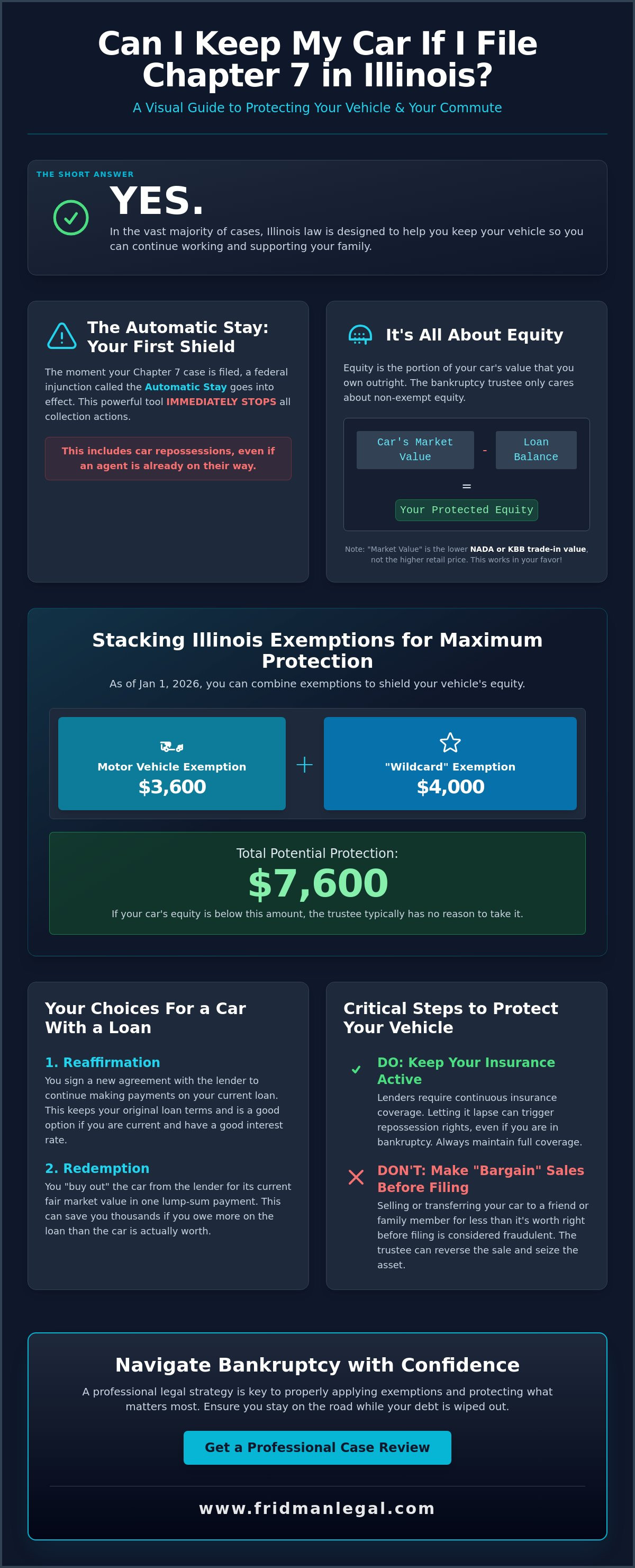
The moment your petition is filed with the court, something called the "Automatic Stay" goes into effect under 11 U.S.C. § 362. This isn't just a suggestion; it's a federal injunction that acts as a legal shield between you and your creditors. It's incredibly powerful because it stops all collection actions, including phone calls, lawsuits, and repossessions, the very second the court receives the paperwork. Even if a repossession agent is already on the way to your driveway, they're legally required to stop. This stay provides the essential breathing room needed to evaluate your situation without the constant anxiety of being stranded. It gives us the time to coordinate with lenders and ensure your rights are fully protected under the updated 2026 guidelines.
The Difference Between Owning and Financing
When we analyze whether can I keep my car if I file chapter 7 in Illinois, we look at the math from two different angles depending on your loan status. If your car is paid off, our focus is entirely on the Illinois state exemption limits to protect the vehicle's full value. However, if you're still making payments, we focus on your "equity." Equity is just the market value of the car minus your loan balance. For example, if your car is worth $12,000 and your loan balance is $10,000, you have $2,000 in equity.
If you're currently financing your vehicle, don't assume you're at a disadvantage. If you owe more on the car than it’s currently worth, you're in a strong position to keep it. This is because the bankruptcy trustee's job is to find assets with value to pay back your creditors. If there's no equity to harvest, the trustee has no reason to touch your car. We'll work through the specific math of your loan at Fridman Legal to ensure you understand exactly where you stand before any papers are signed.
We analyze your situation based on these primary factors:
- The current fair market value of your vehicle based on 2026 data.
- The total balance remaining on your auto loan.
- The specific Illinois exemptions available to you as of the January 1, 2026, legislative updates.
The Math of Illinois Exemptions: Stacking Your Protection
Illinois law provides specific "safe zones" for your property under 735 ILCS 5/12-1001. As of the updates that took effect on January 1, 2026, the motor vehicle exemption allows you to protect $3,600 in equity automatically. But here's the detail that many people overlook: you aren't limited to just that single category. By stacking the $4,000 "wildcard" exemption on top of the vehicle exemption, we can often shield up to $7,600 in total car equity. This strategic layering is a primary reason why the answer to can I keep my car if I file chapter 7 in Illinois is almost always a "yes" for the average commuter.
According to the Bankruptcy Basics provided by the federal court system, the trustee's role is to determine if your assets hold enough value to pay back creditors. However, we don't use the high "asking price" you might see on a dealership lot or a private listing to determine this. Instead, we look at NADA or KBB trade-in values. These figures are typically much lower and represent a more realistic "liquidation value" that the court will accept. If you're concerned about your vehicle's valuation, scheduling a professional case review can help you determine your exact equity before you ever step into a courtroom.
How We Calculate Your Car’s "Bankruptcy Value"
We focus on the trade-in value because that's what a trustee could actually get if they sold the car quickly. It's one of the few times in life where high mileage, mechanical issues, or body damage work in your favor. If your car has 150,000 miles or a dented fender, that lower valuation makes it much easier to stay under the $7,600 protection threshold. The bankruptcy trustee will verify these numbers, so we ensure your documentation is precise and defensible from day one.
What Happens if Your Equity is Over the Limit?
If your car is worth significantly more than the exemptions cover, you still have options. You can often use a "buy-back" agreement, where you pay the trustee the non-exempt portion of the equity over several months to keep the vehicle. It's also important to remember that trustees are practical. If a car only has $500 of "exposed" equity, a trustee likely won't bother seizing it because the costs of towing, storage, and auctioning would eat up all the profit for the creditors. Strategic planning allows us to identify these scenarios well before we file your petition.
Your Three Choices for a Financed Car
If you're still making monthly payments, the question of can I keep my car if I file chapter 7 in Illinois shifts from a conversation about court exemptions to a negotiation with your lender. While Illinois bankruptcy exemptions protect your equity from being seized by a trustee, they don't automatically erase your contract with the bank. You essentially have three distinct paths to choose from based on the condition of the vehicle and the balance of your loan. Deciding which one is right for you usually comes down to whether your car is a "keeper" or a "lemon" that's costing you more than it's worth.
The Pros and Cons of Reaffirming Your Loan
Reaffirmation is essentially a "carve out" from your bankruptcy. You sign a new agreement that legally binds you to the original loan terms as if the filing never happened. The primary benefit is stability; you keep the car and your on-time payments continue to build your credit score. However, this is a serious commitment. Because this debt isn't erased, if you lose your job six months from now and can't pay, the bank can repossess the car and sue you for the remaining balance. We often discuss this risk when planning Chapter 7 Bankruptcy in Northbrook, IL, to ensure our clients don't trade one financial burden for another.
Redemption: The "Reset" Button for Upside-Down Loans
If you owe significantly more than the car is worth, Section 722 of the bankruptcy code offers a powerful alternative called redemption. This allows you to pay the lender the "actual value" of the car in one lump sum to satisfy the entire debt. For instance, if you owe $10,000 on a sedan that's currently only worth $5,000 based on 2026 market data, you can pay $5,000 and own the vehicle outright. While most people don't have $5,000 in cash sitting around, there are specialized lenders that provide "redemption loans" specifically for people in bankruptcy. It's often the smartest move for older cars with high interest rates because it immediately eliminates thousands of dollars in "underwater" debt.
The final option is to simply surrender the vehicle. This is often the most logical choice if the car has constant mechanical issues or if the monthly payments are simply too high for your new budget. You give the keys back, and the entire loan balance is discharged. You walk away with zero liability, allowing you to start fresh with a more affordable vehicle later. We'll look at your budget and the car's reliability to help you decide which of these three paths offers the best long-term financial security.
Common Mistakes to Avoid Before You File
When financial pressure peaks, it's natural to want to protect your assets by any means necessary. However, certain "common sense" moves can backfire during the legal process. If you are asking can I keep my car if I file chapter 7 in Illinois, the answer is usually yes, provided you don't inadvertently trigger red flags for the bankruptcy trustee. The court values transparency above all else, and trying to "hide" a vehicle is the fastest way to lose it. For example, don't sell your car to a family member for $1.00 or a similarly nominal fee. The trustee has the authority to look back at your financial history and can sue the recipient to get the car back, often leaving both you and your relative in a difficult legal position.
Another critical requirement is maintaining your auto insurance. If your coverage lapses, your lender can quickly petition the court to lift the automatic stay we discussed earlier. They'll argue that their collateral is no longer protected, which often leads to immediate repossession. You should also be mindful of the "910-Day Rule." If you purchased your vehicle within 910 days (roughly 2.5 years) of your filing date, the rules regarding how we handle the loan balance are much stricter than if you've owned the car longer. This timing often dictates whether Chapter 7 is your best path or if a different strategy is required to keep you on the road.
The Danger of "Preferential Payments"
You might think paying off your car loan in full right before you file is a smart way to ensure you keep it, but the court might see it differently. A payment of $600 or more to a single creditor within 90 days of filing can be considered a "preferential payment." The trustee has the power to "claw back" that money from the bank to distribute it fairly among all your other creditors. This becomes even more complicated if you've been making payments to "insiders," such as family members who gave you a private loan for the vehicle. You should always speak with a lawyer before making any large, lump-sum payments to ensure you aren't accidentally creating a complication for your case.
Keeping Your Paperwork in Order
Success in a Chapter 7 case depends on the quality of your documentation. We'll need your most recent loan statement and a realistic valuation of the car. Don't be afraid to be honest about the vehicle's flaws. If the engine has a leak or the transmission is slipping, those issues lower the "bankruptcy value" of the car, which actually makes it easier to protect using your Illinois exemptions. Having these details ready ensures your 341 Meeting of Creditors goes smoothly and without surprises. If you're unsure how to value your car's specific condition, contact our team for a detailed strategy session before you take any further steps.
Should you keep making your regular monthly payments? If your intent is to keep the vehicle through a reaffirmation agreement, the answer is almost always yes. Missing payments right before you file sends a signal to the lender that you don't intend to keep the car, which can make negotiations much harder later on. We'll look at your specific payment history to determine the best timing for your filing.
How Fridman Legal Helps You Stay on the Road
When you're dealing with the stress of debt, you don't just need a form-filler; you need a strategist who understands that your car is your lifeline. We've spent the last 20 years navigating the local courts in Cook County, and we know that the answer to can I keep my car if I file chapter 7 in Illinois depends entirely on the preparation we do before your case ever reaches a trustee's desk. Allan Fridman's extensive experience means he's seen virtually every vehicle situation, from luxury leases to high-mileage work trucks, and he knows how to position your assets to maximize your protection under the current 2026 guidelines.
We also believe that professional legal support shouldn't add to your financial anxiety. That's why we offer flat-fee services for our bankruptcy filings. You'll know exactly what the investment is from the start, with no hidden costs or surprise hourly bills popping up later. Our singular goal is to guide you through the process so you reach the finish line with your debt discharged and your car keys still in your pocket.
Personalized Debt Relief in Northbrook and Chicago
Choosing a local boutique firm over a massive "bankruptcy mill" makes a significant difference in the quality of your representation. We don't use a one-size-fits-all approach because every client's equity and income situation is unique. Because we work daily within the Northern District of Illinois, we're familiar with the specific expectations of the local trustees and how they interpret the 2026 exemption updates. This local knowledge allows us to anticipate questions before they're asked, ensuring your case moves forward without unnecessary delays. If you're ready to see how these strategies apply to your specific vehicle, you can Contact Us to start the conversation today.
Your Next Steps to a Fresh Start
During your first consultation with Allan Fridman, we'll take a deep dive into your finances and your goals. We'll look at your loan statements, your car's condition, and your overall debt load to build a roadmap that makes sense for your future. We handle the heavy lifting of gathering information and filing the petition so the weight of creditor calls and legal jargon is finally off your shoulders. We prioritize clear communication so you're never left wondering about the status of your vehicle or your case.
Remember, filing for bankruptcy isn't a sign of failure; it's a proactive, strategic decision to regain control of your life. We're here to ensure you have the reliable transportation you need to drive toward that better future. Let's work together to protect your commute and clear your path toward financial stability.
Take Control of Your Daily Commute
Securing your financial future doesn't have to mean sacrificing your mobility. You've seen how the automatic stay provides immediate protection and how stacking the $3,600 vehicle exemption with the $4,000 wildcard can shield your equity. Many residents are relieved to find that the answer to can I keep my car if I file chapter 7 in Illinois is usually positive when the math is handled correctly from the start. Whether you choose to reaffirm your loan or use redemption to reset an underwater balance, the goal is to emerge from this process with a clear path forward.
O. Allan Fridman brings over 20 years of Illinois bankruptcy experience to your case, providing the personalized attention you won't find at larger firms. We offer flat-fee pricing for Chapter 7 filings so you can plan your recovery with total certainty. Ready to wipe out your debt without losing your ride? Schedule a free consultation with Fridman Legal today. You're taking a vital step toward a more stable life, and we're ready to help you navigate every mile of the way.
Frequently Asked Questions
Can I keep two cars if I file Chapter 7 in Illinois?
You can keep two cars as long as the equity in both vehicles fits within your available exemptions. Since the law only provides one $3,600 motor vehicle exemption per person, the second car would need to be protected using your $4,000 wildcard exemption. If you're married and filing a joint petition, you can each claim these exemptions, which effectively doubles your protection and makes keeping two vehicles much easier for most households.
What happens if my car is worth way more than the exemptions?
If your vehicle's equity exceeds the $7,600 total protection limit, the trustee might consider selling it to pay your creditors. However, we often negotiate a "buy-back" agreement where you pay the trustee the non-exempt portion over several months. It's also common for trustees to abandon the car if the potential profit after sales costs and your exemption payout is too low to benefit the creditors significantly.
Do I have to keep making my car payments while the bankruptcy is pending?
You must continue making your regular monthly payments if your goal is to keep the vehicle. Lenders generally only agree to a reaffirmation if the account is current. If you stop paying while the case is pending, the bank can ask the court for permission to bypass the automatic stay and repossess the car. Staying consistent with your payments shows the court and the lender that you're serious about keeping the asset.
Will filing bankruptcy lower my car payment?
A Chapter 7 filing usually doesn't lower your monthly payment unless you choose the redemption option. When you reaffirm a loan, you're typically sticking with the original interest rate and payment amount. Redemption allows you to buy the car for its actual market value, which often results in a smaller total loan even if the new interest rate is higher. This is one of the most effective ways to handle the question of can I keep my car if I file chapter 7 in Illinois when you're deeply underwater on the loan.
Can the bank still repossess my car after I file?
The bank cannot repossess your car immediately because the automatic stay stops all collection efforts the moment we file your paperwork. However, this protection isn't permanent if you fail to meet your obligations. If you fall behind on payments or let your insurance coverage lapse, the lender can file a motion with the court to "lift" the stay. If the judge agrees, the bank can resume repossession just like they would have before the bankruptcy.
What is the 910-day rule and does it apply to me?
The 910-day rule applies if you purchased your vehicle within approximately 2.5 years of your filing date. This rule was established to prevent people from buying a car and immediately trying to reduce the loan balance in court. While it's more restrictive in Chapter 13 cases, it still impacts your Chapter 7 strategy because it dictates how much leverage you have when negotiating with your lender. We'll check your purchase date during our first meeting to see if this rule affects your specific options.

Article by
O. Allan Fridman
O. Allan Fridman has been practicing law since 2001. His practice is unique in that he does not view himself as a litigation attorney or transactional attorney. Rather, he views each area of law as a tool to pursue the best results for his clients. By practicing in both areas of law, he is able to take a 360-degree view of law. This enables the firm to catch potential drawbacks that are readily identifiable.
By practicing in litigation and transactional law and taking a holistic approach in dealing with our clients, he doesn’t put clients in box — rather, as we are all individuals, so too are the legal services we may require.
Whether it is bankruptcy or litigation or transactional, each client brings challenges and does not fit in any one box. Often times, bankruptcy clients end up not filing bankruptcy because we can achieve a better result through litigation or through an out-of-court resolution with the lender, or through a real estate sale. On the other end of the spectrum, a litigation client with multiple issues and lawsuit may fare better in a bankruptcy.
Since 2001, Allan has practiced in states and federal court, and he is a member of the trial bar of the Northern District of Illinois and admitted in the Northern District of Indiana.
We are a debt relief agency. We help people file for bankruptcy relief under the Bankruptcy Code
The materials on this site are for informational purposes only and do not constitute legal advice. Viewing this site or contacting us does not create an attorney–client relationship, and you should not act or refrain from acting based on any information here without seeking professional legal counsel.