

Most Illinois residents don't realize that the 2026 legal updates have turned medical debt into one of the easiest liabilities to completely erase without losing their family home. It's exhausting to manage constant collector calls or the looming threat of wage garnishment in Cook County, especially when you're trying to focus on recovery. Filing bankruptcy on medical bills Illinois is a strategic move that allows you to reset your finances while keeping your assets fully intact. The law is designed to provide a path forward, and the latest changes make that path much wider for homeowners.
This guide explains how to use the new $50,000 homestead exemption and the automatic $1,000 bank account protection to secure your property during a filing. We'll walk through the 2026 income limits for Chapter 7 and clarify how the state's medical debt relief program fits into a broader financial strategy. You'll gain a clear understanding of how to stop collection lawsuits and secure the total discharge of your medical debt, providing the professional support needed for a true fresh start.
Key Takeaways
- Learn how the 2026 updates to the Illinois Homestead Exemption allow you to protect up to $50,000 in home equity while wiping out your medical debt.
- Understand the specific differences between Chapter 7 and Chapter 13 to determine which path offers the most effective relief for your household income.
- Discover why filing bankruptcy on medical bills Illinois is often a more comprehensive solution than the state’s automatic relief program, which has strict eligibility limits.
- Get the details on new exemptions that protect up to $5,000 in household goods and $1,000 in your bank account from creditors.
- Find out how professional representation can immediately halt collection lawsuits and stop harassing phone calls from debt collectors in Cook County.
The Reality of Medical Debt in Illinois: Why It Happens to Everyone
It's a common misconception that medical debt only happens to people without health insurance. In reality, even families with premium plans often find themselves facing five-figure deductibles and out-of-network costs that no one planned for. The Reality of Medical Debt is that it has become the leading cause of financial insolvency across the country and right here in Illinois. When these bills start stacking up, the pressure can feel unbearable. Many people hesitate to act, hoping for a miracle, but waiting too long often leads to aggressive collection lawsuits that can eventually result in wage garnishment. Filing bankruptcy on medical bills Illinois is frequently the most direct way to stop that cycle before a court judgment is entered against you.
Under Illinois law, medical debt is categorized differently than something like a mortgage or a car loan. It's essential to understand that hospital bills are a form of unsecured debt. Unlike a lender who can take your house if you miss payments, a hospital cannot simply come and take your assets without a court order. However, they are often more aggressive than credit card companies when it comes to litigation. If you're managing multiple providers, the risk of a lawsuit increases with every passing month.
Is Medical Debt Unsecured? Why This Matters for You
Unsecured debt means there's no collateral tied to the money you owe. Doctors can't take your car back. They can't repossess your furniture either. In Illinois courts, medical bills are treated similarly to credit card balances, meaning they're at the bottom of the priority list for payment. Medical debt is priority-neutral in a Chapter 7 filing, which simply means it doesn't get special treatment over other bills and can be wiped out completely. This is a huge advantage for anyone looking to clear their slate without losing their essential property.
The Impact of the Illinois Consumer Fraud Act on Your Bills
As of 2026, new reporting rules under the Illinois Consumer Fraud Act offer some protection for your credit score. These rules prevent many types of medical debt from appearing on your credit report, which helps keep your score stable while you're dealing with health issues. However, there's a significant loophole you should know about. Just because a hospital or collection agency can't report the debt to a credit bureau doesn't mean they can't sue you in a Cook County court. A lawsuit can still lead to a judgment, and a judgment can lead to a lien on your property. Navigating these complex state rules requires a clear strategy. You can explore your options for bankruptcy in Illinois to see how these laws apply to your specific situation. Professional legal help ensures you don't fall into the trap of thinking your credit is safe just because the bills aren't showing up on your report yet.
Chapter 7 vs. Chapter 13: Which Path Wipes Out Your Medical Debt?
Choosing between Chapter 7 and Chapter 13 isn't just about how much you owe; it's about your household income and which assets you want to safeguard. When you're considering filing bankruptcy on medical bills Illinois, you'll find that both chapters are highly effective at providing relief. In almost every case, medical bills are treated as general unsecured debt, meaning they are typically discharged 100% by the end of the process. The real decision comes down to the timeline you prefer and whether you need to protect a high-value property that exceeds state exemptions.
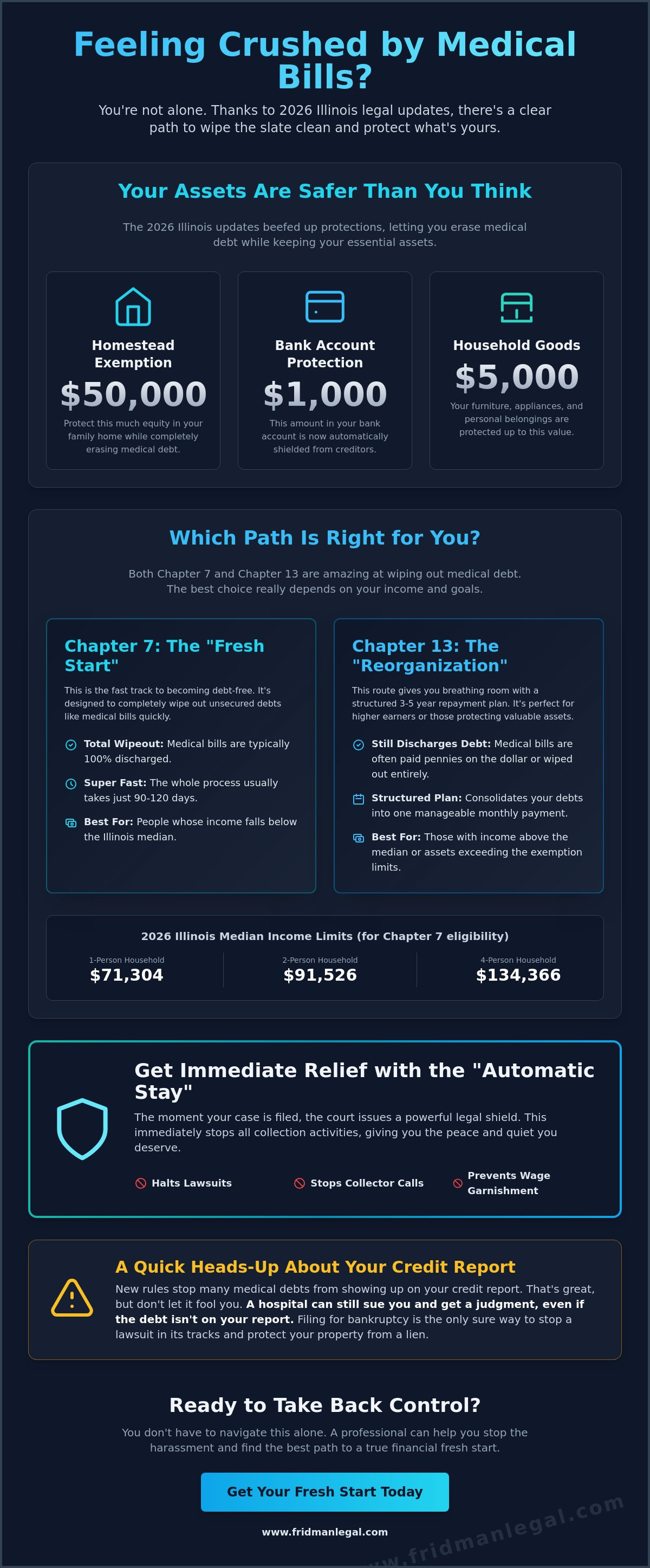
The Illinois Means Test is the first hurdle. This calculation compares your income to the state median to see if you qualify for Chapter 7. As of early 2026, the annual median income figures are $71,304 for a 1-person household and $91,526 for a 2-person household. If you're part of a 4-person family, that limit rises to $134,366. If your income is below these thresholds, Chapter 7 is usually the most efficient way to clear your medical debt. If you're above them, Chapter 13 offers a structured way to handle your finances without losing what you've worked hard to build.
The Chapter 7 "Fresh Start" for Medical Bills
Chapter 7 is often called a "straight" bankruptcy because of its speed. You can usually expect a discharge in about 90 to 120 days from your filing date. The moment your attorney files the paperwork, the court issues an "automatic stay." This legal shield stops pending hospital lawsuits, wage garnishments, and collection calls in their tracks. It's a fast-acting solution for those who simply need the debt gone so they can move forward. For more details on this specific approach, you can read our guide on Chapter 7 Bankruptcy in Northbrook.
When Chapter 13 Makes More Sense for Illinois Families
Chapter 13 is a reorganization that lasts between three and five years. It's a strategic choice for families in the Chicago suburbs who have significant equity in their homes. While the 2026 Illinois homestead exemption is generous, it might not cover everything if your home value has skyrocketed. A Chapter 13 plan allows you to protect that equity, stop foreclosure, and pay back a portion of what you owe over time. The best part is that once you finish the plan, any remaining medical debt is wiped out completely. If you're feeling overwhelmed by the choices, reviewing your debt relief options with a professional can provide the clarity you need.
The Illinois Medical Debt Relief Program vs. Bankruptcy: What is the Catch?
You've likely heard about the Illinois Medical Debt Relief Program making headlines lately. While the state has successfully cleared over $1.1 billion in debt for more than half a million residents as of February 2026, many people are surprised to find they're still receiving collection calls. The program sounds like a perfect solution, but there's a significant catch: you can't actually apply for it. It's an automatic system that relies on the state buying up specific debt from participating providers. If your doctor or hospital hasn't opted in, you're left on your own. This is why filing bankruptcy on medical bills Illinois remains the most reliable way to handle a financial crisis. Bankruptcy doesn't depend on a lottery or a state grant; it's a structured legal process that you control from day one.
The state program is essentially a partnership with a non-profit that buys debt for pennies on the dollar. It's wonderful for those it helps, but it isn't a comprehensive financial strategy. If you have credit card debt, a looming foreclosure, or medical bills from a provider that refused to sell their accounts to the state, the program won't help you. Bankruptcy, on the other hand, addresses your entire financial picture. It forces every single creditor to the table and provides a permanent legal resolution that a pilot program simply cannot offer.
Who Actually Qualifies for the State Program?
The state's initiative targets residents with a household income at or below 400% of the federal poverty level. If your income is higher, you might still qualify if your medical bills equal 5% or more of your annual income. However, the limitation is that only "eligible" debt is covered. Many Northbrook residents find that their providers aren't part of the pilot program, or their income slightly exceeds the thresholds. If you're currently facing a lawsuit in Cook County, waiting for a state notification that may never arrive is a risky strategy. You can speak with a professional to see if a more proactive approach is necessary for your situation.
Why Bankruptcy is a Guaranteed Legal Shield
Unlike state-funded pilot programs that can run out of money or change their rules, the Federal Bankruptcy Code is stable and predictable. When you file, the "Automatic Stay" goes into effect immediately. This isn't a suggestion; it's a federal injunction that forces all creditors to stop their collection efforts, including those not covered by state relief programs. Bankruptcy is a legal right, not a government favor. It provides a comprehensive discharge that wipes the slate clean across all your medical providers at once. If you want to ensure your bank account and home are protected today, filing for bankruptcy offers a level of certainty that a state grant simply can't match.
The Illinois Bankruptcy Process: Protecting Your Assets While Erasing Debt
Once you've decided that filing bankruptcy on medical bills Illinois is your best path forward, the process moves into high gear. For residents here in Cook County, the journey starts with gathering your financial life into one place. You'll need every hospital bill, collection notice, and pay stub from the last six months. It feels like a lot of homework, but it's the only way to ensure the court sees the full picture of your medical debt. When it comes to filing bankruptcy on medical bills Illinois, the paperwork is the most critical part. Most of our Northbrook neighbors file in the Northern District of Illinois, where you'll eventually attend a Meeting of Creditors, often called a 341 meeting. Don't let the name scare you. It's usually a short, professional conversation with a trustee to verify your information, not a courtroom drama.
Will I Lose My House or Car in Illinois?
The biggest fear people have is losing their home. Thanks to the laws that went into effect on January 1, 2026, those fears are largely unfounded. The Illinois Homestead Exemption now protects up to $50,000 of equity in your home, or $100,000 for joint filers. If your car has less than $3,600 in equity, it's safe. There's even a new $5,000 exemption for household goods and a $1,000 automatic bank account protection. You can find more details on how Can You Keep Your House When Filing Bankruptcy in Illinois? by reviewing our dedicated resources.
Step-by-Step: From Consultation to Discharge
Your journey starts with a strategy session where we analyze your specific debts. Once we file the petition, the Automatic Stay kicks in instantly. This is the legal wall that stops collection calls and lawsuits immediately. After that, you'll complete two short credit counseling courses online. Finally, once the trustee finishes their review, you'll receive a discharge notice. This document is your official proof that those medical bills are legally gone forever. To start this process with an experienced advocate by your side, reach out for professional bankruptcy representation today.
Moving Forward with Fridman Legal: How We Help Northbrook Residents Reset
Dealing with the aftermath of a health crisis is hard enough without the added weight of aggressive debt collectors. We believe that your recovery should be your only priority. At Fridman Legal, we take a personalized approach to debt relief that goes beyond just filling out forms. O. Allan Fridman uses his 20 years of experience to look at your entire financial landscape, ensuring that filing bankruptcy on medical bills Illinois is done with a strategy that protects your long-term interests. We don't just see a pile of hospital invoices; we see a family that needs a clear path back to stability.
Our goal is to provide a sense of security while we navigate the complexities of the legal system together. Whether you're dealing with a single massive surgery bill or a series of chronic care costs, the strategy we build is tailored specifically to your goals. We focus on ensuring that every exemption discussed in previous sections is maximized so you can walk away from the process with your assets and your dignity intact. It's about more than just numbers on a page. It's about reclaiming your future.
Why a Local Northbrook Attorney Matters
Having a local office in Northbrook isn't just about convenience. It means we have a deep familiarity with the bankruptcy trustees in the Northern District of Illinois and how they operate. We understand the local real estate market and the specific concerns homeowners in the Chicago suburbs have regarding their property value and equity. This local insight allows us to provide more precise guidance when we're calculating your exemptions and protecting your home. If you're ready to discuss your situation in person, you can Contact Fridman Legal to schedule a time that works for you.
Our Commitment to a Human-Centric Experience
We've built our practice on the idea that professional legal representation should be transparent and accessible. For Chapter 7 filings, we utilize a flat-fee structure so you aren't surprised by hidden costs during an already stressful time. You won't be passed off to a paralegal or a junior associate; you'll have direct communication with your attorney throughout the entire process. Filing bankruptcy on medical bills Illinois is a significant step, and you deserve a partner who is as invested in your fresh start as you are. We invite you to reach out for a no-pressure consultation to discuss your specific bills and explore how the 2026 laws can work in your favor.
Your Path to Financial Recovery Starts Here
You don't have to carry the weight of hospital bills forever. The 2026 updates to the Illinois Homestead Exemption and bank account protections mean you can wipe the slate clean without losing your most valuable assets. Whether you choose Chapter 7 or Chapter 13, filing bankruptcy on medical bills Illinois is a legal right designed to give you a genuine fresh start. It's about moving past the collection calls and focusing on your health and family again.
O. Allan Fridman brings nearly 20 years of Illinois bankruptcy experience to every case, providing the personalized attention you won't find at larger firms. We offer flat-fee Chapter 7 services so you have full transparency throughout the process. When you're ready to stop the lawsuits and reclaim your peace of mind, we're here to guide you through every step. Schedule a free, conversational consultation with Fridman Legal today and take that first step toward financial freedom. You've been through enough; let us handle the legal strategy so you can look forward to a brighter future.
Frequently Asked Questions
Can I file bankruptcy on just my medical bills and keep my credit cards?
No, you can't pick and choose which debts to include in your filing. When filing bankruptcy on medical bills Illinois, the law requires you to list every single creditor you owe money to, including credit card companies and personal loans. While this means your current cards will likely be closed, many people find they can start rebuilding their credit with new, secured options shortly after their discharge is finalized.
Does filing for medical bankruptcy in Illinois stop wage garnishment immediately?
Yes, the protection starts the very moment your petition is filed with the court. A legal provision called the "automatic stay" goes into effect instantly, which forces all creditors to stop collection actions. This includes halting any active wage garnishments or bank account levies. It provides the immediate breathing room you need to reorganize your finances without the constant fear of a shrinking paycheck.
How much medical debt do I need to have before it makes sense to file?
There is no specific dollar amount required by law to qualify for bankruptcy. Instead of focusing on a specific number, you should look at your debt-to-income ratio and your ability to pay. If your medical bills are so high that you can't cover basic living expenses like rent or groceries while making payments, it's a sign that a legal discharge might be your best path forward.
Will my employer find out if I file for bankruptcy on medical bills?
In most cases, your employer will never know about your filing. Bankruptcy is a public record, but the court doesn't send notices to employers unless they are a creditor you owe money to. The only common exception is if you have an active wage garnishment; in that case, your payroll department must be notified to stop the deductions, which usually comes as a welcome update for everyone involved.
Can I still get medical care from the same hospital after discharging their bill?
Hospitals are legally required to provide emergency care regardless of your financial history. However, private doctors or hospitals can choose to refuse non-emergency or elective services if you've discharged a debt with them in the past. If you're worried about maintaining a relationship with a specific specialist, it's a good idea to discuss your situation with them or plan to transition to a new provider after your case.
How long does medical bankruptcy stay on my credit report in Illinois?
A Chapter 7 filing stays on your credit report for 10 years, while a Chapter 13 filing remains for seven years. While that sounds like a long time, it's often better for your score than leaving years of unpaid medical judgments and late marks on your record. Most people see their scores begin to climb within a year or two as they demonstrate new, responsible financial habits.
Is there a limit to how much medical debt I can wipe out in Chapter 7?
There is absolutely no limit to the amount of medical debt you can discharge in a Chapter 7 case. Whether your bills total $20,000 or $200,000, filing bankruptcy on medical bills Illinois allows for the complete elimination of these unsecured debts. This makes it an incredibly effective tool for families who have faced catastrophic health events that resulted in six-figure hospital invoices they could never hope to pay back.

Article by
O. Allan Fridman
O. Allan Fridman has been practicing law since 2001. His practice is unique in that he does not view himself as a litigation attorney or transactional attorney. Rather, he views each area of law as a tool to pursue the best results for his clients. By practicing in both areas of law, he is able to take a 360-degree view of law. This enables the firm to catch potential drawbacks that are readily identifiable.
By practicing in litigation and transactional law and taking a holistic approach in dealing with our clients, he doesn’t put clients in box — rather, as we are all individuals, so too are the legal services we may require.
Whether it is bankruptcy or litigation or transactional, each client brings challenges and does not fit in any one box. Often times, bankruptcy clients end up not filing bankruptcy because we can achieve a better result through litigation or through an out-of-court resolution with the lender, or through a real estate sale. On the other end of the spectrum, a litigation client with multiple issues and lawsuit may fare better in a bankruptcy.
Since 2001, Allan has practiced in states and federal court, and he is a member of the trial bar of the Northern District of Illinois and admitted in the Northern District of Indiana.
We are a debt relief agency. We help people file for bankruptcy relief under the Bankruptcy Code
The materials on this site are for informational purposes only and do not constitute legal advice. Viewing this site or contacting us does not create an attorney–client relationship, and you should not act or refrain from acting based on any information here without seeking professional legal counsel.