

What if receiving a foreclosure summons wasn't the end of your story, but actually the start of a legal countdown that gives you the upper hand? In a market like Highland Park, where the median list price has climbed to $950,000 as of June 2026, the pressure to protect your home equity is higher than ever. You're likely feeling the weight of constant bank calls and the confusion of complex legal notices arriving at your door. If you're searching for how to avoid foreclosure in Highland Park IL, you aren't alone; Illinois saw 1,150 foreclosure starts just last month. It's an incredibly heavy burden to carry, especially when your family's stability is on the line.
We understand that the legal system can feel designed to keep you in the dark, but there are specific "pause buttons" you can press right now. This guide will show you exactly how to use local Lake County resources and established legal strategies to stop the clock and stay in your home. We'll walk through the 2026 Illinois exemptions, the benefits of the 19th Judicial Circuit's mediation program, and how options like Chapter 13 bankruptcy or debt negotiation can reduce your monthly payments. You'll gain a clear, professional roadmap to regain control and finally silence the phone.
Key Takeaways
- Illinois is a judicial foreclosure state, which means you'll have more time to respond to a lawsuit than you might think.
- Discover how to build a "Hardship Package" that proves your situation to the lender and opens the door for a loan modification.
- Learn the specific legal tactics for how to avoid foreclosure in Highland Park IL, including how to challenge the bank's right to sue.
- Find out how filing for Chapter 13 bankruptcy triggers an automatic stay that halts a foreclosure sale immediately.
- See how a strategic approach can help you restructure your debt and keep your home while lowering your monthly payments.
Understanding the Foreclosure Timeline in Highland Park & Lake County
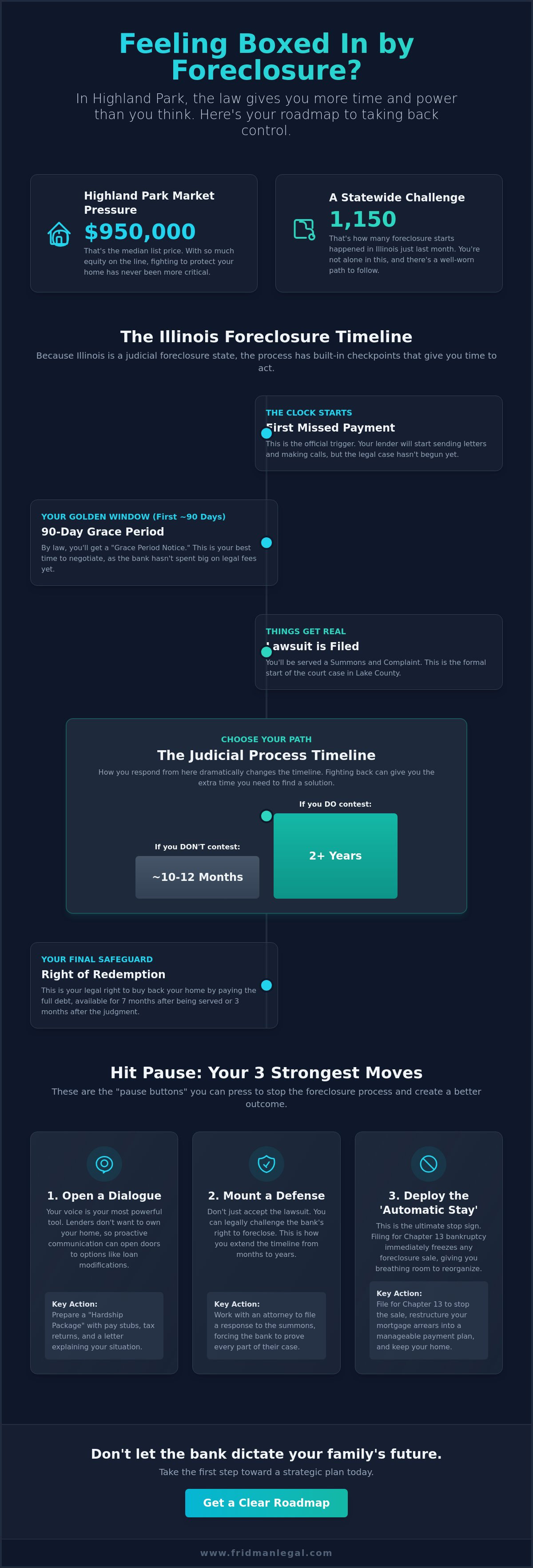
Illinois is a judicial foreclosure state. This means your lender can't just take your keys; they have to sue you in the Lake County Circuit Court first. For anyone researching how to avoid foreclosure in Highland Park IL, this is actually good news. It ensures you have a seat at the table and a chance to present a defense before a judge. While the bank starts its engines after your first missed payment, the law provides several checkpoints that can slow things down. A solid foundation for understanding the foreclosure process starts with realizing that you aren't just a passive observer. You're a defendant with rights that can be asserted to protect your equity.
The "Pre-Foreclosure" phase is the period between your first missed payment and the official filing of a lawsuit. During this time, your lender will send letters and make calls. The Notice of Default is the most critical document you'll see early on. It's the bank's formal way of saying the clock has started. In Highland Park, these cases are typically heard at the courthouse in Waukegan, which is the seat of the 19th Judicial Circuit. Knowing exactly where your case sits in this timeline is the first step toward regaining control.
The 90-Day Grace Period
In Illinois, lenders are required to send a Grace Period Notice before they can even file a foreclosure case. This gives you a 30-day window to seek housing counseling or legal advice. Many homeowners use this time to contact a debt settlement lawyer to explore options like loan modifications or repayment plans. Ignoring these letters is a mistake. The mail from your servicer during these three months contains the exact instructions you need to prevent the case from ever reaching a courtroom. It's the best time to negotiate because the bank hasn't yet spent thousands on legal fees.
The Judicial Process in Lake County
Once the bank files the lawsuit, you'll receive a Summons and a Complaint. These documents aren't just scary paperwork; they're the formal start of the litigation. In 2026, an uncontested foreclosure in Lake County usually takes about 10 to 12 months from that first missed payment to a final sale. However, if you choose to contest the filing, that timeline can easily stretch to two years or more. This extra time is often what's needed to secure a new job or finalize a traditional sale in Highland Park's competitive market, where homes often sell in under two weeks.
The right of redemption is your legal power to keep your home by paying off the total debt within seven months of being served with a summons or three months after a judgment of foreclosure is entered, whichever is later. Understanding these specific dates is the most effective way to figure out how to avoid foreclosure in Highland Park IL. Knowing when the point of no return actually happens helps you make calmer, more strategic decisions for your family's future.
Immediate Actions: Talking to Your Lender Before It Is Too Late
If you've started falling behind on your mortgage, your first instinct might be to stop answering the phone. It's a natural reaction to high stress, but silence is actually your lender's biggest ally. When you stop communicating, the bank assumes the worst and moves forward with the legal process. Breaking that silence is the most effective way to start figuring out how to avoid foreclosure in Highland Park IL. Lenders generally don't want to own your home; they want the interest and the principal. This is especially true in a high-value market like Highland Park, where the median sale price for single-family homes reached $970,000 in May 2026. Banks aren't set up to manage premium Lake County real estate, so they're often more willing to negotiate a "workout" than you might expect.
To start this conversation, you'll need to prepare a professional "Hardship Package." This isn't just a letter; it's a comprehensive dossier that includes your recent tax returns, pay stubs, and a detailed explanation of the financial setback you're facing. Resources like the Illinois Housing Development Authority offer free counseling to help you organize these documents effectively. It's also vital to understand who you're actually talking to. The company that sends your monthly statement is usually a loan servicer, not the actual owner of your mortgage. The servicer has specific guidelines from the investor, so knowing which rules apply to your specific loan is a major part of your defense strategy.
Forbearance vs. Loan Modification
Forbearance is a temporary pause in your payments. It's a great tool if you've had a short-term crisis, like a brief illness, but it isn't a permanent fix. Once the period ends, you'll still owe those missed payments. A loan modification is much more powerful because it actually changes the terms of your contract. With 30-year fixed rates currently hovering around 6.72% as of mid-June 2026, a modification can help by extending your loan term or lowering your interest rate to make the monthly bill affordable. Just be careful; big banks are notorious for "losing" modification paperwork, so keep a log of every call and every document you send.
Short Sales and Deeds-in-Lieu
Sometimes, keeping the house isn't the best financial move for your family's future. If you've decided to walk away but want to protect your credit, a short sale allows you to sell the home for less than the mortgage balance. This process requires a real estate lawyer for closing to ensure the lender waives their right to pursue you for the remaining debt later. Another option is a Deed-in-Lieu of Foreclosure, which is essentially a peaceful handover of the property to the bank. If you're feeling overwhelmed by these choices, reaching out to a foreclosure defense professional can help you decide which path protects your interests best.
Foreclosure Defense: Legal Strategies to Fight Back in Court
When the bank serves you with a lawsuit, it's easy to feel like the game is already over. But in the legal world, a complaint is just an opening move. Foreclosure defense is a powerful strategy for anyone looking at how to avoid foreclosure in Highland Park IL because it shifts the burden of proof back to the lender. Often, these defenses aren't about finding a "magic" loophole that makes the debt disappear; they're about identifying procedural errors that buy you the time needed to finalize a loan modification or a sale. If the bank can't prove they followed every rule to the letter, the court can't simply hand them your home. Resources like Illinois Legal Aid provide detailed breakdowns of these timelines, but applying them to your specific case requires a tactical eye.
A common strategy involves challenging the lender's "standing". Since mortgages are frequently sold and bundled into securities, the bank suing you might not actually have the original note in their possession. If they can't prove they owned the debt at the exact moment they filed the lawsuit, they don't have the right to foreclose. We also look for servicing errors, such as misapplied payments or a failure to send the required notices. To protect these rights, you must file a formal "Answer" to the complaint within 30 days of being served. If you don't, the court can enter a default judgment, which fast-tracks the sale of your property and removes your ability to negotiate from a position of strength.
Common Legal Defenses in Illinois
If you have an FHA or HUD-backed loan, the lender must follow strict "loss mitigation" steps before filing a lawsuit. Failure to offer a face-to-face meeting or explore all available options can be a valid defense that gets a case dismissed. We also investigate potential violations of the Truth in Lending Act (TILA) or the Real Estate Settlement Procedures Act (RESPA), which govern how lenders must disclose information. Sending a formal "Verification of Debt" request is a key step that forces the lender to provide an accurate, line-by-line accounting of what you owe, which naturally slows down the litigation process while the bank gathers its evidence.
The Role of Mediation
The 19th Judicial Circuit Court in Lake County continues to offer a Mortgage Foreclosure Mediation Program in 2026. This is a vital resource where a neutral third party helps you and the lender reach an agreement outside of a traditional courtroom setting. Having a lawyer represent you here is a game-changer. It takes the emotional weight off your shoulders and ensures the bank's attorneys don't use complex jargon to pressure you into a bad deal. A professional advocate knows what the bank is actually allowed to do under the law, which often leads to much better settlement terms than you could ever get on your own.
Using Bankruptcy to Stop a Sale and Save Your Home
While many people view bankruptcy as a last resort, in the legal world, it is often the most powerful tool available to homeowners. The moment you file for bankruptcy, a federal injunction called the "Automatic Stay" goes into effect. This order legally prohibits your lender from continuing with the foreclosure process, effectively hitting a pause button on everything, including a scheduled sheriff's sale. If you are looking for a definitive way for how to avoid foreclosure in Highland Park IL, the Automatic Stay provides the immediate breathing room you need to reorganize your finances without the constant threat of losing your roof.
The timing of your filing is the most critical factor in this strategy. To stop a sale, the bankruptcy petition must be filed before the hammer falls at the auction. Waiting until the last minute is risky, but a strategic filing can save a home even days before the scheduled sale date. This isn't about running away from debt; it is about using federal law to force the bank to the negotiating table on your terms. If you're facing an urgent deadline, speaking with a bankruptcy professional can help you determine if this is the right move for your specific situation.
Chapter 13: The Repayment Plan
Chapter 13 is frequently called the "Homeowner’s Chapter" because it is designed for people with a steady income who want to keep their property. It allows you to take all your missed mortgage payments, known as arrears, and spread them out over a three to five year repayment plan. As long as you make your new monthly mortgage payments plus the plan payment, the bank cannot foreclose. For Highland Park homes that have seen a dip in value, Chapter 13 also offers the possibility of "stripping" a second mortgage or HELOC, reclassifying it as unsecured debt if the home's value doesn't cover the first mortgage. If you don't have the income for a long term plan, you might want to look into Chapter 7 Bankruptcy in Northbrook as an alternative to wipe out other debts and free up cash flow.
The Bankruptcy Myths vs. Reality
The biggest myth about bankruptcy is that you will lose everything you own. In reality, Illinois law provides generous exemptions to protect your assets. As of January 1, 2026, the Illinois homestead exemption protects up to $50,000 of equity for a single person and $100,000 for a married couple filing jointly. Most people find that their cars, household goods, and retirement accounts are fully protected. Another common fear is that your credit will be ruined forever. While a bankruptcy does stay on your report, many homeowners find their credit scores actually improve within a year or two because they've eliminated the debt that was dragging them down. Viewing bankruptcy as a responsible financial tool rather than a failure is the first step toward long term stability.
How Fridman Legal Helps Highland Park Homeowners
At Fridman Legal, we believe that saving your home requires more than just filling out forms; it takes a sophisticated, multi-angled strategy. Attorney O. Allan Fridman brings over 20 years of experience to every case, providing the kind of personalized attention that larger, impersonal firms simply cannot match. In 2026, the housing market remains competitive, but the legal landscape for homeowners is more complex than ever. We don't just look at your mortgage in a vacuum. Our team analyzes your situation through the lenses of both real estate law and bankruptcy law to find the most effective path forward. Because our office is located in Northbrook, we're just a few minutes away from Highland Park, making it easy for us to meet and review your documents in person. We know that when you're looking for how to avoid foreclosure in Highland Park IL, you need a partner who is accessible and transparent. Our flat-fee structures for bankruptcy filings are designed to eliminate the fear of mounting legal bills, providing you with total cost certainty from the start.
Our Foreclosure Defense Process
Our approach to how to avoid foreclosure in Highland Park IL starts with a forensic look at your loan history. We dig into your original closing documents and payment records to find the lender errors or servicing violations that can turn the tide of a court case. We don't just take the bank's word for what you owe; we verify every fee and interest calculation. While we're building your legal defense, we're also actively negotiating with your loan servicer to explore modifications or settlements. If a servicer failed to follow the proper loss mitigation steps required for your specific loan type, we use that as leverage in court. This dual-track strategy ensures that no opportunity is missed. If you're ready to stop the cycle of stress and silence the phone calls, we invite you to contact us today for a professional consultation.
Why Choose a Specialized Bankruptcy Lawyer in Chicago?
Working with a specialized advocate who understands the Chicago suburbs and the Lake County court system gives you a distinct advantage. We're intimately familiar with the procedural nuances of the 19th Judicial Circuit, including the specific rules that govern foreclosure mediation in Waukegan. This local knowledge allows us to move you from a state of constant panic into a structured, legal plan of action. You don't have to face the bank's attorneys alone. We help you transition from a defensive posture to an offensive one, using every available legal tool to protect your equity and your family's stability. Our goal is to serve as your shield, handling the complex litigation so you can focus on your future. Remember, you have significant rights under Illinois law, and we're here to make sure those rights are fully protected.
Take Control of Your Home’s Future Today
Facing a foreclosure notice is undoubtedly one of life's most stressful events, but it doesn't have to be the final word on your property. You've seen that the Illinois judicial process provides a structured timeline and that federal tools like the Automatic Stay can halt a sale immediately. Whether you choose to fight the bank through a strategic defense or reorganize your debt via Chapter 13, the power to act is still in your hands. Understanding how to avoid foreclosure in Highland Park IL is simply the first step; the next is implementing a professional plan that protects your equity and your family's peace of mind.
With nearly 20 years of experience in Illinois bankruptcy and real estate law, we provide the local representation you need right here in the Highland Park area. We believe in transparency; our firm offers flat-fee pricing for Chapter 7 and Chapter 13 filings to ensure you have cost certainty during a difficult time. You don't have to navigate the complexities of the Lake County court system alone. We invite you to schedule a confidential consultation with Fridman Legal to save your home. There is a path forward, and we're here to help you find it.
Frequently Asked Questions
Can I stop a foreclosure sale the day before it happens?
Yes, you can stop a foreclosure sale as late as the day before it occurs by filing a bankruptcy petition. This action triggers an automatic stay, which is a federal injunction that prevents the lender from moving forward with the auction. While it's better to act earlier, this provides an emergency option for anyone researching how to avoid foreclosure in Highland Park IL. You'll just need to ensure the court receives the filing before the sale begins.
How long does the foreclosure process take in Highland Park, IL?
An uncontested foreclosure in Lake County generally takes between 10 and 12 months from your first missed payment to the final sale. However, because Illinois is a judicial state, the process can stretch to two years or more if you choose to file a formal defense. This timeline gives you significant opportunities to negotiate a loan modification or finalize a traditional sale in the competitive Highland Park real estate market.
Will filing for bankruptcy stop my foreclosure immediately?
Filing for bankruptcy stops the foreclosure process immediately through the power of the automatic stay. This federal protection prevents lenders from calling you, sending demand letters, or proceeding with a scheduled sale. It's one of the most reliable ways for how to avoid foreclosure in Highland Park IL because it shifts the case to federal court. This gives you the necessary time to restructure your debt and catch up on payments through a managed plan.
Do I have to leave my house as soon as I get a foreclosure notice?
You don't have to leave your home when you receive a foreclosure notice or even after a lawsuit is filed. In Illinois, you can legally stay in the property until the court confirms the judicial sale and an order of possession is issued. This process often takes many months after the initial summons. It allows you the time needed to plan your next move or work on a legal strategy to keep the home.
Is there a way to lower my mortgage payments if I’m behind?
You can lower your monthly payments through a loan modification, even if you're already behind on your mortgage. This process involves negotiating with your lender to reduce the interest rate or extend the loan term. While it requires submitting a detailed hardship package, it's a common way for homeowners to resolve a default without losing their property. It's often the best path for those who want to stay in their homes long term.
What is the "Right of Redemption" in Illinois foreclosure law?
The right of redemption allows you to save your home by paying the full amount owed on the mortgage plus certain costs. In Illinois, this period usually lasts for seven months after you're served with the summons or three months after a judgment is entered. It's a powerful protection that ensures you have a final window to satisfy the debt. This right exists to give homeowners one last chance to keep their property title.
Can I sell my house while it is in foreclosure?
You have the right to sell your house during the foreclosure process to pay off the lender. Since Highland Park homes often sell quickly, a traditional sale might allow you to keep your equity rather than losing it at a public auction. If the home's value is less than what you owe, you'll need to negotiate a short sale with your lender. This requires their specific approval of the purchase price before closing.
Should I talk to a HUD counselor or a foreclosure defense attorney?
HUD counselors are excellent for general guidance, but they can't represent you in the Lake County Circuit Court. A foreclosure defense attorney provides the legal advocacy needed to file an Answer and challenge the bank's standing. For most homeowners facing a lawsuit, having a legal professional ensures that your rights are fully protected throughout the judicial process. It's the best way to handle the complex litigation that a counselor isn't licensed to manage.

Article by
O. Allan Fridman
O. Allan Fridman has been practicing law since 2001. His practice is unique in that he does not view himself as a litigation attorney or transactional attorney. Rather, he views each area of law as a tool to pursue the best results for his clients. By practicing in both areas of law, he is able to take a 360-degree view of law. This enables the firm to catch potential drawbacks that are readily identifiable.
By practicing in litigation and transactional law and taking a holistic approach in dealing with our clients, he doesn’t put clients in box — rather, as we are all individuals, so too are the legal services we may require.
Whether it is bankruptcy or litigation or transactional, each client brings challenges and does not fit in any one box. Often times, bankruptcy clients end up not filing bankruptcy because we can achieve a better result through litigation or through an out-of-court resolution with the lender, or through a real estate sale. On the other end of the spectrum, a litigation client with multiple issues and lawsuit may fare better in a bankruptcy.
Since 2001, Allan has practiced in states and federal court, and he is a member of the trial bar of the Northern District of Illinois and admitted in the Northern District of Indiana.
We are a debt relief agency. We help people file for bankruptcy relief under the Bankruptcy Code
The materials on this site are for informational purposes only and do not constitute legal advice. Viewing this site or contacting us does not create an attorney–client relationship, and you should not act or refrain from acting based on any information here without seeking professional legal counsel.


