

Could a strategic filing under the U.S. Bankruptcy Code be the most effective method to preserve your Northbrook residence or Chicago business interests? While many view insolvency as a finality, sophisticated actors recognize it as a precise legal mechanism for debt restructuring and asset protection. Understanding how to file for bankruptcy in Cook County Illinois requires more than just filling out forms; it demands a rigorous adherence to the procedural nuances of the Northern District of Illinois. In 2026, the complexity of the Means Test and the logistical requirements of the 341 Meeting of Creditors continue to present significant hurdles for those seeking a fresh start.
You've likely felt the mounting pressure of potential wage garnishments or the looming threat of foreclosure. It's a rational response to a complex financial environment where the rules of the Bankruptcy Abuse Prevention and Consumer Protection Act dictate every move. This guide provides a professional roadmap to secure a debt discharge while maintaining your professional standing. We'll examine the specific requirements for the Dirksen Federal Building, clarify the necessary local forms, and outline the sequence of events from the initial petition to the final decree.
Key Takeaways
- Identify the jurisdictional framework of the Northern District of Illinois and the federal statutes that govern the debt resolution process.
- Ensure compliance with mandatory pre-filing requirements, including state-approved credit counseling and the systematic gathering of essential financial documentation.
- Execute a precise, step-by-step strategy for how to file for bankruptcy in Cook County Illinois, from drafting the formal petition to filing at the Dirksen Courthouse.
- Leverage Illinois-specific exemptions to strategically protect your real estate and personal property from liquidation during the legal proceedings.
- Navigate the complexities of the Meeting of Creditors and the final verification process to secure a successful discharge of your qualifying debts.
Understanding Bankruptcy Options in Cook County and Northern Illinois
Bankruptcy represents a formal federal legal procedure governed strictly by Title 11 of the U.S. Code. For residents and business entities within Cook County, these proceedings fall under the exclusive jurisdiction of the United States Bankruptcy Court for the Northern District of Illinois, Eastern Division. The primary objective of this process is the attainment of a discharge. This court order serves as a permanent injunction against the collection of specific debts, effectively releasing the debtor from personal liability. When individuals research how to file for bankruptcy in Cook County Illinois, they're seeking a structured resolution to insolvency that balances debtor relief with creditor rights.
A comprehensive understanding of Bankruptcy in the United States involves distinguishing between liquidation and reorganization frameworks. The choice between these paths depends on the debtor's income, asset valuation, and long-term financial objectives. The court's 2026 guidelines emphasize transparency and the precise disclosure of all financial interests to ensure the integrity of the Northern District’s docket.
Chapter 7 vs. Chapter 13: Which fits your situation?
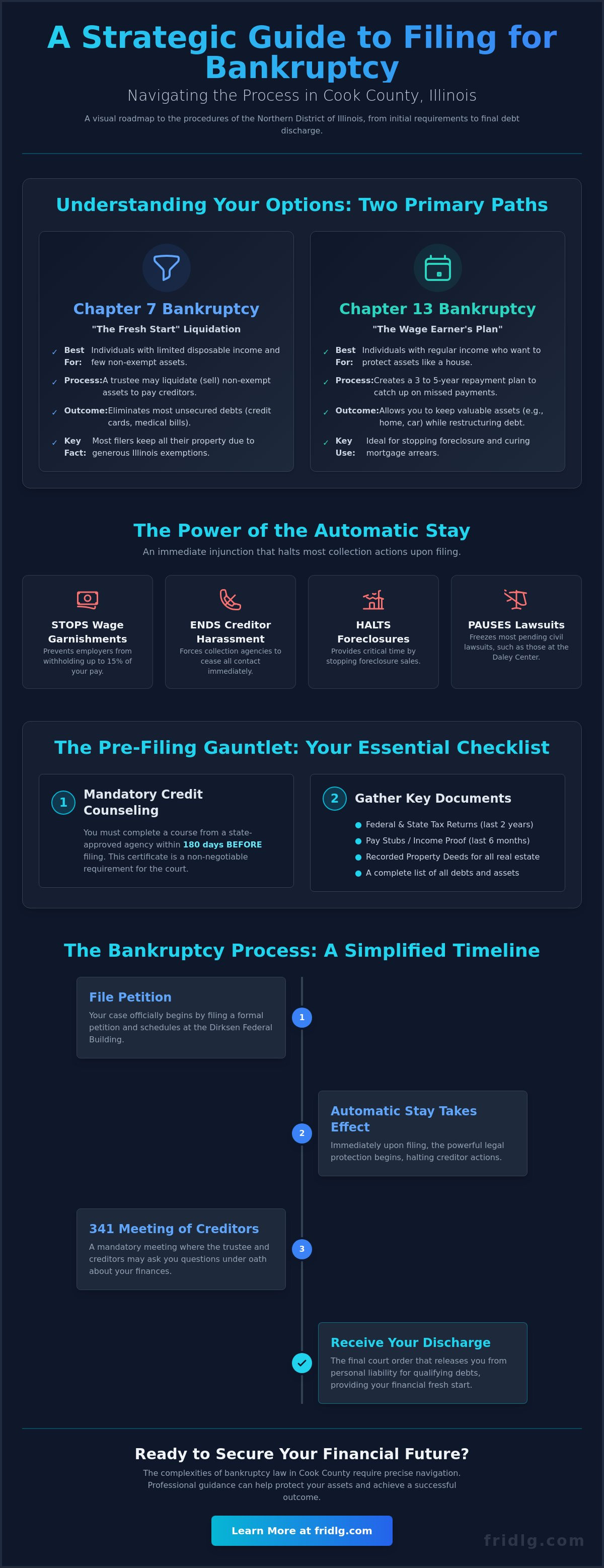
Chapter 7, often termed a "Fresh Start" liquidation, is designed for individuals with limited disposable income who don't possess significant non-exempt assets. In this process, a court-appointed trustee evaluates assets to determine if any can be sold to satisfy creditor claims. Most Cook County filers find their personal property falls under Illinois state exemptions, allowing them to retain their belongings while eliminating unsecured debt.
Chapter 13 serves as a "Wage Earner’s Plan" for those with consistent income who wish to protect specific assets. This path allows for debt reorganization over a three to five-year period. In affluent areas like Northbrook, homeowners frequently choose Chapter 13 to cure mortgage arrears or protect home equity that exceeds the current Illinois homestead exemption limits. It's a strategic tool for preserving real estate while systematically addressing tax obligations or domestic support arrears.
The Role of the Automatic Stay in Chicago
The filing of a bankruptcy petition triggers the automatic stay, a powerful statutory injunction that takes effect immediately. This mechanism halts most collection actions, including Cook County foreclosure sales and pending civil lawsuits in the Daley Center. It provides a critical pause for those determining how to file for bankruptcy in Cook County Illinois while facing aggressive litigation.
- Wage Garnishments: The stay prohibits Illinois employers from continuing to withhold the 15% maximum garnishment from a debtor’s paycheck the moment the case is filed.
- Creditor Harassment: All communication from collection agencies must cease, redirecting all inquiries to the bankruptcy court or legal counsel.
- Utility Disconnections: The stay can prevent the immediate shut-off of essential services, provided certain post-petition requirements are met.
The stay remains in place throughout the duration of the case unless a creditor successfully petitions the court for relief. This protection ensures that the debtor’s estate remains preserved while the court deliberates on the final discharge of debts.
Preparing to File: Essential Pre-Filing Steps and Requirements
The process of understanding how to file for bankruptcy in Cook County Illinois begins long before you enter the Everett McKinley Dirksen United States Courthouse. Precision at this stage determines the viability of your petition. You must complete a credit counseling course from an agency approved by the U.S. Trustee for the State of Illinois within the 180 days preceding your filing. This certificate is a jurisdictional prerequisite; without it, the court will dismiss your case almost immediately.
Compiling the "Cook County Checklist" requires rigorous attention to detail. You'll need to aggregate your federal and state tax returns for the last two years, pay stubs representing the last six months of income, and recorded property deeds for any real estate assets. Full disclosure of all assets and liabilities is the only way to maintain the integrity of your filing. Attempting to shield assets or failing to report a secondary income stream can lead to allegations of bankruptcy fraud, which carries severe federal penalties.
Statistics from the Northern District of Illinois indicate that individuals who proceed "pro se," or without legal representation, face a significantly higher risk of case dismissal. The procedural complexity of the local rules often overwhelms unrepresented filers. Reviewing the court's guidance on Filing for Bankruptcy in the Northern District of Illinois reveals the technical demands placed on every petitioner. For those seeking to preserve their long term financial interests, securing strategic legal counsel is often a necessary safeguard against avoidable errors.
Passing the Illinois Means Test
The Means Test determines your eligibility for Chapter 7 liquidation by comparing your average monthly income against the Illinois median for a household of your size. If your income exceeds this threshold, you must calculate "allowable expenses" based on IRS standards specifically adjusted for the Chicago-Naperville-Elgin metropolitan area. These standards account for the higher cost of living in Cook County. If your disposable income remains too high after these deductions, you'll likely need to transition your filing from Chapter 7 to a Chapter 13 repayment plan.
Inventorying Your Assets and Debts
You must categorize every financial obligation into secured or unsecured debt. Secured debts involve collateral, such as mortgages on Chicago residences or car loans. Unsecured debts include medical bills from local facilities like Cook County Health or outstanding credit card balances. Every creditor must be listed, including local vendors or private lenders within the 606 zip codes. The Bankruptcy Schedules serve as the formal backbone of your petition, documenting every facet of your financial standing for the court's review. Accuracy here prevents creditors from challenging the discharge of your debts later in the process.
Step-by-Step Process for Filing in the Northern District of Illinois
Initiating a bankruptcy case requires the meticulous preparation of a formal petition, numerous supporting schedules, and a Statement of Financial Affairs (SOFA). These documents serve as the evidentiary foundation for your financial standing. You'll need to list every asset, from real estate holdings to intangible intellectual property, while categorizing all liabilities as secured, priority, or general unsecured debts. Precision in this phase is paramount; the omission of a single creditor or asset can jeopardize the entire discharge process. When determining how to file for bankruptcy in Cook County Illinois, you must ensure that your schedules align perfectly with the Illinois bankruptcy exemptions to protect your property from liquidation by the court.
The filing fee for a Chapter 7 case is currently $338, while a Chapter 13 case requires $313. These fees are payable to the Clerk of the Court at the time of filing. If your household income is less than 150% of the official poverty guidelines, you may submit an application to waive these costs. Once the petition is accepted, the court appoints a Bankruptcy Trustee. This individual acts as an independent fiduciary, tasked with reviewing your documentation, verifying your assets, and ensuring that the distribution to creditors follows the strict priority levels established by the Bankruptcy Code.
Filing Logistics at the Dirksen Federal Building
All Cook County bankruptcy filings fall under the jurisdiction of the U.S. Bankruptcy Court for the Northern District of Illinois, Eastern Division. The physical Clerk’s Office is located at the Everett McKinley Dirksen United States Courthouse, 219 South Dearborn Street, Chicago, IL 60604. While legal counsel utilizes the Case Management/Electronic Case Files (CM/ECF) system for digital submissions, individuals representing themselves must typically deliver paper documents to the 21st floor. You must comply with the Eastern Division’s local rules and any standing orders issued by your assigned judge. These rules dictate everything from signature requirements to the specific formatting of the creditor matrix.
Post-Filing Deadlines and Duties
The filing of the petition triggers an automatic stay, but it also activates several strict deadlines. You must provide the appointed Trustee with your most recent federal tax transcripts and pay stubs at least seven days before the meeting of creditors. Failure to meet this deadline often results in a summary dismissal of the case. Additionally, you're required to complete a second mandatory instructional course: the Debtor Education or Financial Management course. This must be finished before the court will grant a final discharge. You should monitor the court docket regularly to track any motions for relief from the stay or formal objections filed by creditors. Timely responses to these legal challenges are essential for maintaining the integrity of your filing.
Protecting Your Assets: Illinois Exemptions and Cook County Real Estate
Illinois is one of the states that opted out of the federal bankruptcy exemption system. This decision means that residents must use state-specific protections defined by the Illinois Compiled Statutes rather than the federal list. These laws determine which assets you keep and which the court might liquidate to satisfy creditors. Understanding these specific rules is a critical phase of learning how to file for bankruptcy in Cook County Illinois, as it dictates the long-term stability of your household after the case concludes.
Asset protection requires a disciplined, strategic approach. For instance, the involvement of a real estate lawyer for closing is often necessary when managing property transfers or title issues near a bankruptcy filing. Coordinating your bankruptcy petition with broader real estate strategies ensures that your Northbrook residence or commercial holdings aren't inadvertently compromised by timing errors or valuation discrepancies.
The Illinois Homestead Exemption
The homestead exemption is the primary tool for protecting the equity in your primary residence. Under current Illinois law, an individual filer can exempt up to $15,000 of equity in their home. Married couples filing a joint petition can combine their interests to protect a total of $30,000. It's important to realize that this exemption applies to equity, not the total market value. If your mortgage balance is $300,000 and the home is worth $310,000, your $10,000 in equity is fully protected.
If your equity significantly exceeds these statutory limits, the Chapter 7 trustee may seek to sell the home to pay creditors. In such complex scenarios, homeowners often benefit from reviewing our specialized guide on Chapter 7 bankruptcy Illinois to understand how to mitigate these risks. Proper valuation is the foundation of a successful filing.
Personal Property and Wildcard Exemptions
Beyond real estate, Illinois law provides specific categories to shield your daily essentials. The "Wildcard" exemption is perhaps the most versatile tool available. It allows you to protect up to $4,000 of any personal property, including cash, tax refunds, or jewelry. This is frequently used to cover assets that don't fit into other defined categories. Other standard exemptions include:
- Motor Vehicles: You can protect up to $2,400 in equity for one vehicle.
- Tools of the Trade: Up to $1,500 for equipment or books used in your profession.
- Retirement Accounts: ERISA-qualified plans, such as 401(k)s and most IRAs, are generally 100% exempt from the bankruptcy estate.
- Necessary Clothing: Standard personal attire is protected without a specific dollar limit.
Strategic application of these exemptions is the difference between a total loss and a fresh start. When you're determining how to file for bankruptcy in Cook County Illinois, you must disclose all assets accurately to avoid allegations of fraud. The court's transparency requirements are strict. Every asset must be accounted for on your schedules to ensure the protection remains valid.
Navigating the Meeting of Creditors and Achieving a Discharge
The final phase of understanding how to file for bankruptcy in Cook County Illinois involves the 341 Meeting of Creditors. This mandatory hearing typically occurs 30 to 45 days after your initial filing. While the name suggests a room full of hostile lenders, the reality is often more clinical. In the Northern District of Illinois, these meetings are currently conducted via Zoom or teleconference, which provides a level of comfort for debtors in Northbrook or downtown Chicago. You'll be required to testify under oath, confirming that all information in your petition is true and complete.
The process requires strict adherence to identification protocols. You must provide your original Social Security card and a government-issued photo ID to the Trustee before the meeting begins. During the session, the Trustee will ask a series of standard questions regarding your assets, transfers of property in the last two years, and the accuracy of your schedules. Creditors occasionally attend to ask about specific collateral, but their presence is rare in most consumer cases. Providing direct, honest answers ensures the meeting concludes in approximately 10 to 15 minutes.
Following the meeting, a 60-day waiting period begins. This duration allows creditors to file objections if they believe a debt shouldn't be discharged due to fraud or other legal exceptions. If no objections are filed by the deadline, the court moves to finalize your case.
The Role of the Trustee in the Eastern Division
The Trustee is a court-appointed official who represents the bankruptcy estate. It's a common misconception that they work for the creditors; their actual role is to maximize the value of the estate for distribution. In the Chicago area, approximately 95 percent of Chapter 7 consumer cases result in a "No-Asset Report." This means the Trustee has determined that your property is either exempt under Illinois law or lacks enough value to justify a sale. Maintaining a cooperative relationship with the Trustee is vital. If they request additional documentation, such as updated bank statements or tax returns, you should provide them within 14 days to maintain your case's momentum.
Life After Discharge: Rebuilding in Northbrook
The discharge order is the ultimate goal of the bankruptcy process. It acts as a permanent federal injunction, legally barring creditors from contacting you or attempting to collect on discharged debts. Once the 60-day window for creditor objections passes, the court issues this order, effectively erasing your qualifying liabilities. Your journey toward financial stability doesn't end with the discharge; it begins there. Many individuals see their credit scores begin to stabilize within 12 months of the order. By utilizing secured credit cards and maintaining on-time payments for remaining obligations like rent or utilities, you can strategically rebuild your financial profile. If you're ready to start this transition, Contact Fridman Legal for a flat-fee bankruptcy consultation to review your options with a professional.
Securing Your Financial Recovery in the Northern District of Illinois
Navigating the legal intricacies of the Northern District of Illinois requires a precise understanding of federal codes and local court procedures. Successfully executing the process involves more than just submitting paperwork; it demands a strategic approach to asset protection through Illinois-specific exemptions and a thorough preparation for the mandatory 341 Meeting of Creditors. When you understand how to file for bankruptcy in Cook County Illinois, you move from a state of financial uncertainty to a position of controlled recovery. This journey relies on meticulous documentation and an adherence to the strict timelines established by the 2005 Bankruptcy Abuse Prevention and Consumer Protection Act.
Professional guidance ensures your filing remains compliant while maximizing your potential for a full discharge. O. Allan Fridman provides personalized representation backed by nearly 20 years of experience within Cook County courts. Our firm utilizes transparent flat-fee structures for Chapter 7 filings to provide clarity during a complex transition. You don't have to manage these legal burdens alone. We invite you to Schedule a Consultation with a Northbrook Bankruptcy Attorney to discuss your specific financial objectives. Taking this definitive step today establishes the foundation for your long-term stability and peace of mind.
Frequently Asked Questions
Do I have to go to court in person to file for bankruptcy in Cook County?
You won't typically need to appear in a physical courtroom for your initial 341 meeting of creditors. The U.S. Bankruptcy Court for the Northern District of Illinois currently conducts these proceedings via Zoom or telephonic platforms. This administrative efficiency allows debtors to participate from a remote location. While a judge may require an in-person hearing for contested matters, most standard cases conclude without the debtor ever entering the Everett McKinley Dirksen United States Courthouse.
Can I keep my car if I file for Chapter 7 in Illinois?
You can retain your vehicle if its equity falls within the specific exemptions provided by Illinois Compiled Statutes 735 ILCS 5/12-1001. The current motor vehicle exemption protects up to $2,400 in equity for a single filer. If the vehicle's value exceeds this threshold, you might apply the $4,000 wildcard exemption to preserve the asset. Maintaining current loan payments is mandatory if you intend to reaffirm the debt after learning how to file for bankruptcy in Cook County Illinois.
How long does the bankruptcy process take in the Northern District of Illinois?
A standard Chapter 7 liquidation typically concludes within four to six months from the initial filing date. Chapter 13 reorganization cases require a much longer commitment, spanning a court-approved payment plan of either 36 or 60 months. The Northern District of Illinois processes thousands of petitions annually, so your specific timeline depends on the complexity of your financial disclosures and the promptness of your mandatory credit counseling certifications.
Will my employer find out if I file for bankruptcy?
Your employer won't receive a formal notification from the court unless you're filing Chapter 13 and require a payroll deduction order for plan payments. Bankruptcy filings are public records, yet the court doesn't proactively inform private employers of a Chapter 7 petition. Unless your employer is a listed creditor or you hold a specific security clearance requiring disclosure, the filing remains a matter of public record that few employers actively monitor.
Can I file for bankruptcy if I own a business in Chicago?
You can certainly file for bankruptcy while owning a business in Chicago, though the entity's legal structure dictates the outcome. Sole proprietors are personally liable for business debts, meaning their filing encompasses both personal and commercial obligations. If your business is an LLC or corporation, you must decide whether to liquidate the entity under Chapter 7 or seek a strategic reorganization through Chapter 11 to maintain operations.
What debts cannot be discharged in an Illinois bankruptcy case?
Certain obligations remain legally enforceable even after a successful discharge order. These include domestic support obligations like alimony and child support, most student loans, and recent tax debts owed to the IRS or Illinois Department of Revenue. Fines resulting from criminal activity or DUI-related personal injury judgments are also non-dischargeable. Identifying these specific liabilities is a critical step in learning how to file for bankruptcy in Cook County Illinois effectively.
How much does it cost to file for bankruptcy in Cook County (court fees)?
The federal court mandates specific filing fees that apply to all petitioners in the Northern District of Illinois. As of late 2024, the administrative cost to file a Chapter 7 petition is $338, while a Chapter 13 petition requires a $313 fee. These amounts are paid directly to the Clerk of the Court. Petitioners with household incomes below 150 percent of the federal poverty guidelines may submit a request to waive these fees entirely.
Can spouses file a joint bankruptcy petition in Illinois?
Spouses have the legal right to file a single joint petition, which often proves more cost-effective than individual filings. A joint case covers all shared and individual debts under one filing fee and a single 341 meeting. This approach is particularly beneficial when both parties are liable for significant marital debts, as it ensures a comprehensive discharge for the entire household while doubling certain available Illinois property exemptions.

Article by
O. Allan Fridman
O. Allan Fridman has been practicing law since 2001. His practice is unique in that he does not view himself as a litigation attorney or transactional attorney. Rather, he views each area of law as a tool to pursue the best results for his clients. By practicing in both areas of law, he is able to take a 360-degree view of law. This enables the firm to catch potential drawbacks that are readily identifiable.
By practicing in litigation and transactional law and taking a holistic approach in dealing with our clients, he doesn’t put clients in box — rather, as we are all individuals, so too are the legal services we may require.
Whether it is bankruptcy or litigation or transactional, each client brings challenges and does not fit in any one box. Often times, bankruptcy clients end up not filing bankruptcy because we can achieve a better result through litigation or through an out-of-court resolution with the lender, or through a real estate sale. On the other end of the spectrum, a litigation client with multiple issues and lawsuit may fare better in a bankruptcy.
Since 2001, Allan has practiced in states and federal court, and he is a member of the trial bar of the Northern District of Illinois and admitted in the Northern District of Indiana.
We are a debt relief agency. We help people file for bankruptcy relief under the Bankruptcy Code
The materials on this site are for informational purposes only and do not constitute legal advice. Viewing this site or contacting us does not create an attorney–client relationship, and you should not act or refrain from acting based on any information here without seeking professional legal counsel.


