

In October 2023, a Northbrook resident attempted to refinance their primary residence, only to find that a municipal dispute from three years prior had evolved into a recorded lien on home. This single legal filing immediately halted the underwriting process and introduced a layer of complexity that threatened their financial liquidity. You likely view your property as a foundation of stability; therefore, the realization that a third party holds a legal stake in your title is both frustrating and professionally concerning. The intricacies of Illinois property law often make these situations feel insurmountable without a structured approach.
You'll gain a comprehensive understanding of the legal implications surrounding property encumbrances and discover the precise strategic pathways available to resolve them. We'll analyze the specific categories of claims, from mechanic's liens to judgment orders. This guide provides a clear roadmap for restoring your property rights and securing your peace of mind. Our objective is to transform legal confusion into a disciplined strategy for title clearance.
Key Takeaways
- Understand the legal nature of property encumbrances in Illinois and how they function as security for underlying debt obligations.
- Identify the specific types of liens frequently encountered in Cook County and the unique regulatory requirements governing their filing in the Northbrook area.
- Discover strategic pathways to resolve a lien on home, including title verification processes and professional negotiation techniques for debt settlement.
- Learn why professional legal oversight is essential to avoid recording errors that can further cloud property titles and jeopardize future real estate transactions.
Defining the Property Lien in the Illinois Real Estate Context
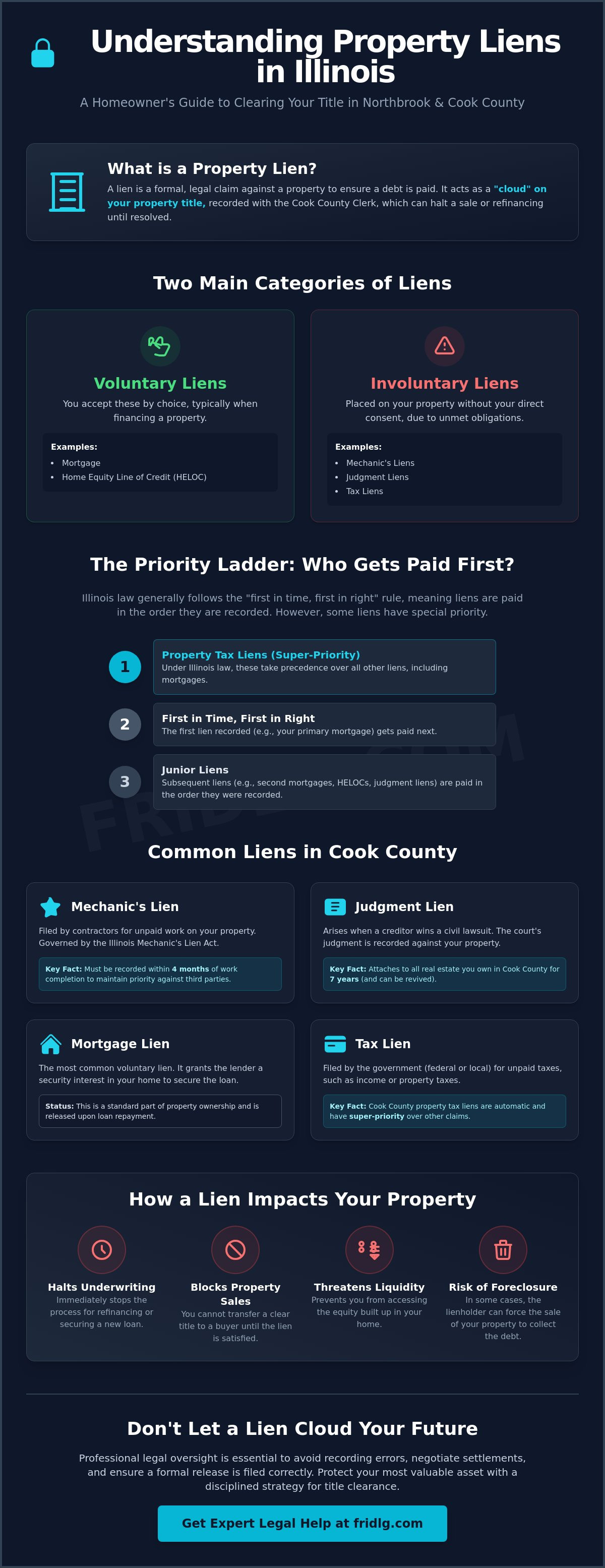
In the Illinois legal system, a lien represents a formal claim or encumbrance secured against a property to ensure the fulfillment of a debt or obligation. When a creditor places a What is a property lien? on an asset, they establish a legal interest that remains attached to the real estate until the underlying liability is satisfied. For Northbrook residents, these instruments are recorded with the Cook County Clerk, an office that absorbed the functional duties of the Recorder of Deeds on December 7, 2020. A lien functions as a legal "cloud" on a title that prevents clear transfer of ownership. This public record alerts potential buyers and title companies that the owner's equity is subject to third-party claims. Effectively, a lien on home assets acts as a barrier to sale or refinancing, requiring strategic resolution to restore clear title. These filings are permanent markers that remain until a formal release is recorded in the county records.
Voluntary vs. Involuntary Liens
The classification of a lien dictates the legal recourse available to the homeowner. Voluntary liens are those you accept by choice, such as a mortgage or a home equity line of credit (HELOC). These are foundational to modern property acquisition. Conversely, involuntary liens arise without owner consent. These include mechanic's liens filed by contractors under the Illinois Mechanics Lien Act (770 ILCS 60/) or judgment liens resulting from court rulings. In Northbrook, distinguishing between these types is critical for developing a defense strategy. Involuntary claims often signal a breach of contract or a failure to meet statutory obligations. They require immediate legal intervention to prevent foreclosure or loss of asset liquidity.
The Legal Priority of Liens
Illinois law generally follows the "first in time, first in right" principle. This means the chronological order of recording with the Cook County Clerk determines the order of payment during a liquidation event. If a property is sold, the senior lienholder receives funds before junior claimants. However, specific exceptions exist. Property tax liens possess "super-priority" status under Illinois Compiled Statutes (35 ILCS 200/). These tax claims take precedence over even the oldest mortgages. Understanding this hierarchy is essential when evaluating a lien on home equity. It dictates which creditors hold the most leverage in a negotiation or foreclosure proceeding. Proper legal analysis identifies where each claim sits in the queue of repayment, which is vital for protecting your financial interests during a transaction.
Common Types of Liens Encountered in Northbrook and Chicago
A lien on home functions as a legal encumbrance that clouds the title, preventing a seamless transfer of ownership until the underlying debt is satisfied. For a lien to be legally enforceable against third parties, such as subsequent purchasers or lenders, it must be properly recorded with the Cook County Clerk’s Office. This public filing establishes the priority of the claim in the chain of title. Creditors utilize these instruments to transform an unsecured debt into a secured interest, ensuring they've a recovery mechanism during a sale or refinancing event. In the Northbrook real estate market, identifying these encumbrances early is vital for maintaining the integrity of a transaction.
Mortgage and Mechanic’s Liens
Mortgage liens represent the most frequent voluntary encumbrance for Northbrook residents. When you sign a mortgage, you're granting the lender a consensual lien on home assets to secure the loan. Conversely, mechanic’s liens are involuntary and governed by the Illinois Mechanic’s Lien Act (770 ILCS 60/). If a contractor performs permanent improvements on a Northbrook property and remains unpaid, they can cloud the title. To maintain priority against third parties, contractors must record their lien within four months of completing the work. Missing this strict window significantly weakens their legal standing against subsequent buyers, though they may still have claims against the original owner.
Judgment and Tax Liens
Judgment liens arise when a creditor wins a civil lawsuit in the Cook County Circuit Court. Once recorded, the judgment attaches to all real estate owned by the debtor within the county for a period of seven years, though it can be revived. Tax liens operate on both federal and local levels. The IRS files a Notice of Federal Tax Lien for unpaid income taxes, which takes broad priority over many other interests. At the local level, Cook County property tax liens are unique; they're automatic. Under Illinois law, these liens attach to the property on January 1st of each tax year, even before the bill is issued. This ensures the county remains the first in line for payment during a tax sale.
HOA and Utility Liens
In Northbrook, homeowners' associations (HOAs) possess significant leverage regarding unpaid assessments. Under the Illinois Condominium Property Act or the Common Interest Community Association Act, an HOA can place a lien on a unit for delinquent monthly dues or special assessments. These organizations have the power to initiate foreclosure proceedings to recover the debt, often regardless of the mortgage status. Additionally, municipalities like Northbrook can record liens for unpaid water, sewer, or weed abatement services. These relatively small debts can escalate into significant title issues during a transaction. Securing strategic legal counsel allows property owners to address these encumbrances before they jeopardize a sale or refinancing effort.
The Practical Impact of a Lien on Your Illinois Property
An active lien on home titles functions as a legal freeze on your most significant asset. It prevents you from transferring ownership or accessing the equity you've built over years of mortgage payments. In the Northbrook real estate market, a clear title is the baseline requirement for any transaction. When a creditor attaches a debt to your property, they effectively become a silent partner in your home's value, one who must be satisfied before you receive a single dollar from a sale.
Title companies are risk-averse by design. They won't issue a "clean" title insurance policy if a search reveals an unresolved judgment or mechanic's lien. Without this insurance, a buyer's lender will not release funds, effectively killing the deal before it reaches the closing table. Engaging a closing attorney for real estate early in the process is the most effective way to identify these encumbrances. A legal professional conducts a thorough title commitment review to spot these issues weeks before the scheduled move-out date, allowing time for resolution or negotiation.
Selling and Refinancing Obstacles
If you plan to refinance your mortgage to take advantage of lower interest rates, a lien will halt the process immediately. Lenders require "first position" status, meaning they want to be the first in line to get paid if the house is sold. A pre-existing lien on home equity disrupts this hierarchy. To move forward, you must obtain a payoff letter from the lienholder. This document specifies the exact amount required to release the claim, including accrued interest and legal fees.
These figures directly impact your bottom line. You can consult our guide on how much are closing costs in Illinois to see how these involuntary payoffs factor into your net proceeds. In many cases, the title company will withhold the payoff amount from your sale profits at closing to ensure the lien is satisfied and the buyer receives an unencumbered deed.
The Risk of Foreclosure
While many believe only mortgage lenders can seize a home, judgment creditors also possess the power to force a sale through a judicial foreclosure. However, this is a complex legal path. Creditors must first "perfect" the lien by recording it with the Cook County Recorder of Deeds. "Enforcing" the lien is a separate, more aggressive step involving a lawsuit to compel the sale of the property.
Illinois law provides some protection through the Homestead Exemption (735 ILCS 5/12-901). This statute protects a specific portion of your equity from certain creditors:
- $15,000 for an individual homeowner.
- $30,000 for a married couple filing jointly.
Liens also create severe complications for estate planning in Northbrook. If a homeowner passes away with an active lien, the debt doesn't vanish. It remains attached to the property, often forcing the executor of the estate to sell the home to satisfy creditors before any inheritance can be distributed to heirs. This can delay the probate process by several months, adding stress to an already difficult period for the family.
Strategic Methods for Removing or Resolving a Lien on Your Home
Resolving a lien on home titles requires a methodical approach that prioritizes legal accuracy and financial strategy. The process begins with a formal title search to verify the lien's validity. Errors in public records occur in approximately 25% of title searches; confirming that the debt is actually yours and the amount is correct is a prerequisite for any further action. Once verified, homeowners must choose between negotiation, litigation, or statutory expiration to clear their property's title. After any resolution, you must file a "Release of Lien" with the Cook County Clerk to ensure the public record reflects the satisfaction of the debt.
Lien Avoidance through Bankruptcy
For Northbrook residents facing overwhelming unsecured debt, Chapter 7 bankruptcy in Illinois offers a powerful mechanism to eliminate the underlying personal liability of certain debts. While a bankruptcy discharge doesn't automatically vanish a consensual lien, it prevents creditors from pursuing you personally for the balance. In Chapter 13 cases, "lien stripping" allows homeowners to remove junior mortgages if the home's market value is less than the balance of the primary mortgage. Additionally, a specific "avoidance" motion can remove judgment liens that impair your $15,000 Illinois homestead exemption, effectively stripping the lien from the property through a court order.
Negotiation and Settlement Strategies
Creditors often prefer immediate liquidity over the long, uncertain process of foreclosure. This creates an opportunity for homeowners to negotiate a settlement for a fraction of the total lien amount. A successful resolution of a lien on home is often facilitated by a debt settlement lawyer who can leverage the creditor's risk against a lump-sum payment. It's vital that any agreement results in a formal "Lien Release" document in recordable form. Without this document, the lien remains a cloud on the title, even if the money has changed hands.
Statutory Expiration and Legal Challenges
Illinois law provides several avenues to challenge the legality of a lien. Judgment liens in Illinois have a statute of limitations of 7 years, though they can be revived for another 7-year period if the creditor acts within the prescribed timeframe. Mechanic's liens are even more vulnerable to legal challenges; they require strict adherence to statutory notice requirements, such as the 90-day notice rule for subcontractors. If a contractor fails these procedural hurdles, the lien may be deemed invalid. In cases where a lien is expired or clearly illegitimate, a quiet title action allows the homeowner to sue the lienholder to force the removal of the encumbrance from the record.
If you're ready to clear your property title and restore your financial standing, contact our strategic advisors today for a comprehensive case evaluation.
Navigating Complex Lien Disputes with Northbrook Legal Counsel
Attempting a DIY approach to lien removal presents substantial risks to your property's long term marketability. Recording an improperly drafted release or an legally deficient satisfaction of judgment creates a persistent cloud on the title. These administrative errors often remain undetected until a title search is performed during a high stakes sale; at that point, the error can collapse the transaction. Professional oversight ensures that every document filed with the Cook County Clerk meets the precise statutory requirements of Illinois law.
Resolving a lien on home requires a sophisticated strategy that balances real estate statutes with bankruptcy law insights. Creditors often utilize specific Illinois codes to pressure homeowners into unfavorable settlements. However, a strategic legal defense can identify procedural flaws or expired statutes of limitations that may invalidate a claim entirely. Early legal intervention remains the most effective method to prevent a standard encumbrance from escalating into a full foreclosure proceeding.
Fridman Legal approaches every case with a focus on precision and discretion. Our representation is built on a foundation of results driven advocacy, ensuring that your property interests are defended against aggressive creditors. We prioritize the preservation of your home equity through methodical negotiation and, when necessary, rigorous litigation.
Evaluating Your Options in 2026
Current Illinois real estate trends for 2026 indicate that Northbrook property values remain a primary target for aggressive debt collection. Homeowners often find that real estate attorney fees are a minor investment compared to the devastating loss of equity that occurs during an uncontested judicial sale. Furthermore, lien resolution is a vital pillar of comprehensive estate planning; an unresolved debt can stall the transfer of family assets to the next generation for years. We analyze these intersections to provide a holistic solution for your financial future.
Contacting Fridman Legal for a Consultation
Fridman Legal provides structured, personalized strategy sessions for homeowners, contractors, and business owners dealing with a lien on home. These sessions focus on identifying the most efficient path to a clear title. To ensure a productive initial consultation, please have the following documentation ready for review:
- The recorded Notice of Lien or Claim of Lien document.
- All recent correspondence from the lienholder or their legal representative.
- A current title report or property deed.
- Documentation regarding the underlying debt, such as contracts or invoices.
Our firm handles these matters with the gravity they deserve. By securing professional legal oversight today, you protect your property's future and ensure your real estate assets remain unencumbered by historical claims.
Securing Your Property Interests in the Northbrook Market
Resolving a lien on home requires a methodical approach to ensure the long-term integrity of your Illinois real estate title. Identifying the specific nature of a claim, whether it's a statutory mechanic's lien or a judgment lien, is the first step toward restoring your property's marketability. These legal encumbrances often intersect with complex financial regulations that demand precise navigation. Effective resolution strategies depend on a deep understanding of how state statutes govern property rights and creditor claims in the Chicago area.
Fridman Legal leverages nearly 20 years of Illinois legal experience to provide the strategic counsel necessary for these disputes. Our expertise across both Bankruptcy and Real Estate Law allows us to develop personalized, results-driven legal solutions tailored to your unique circumstances. You don't have to face these legal hurdles without professional support. We're committed to protecting your equity through disciplined and transparent representation. Consult with a Northbrook Lien Specialist at Fridman Legal to begin clearing your title today. Your property's future remains our primary focus.
Frequently Asked Questions
How do I find out if there is a lien on my house in Cook County?
You can verify the status of a lien on home property by searching the Cook County Clerk’s Office records online or visiting the physical office at 118 North Clark Street in Chicago. The 2024 digital portal allows Northbrook homeowners to search by Property Index Number (PIN) or owner name to identify recorded encumbrances. This search identifies involuntary liens like tax or mechanic's liens that affect your title's clarity.
Can a creditor put a lien on my home without me knowing?
Creditors generally can't attach a lien without providing legal notice, though the notification process varies by the type of debt. Under the Illinois Code of Civil Procedure (735 ILCS 5/2-101), a judgment creditor must serve a summons or notice before a court grants a lien. If you don't monitor your legal mail or court notices, a lien might appear on the title before you realize the legal proceedings have concluded.
Does a lien on my home ever expire in Illinois?
Judgment liens in Illinois remain valid for 7 years from the date of entry, but creditors can renew them for an additional 7-year term under 735 ILCS 5/12-108. Mechanic's liens expire if the claimant doesn't file a foreclosure suit within 2 years of completing the work. This expiration doesn't automatically remove the record, so homeowners must often file specific documentation to clear the title at the county level.
Will filing for bankruptcy remove a lien from my property?
Filing for bankruptcy doesn't automatically remove a lien on home assets, as the lien remains attached to the property even if the underlying debt is discharged. You must file a separate Motion to Avoid Lien under 11 U.S.C. § 522(f) to strip judicial liens that impair your homestead exemption. This process applies to judgment liens but generally doesn't affect voluntary liens like mortgages or statutory tax liens.
Can I sell my Northbrook home if it has an active lien?
You can sell a Northbrook property with an active lien, but the debt must be satisfied from the sale proceeds at the time of closing. Title companies in Cook County won't issue a clear title policy to the buyer unless the lien is paid or bonded over. Approximately 95% of residential transactions involve clearing existing encumbrances to ensure the new owner receives unencumbered legal title and a valid deed.
What is the difference between a property lien and a mortgage?
A mortgage is a specific type of voluntary lien where you pledge your property as collateral for a loan, while other property liens are often involuntary. Involuntary liens, such as those from the IRS or unpaid contractors, are placed without your consent due to unpaid obligations. Both types create a legal claim against the asset, but their origins and the methods for their removal differ significantly in a legal context.
How much does it cost to remove a lien on a home?
The administrative cost to record a Release of Lien with the Cook County Clerk is $60 for the first 2 pages according to the 2024 fee schedule. This fee doesn't include the actual payment of the debt or legal fees required to negotiate a settlement with the creditor. Total costs fluctuate based on the lien's value and the complexity of the legal negotiations required to obtain the release document.
Can a contractor put a lien on my house for a small amount of money?
Illinois law doesn't establish a minimum dollar threshold for filing a mechanic's lien, meaning a contractor can encumber your property for any unpaid balance. Under the Illinois Mechanic’s Lien Act (770 ILCS 60/), subcontractors must provide a 90-day notice to the owner before recording a claim. Even a dispute over $500 can lead to a recorded lien that complicates your ability to refinance or sell your Northbrook residence.

Article by
O. Allan Fridman
O. Allan Fridman has been practicing law since 2001. His practice is unique in that he does not view himself as a litigation attorney or transactional attorney. Rather, he views each area of law as a tool to pursue the best results for his clients. By practicing in both areas of law, he is able to take a 360-degree view of law. This enables the firm to catch potential drawbacks that are readily identifiable.
By practicing in litigation and transactional law and taking a holistic approach in dealing with our clients, he doesn’t put clients in box — rather, as we are all individuals, so too are the legal services we may require.
Whether it is bankruptcy or litigation or transactional, each client brings challenges and does not fit in any one box. Often times, bankruptcy clients end up not filing bankruptcy because we can achieve a better result through litigation or through an out-of-court resolution with the lender, or through a real estate sale. On the other end of the spectrum, a litigation client with multiple issues and lawsuit may fare better in a bankruptcy.
Since 2001, Allan has practiced in states and federal court, and he is a member of the trial bar of the Northern District of Illinois and admitted in the Northern District of Indiana.
We are a debt relief agency. We help people file for bankruptcy relief under the Bankruptcy Code
The materials on this site are for informational purposes only and do not constitute legal advice. Viewing this site or contacting us does not create an attorney–client relationship, and you should not act or refrain from acting based on any information here without seeking professional legal counsel.


