

What if your upcoming tax refund wasn't a target for creditors, but actually the fuel for your fresh start? Most people I talk to in Northbrook and Chicago are terrified that filing for bankruptcy means handing over their hard-earned refund check to a court trustee. It's a completely valid fear, especially when you're counting on that money to cover groceries or rent while trying to get out from under a mountain of debt. The good news is that keeping your tax refund during chapter 7 Illinois is not only possible; it's a strategic part of the process when handled correctly.
I understand how stressful this feels, but you don't have to lose your financial lifeline to find relief. You'll learn exactly how Illinois law allows you to protect your refund so you can keep your money while still wiping out your debt for good. We'll walk through the updated 2026 exemption limits, including the $4,000 wildcard rule, and explain why the specific date you choose to file can make or break your ability to stay in control of your cash.
Key Takeaways
- Understand how to use the $4,000 Illinois wildcard exemption to safeguard your cash and keep your refund where it belongs.
- Discover why the date you choose to file is the most critical factor in keeping your tax refund during chapter 7 Illinois.
- Learn the difference between spending your refund on daily necessities and making "preferential transfers" that could complicate your case.
- Get a clear explanation of the bankruptcy estate so you know exactly which assets are protected under the new 2026 laws.
Wait, Does the Bankruptcy Trustee Really Get My Tax Refund?
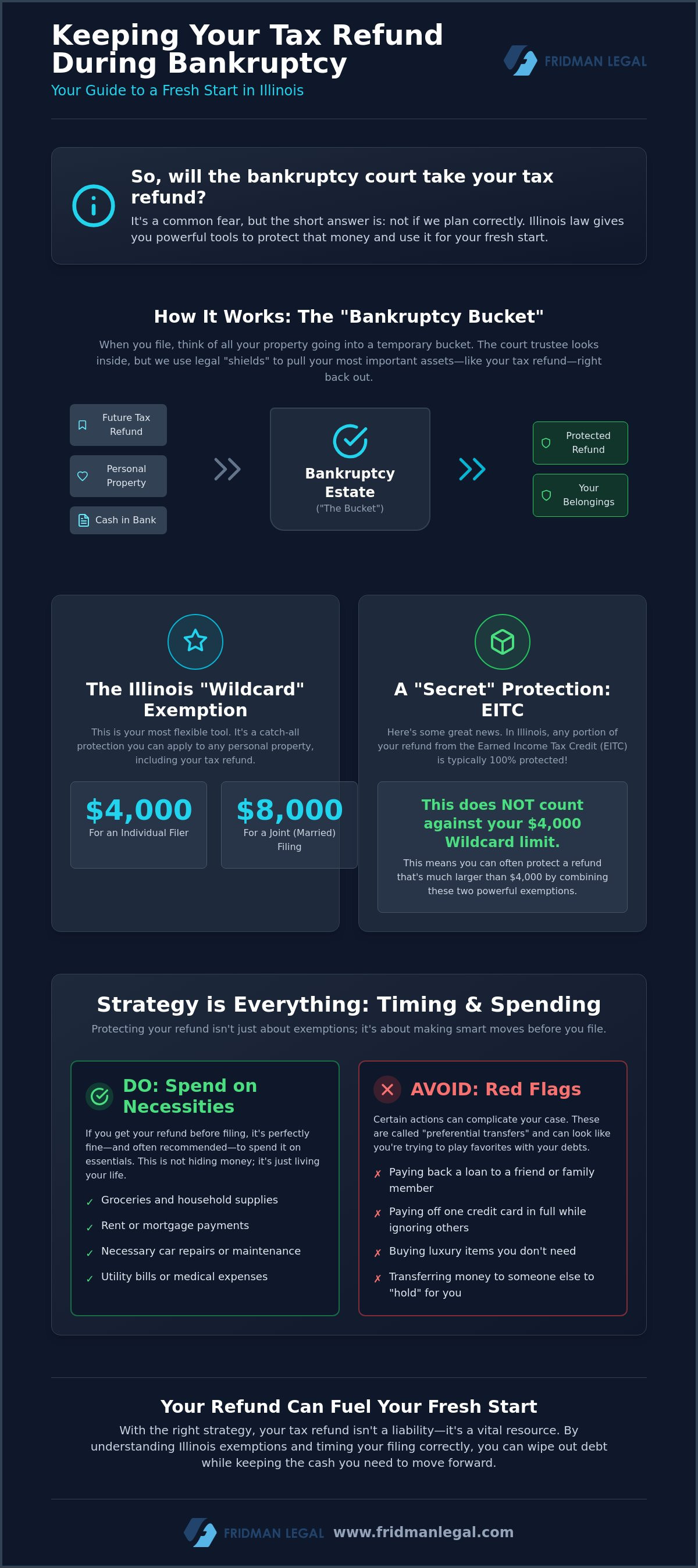
Imagine the bankruptcy estate as a large bucket. On the day you file your case, every single thing you own goes into that bucket. This includes your car, your furniture, and yes, your future tax refund. The Trustee's primary objective is to look inside that bucket and see if there's anything valuable enough to sell to pay back the people you owe. It sounds intimidating, but this is a standard part of the process. In many cases, the goal is to show the court that while the bucket contains assets, they're all protected by law.
The good news is that just because something is in the "bucket" doesn't mean it has to stay there. Illinois law provides legal shields, known as exemptions, that allow us to pull your refund back out of the bucket. As of January 1, 2026, these protections have become even more robust for residents in Northbrook and Chicago. This is the foundation for keeping your tax refund during chapter 7 Illinois. We use these rules to ensure your financial lifeline stays in your pocket rather than being distributed to credit card companies.
Why the IRS refund is considered your property
Even if that check isn't in your mailbox yet, the money you earned throughout the previous year is legally yours. In technical terms, you've accrued an interest in those funds because the work that generated the refund is already finished. The bankruptcy estate consists of all legal and equitable interests of the debtor as of the commencement of the case. This means the moment you file, your right to receive that refund becomes an asset of the estate. The specific date you file your petition acts as a legal cutoff. Anything earned before that date belongs in the bucket; anything earned after generally stays with you.
The role of the Illinois Chapter 7 Trustee
During your mandatory 341 meeting, which is part of the standard Chapter 7 Bankruptcy Overview, the Trustee will review your financial documents. They aren't looking to catch you in a lie; they're simply performing their legal duty to identify assets that aren't protected. They typically focus on a few key areas:
- Recent tax returns and expected refunds for the current year.
- Bank account balances on the exact day of your filing.
- Valuable personal property that exceeds the state's exemption limits.
Most Chapter 7 Bankruptcy Filing cases in the Northern District of Illinois end up as "no-asset" cases. This happens when we use state law to protect everything you own. Being upfront about your expected refund allows us to apply the right protections before the Trustee even asks the question. If we know the refund is coming, we can plan the filing to shield it completely and keep your cash where it belongs.
Using the Illinois 'Wildcard' Exemption to Protect Your Cash
The "Wildcard" exemption is easily the most versatile tool we have in an Illinois bankruptcy case. While other laws protect specific things like your primary home or a modest vehicle, the wildcard is a catch-all. In Illinois, you're allowed to protect up to $4,000 of any personal property you choose. This includes the money sitting in your checking account, your jewelry, or your anticipated tax refund. If you're married and filing a joint case, you can combine your exemptions to shield up to $8,000 in assets. This flexibility is the primary mechanism for keeping your tax refund during chapter 7 Illinois because it allows us to claim that money before the Trustee can touch it.
This protection is separate from the ones that cover your clothes, car, or household goods. Think of it as a floating shield that we can move wherever it's needed most. If your car is already fully protected by the motor vehicle exemption, we can put the full $4,000 toward your tax refund. It's all about strategic allocation to make sure your most liquid assets remain in your hands.
Maximizing the $4,000 Wildcard
Precision matters when we're filling out your bankruptcy schedules. We have to look at the total amount of cash you'll have on the day you file, including your bank balance and every penny of the refund you expect. If your total liquid assets are under $4,000, we can usually protect everything. However, if your refund is significantly larger than the limit, we need a more nuanced plan. We might look at timing the filing or using other specific exemptions first to save the wildcard for the cash. Every dollar needs a home on those forms; if it isn't listed as exempt, it's technically up for grabs.
The 'Secret' Protection: Earned Income Tax Credits (EITC)
One area where many people get confused is the difference between a standard tax overpayment and specific tax credits. In Illinois, the Earned Income Tax Credit (EITC) is typically 100% exempt. This means it doesn't even count against your $4,000 wildcard limit. This is a massive advantage for families with children. By carefully reviewing your tax return, we can separate the EITC portion from the rest of the refund. This allows us to protect a much larger total amount than you might think at first glance. Identifying these credits is a game-changer for maintaining your financial stability during the process.
According to the Illinois 'Wildcard' Exemption guidelines, these rules are designed to give you a true fresh start. You shouldn't have to choose between debt relief and having the funds to take care of your family. If you're unsure how these numbers apply to your specific tax situation, reaching out to a professional bankruptcy attorney can help clarify the path forward.
Timing is Everything: When to File and What to Do with the Money
Filing for bankruptcy in January looks very different from filing in June. The reason is simple; the calendar dictates how much of your refund is "ripe" for the Trustee to pick. If you file on December 31st, nearly 100% of the refund you'll receive in the spring is considered an asset of the bankruptcy estate. However, if you file on July 1st, the Trustee usually only has a claim to about half of your next refund. This is known as the pro-rata rule. Understanding these IRS Rules on Tax Refunds in Bankruptcy is essential for anyone trying to time their case perfectly.
Sometimes, waiting just a few weeks to file your petition can save you thousands of dollars. If you're expecting a $5,000 refund and your wildcard exemption is already used up by other assets, filing after you've received and spent that money on necessities is often the smartest move. The Trustee can't take money that no longer exists, provided you spent it on the right things. This is a common strategy for residents in Northbrook and Chicago who need that cash to stay afloat while their case moves through the Northern District of Illinois.
The 'Spend-Down' Strategy
If you already have the check in your hand, you don't have to just sit on it and hope for the best. You can legally spend that money before you file, but you have to be careful. The court wants to see that you used the funds for "ordinary and necessary" living expenses. This includes things like rent, groceries, car repairs, or even your bankruptcy attorney's fees. Keep every single receipt. If the Trustee asks where that $3,000 went, you want to be able to hand over a folder of proof. One critical mistake to avoid is paying back a loan to a family member. The court views this as a "preferential transfer" and can actually sue your relative to get that money back.
Filing while the refund is still 'pending'
If you haven't filed your taxes yet but know a refund is coming, we have to estimate the amount on your schedules. It's better to over-estimate slightly than to under-report. Once your taxes are actually filed and the exact number is known, we can update your bankruptcy paperwork. Transparency is your best defense during the 341 meeting. When the Trustee asks about your taxes, having a clear estimate and a plan for your exemptions shows that you're acting in good faith. This proactive approach is a cornerstone of keeping your tax refund during chapter 7 Illinois.
Avoiding Red Flags: The Right and Wrong Ways to Spend Your Refund
Spending your tax refund before you file isn't just about moving money around; it's about ensuring your financial decisions don't trigger an audit or a lawsuit from the Trustee. The bankruptcy court uses a standard often called the "reasonable and necessary" test. Essentially, the court wants to see that you're using your assets to maintain a basic standard of living rather than splurging on luxuries before wiping out your debt. Keeping your tax refund during chapter 7 Illinois is much easier when your bank statements show a trail of responsible, essential purchases.
One of the most dangerous traps I see in Northbrook and Chicago is the "preferential transfer." You might feel a moral obligation to pay back a $2,000 loan from your brother before you file your case. While your intentions are good, the law sees this as unfair to your other creditors. The Trustee has the legal authority to sue your family member to recover that money so it can be distributed among your credit card companies or medical providers. Avoiding these types of payments is the best way to protect your loved ones from being dragged into your legal proceedings.
Safe expenses: Where the money should go
When you're looking for ways to use your refund money before filing, focus on the fundamentals of your household. The court generally won't take issue with funds spent on rent, utilities, or mortgage payments. Other safe zones include necessary car repairs to keep you commuting to work or overdue medical bills for your family. You can also use these funds to pay for your Chapter 7 bankruptcy Illinois legal fees. This is considered a productive use of your assets because it directly facilitates your path to a fresh start. If you have questions about whether a specific expense is safe, it's always best to speak with a professional who can review your situation.
Danger zones: What to avoid at all costs
Transparency is your greatest asset in a Chapter 7 case. Trying to hide your refund by withdrawing it all in cash and putting it under a mattress is a strategy that almost always backfires. Trustees are experts at spotting large, unexplained cash withdrawals right before a filing. You should also avoid these specific red flags:
- Luxury purchases: Buying a jet ski, high-end electronics, or designer jewelry.
- Preferential debt payments: Paying off one specific credit card while ignoring the rest of your debt.
- Travel: Booking expensive vacations or unnecessary international trips.
- Gifts: Transferring money or property to friends or family members for nothing in return.
The court expects you to act in good faith. If you can show that every penny of your refund went toward keeping your lights on and your family fed, you'll find the process much smoother. Documentation is your shield; keep every receipt and bank statement to prove exactly where that money went.
Navigating Your Fresh Start with Fridman Legal
Deciding to file for bankruptcy is a significant step toward reclaiming your financial life, but you shouldn't have to spend your nights wondering if your bank account will be emptied by a court order. The rules we've discussed, from the $4,000 wildcard exemption to the specific protections for the Earned Income Tax Credit, are powerful tools. However, they're only effective when applied with precision. At Fridman Legal, we specialize in building custom protection plans that prioritize keeping your tax refund during chapter 7 Illinois so you can focus on rebuilding instead of just surviving.
Every financial situation is unique. A strategy that works for a single filer in Chicago might look very different for a family in Northbrook with multiple dependents and a complex tax history. We take the time to review your specific tax situation, looking at your withholdings, anticipated credits, and filing timeline. This level of personalized, results-driven attention ensures that no detail is overlooked and no exemption is left on the table. With nearly 20 years of experience, Attorney O. Allan Fridman understands how to navigate these complexities with the professional integrity you deserve.
Why a local Northbrook attorney makes a difference
There's a distinct advantage to working with a firm that's deeply embedded in the Northern District of Illinois. We're familiar with the specific Trustees who oversee cases in Cook County, and we understand their expectations during the 341 meeting. Large "bankruptcy mills" often treat clients like numbers on a spreadsheet, but we provide the discreet, intelligent counsel required for high-stakes financial transitions. Our approach is supportive and expert-led, ensuring you feel secure throughout the entire process. We also offer flat-fee bankruptcy services, so you'll know exactly what to expect without any hidden financial surprises.
Taking the first step toward debt relief
Moving forward doesn't have to be overwhelming. When you're ready to start the conversation, we'll walk you through the process step-by-step. To make our first talk as productive as possible, it's helpful to gather a few items:
- Your two most recent federal and state tax returns.
- Recent pay stubs or proof of income.
- A general list of your current debts and assets.
- Bank statements from the last few months.
We handle the heavy lifting of the paperwork and legal filings so you can keep your energy focused on your future. If you're ready to stop the cycle of debt and protect your financial interests, contact Fridman Legal today to schedule your talk. Let's make sure your fresh start begins on solid ground.
Secure Your Financial Future Today
You've seen that your tax refund doesn't have to be a casualty of your bankruptcy filing. By leveraging the $4,000 Illinois wildcard exemption and being strategic about your filing date, you can protect your cash and use it for what matters most. Whether you're spending that money on essential repairs or using it to cover your legal fees, the goal is to ensure you emerge from this process with a stable foundation.
Keeping your tax refund during chapter 7 Illinois is entirely a matter of preparation and precise timing. With nearly 20 years of experience and a convenient office in Northbrook, we're here to help you navigate every detail. We offer flat-fee Chapter 7 services so you can move forward without worrying about unpredictable costs. Schedule a consultation with Fridman Legal to protect your assets and take the first real step toward the relief you deserve. You don't have to do this alone; let's build your plan together.
Frequently Asked Questions
Can the trustee take my tax refund if I already spent it?
The trustee cannot take a tax refund that has already been spent on legitimate necessities before your case is filed. Since the money is no longer an asset in your possession on the day you file, it technically doesn't enter the bankruptcy estate. You must be prepared to provide receipts or bank statements to prove the funds went toward "reasonable and necessary" living expenses rather than luxury items.
How much is the Illinois wildcard exemption in 2026?
The Illinois wildcard exemption is currently $4,000 per person for any personal property you choose to protect. This is the primary tool for keeping your tax refund during chapter 7 Illinois because it can be applied directly to cash or anticipated checks. If you are filing a joint petition with your spouse, you can combine your exemptions to shield a total of $8,000 in assets.
Is my Earned Income Tax Credit (EITC) safe in bankruptcy?
Yes, the Earned Income Tax Credit is generally 100% exempt under Illinois law and does not count against your wildcard limit. This specific protection is designed to ensure that families keep the credits intended for their basic support. It is vital to keep these funds separate from other money in your bank account so they remain easily identifiable to the Trustee.
Should I wait until I get my tax refund to file for Chapter 7?
Waiting to file might be the best strategy if your expected refund is significantly larger than your available exemptions. If you receive and spend the money on necessities like rent or car repairs before filing, you effectively remove that asset from the Trustee's reach. We look at your specific refund amount and filing timeline to decide if a brief delay will save you thousands of dollars.
What happens if I don't disclose my tax refund on my bankruptcy forms?
Failing to disclose a tax refund is considered a serious violation that can lead to the dismissal of your case or even charges of bankruptcy fraud. Trustees in the Northern District of Illinois are trained to look for expected refunds and will ask for your tax returns during the 341 meeting. Transparency is always the safest path; it's much better to protect the money legally through exemptions than to risk your discharge.
Can I use my tax refund to pay for my bankruptcy lawyer?
You can absolutely use your tax refund to pay for your bankruptcy attorney's fees before you file your petition. The court views this as a productive use of your assets because it helps you resolve your debt and achieve a fresh start. Many of our clients in Northbrook use their spring refunds to cover our flat-fee services and finally put their financial stress behind them.
Will the trustee take my spouse's refund if we file separately?
If you file for bankruptcy individually, the Trustee generally only has a claim to your portion of a joint tax refund. We determine your share by looking at how much of the household income you earned versus your spouse. Your spouse's separate property and their portion of the refund are typically protected from your creditors as long as the funds aren't commingled.
What counts as a 'necessary' expense when spending a refund before filing?
Necessary expenses are things you truly need to live and work, such as groceries, utilities, medical care, and housing payments. Essential car repairs or buying clothes for your children also fall into this category. The court's main concern is that you aren't "hiding" assets by buying luxury goods or paying back loans to family members right before your filing date.

Article by
O. Allan Fridman
O. Allan Fridman has been practicing law since 2001. His practice is unique in that he does not view himself as a litigation attorney or transactional attorney. Rather, he views each area of law as a tool to pursue the best results for his clients. By practicing in both areas of law, he is able to take a 360-degree view of law. This enables the firm to catch potential drawbacks that are readily identifiable.
By practicing in litigation and transactional law and taking a holistic approach in dealing with our clients, he doesn’t put clients in box — rather, as we are all individuals, so too are the legal services we may require.
Whether it is bankruptcy or litigation or transactional, each client brings challenges and does not fit in any one box. Often times, bankruptcy clients end up not filing bankruptcy because we can achieve a better result through litigation or through an out-of-court resolution with the lender, or through a real estate sale. On the other end of the spectrum, a litigation client with multiple issues and lawsuit may fare better in a bankruptcy.
Since 2001, Allan has practiced in states and federal court, and he is a member of the trial bar of the Northern District of Illinois and admitted in the Northern District of Indiana.
We are a debt relief agency. We help people file for bankruptcy relief under the Bankruptcy Code
The materials on this site are for informational purposes only and do not constitute legal advice. Viewing this site or contacting us does not create an attorney–client relationship, and you should not act or refrain from acting based on any information here without seeking professional legal counsel.