

What if the debt relief strategy you're leaning toward actually leaves you more vulnerable than the debt itself? It's a question worth asking because the legal climate in our state has shifted significantly this year. Many people are currently wondering if debt settlement is a good idea in Illinois, especially as they face the daily stress of harassing collection calls and the very real fear of wage garnishments. You're likely looking for a way to stop the phone from ringing, reduce what you owe, and keep your life out of a courtroom. It's a heavy burden to carry, and wanting a clean slate is completely understandable.
In this article, you'll get a clear-eyed and honest look at the risks and rewards of debt settlement in Illinois so you can decide if it's the right move for your financial future. We'll look at the strict fee caps that protect you from predatory companies and how the massive 2026 increases in property exemptions might make other paths more protective of your personal assets. By the end, you'll have the strategic insight needed to handle these complex regulations with confidence and peace of mind.
Key Takeaways
- Get a clear explanation of the "stop paying" strategy and why it often causes your credit score to drop before any negotiations even begin.
- Discover how to figure out if debt settlement is a good idea in Illinois by comparing the total balance you owe against the reality of potential creditor lawsuits.
- See why the legal "automatic stay" in bankruptcy offers a level of protection from garnishments that private settlement programs simply can't match.
- Learn about the 2026 Illinois laws that limit how much of your paycheck can be taken and how long creditors have to sue you.
- Walk through a practical way to audit your monthly budget so you don't commit to a settlement plan you can't actually finish.
What Exactly is Debt Settlement (and How Does it Work in Illinois)?
Understanding What is debt settlement? begins with realizing it's a negotiation, not a guaranteed program. Essentially, it's a process where you, or a firm representing you, attempts to convince your creditors to accept a single lump sum that's less than the total balance you owe. Once they agree and you pay that specific amount, the remaining debt is forgiven. You might be asking, is debt settlement a good idea in Illinois given the current legal landscape? The answer depends on how well you understand the mechanics beneath the surface.
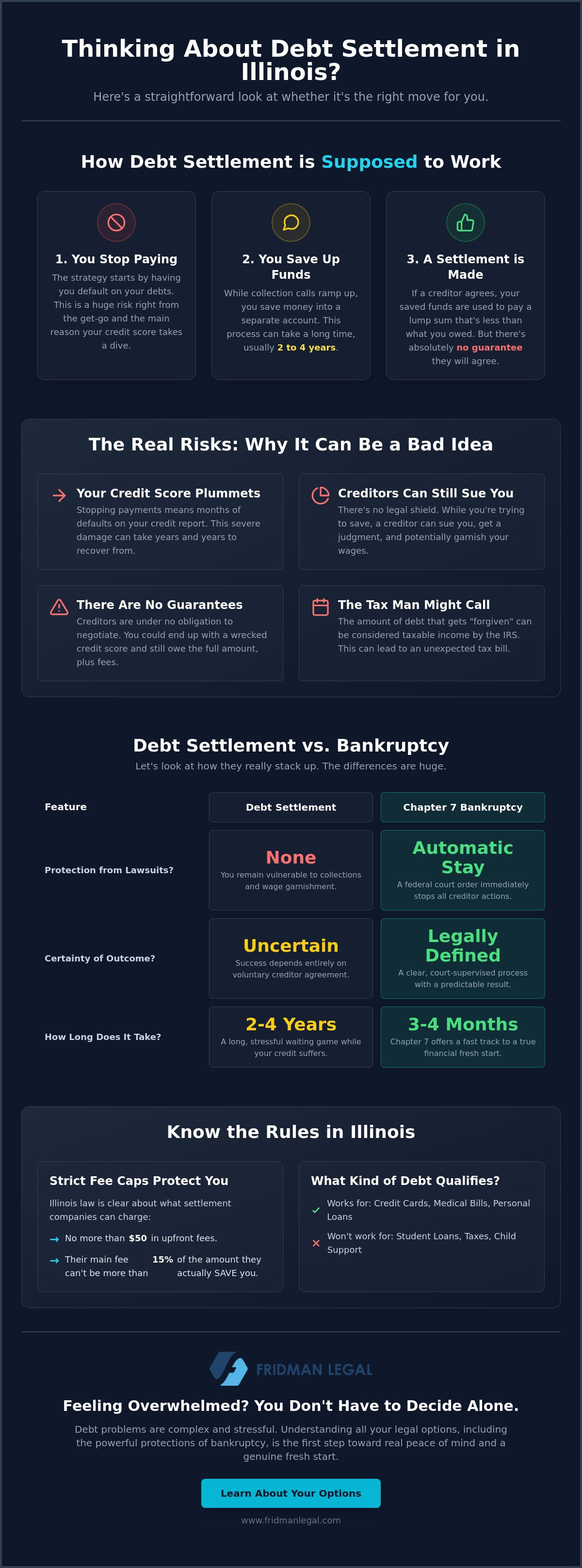
To get creditors to the negotiating table, most debt relief companies will tell you to stop making your monthly payments entirely. The logic here is that a bank won't settle if they're still receiving checks from you. They need to see that you're in default and that a total loss is a real possibility. This "stop paying" strategy is where the risk begins. While you're saving up that lump sum in a separate account, your credit score is taking a heavy hit. Late fees and interest continue to pile up, often making the balance grow before it ever shrinks.
It's also vital to know which debts actually qualify for this path. This process works well for unsecured debts like credit cards or medical bills. However, it won't help with student loans, child support, or tax debt. Illinois residents are protected by the Illinois Consumer Fraud and Deceptive Business Practices Act, which helps keep settlement companies from making impossible promises. Even with these protections, nothing stops your creditors from suing you while you're waiting to settle. If the uncertainty of this process feels overwhelming, looking into Chapter 7 or Chapter 13 bankruptcy might provide the legal protection you need.
The Difference Between Settlement and Consolidation
Many people mix these up, but they're very different tools. Consolidation involves taking out a new loan to pay off your old ones. You still owe the full amount, just to one lender. Settlement is more like a "haircut" on the principal balance. While consolidation might feel lighter on your monthly budget because of a lower interest rate, it doesn't reduce the total debt like a successful settlement can. Choosing between them depends on whether you can afford to pay the full principal over time.
The Timeline: How Long Does This Actually Take?
This isn't a quick fix. Most plans take anywhere from 24 to 48 months to complete. That's a long time to deal with collection calls and the threat of a lawsuit. For many in Illinois, this waiting period is the most stressful part. You're sitting in a legal "no man's land" while you wait for your saved funds to grow large enough to make an offer. Managing these expectations is vital before you sign any contracts or stop your payments.
The Real Risks: Why Debt Settlement Might Be a Bad Idea
While the idea of paying back only half of what you owe sounds like a perfect exit strategy, the path is often paved with significant legal and financial landmines. If you're weighing whether is debt settlement a good idea in Illinois, you have to look past the marketing brochures. The first casualty is almost always your credit score. Because the process requires you to stop making payments, your report will show a series of missed payments and defaults. For many, their score tanks so deeply that it takes years to recover, long after the debt is technically gone.
There's also a common misconception that creditors have to talk to you. They don't. No law in Illinois or at the federal level forces a bank to accept a penny less than what you signed for. While you're busy "saving" money in a side account, the bank might be busy preparing a lawsuit. If they win, they can pursue a judgment that lasts for 15 years under current Illinois law. Understanding these risks of debt settlement is essential before you commit your future to a negotiation that might never happen.
Then there's the issue of fees. Illinois has strict rules here. Companies can't charge you upfront fees over $50, and they can't take more than 15% of the amount they actually save you. However, even that 15% adds up. If you settle a $20,000 debt for $10,000, you're paying $1,500 in fees. When you add that to the potential legal costs if things go wrong, the "savings" start to look much smaller. If the pressure of these risks feels too high, you might want to speak with a professional who can help you evaluate more stable legal protections.
When Creditors Refuse to Play Ball
Some major lenders simply refuse to negotiate with settlement firms. They'd rather spend the money on a lawyer to sue you and garnish your wages. If you're halfway through a three year program and get a court summons, the settlement company often can't help you in the courtroom. You're left holding the bag. There's also the danger of "zombie debt." This happens when a debt isn't settled correctly and a new collector buys it years later, starting the harassment all over again.
The Hidden Costs of "Saving" Money
The biggest surprise for most people is the "Tax Bomb." The IRS generally views forgiven debt as taxable income. If a creditor forgives $5,000 of your debt, you might owe taxes on that $5,000 as if you earned it at your job. Receiving an IRS Form 1099-C is the most surprising part of the process for most people. When you combine those taxes with the settlement fees, a "50% savings" can quickly dwindle down to a net gain of only about 25%.
Debt Settlement vs. Bankruptcy: Which is the Smarter Move?
When you're staring down a mountain of bills, the choice often comes down to two very different paths: settling for less or filing for bankruptcy. If you're trying to figure out is debt settlement a good idea in Illinois, you have to look at the legal shield that only one of these options provides. Bankruptcy comes with something called the "automatic stay." The moment you file, a legal wall goes up. Collection calls stop. Lawsuits freeze. Wage garnishments are cut off immediately. Settlement doesn't offer this. While you're negotiating, your creditors are still free to sue you in an Illinois court, which can lead to the very garnishments you're trying to avoid.
Predictability is another huge factor to consider. Bankruptcy follows a very strict, court-ordered timeline. In a Chapter 7 case, you could be debt-free in about 90 days. Settlement, on the other hand, is a "maybe" that can drag on for four years or more. You're essentially betting that your creditors will play ball while your credit score takes a beating every single month. Even with the consumer rights outlined in the Illinois Debt Settlement Consumer Protection Act, you don't have the same level of certainty that a federal judge provides. If a creditor decides they won't settle, your entire plan could fall apart three years in.
Cost-wise, people often assume bankruptcy is more expensive because of the legal fees. But if you calculate years of settlement fees plus the "tax bomb" we discussed earlier, a flat-fee bankruptcy filing often ends up being the cheaper route in the long run. You get a definitive end date and a legal discharge that creditors can't ignore. It's a structured process that prioritizes your financial recovery over a bank's profit margin.
Chapter 7: The Fast Track
If you have few assets and your income falls below a certain level, Chapter 7 is often the cleanest break. You'll need to pass the "Means Test" to qualify in Illinois, which compares your income to the state average. It's designed to give you a true fresh start by wiping out unsecured debts like credit cards and medical bills in just a few months. For a deeper look at how this works locally, check out this guide on Chapter 7 Bankruptcy in Northbrook, IL.
Chapter 13: The Legal Repayment Plan
Chapter 13 is a 3-to-5 year court-protected reorganization of your finances. It's a powerful tool if you're behind on your mortgage but want to keep your home from foreclosure. Think of it as a government-enforced debt settlement where the court, not the bank, decides what's a fair monthly payment based on what you can actually afford. It stops collection actions in their tracks and gives you a clear, manageable path toward total debt relief.
Illinois Laws You Need to Know Before Deciding
Deciding whether is debt settlement a good idea in Illinois requires a hard look at the actual laws that govern your money and property. The "Land of Lincoln" has some of the most specific consumer protection rules in the country, and these can either be your best friend or a hidden trap. If you're dealing with aggressive debt collectors in the Chicago suburbs, you aren't just fighting a bank; you're operating within a complex state legal system. Knowing where the boundaries are can help you decide if you have enough leverage to settle or if you need a more robust legal shield.
One of the most significant changes for 2026 involves what we call "exemptions." These are the legal protections that keep creditors from taking everything you own. As of January 1, 2026, Illinois has significantly increased these safety nets. For example, the homestead exemption has jumped to $50,000 for individuals, and you can now protect up to $3,600 in equity in your car. There's even a new $1,000 automatic protection for your bank account to prevent it from being frozen the moment a collector files a citation. These numbers matter because they dictate how much "collectible" wealth you actually have. If most of your assets are exempt, you might have more power in a settlement negotiation than you think.
However, navigating the Cook County or Lake County court systems isn't something you should do based on a blog post alone. A local Northbrook attorney can look at your specific situation and see if a collector has even followed the rules. If they haven't, you might have grounds to dismiss the case entirely. If the legal pressure is mounting, it's often best to consult with a professional who understands the local court landscape.
Understanding the Statute of Limitations
In Illinois, creditors don't have forever to sue you. For most credit card debts, which are often treated as oral contracts or open accounts, the limit is five years. For written contracts, it's ten years. It's a common trap to "restart the clock" by making a small "good faith" payment. Doing this can reset that five or ten year timer, giving a collector a fresh window to take you to court. Use this timeline as leverage; if a debt is four years old, you're in a much stronger position to negotiate a deep discount.
Wage Garnishment in the Chicago Suburbs
If a creditor wins a judgment in an Illinois court, they'll likely try to garnish your wages. State law generally limits this to 15% of your gross weekly wages, but that's still a massive hit to any family budget. It's vital to understand your wage garnishment rights before you agree to a settlement plan. While settlement doesn't stop an active garnishment, bankruptcy acts as an immediate "off switch," often stopping the deduction before your next paycheck is even processed.
How to Make a Choice You Wont Regret
Making a final decision about your financial future requires more than just a gut feeling. If you're still weighing whether is debt settlement a good idea in Illinois, you need to move from speculation to a structured analysis. The first step is a brutal audit of your current situation. Total up every penny you owe and categorize it by type. You need to know exactly how much is unsecured credit card debt, which can be settled, versus non-dischargeable debt like student loans or tax obligations. Without this bird's eye view, you're essentially flying blind into a negotiation.
Once you have your totals, you must look at your disposable income with total honesty. Debt settlement isn't a magic wand; it requires you to build a significant lump-sum fund. If your budget is so tight that you can't realistically save several thousand dollars over the next 12 to 24 months, a settlement strategy might actually leave you more vulnerable to the lawsuits we discussed earlier. You don't want to stop making payments only to realize three months later that you don't have the cash flow to actually settle the accounts. This is where many people find that a Chapter 7 or Chapter 13 filing provides a much more predictable exit strategy.
Finally, you need to be wary of the "debt relief" call centers that dominate your search results. These companies are often staffed by salespeople, not legal experts. They're trained to sell you a program, not to protect your rights in an Illinois courtroom. When determining if is debt settlement a good idea in Illinois for your specific family, consulting with a legal professional who understands the local court rules is the only way to get a balanced view of both the risks and the rewards.
Why a Local Attorney is Better Than a National Company
A national settlement company might have a fancy website, but they can't walk into a Cook County courtroom to defend you if a creditor files a lawsuit. A local attorney provides a level of protection that an algorithm simply can't match. You benefit from attorney-client privilege, meaning you can discuss your finances with total transparency. Most importantly, you get a personalized strategy based on how local judges and creditors actually behave in our specific legal district.
Taking the First Step Toward Relief
The "head in the sand" approach is the only guaranteed way to lose this battle. Ignoring the calls and letters only gives your creditors more time to build a case against you. When you sit down for a consultation at Fridman Legal, we don't just look at your debt; we look at your goals. We'll give you a straight-talk assessment of whether settlement, consolidation, or bankruptcy is the most efficient path to your fresh start. Ready for a real answer? Reach out to O. Allan Fridman today for a straight-talk assessment of your options.
Taking Control of Your Debt Strategy
Choosing the right path through debt is one of the most significant financial decisions you'll ever make. You've seen how the 2026 legal updates in our state have changed the playing field, offering better protection for your home and bank accounts. While settlement might seem like an easy out, the "tax bomb" and the lack of legal protection from lawsuits are risks you can't ignore. Truly determining if is debt settlement a good idea in Illinois requires looking at your specific assets and income through a professional lens.
O. Allan Fridman brings nearly 20 years of Illinois bankruptcy experience to your corner, offering the kind of personalized legal guidance that national call centers simply can't provide. Whether you're considering a flat-fee bankruptcy filing or a complex negotiation, you deserve a solution that prioritizes your long-term stability. Don't let another day of collection calls drain your energy. Get a Free, Honest Evaluation of Your Debt Options today and start building the future you deserve. You've got the facts; now it's time to take the next step toward peace of mind.
Common Questions About Illinois Debt Relief
Is debt settlement legal in Illinois?
Yes, debt settlement is entirely legal and is strictly regulated by the Illinois Debt Settlement Consumer Protection Act. This law was designed to stop predatory companies from taking advantage of people in financial distress. In our state, these companies are prohibited from charging high upfront fees. They can only collect a one-time setup fee of $50 or less, and their main service fee is capped at 15% of the amount they actually save you, which they can only collect after a settlement is finalized.
Will debt settlement stop a lawsuit in Cook County?
No, joining a settlement program doesn't provide any legal protection against an active lawsuit. Because settlement is a voluntary negotiation between you and a bank, the creditor can continue their legal pursuit in the Cook County court system at the same time. If you're looking for a way to freeze a lawsuit immediately, bankruptcy is usually the only tool that provides an automatic stay to stop all legal actions in their tracks.
How does debt settlement affect my Illinois state taxes?
Forgiven debt is generally viewed as taxable income by both the IRS and the state of Illinois. If a creditor agrees to wipe away $5,000 of your balance, they'll likely issue an IRS Form 1099-C. You're then required to report that "canceled debt" as income on your tax returns. This can lead to a surprising tax liability, which is why it's vital to factor in these extra costs when deciding if debt settlement is a good idea in Illinois for your situation.
Can I do debt settlement on my own without a company?
You absolutely have the right to negotiate with your creditors directly without hiring a third party. Many people find they have better luck speaking with a bank's internal recovery department themselves. This approach allows you to avoid the 15% service fees that professional firms charge. However, it does require a significant amount of time, persistence, and a thick skin to handle the frequent collection calls that happen during the negotiation phase.
What is the "Means Test" and does it apply to debt settlement?
The Means Test is a specific financial calculation used only for bankruptcy filings; it has no impact on your ability to settle a debt. In a bankruptcy case, this test looks at your average monthly income to see if you qualify for Chapter 7 or if you're required to file Chapter 13. Since debt settlement is a private contract, there's no income limit or government test required to start the process.
Is it better to settle debt or file for Chapter 7 bankruptcy?
The answer depends on how quickly you need relief and what assets you're trying to protect. Chapter 7 bankruptcy is often a faster and more predictable route, typically resulting in a total debt discharge in about 90 days. Settlement can take four years or more and doesn't offer a guarantee that every creditor will participate. If you have significant assets that exceed the 2026 Illinois exemptions, settlement might be a way to avoid the liquidation risks of bankruptcy.
How long does a debt settlement stay on my credit report?
A settled account will generally remain on your credit report for seven years from the date the account first became delinquent. While the entry will show that the balance is "settled" or "paid for less than the full amount," it's still considered a negative mark. Your score will likely begin to recover once the debt is resolved, but the history of the default stays visible to future lenders for the full seven-year period.
Can a debt settlement company stop my wages from being garnished?
No, a debt settlement company has no legal power to stop an active wage garnishment in Illinois. Only a court order or a bankruptcy filing can force a creditor to stop taking 15% of your paycheck. While a settlement firm might try to negotiate a deal to end the garnishment, the creditor is under no legal obligation to stop the deductions until the debt is paid or a judge intervenes.

Article by
O. Allan Fridman
O. Allan Fridman has been practicing law since 2001. His practice is unique in that he does not view himself as a litigation attorney or transactional attorney. Rather, he views each area of law as a tool to pursue the best results for his clients. By practicing in both areas of law, he is able to take a 360-degree view of law. This enables the firm to catch potential drawbacks that are readily identifiable.
By practicing in litigation and transactional law and taking a holistic approach in dealing with our clients, he doesn’t put clients in box — rather, as we are all individuals, so too are the legal services we may require.
Whether it is bankruptcy or litigation or transactional, each client brings challenges and does not fit in any one box. Often times, bankruptcy clients end up not filing bankruptcy because we can achieve a better result through litigation or through an out-of-court resolution with the lender, or through a real estate sale. On the other end of the spectrum, a litigation client with multiple issues and lawsuit may fare better in a bankruptcy.
Since 2001, Allan has practiced in states and federal court, and he is a member of the trial bar of the Northern District of Illinois and admitted in the Northern District of Indiana.
We are a debt relief agency. We help people file for bankruptcy relief under the Bankruptcy Code
The materials on this site are for informational purposes only and do not constitute legal advice. Viewing this site or contacting us does not create an attorney–client relationship, and you should not act or refrain from acting based on any information here without seeking professional legal counsel.