

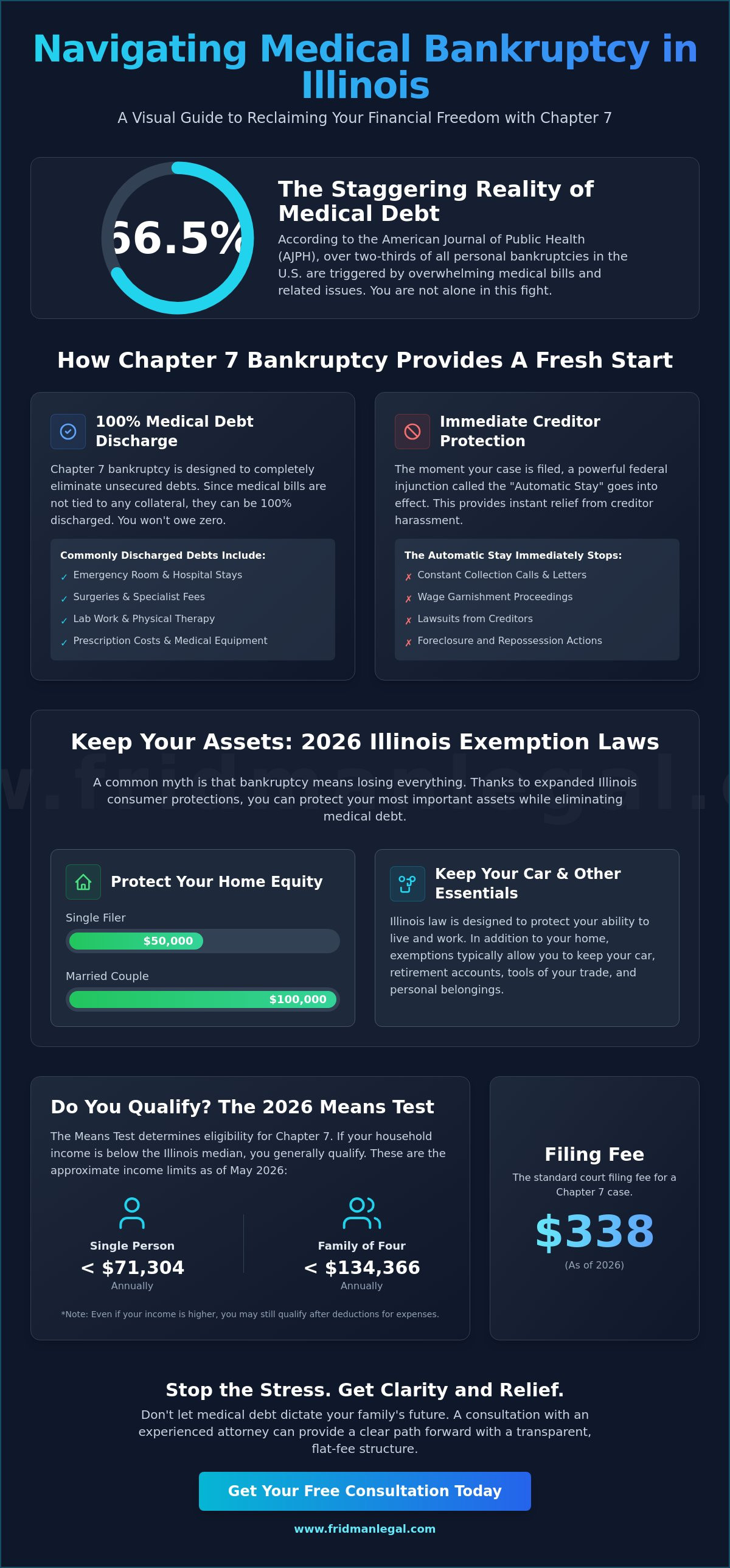
Did you know that 66.5% of all bankruptcies in the United States are actually caused by medical issues? It's a staggering figure from the AJPH that proves you aren't alone in this struggle. You've likely spent months or even years trying to balance hospital bills against your mortgage, only to be met with constant collection calls and the anxiety of potential wage garnishment. It feels like you're being punished for an illness or injury you didn't ask for. When the pressure becomes too much, speaking with a medical bill bankruptcy attorney Glenview can provide the clarity you need to stop those collectors in their tracks immediately.
You don't have to lose your life's work to find relief. Thanks to the expanded Illinois consumer protections that went into effect on January 1, 2026, you can now protect up to $50,000 in equity in your primary Glenview home; that amount jumps to $100,000 for married couples. This guide explains how a Chapter 7 filing can discharge 100% of your medical debt while keeping your car and your house safe. We'll break down the $338 filing fee and the specific 2026 income limits you need to know to reclaim your financial freedom and protect your family's future.
Key Takeaways
- You'll learn why medical bills are classified as unsecured debt, which makes them a primary candidate for a total discharge in bankruptcy.
- Find out how a medical bill bankruptcy attorney Glenview uses the 2026 Means Test to help you qualify for a fresh financial start.
- Discover how the latest Illinois exemption laws allow you to keep your Glenview home and car while your medical debt is wiped away.
- Get a clear look at the filing timeline so you know exactly when the collection calls will stop and when your debt will be gone.
- Understand how a transparent flat-fee model removes the stress of hidden legal costs, giving you one less thing to worry about.
Why Medical Bills Are the Leading Cause of Bankruptcy in Glenview
Facing a stack of medical bills creates a specific kind of pressure. It isn't like a credit card spree or a failed business venture; it's the result of a health crisis you didn't choose. For many families in Cook County, these unexpected costs become the leading cause of bankruptcy, even for those who thought they were financially secure. Medical debt is what the legal system calls "unsecured debt." This means there's no collateral, like a house or a car, tied to the balance. Because of this status, these bills are prime candidates for a total discharge. When you consult a medical bill bankruptcy attorney Glenview, you're looking for a legal "reset button" that the law provides specifically for these no-fault financial situations.
The Reality of Medical Debt in 2026
Even in 2026, the gap between insurance coverage and hospital charges remains a massive hurdle. A 2024 KFF report estimated total U.S. medical debt at $220 billion, affecting roughly 1 in 3 adults. High deductibles and "out-of-network" surprises can leave a Glenview resident with a five-figure balance overnight. In a Chapter 7 filing, medical debt is categorized as a non-priority unsecured claim. This means it sits at the back of the line behind obligations like taxes or child support. In the vast majority of cases, these bills are wiped out completely. You aren't alone in this path. Thousands of Illinois residents use Chapter 7 bankruptcy every year to protect their assets and ensure their family's stability.
When the Collection Calls Start in Glenview
It usually starts with a polite letter, but it quickly shifts into aggressive phone calls at all hours. Debt collectors for major hospital systems are often relentless. They don't prioritize your recovery or your family's peace of mind; they only focus on the balance. This is where the legal process offers its most immediate relief. The moment a medical bill bankruptcy attorney Glenview files your petition, the "Automatic Stay" goes into effect. This powerful federal injunction legally forbids creditors from contacting you. It stops the calls, ends the letters, and halts any pending lawsuits or wage garnishments instantly. This protection provides the immediate breathing room you need to focus on your health instead of your mailbox.
How Chapter 7 Bankruptcy Wipes Out Your Medical Debt
If you're looking for a way to erase a mountain of hospital invoices, Chapter 7 is the most direct path. Many people worry that the legal process is overly complex, but a medical bill bankruptcy attorney Glenview can simplify it into a few clear steps. It essentially starts with a financial snapshot called the "Means Test." This isn't a high-stakes exam; it's a straightforward math check to see if your income falls below the Illinois median. For instance, as of May 2026, a single person earning less than $71,304 or a family of four earning under $134,366 usually qualifies automatically. Even if you're slightly above those numbers, you might still qualify after accounting for your actual living expenses.
The primary goal of this process is the "discharge." According to the Chapter 7 Bankruptcy Basics, a discharge releases you from personal liability for most types of debts. Unlike debt settlement, which only reduces what you owe, Chapter 7 completely eliminates the legal obligation to pay back your medical providers. You won't just be paying less; you'll owe zero.
What Debts Go Away?
In a typical filing, almost all medical-related costs are wiped clean. This includes:
- Emergency room visits and long-term hospital stays
- Surgeries and specialist consultations
- Physical therapy and lab fees
- Prescription costs and medical equipment rentals
The Illinois Exemptions You Need to Know
A common fear is that "liquidation" means losing everything you own. In reality, modern Illinois laws are designed to let you keep your essentials. As of January 1, 2026, the homestead exemption allows you to protect up to $50,000 of equity in your home, or $100,000 if you're filing jointly with a spouse. You also get a $3,600 exemption for your vehicle and a $4,000 "wildcard" exemption that can be applied to any personal property you choose. You can explore the specifics in this Chapter 7 Illinois guide to see how these numbers apply to your situation. Most people who work with a medical bill bankruptcy attorney Glenview find they don't lose a single piece of property. If you're ready to see how these exemptions protect your assets, you can learn more about our approach to debt relief.
The Importance of a Local Glenview-Area Bankruptcy Attorney
Choosing the right legal partner is just as important as the decision to file. While bankruptcy is a federal process, the way it plays out in the Northern District of Illinois depends heavily on local procedural rules and the specific expectations of Cook County trustees. A medical bill bankruptcy attorney Glenview understands these local nuances. They know exactly how local trustees review medical expenses and what documentation will satisfy their inquiries. Since healthcare debt remains a leading cause of personal bankruptcy, having someone who has handled hundreds of similar cases in this specific jurisdiction is a massive advantage.
You might wonder if you can handle the paperwork yourself to save on costs. It's a fair question, but even a small administrative error can lead to your case being dismissed or certain assets being put at risk. The court doesn't provide "do-overs" for missed deadlines or incorrectly categorized property. Working with a professional ensures that your filing is accurate the first time, providing the peace of mind that your discharge will actually go through without a hitch. This level of precision is exactly why local representation is so valuable.
Avoiding the "Bankruptcy Mill" Experience
Many large firms operate like high-volume factories where you rarely speak to the same person twice. You're often passed off to a paralegal or a junior associate who doesn't know the specifics of your situation. This "bankruptcy mill" approach can feel cold and dismissive, especially when you're already dealing with the stress of medical debt. At a boutique practice, you get the benefit of direct, one-on-one communication with O. Allan Fridman. This personal connection means you're better prepared for the meeting of creditors, as your attorney has a deep understanding of your financial history and can anticipate any questions the trustee might have.
Proximity Matters: Northbrook and Glenview
Fridman Legal is located in Northbrook, just a short drive from Glenview. This proximity isn't just about convenience; it's about accessibility. Whether you need to drop off a few last-minute documents or prefer to meet in person for a quick status update, being close by makes the process feel much more manageable. It's easier to build a relationship of trust when your attorney is a member of your own community. This neighborly feel, combined with professional expertise, ensures that you never feel like just another case number. If you're ready to discuss your options with a local expert, you can reach out to our office to schedule a consultation.
What to Expect During the Bankruptcy Filing Process
Understanding the timeline of a bankruptcy case helps remove the fear of the unknown. While every financial situation has its own unique details, the process generally follows a predictable path that takes about 4 to 6 months from start to finish. A medical bill bankruptcy attorney Glenview will guide you through each phase, ensuring you meet all federal requirements without the stress of managing the paperwork alone. One of the first steps you'll take is completing a pre-filing credit counseling course. Don't let the name intimidate you; it's a simple online task that usually takes about an hour and costs between $10 and $50 according to verified 2026 standards.
Once your petition is filed, the court schedules what's known as the "341 Meeting" or the Meeting of Creditors. This sounds like a formal trial, but it's actually a brief meeting where a trustee asks a few clarifying questions about your filing. In the vast majority of cases involving medical debt, creditors don't even show up. Your attorney sits with you through the entire session, which often lasts less than 10 minutes. After this meeting, there's a waiting period of roughly 60 days before the court issues your final discharge notice. This document is the official confirmation that your medical bills are legally gone forever.
Step 1: The Initial Strategy Session
Your journey begins with a judgment-free consultation where we look at the big picture of your finances. This is the time to gather your paystubs from the last six months, your most recent tax returns, and that stack of medical bills you've been avoiding. We use this information to determine if Chapter 7 is the right tool for your specific needs. You can set up your initial strategy session to get a clear look at your options without any pressure.
The Path to Your Discharge
One of the biggest misconceptions about bankruptcy is that you'll have to spend days defending yourself in a courtroom. In reality, most Chapter 7 petitioners never have to step foot in a court of law. The process is handled primarily through digital filings and the brief trustee meeting mentioned earlier. Once that final paperwork arrives in your mailbox, the "fresh start" isn't just a legal term; it's a tangible reality. You'll finally have the ability to answer your phone without fear and plan for your future again. If you're ready to start this timeline, consult with a medical bill bankruptcy attorney Glenview today to begin your filing.
Fridman Legal: Transparent, Flat-Fee Debt Relief
When you're already buried under hospital bills, the last thing you need is a legal bill that changes every time you pick up the phone. At Fridman Legal, we believe that transparency is the foundation of a successful partnership. O. Allan Fridman has spent over 20 years helping Glenview families navigate the complexities of the federal court system. As a medical bill bankruptcy attorney Glenview, he understands that you're looking for a clear exit strategy, not a new set of financial headaches. We don't view ourselves as just a service provider; we're your partners in reclaiming the stability you had before the medical crisis began. We handle the heavy lifting of the legal paperwork so you can focus on your physical and emotional recovery.
Why Our Flat-Fee Model Works for You
Many firms offer "free evaluations" but remain vague about the actual cost of representation until you're already committed. This creates unnecessary anxiety during an already stressful time. We use a flat-fee model because it allows for open, honest communication. You won't have to worry about "the clock running" every time you have a question about your filing or the $338 court filing fee. This approach ensures that you can get the answers you need without fear of hidden charges or surprise invoices at the end of the month. You can explore our full range of bankruptcy services to see how we prioritize your financial recovery through a predictable and professional process.
Starting Your New Chapter Today
Life after a Chapter 7 discharge is about much more than just numbers on a spreadsheet. It's about the peace of mind that comes with a silent phone and an empty mailbox. Many of our clients are surprised to find that their credit scores can actually start to improve within 12 to 18 months of filing, as the removal of 100% of their medical debt significantly improves their debt-to-income ratio. Rebuilding is a process, and it starts with the single step of deciding to take control of a situation that was never your fault to begin with. If you're ready to stop the collection calls and start fresh in 2026, reach out for a conversational, no-pressure chat. We're here to help you wipe the slate clean and move forward with the confidence you deserve.
Take the First Step Toward Your Financial Reset
Medical debt doesn't have to define your future. The legal framework in Illinois provides powerful tools like Chapter 7 to completely discharge unsecured medical bills while keeping your Glenview home and car safe through specific 2026 exemptions. This process is structured, predictable, and designed to offer immediate relief from the harassment of collection agencies. Working with a dedicated medical bill bankruptcy attorney Glenview ensures that every detail of your filing is handled with precision, avoiding the common pitfalls of a DIY approach.
With nearly 20 years of local legal experience, O. Allan Fridman provides the personalized attention your case deserves. You'll work directly with the principal attorney and benefit from our transparent flat-fee pricing model, which means no hidden surprises or hourly billing anxiety. It's time to stop worrying about the past and start planning for a stable, debt-free future. Talk to O. Allan Fridman about your medical debt today and find out how we can help you turn the page. You deserve the peace of mind that comes with a clean slate.
Frequently Asked Questions
Can I really wipe out all my medical bills through bankruptcy?
Yes, you can discharge 100% of your qualifying medical debt through a Chapter 7 filing. Since medical bills are considered non-priority unsecured debt, they're among the first obligations wiped out by the court. This includes everything from emergency room visits to long-term physical therapy and lab fees. Once the court grants your discharge, you no longer have any legal responsibility to pay those providers back, allowing you to start over with a clean slate.
Will I lose my home in Glenview if I file for medical debt relief?
Most residents keep their homes because of the generous Illinois homestead exemption. As of January 1, 2026, an individual can protect up to $50,000 of equity in their primary residence. If you're married and filing jointly, that protection doubles to $100,000. Unless your home has significantly more equity than these specific limits, your property remains safe. A medical bill bankruptcy attorney Glenview can help you calculate your equity to ensure your home is protected before you file.
How much does a medical bill bankruptcy attorney in Glenview cost?
While attorney fees depend on the complexity of your case, the court filing fees are fixed at a national rate. In 2026, the filing fee for Chapter 7 is $338. For legal representation in Illinois, attorney fees typically range between $1,100 and $3,000. It's wise to choose a firm that offers a flat-fee model so you don't have to worry about unpredictable hourly billing while you're already managing a financial crisis.
What happens to my credit score after I file Chapter 7?
Your credit score will likely drop initially, but it often rebounds much faster than people expect. By discharging a large amount of medical debt, you're actually improving your debt-to-income ratio, which is a major factor for future lenders. Many filers see their scores begin to recover within 12 to 24 months. It's often a much faster path to healthy credit than struggling with unpaid bills and collection marks for the next decade.
Can medical providers refuse to treat me if I discharge their bills?
Private medical practices can choose to stop seeing you for routine care if you discharge their specific bill. However, federal law under EMTALA requires any hospital with an emergency department to treat you in an emergency regardless of your past debt. Most people find new providers if necessary, but the trade-off of being debt-free is usually worth the minor inconvenience of switching doctors for non-emergency visits.
How long does the Chapter 7 process take in Illinois?
The entire Chapter 7 process in Illinois typically takes between 4 and 6 months from the date of your initial filing. This timeline includes the mandatory waiting periods required by the court and the 341 Meeting of Creditors. While the legal protection of the "Automatic Stay" begins the second you file, the final discharge notice usually arrives about 60 days after your meeting with the trustee, officially ending your legal obligation to the debt.
Will my employer find out that I filed for bankruptcy?
Bankruptcy filings are public records, but the court doesn't send a notification to your employer. Unless you're currently facing a wage garnishment that needs to be stopped, your boss will likely never know you filed. Most people find that the process remains entirely private within their professional circles. It's a legal tool designed for your financial recovery, not a matter for your human resources department to manage.
What is the difference between debt settlement and bankruptcy for medical bills?
Debt settlement involves negotiating to pay a percentage of what you owe, while bankruptcy is a court-ordered discharge of the entire balance. Settlement often creates a tax liability because the IRS views "forgiven" debt as taxable income. In contrast, a bankruptcy discharge isn't considered taxable income. A medical bill bankruptcy attorney Glenview can explain why Chapter 7 is often a more permanent and tax-efficient solution for overwhelming healthcare costs compared to settlement programs.

Article by
O. Allan Fridman
O. Allan Fridman has been practicing law since 2001. His practice is unique in that he does not view himself as a litigation attorney or transactional attorney. Rather, he views each area of law as a tool to pursue the best results for his clients. By practicing in both areas of law, he is able to take a 360-degree view of law. This enables the firm to catch potential drawbacks that are readily identifiable.
By practicing in litigation and transactional law and taking a holistic approach in dealing with our clients, he doesn’t put clients in box — rather, as we are all individuals, so too are the legal services we may require.
Whether it is bankruptcy or litigation or transactional, each client brings challenges and does not fit in any one box. Often times, bankruptcy clients end up not filing bankruptcy because we can achieve a better result through litigation or through an out-of-court resolution with the lender, or through a real estate sale. On the other end of the spectrum, a litigation client with multiple issues and lawsuit may fare better in a bankruptcy.
Since 2001, Allan has practiced in states and federal court, and he is a member of the trial bar of the Northern District of Illinois and admitted in the Northern District of Indiana.
We are a debt relief agency. We help people file for bankruptcy relief under the Bankruptcy Code
The materials on this site are for informational purposes only and do not constitute legal advice. Viewing this site or contacting us does not create an attorney–client relationship, and you should not act or refrain from acting based on any information here without seeking professional legal counsel.