

Recent data shows that bankruptcy filings in the United States increased by nearly 12 percent over the last year. For those managing significant debt or facing potential foreclosure in Cook County, this trend highlights a growing need for precise legal guidance. Securing a qualified legal partner is the most critical step in protecting your financial future. Knowing the specific questions to ask a bankruptcy lawyer Chicago ensures that you're working with a professional who can manage the complexities of the current regulatory environment.
In many cases, these financial hardships are triggered by unforeseen accidents and medical expenses. For individuals dealing with injuries caused by negligence, partnering with a dedicated firm like The Todd Law Group, PLLC can provide the legal support necessary to secure a settlement that stabilizes their finances before bankruptcy becomes the only option.
It's vital to prioritize the protection of your home and assets, especially with the 2026 updates to Illinois exemption laws. You deserve a clear, objective path toward debt relief that stops creditor harassment and provides long-term stability. We promise to provide the exact criteria needed to vet an attorney for tactical expertise and professional alignment. We'll walk through the essential inquiries that reveal a lawyer's proficiency, from their experience with Chapter 13 reorganizations to their command of the latest Illinois asset protections.
Key Takeaways
- Learn why your first meeting is the best time to test a lawyer's strategy so you don't waste money on a plan that isn't a good fit.
- Discover how to verify local expertise by asking about their monthly case volume in Cook County and their familiarity with Chicago trustees.
- Use our list of questions to ask a bankruptcy lawyer Chicago to get straight answers about flat fees and whether you'll work directly with an attorney.
- Find out how to protect your home and car by asking how the 2026 Illinois exemption updates specifically impact your Chapter 7 or Chapter 13 filing.
Why the first meeting with a Chicago bankruptcy lawyer is your most important move
Your first meeting with a Chicago bankruptcy lawyer isn't just a standard appointment. It's the moment you decide who you're trusting with your home, your car, and your peace of mind. Most people walk in feeling a bit of anxiety, but you should treat this like a high-level job interview. You're the employer in this scenario. You need to see if this person actually listens or if they're just waiting for you to stop talking so they can hand you a bill. This is your chance to run a "vibe check" to ensure you feel respected. If the office feels cold or the attorney seems rushed, that's likely how your case will feel for the next several months.
Preparing the right questions to ask a bankruptcy lawyer Chicago during this first encounter is what separates a successful filing from a stressful one. This meeting is the only time you get a look at the legal strategy before you commit your money. Bankruptcy isn't a one-size-fits-all process. The U.S. Bankruptcy Code offers several different paths; picking the wrong one can lead to nightmare scenarios where you lose property you thought was protected. A good consultation reveals the tactical plan. It moves you from confusion to a clear path. You aren't just buying a service; you're hiring a partner to protect your financial future.
Setting the stage for a successful consultation
Bringing your most recent bills and pay stubs makes a huge difference. It allows the lawyer to give you real answers instead of vague guesses. You also have to be 100% honest about every asset you own. Hiding a bank account or a vehicle is the fastest way to ruin a case. When you're open, a conversational lawyer can take the dense jargon of Illinois law and make it feel manageable. It turns a scary legal hurdle into a collaborative project where you finally feel in control again.
The difference between a "paper-pusher" and a strategist
You want a strategist, not a paper-pusher. A paper-pusher just fills out forms and hopes for the best. A strategist looks at the big picture of your debt relief and anticipates problems before they happen. Watch for red flags. If you're being ignored by staff or feel like you're being herded through the process, take it seriously. At Fridman Legal, we prioritize a personalized, human-centric approach. We know that behind every case file is a person looking for a fresh start; we treat that responsibility with professional integrity and precision.
Essential questions about experience and local Illinois expertise
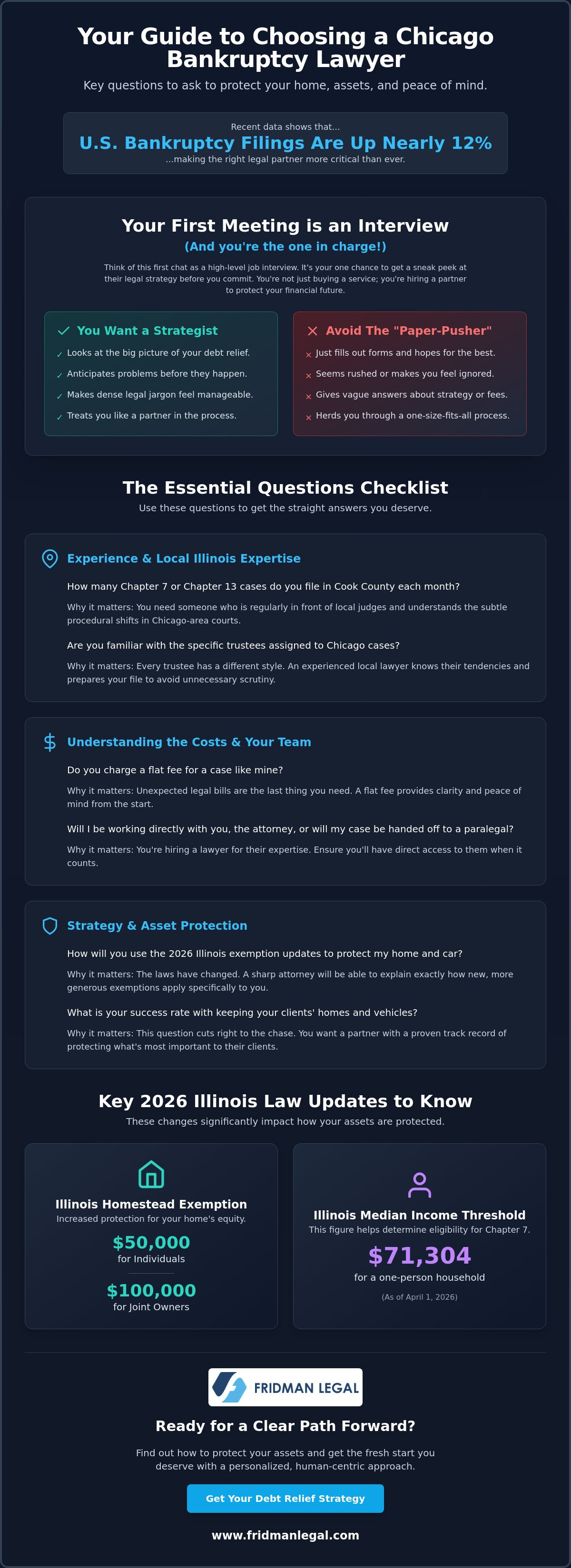
When you're interviewing potential counsel, you need to look past generic legal degrees. You want to know exactly how they operate in the Northern District of Illinois. One of the most telling questions to ask a bankruptcy lawyer Chicago is how many Chapter 7 or Chapter 13 cases they file in Cook County every single month. High volume doesn't always mean quality, but a lawyer who isn't regularly in front of local judges might miss the subtle procedural shifts that happen in our courts. You should also ask if they're familiar with the specific trustees assigned to Chicago cases. Every trustee has a different style or focus; knowing these nuances helps your attorney prepare your file to avoid unnecessary scrutiny.
The financial landscape changed significantly in early 2026. For example, as of April 1, 2026, the median income threshold for a one person household in Illinois is $71,304. If your income fluctuates, you need to know how your lawyer handles the Illinois Means Test. This isn't just about plugging numbers into a calculator; it's about strategic timing. A seasoned professional understands the Bankruptcy Basics but applies them with local precision. They should be able to tell you their success rate with keeping homes and cars, especially given the updated 2026 exemption limits. If you're curious about how your specific income affects your options, a professional review of your debt relief strategy can provide much needed clarity.
Navigating the Illinois-specific bankruptcy rules
Effective January 1, 2026, the Illinois homestead exemption increased to $50,000 for individuals and $100,000 for joint owners. You must ask your lawyer how they'll use these specific protections for your personal property. Local court procedures in Northbrook can differ slightly from the downtown Chicago calls. Having nearly twenty years of local experience ensures that your case doesn't get tripped up by a minor local rule that a national bankruptcy mill might overlook.
Experience beyond just filing the paperwork
Filing the petition is only the beginning. You need to know if your lawyer has experience with adversary proceedings or disputes with aggressive creditors. Complications like unlisted assets can pop up later; you want a partner who knows how to amend a filing without losing protection. If you're specifically looking at a Chapter 7 bankruptcy Illinois filing, these tactical questions are even more vital. Getting clear answers now prevents expensive surprises later. A strategist will always look at the long term implications of your filing rather than just the immediate paperwork.
Understanding the costs and the "who" behind your case
Once you've verified a lawyer's experience, it's time to talk about the logistics of your partnership. You don't want to feel like a case number in a high volume "bankruptcy mill." One of the most revealing questions to ask a bankruptcy lawyer Chicago is whether you'll be working directly with the attorney or if your file will be handed off to a paralegal. While support staff are valuable, you're paying for legal expertise. You need to know that the person representing you at the creditors' meeting is the same person who designed your strategy. If you can't get a straight answer about who will be answering your emails, that's a signal to look elsewhere.
Price transparency is just as critical. Most reputable Chicago firms offer a flat rate for Chapter 7 filings, but you have to dig into what that actually covers. Does the fee include the mandatory creditors' meeting? What happens if a creditor challenges your filing or if you need to amend your schedules later? You should also distinguish between legal fees and court costs. As of 2026, the verified court filing fee for Chapter 7 is $338, while Chapter 13 is $313. If a quote seems unusually low, check if these administrative costs are hidden in the fine print. For a clear breakdown of how we handle these details, you can reach out for a transparent legal partnership.
The transparency check: No hidden surprises
A flat-fee structure is generally the most predictable choice for consumer bankruptcy. It prevents the anxiety of watching the clock every time you have a question. Beyond the filing fees, you'll also need to account for credit counseling and debtor education courses, which typically cost between $15 and $50. You can find more detail on these requirements through consumer resources from the U.S. Trustee Program. Always insist on a written fee agreement. It should clearly define the scope of work so there's no confusion about what's included in the price.
Communication: Will you take my calls?
Communication is the foundation of professional integrity. Ask about the firm's policy for returning calls or emails. You're going through a major life transition; you shouldn't have to wait days for an update on your "Automatic Stay" or the status of your discharge. A strategist who values your interests will prioritize clear, timely updates. We believe that professional support should be both expert and accessible. You deserve a lawyer who speaks to you with the respect and clarity that a serious financial fresh start requires.
Strategy questions: What actually happens to your assets?
The core of your consultation should focus on the tangible results for your property. You aren't just looking for a way out of debt; you're looking for a way to keep what you've worked hard to build. One of the most vital questions to ask a bankruptcy lawyer Chicago is which specific chapter they recommend for your situation and exactly why they've made that choice. For example, if you're facing foreclosure, a Chapter 13 filing might be the only way to catch up on missed payments over three to five years. Conversely, if your income is below the April 2026 threshold of $71,304 for a single person, a Chapter 7 might be the faster, more efficient route to a fresh start. You also need to ask about the biggest risk they see in your file. Every financial situation has a potential pitfall, whether it's a recent large purchase or a specific asset that's difficult to exempt.
A strategist won't just tell you what the law says; they'll tell you how it applies to your specific car, bank account, and retirement fund. They should explain the alternatives to bankruptcy too. In some cases, a debt settlement lawyer might be able to negotiate with creditors without a court filing. However, if bankruptcy is the best path, you need to know how they plan to stop wage garnishment immediately. The moment your case is filed, the "Automatic Stay" goes into effect, which legally prevents creditors from touching your paycheck or calling your home. If you want to ensure your property is shielded correctly, protect your assets through a strategic bankruptcy filing by speaking with a professional who understands the nuances of the 2026 Illinois laws.
Protecting your most valuable possessions
You should ask specifically about the Illinois "Wildcard Exemption." As of 2026, this allows you to protect up to $4,000 of any personal property, or $8,000 if you're filing a joint case with your spouse. This is often used to save cash in a bank account or equity in a vehicle that exceeds the standard $3,600 motor vehicle exemption. A skilled lawyer knows how to stack these exemptions like building blocks to keep your assets safe from the trustee.
The "What If" scenarios
It's common to worry about mistakes. Ask what happens if you accidentally forget to list a medical bill or a credit card debt on your initial petition. A good attorney can usually amend the schedules to include these debts later. You should also clarify how the filing affects your spouse if you're the only one filing. Generally, your bankruptcy won't appear on their credit report, but if you have joint debts, the creditor might still pursue them for payment unless you've chosen a Chapter 13 plan that accounts for those co-signed liabilities.
Finding the right fit with Fridman Legal in Northbrook
Choosing the right advocate is the final, most important piece of your financial recovery. You've prepared your list of questions to ask a bankruptcy lawyer Chicago; now you need a firm that provides transparent, strategic answers. O. Allan Fridman brings nearly twenty years of local experience to every case. This isn't just about knowing which forms to file. It's about having a deep understanding of the Cook County court system and the specific expectations of local trustees. We focus on removing the weight of debt from your shoulders so you can focus on rebuilding your life. Our Northbrook office provides a professional, discreet environment where you can discuss your situation face-to-face without the chaos of a downtown mega-firm.
We understand that the "vibe check" we mentioned earlier is a vital part of the process. You need to feel heard and respected. We've built our practice on a commitment to a conversational, stress-free client experience. You aren't just another file in a cabinet; you're a person who deserves a fresh start. We take the time to explain the complexities of the 2026 Illinois exemptions so you never feel left in the dark. By handling the heavy lifting of the legal process, we give you the space to breathe and plan for what comes next.
A results-driven approach to your fresh start
We view Chapter 7 and Chapter 13 as powerful tools for stability rather than just legal escape routes. Our background in civil litigation provides a unique advantage in complex cases. If a creditor becomes aggressive or challenges your filing, we have the tactical expertise to defend your interests vigorously. We aren't just filing paperwork; we're protecting your future with professional integrity. If you're ready to see how a strategist can change your outlook, you can contact us for a consultation today.
Your next steps toward financial freedom
Scheduling your first conversation with us is a straightforward process. During your initial strategy session, we'll review your debts, assets, and goals to determine the most effective path forward. We'll look at specific 2026 data, like the $134,366 income threshold for a four person household, to ensure your filing is timed perfectly. Here is what you can expect during our first meeting:
- A thorough review of your current income and debt obligations.
- A detailed explanation of how the $50,000 homestead exemption protects your equity.
- A clear answer on whether Chapter 7 or Chapter 13 provides the best protection for your car.
- A transparent breakdown of our flat fee structure with no hidden surprises.
There's no judgment here, only expert support focused on your long term success. To learn more about how we can help you stop creditor harassment and protect your home, visit our bankruptcy services page and take that first step toward a debt free life.
Take the final step toward your fresh start
You now have a clear understanding of how the 2026 Illinois exemptions protect your home and car. Choosing the right legal partner is the most important decision you'll make for your financial future. Armed with these specific questions to ask a bankruptcy lawyer Chicago, you can now find a professional who actually listens and plans for your long term success. You deserve a strategist who knows the Cook County court system inside and out. At Fridman Legal, we offer nearly 20 years of local legal experience and the personalized attention of O. Allan Fridman himself. We specialize in the nuances of Cook County bankruptcy procedures to ensure your assets stay protected under the law. We handle the complicated paperwork and creditor calls so you can focus on rebuilding your life. Schedule your free strategy session with Fridman Legal today and put your debt behind you for good. You've already done the hard work of researching your options; now it's time to secure the fresh start you deserve.
Frequently Asked Questions
How much does a bankruptcy lawyer typically cost in Chicago?
Legal fees for bankruptcy vary based on the complexity of your financial situation and the chapter you file. While we don't quote specific legal fees here, you should account for the standard court filing fees, which are $338 for Chapter 7 and $313 for Chapter 13 as of 2026. Most reputable firms offer a flat-fee structure for consumer cases, which provides predictability and ensures you aren't billed for every phone call or email.
Do I really need a lawyer to file bankruptcy in Illinois?
You aren't legally required to have a lawyer, but filing "pro se" is exceptionally risky. Bankruptcy involves strict deadlines and complex Illinois exemption laws that changed significantly in early 2026. Without professional guidance, you might accidentally omit assets or fail the Means Test, leading to a dismissed case or the loss of property. A strategist ensures your filing is accurate and your assets are fully protected from the start.
Can a Chicago bankruptcy lawyer stop my wage garnishment immediately?
Yes, filing for bankruptcy triggers an "Automatic Stay" that halts most collection actions instantly. This legal injunction stops wage garnishments, bank levies, foreclosure sales, and even harassing phone calls from creditors. Your attorney will notify your employer and the creditors as soon as the case number is assigned. It's one of the fastest ways to regain control over your monthly income and stop the financial bleed.
What questions should I ask about the Illinois Means Test?
Ask your lawyer how they handle deductions and the timing of your filing to ensure you qualify for Chapter 7. As of April 1, 2026, the median income threshold for a one person household in Illinois is $71,304. If your income is close to or above this limit, you'll want to know which specific expenses can be used to offset your gross earnings. The goal is to move through the test with precision to secure a total debt discharge.
Will my lawyer go to the meeting of creditors with me?
A dedicated attorney will always attend the 341 meeting of creditors with you to provide professional support. This is one of the vital questions to ask a bankruptcy lawyer Chicago before you sign a retainer agreement. You shouldn't be handed off to a "coverage attorney" who doesn't know your file. Having your actual lawyer there ensures that the trustee's questions are answered accurately and that your interests are defended if any complications arise.
How do I know if I should file for Chapter 7 or Chapter 13?
The choice depends on your specific goals, such as keeping a home with significant equity or simply wiping out credit card debt. Chapter 7 is a liquidation process that discharges most unsecured debts in a few months. Chapter 13 is a reorganization plan that allows you to catch up on missed mortgage or car payments over three to five years. Your income level and the nature of your assets will ultimately dictate which path is strategically sound.
What is the first thing a bankruptcy lawyer will ask me?
Your lawyer will first ask for a comprehensive list of what you own and what you owe. They need to see the "big picture" of your financial life to determine your eligibility and identify potential risks. Be prepared to discuss your household income from the last six months and any major property transfers you've made recently. This transparency allows them to build a strategy that shields your property using the latest 2026 Illinois exemptions.
Can I keep my car if I file for bankruptcy in Cook County?
Most people in Cook County keep their vehicles by using the state's specific property exemptions. Illinois law allows a $3,600 motor vehicle exemption, and you can often "stack" this with the $4,000 wildcard exemption for a total of $7,600 in protected equity. If you're still making payments, you'll generally keep the car as long as you stay current. Your lawyer will help you decide if a reaffirmation agreement or a Chapter 13 plan is the best way to secure your transportation.

Article by
O. Allan Fridman
O. Allan Fridman has been practicing law since 2001. His practice is unique in that he does not view himself as a litigation attorney or transactional attorney. Rather, he views each area of law as a tool to pursue the best results for his clients. By practicing in both areas of law, he is able to take a 360-degree view of law. This enables the firm to catch potential drawbacks that are readily identifiable.
By practicing in litigation and transactional law and taking a holistic approach in dealing with our clients, he doesn’t put clients in box — rather, as we are all individuals, so too are the legal services we may require.
Whether it is bankruptcy or litigation or transactional, each client brings challenges and does not fit in any one box. Often times, bankruptcy clients end up not filing bankruptcy because we can achieve a better result through litigation or through an out-of-court resolution with the lender, or through a real estate sale. On the other end of the spectrum, a litigation client with multiple issues and lawsuit may fare better in a bankruptcy.
Since 2001, Allan has practiced in states and federal court, and he is a member of the trial bar of the Northern District of Illinois and admitted in the Northern District of Indiana.
We are a debt relief agency. We help people file for bankruptcy relief under the Bankruptcy Code
The materials on this site are for informational purposes only and do not constitute legal advice. Viewing this site or contacting us does not create an attorney–client relationship, and you should not act or refrain from acting based on any information here without seeking professional legal counsel.