

Paying off a large chunk of your debt right now might seem like the most honest way to handle a financial crisis, but it could actually jeopardize your legal standing if you eventually need to file for bankruptcy. Many people believe that settling credit card debt before bankruptcy is the safer bet for their credit score, yet they often overlook the "look-back" period that allows a trustee to reclaim those payments. It's easy to feel paralyzed by the stigma of bankruptcy or the confusion of potential tax bills on forgiven debt. You just want the collection calls to stop and a clear path to protect your home and your car.
You're going to learn the specific risks and rewards of settling versus filing so you can finally move toward a future with zero debt. With U.S. credit card debt now exceeding $1.23 trillion, the strategy you choose matters more than ever. We'll break down the 2026 Illinois exemption updates, such as the increased $50,000 homestead protection, and explain how to navigate the 90-day preferential payment rule without losing your hard-earned assets.
Key Takeaways
- Understand why a lump-sum settlement might feel like the right move but often lacks the long-term legal protection provided by a bankruptcy discharge.
- Discover how settling credit card debt before bankruptcy can trigger the 90-day preferential payment rule, allowing a trustee to reclaim those funds from your creditors.
- Learn about the hidden financial traps of debt settlement, such as the potential tax liabilities on forgiven debt that you won't face in a bankruptcy filing.
- Evaluate your debt-to-income ratio and local asset equity to see if the 2026 Illinois exemption updates offer a more secure path to a fresh start.
- Find out how a personalized legal strategy can help you choose between debt negotiation and filing to ensure your home and car remain protected.
Can You Actually Settle Credit Card Debt Before Jumping into Bankruptcy?
Yes, you can absolutely try to resolve your balances before setting foot in a courtroom. Many people look into settling credit card debt before bankruptcy because they want to honor their obligations without the public record of a filing. Debt settlement is a voluntary agreement between you and a lender to close an account for a fraction of the balance. It usually involves offering a lump sum of cash in exchange for the creditor forgiving the rest of what you owe.
In 2026, the credit landscape has shifted significantly. With total U.S. credit card debt now exceeding $1.23 trillion, banks have become much more pragmatic about their recovery efforts. If they sense you are on the verge of insolvency, they'd often rather take a guaranteed payment now than risk getting nothing at all through a Chapter 7 liquidation. This shift makes negotiation a viable, though complex, first step for many residents in the Chicago area.
The Mindset of Debt Settlement
The "B-word" carries a heavy stigma that keeps many people stuck in a cycle of high interest and aggressive collection calls. You might feel that Debt settlement is the more noble route because it feels like a compromise rather than an escape. The emotional weight of dealing with debt collectors is exhausting, and a settlement can feel like a way to regain control. However, you have to be honest about whether this is a permanent cure or just a temporary band-aid. If you have $50,000 in total debt and settle one $5,000 card, you still have $45,000 hanging over your head. True financial peace requires looking at the whole picture, not just the loudest caller.
How Creditors View Your Financial Distress
Banks are cold calculators. They know that once you file for bankruptcy, their chance of recovering unsecured debt drops to nearly zero in many cases. This is why a creditor might accept 40 cents on the dollar today. They are gambling. They hope to get something before you seek legal protection. But you should stay alert; while you are trying to negotiate, that same creditor could still file a lawsuit against you. Settling credit card debt before bankruptcy requires a precise timeline. If you move too slowly, a wage garnishment could start before you ever reach an agreement. Creditors will push for the maximum they think they can get, often using the threat of litigation to force your hand.
The Pros and Cons of Debt Settlement vs. Filing for Bankruptcy
Settlement often feels like the path of least resistance. You avoid the courtroom and keep your name off the public bankruptcy dockets. However, the Federal Trade Commission guide on debt relief warns that these programs aren't without significant risks. While settling credit card debt before bankruptcy might seem cheaper, the financial reality often tells a different story. Bankruptcy offers a "discharge," which is a permanent legal order that forbids creditors from ever bothering you again. Settlement, on the other hand, is just a contract. If a creditor sells your account to a third party before you finish paying, you might find yourself starting the negotiation process all over again.
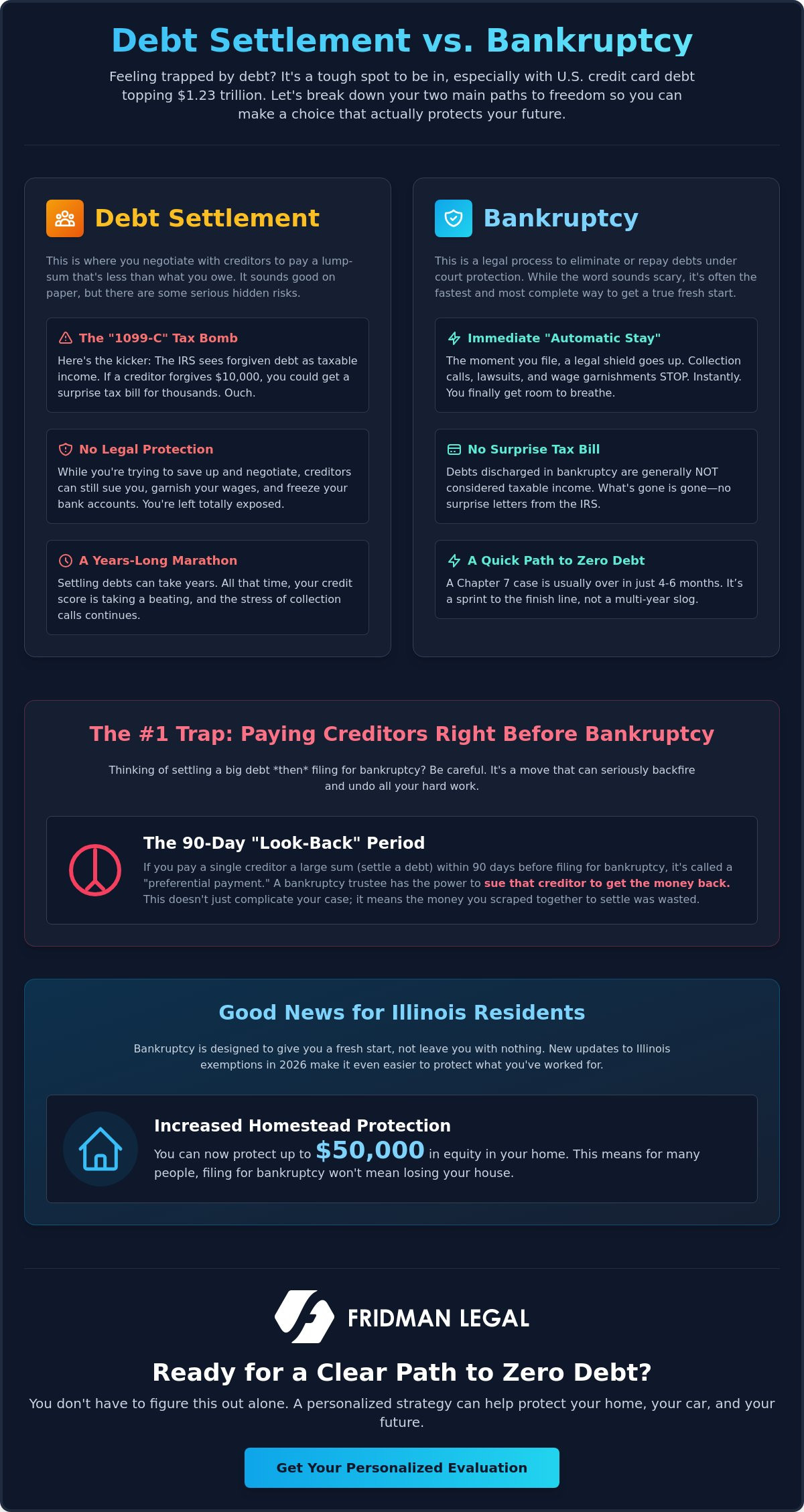
Speed is another factor to consider. A standard Chapter 7 case usually concludes in about four to six months. Debt settlement programs often require you to stop making payments for years to build up enough cash for a lump sum. During those years, your credit is in a freefall and you're vulnerable to lawsuits. Bankruptcy stops that clock instantly. If you're weighing these paths, looking at a comprehensive debt evaluation can clarify which timeline fits your goals.
The IRS and the 1099-C Tax Bomb
The IRS views forgiven debt as income. If you owe $15,000 and settle for $5,000, the $10,000 difference is considered taxable. You'll likely receive a 1099-C form in the mail. If you're in a 25% tax bracket, that "savings" just triggered a $2,500 tax bill you didn't plan for. In contrast, debts discharged through Chapter 7 or Chapter 13 bankruptcy are generally not treated as taxable income. You get the relief without the surprise bill from the federal government. It's a critical distinction that many debt settlement companies fail to mention during their sales pitches.
Credit Score Recovery: The Long Game
Both choices will damage your credit score, but the recovery paths differ. A settlement marks your report as "settled for less than full balance." This stays for seven years and can look like a red flag to future lenders because it shows you didn't fulfill the original contract. Bankruptcy is a major hit initially, but it's a clean break. Many people find they can qualify for a mortgage in Chicago or Northbrook just two years after a Chapter 7 discharge because their debt-to-income ratio has improved so drastically. Bankruptcy allows you to start rebuilding from zero, while settlement can leave you in a credit "limbo" for much longer.
The Preferential Payment Trap: Why Settling Debt Can Backfire
Imagine you've finally saved enough to settle a $10,000 balance for $4,000. You sign the papers, send the wire, and breathe a sigh of relief, thinking that specific headache is over. If your financial situation doesn't improve and you decide to file for bankruptcy two months later, that "settlement" could become a legal nightmare. This happens because of the preferential payment rule. A preferential transfer is any payment over $600 made to a creditor shortly before filing that gives them more than they would have received in the bankruptcy. When you are settling credit card debt before bankruptcy, you are essentially picking favorites, and the court doesn't allow that level of inequity among your creditors.
The law requires that all creditors in the same class receive a fair, pro-rata share of your available assets. By handing a large lump sum to one bank while leaving others with nothing, you've created a preference. This rule doesn't just apply to credit cards; it covers any unsecured debt. If you're planning your financial recovery, you have to look at the calendar as closely as you look at your bank balance.
How a Trustee "Claws Back" Your Hard-Earned Money
The trustee in a Chapter 7 bankruptcy Illinois case has a specific mandate to gather assets for the benefit of all your creditors. If you settled a large balance within 90 days of your filing, the trustee has the power to "claw back" those funds. They can actually sue the credit card company to force them to turn the money over to the bankruptcy estate. While you aren't the one being sued, you'll be caught in the middle of the litigation. It’s incredibly stressful to realize the money you scraped together to settle a debt is being fought over in court months after you thought the account was closed.
Avoiding the "Good Intentions" Mistake
Many people make the mistake of trying to clear their conscience before they file. You might want to pay back a loan from your parents or settle with a local credit union you've used for years. If you pay back an "insider" like a family member or business partner, the look-back period extends from 90 days to a full year. The trustee can go after your relatives to get that money back, which creates massive family tension. To avoid these traps, you need a strategic waiting period. Timing is everything. If you settle a debt today, you might need to wait at least 91 days before filing your petition. Consulting a professional ensures you don't accidentally trigger a claw-back that ruins your fresh start.
How to Decide Between Settling and Filing in the Chicago Area
Deciding which path to take often comes down to a simple math problem. If your total unsecured debt exceeds 50% of your annual income, the odds of successfully settling credit card debt before bankruptcy are slim. You need to look at your debt-to-income ratio with total honesty. If you're struggling to cover basic living expenses in Northbrook while creditors are hounding you for minimum payments, settlement might just be delaying the inevitable. On the other hand, if you have access to a lump sum and your debt is manageable, negotiation could be a viable exit strategy.
The 2026 Illinois exemption updates have changed the "risk" profile of filing for bankruptcy. As of January 1, 2026, the homestead exemption has increased to $50,000 per person. If you and your spouse own a home in Cook County, you can now protect up to $100,000 in home equity. This makes Chapter 7 a much more attractive option for homeowners who were previously afraid of losing their property. When you realize you can keep your home, your car (with the new $3,600 exemption), and still wipe out your debt, the choice often becomes much clearer.
The Lump Sum Problem
One of the biggest hurdles in settlement is finding the cash. I often see people tempted to raid their 401k or IRA to pay off a credit card. This is usually a terrible financial move. Your retirement accounts are fully protected in bankruptcy. If you withdraw that money to settle, you're losing your future security and likely triggering a massive tax penalty. Bankruptcy allows you to keep that retirement nest egg intact while legally discharging the debt you're currently struggling to pay. Don't sacrifice your 65-year-old self to solve a problem that the legal system is designed to handle today.
Living in Cook County: Local Legal Nuances
Local courts in the Chicago area move quickly once a creditor decides to sue. If a bank gets a judgment against you, they can garnish up to 15% of your gross wages. While you are trying to negotiate, the creditor has no legal obligation to stop their lawsuit. However, the new Illinois laws provide an automatic $1,000 protection for funds in a checking or savings account, which offers a small safety net. If you aren't quite ready for the courtroom, consulting a Debt settlement lawyer in Northbrook can help you weigh these local factors. If you're feeling overwhelmed by the complexity of these choices, a professional legal assessment can provide the clarity you need to move forward with confidence.
Navigating Your Debt Relief Options with Fridman Legal
Choosing between settling credit card debt before bankruptcy isn't a decision you should make in a vacuum. O. Allan Fridman understands that every financial crisis has its own unique set of variables. Whether you're dealing with a sudden medical expense or a business downturn, you need a strategy that looks at your entire portfolio. Most debt relief agencies will only push the one service they sell. At Fridman Legal, we evaluate both debt negotiation and bankruptcy filings to see which one actually serves your long-term interests in the Chicago area. We don't believe in a one-size-fits-all approach because your home in Northbrook and your retirement savings deserve a customized defense.
The benefit of working with a lawyer who understands both sides of the coin is clarity. You won't have to wonder if you're making a mistake that will trigger a trustee claw-back or a surprise tax bill. We provide a bridge between the complex regulatory environment and your daily life. Our goal is to move you from a state of constant financial anxiety to a position of strength with a clear, actionable plan. Having local expertise matters when you're dealing with Cook County courts and Illinois-specific exemptions. We know how the local judges and trustees operate, and we use that knowledge to protect your assets.
A Human Approach to Legal Challenges
We've all heard the robotic, detached legal advice that treats you like a line item on a spreadsheet. Our firm focuses on direct, conversational support that cuts through the legal jargon. We're committed to finding the path that saves you the most money while minimizing your emotional stress. During your initial consultation, we'll look at your specific creditors, your current income, and the 2026 Illinois exemption updates. It's about giving you a clear map so you aren't guessing about your financial future. We provide the professional integrity you expect with the supportive guidance you actually need.
Your Next Steps Toward Financial Freedom
Acting early is the most effective way to keep your options open. Once a creditor gets a judgment against you, your ability to negotiate a favorable settlement shrinks. To give you the best advice, we'll need to look at your full list of debts, your monthly expenses, and your asset values. This data allows us to determine if settling credit card debt before bankruptcy is a realistic goal or if a Chapter 7 or Chapter 13 filing provides a more secure shield for your family. We'll help you gather the necessary documents and time your moves to avoid the preferential payment traps we've discussed. Reach out to Fridman Legal today for a confidential review of your case and start your journey toward a debt-free life.
Secure Your Financial Future Today
Choosing the right path out of debt requires more than just a quick calculation of your current balances. We've explored how the specific timing of settling credit card debt before bankruptcy can trigger legal complications like the preferential payment trap, potentially undoing months of your hard work. With the 2026 Illinois homestead exemption now protecting up to $50,000 of your equity, the legal landscape has shifted significantly in favor of those seeking a permanent discharge over a temporary settlement band-aid.
You don't have to navigate these complex regulatory waters alone. O. Allan Fridman brings nearly 20 years of local legal experience to every case, specializing in both Chapter 7 and Chapter 13 filings. We focus on personalized representation to ensure your assets remain protected while you move toward a life free of collection calls and predatory interest charges. It's time to replace financial anxiety with a professional, actionable strategy that actually works. Schedule a confidential debt relief consultation with Fridman Legal to discuss your specific situation. You deserve a fresh start built on a foundation of expert legal guidance and long-term stability.
Common Questions About Debt Settlement and Bankruptcy
Is it better to settle or file for bankruptcy for credit card debt?
The best choice depends on your debt-to-income ratio and the total value of your assets. Bankruptcy provides a permanent legal discharge and generally doesn't result in a tax bill, whereas debt settlement is a voluntary contract that can lead to taxable income on the forgiven portion. If your unsecured debt exceeds 50% of your annual income, bankruptcy is usually the more stable and cost-effective long-term solution.
Will settling a debt stop a bankruptcy trustee from taking my assets?
No, settling a debt doesn't provide asset protection and can sometimes trigger a trustee's intervention. If you use cash to settle a debt right before filing, the trustee may view it as an unfair transfer to one creditor over others. Your assets are actually protected by Illinois legal exemptions, such as the $50,000 homestead exemption, rather than the settlement process itself.
How long do I have to wait to file for bankruptcy after settling a debt?
You should generally wait at least 91 days after making a settlement payment to avoid the standard look-back period. If you file within 90 days of a payment over $600, the trustee has the power to claw that money back from the creditor. If the payment was made to an "insider," such as a family member or business partner, the required waiting period extends to one full year.
Can a creditor still sue me if I am in the middle of a debt settlement?
Yes, creditors maintain the legal right to file a lawsuit or seek a judgment while negotiations are still pending. Debt settlement offers no legal shield against litigation or wage garnishments. Only a bankruptcy filing triggers an automatic stay, which is a court order that instantly stops all collection activities, including active lawsuits and phone calls.
What are the tax consequences of settling credit card debt in Illinois?
The IRS typically treats forgiven debt as taxable income, meaning you'll likely receive a 1099-C form after a successful settlement. For example, if a bank forgives $6,000 of your balance, that amount is added to your taxable income for the year. When you are settling credit card debt before bankruptcy, you must factor in this potential tax "bomb" which doesn't exist for debts discharged through the bankruptcy court.
Can I settle some credit cards and include others in a bankruptcy filing?
You're legally required to list every creditor you owe in your bankruptcy petition, so you can't exclude specific accounts. While you can attempt settling credit card debt before bankruptcy for a few accounts, any significant payments made shortly before your filing will be scrutinized by the trustee. It's often more strategic to address all your unsecured debts at once to ensure a clean financial break.
How does Illinois law protect my home and car during debt relief?
Illinois provides robust exemptions that were significantly increased as of January 1, 2026. You can now protect up to $50,000 in home equity per person and $3,600 in equity for a single motor vehicle. There's also a $4,000 wildcard exemption that you can apply to cash or other personal property, ensuring you keep the essentials while your qualifying debts are wiped away.
What is the "look-back" period for preferential payments in Chicago courts?
The look-back period is 90 days for general creditors like major banks and 365 days for insiders like relatives. During these windows, the trustee reviews any payments totaling more than $600 to ensure no single creditor received more than their fair share. If a payment falls within these timeframes, the trustee can sue the creditor to recover the funds for the benefit of all your other creditors.

Article by
O. Allan Fridman
O. Allan Fridman has been practicing law since 2001. His practice is unique in that he does not view himself as a litigation attorney or transactional attorney. Rather, he views each area of law as a tool to pursue the best results for his clients. By practicing in both areas of law, he is able to take a 360-degree view of law. This enables the firm to catch potential drawbacks that are readily identifiable.
By practicing in litigation and transactional law and taking a holistic approach in dealing with our clients, he doesn’t put clients in box — rather, as we are all individuals, so too are the legal services we may require.
Whether it is bankruptcy or litigation or transactional, each client brings challenges and does not fit in any one box. Often times, bankruptcy clients end up not filing bankruptcy because we can achieve a better result through litigation or through an out-of-court resolution with the lender, or through a real estate sale. On the other end of the spectrum, a litigation client with multiple issues and lawsuit may fare better in a bankruptcy.
Since 2001, Allan has practiced in states and federal court, and he is a member of the trial bar of the Northern District of Illinois and admitted in the Northern District of Indiana.
We are a debt relief agency. We help people file for bankruptcy relief under the Bankruptcy Code
The materials on this site are for informational purposes only and do not constitute legal advice. Viewing this site or contacting us does not create an attorney–client relationship, and you should not act or refrain from acting based on any information here without seeking professional legal counsel.