

What if the relief you felt after finally settling a high-interest debt was replaced by a cold sweat when you opened your tax mail next January? Many people celebrate when they convince a creditor to accept a partial payment, but they often overlook the fact that the IRS usually treats that forgiven balance as taxable income. Understanding the tax implications of debt settlement Illinois taxpayers encounter is vital because a $5,000 debt reduction could suddenly turn into a tax bill you weren't expecting. It's a stressful situation for anyone in Cook County who is already dealing with financial instability and the weight of aggressive collection efforts.
I understand that receiving a 1099-C form can feel like you're being punished for trying to fix your finances. You'll learn exactly how to use insolvency or the updated 2026 Illinois exemptions to protect your assets and keep your tax liability as low as possible. This overview covers how to use federal and state laws, including bankruptcy options, to find a permanent solution that stops the cycle of debt without creating a new crisis with the IRS. We'll look at the specific ways you can shield your bank account and home while ensuring your debt settlement doesn't become a new tax problem.
Key Takeaways
- Forgiven debt is usually seen as taxable income by the IRS, meaning the money you save in a settlement could lead to a surprise tax bill.
- You'll need to watch for Form 1099-C in the mail, which is the official document creditors use to report your canceled debt to the government.
- Understanding the tax implications of debt settlement Illinois residents face is vital, especially since bankruptcy often allows you to discharge debt without any tax penalties at all.
- Illinois generally follows federal tax rules, so a settlement that increases your federal bill will likely increase what you owe the state too.
- Using legal strategies like the insolvency exclusion can help you protect your bank account and home from aggressive collection actions and unnecessary tax liability.
The Hidden Cost of Debt Settlement: Why the IRS Sees Forgiven Money as Income
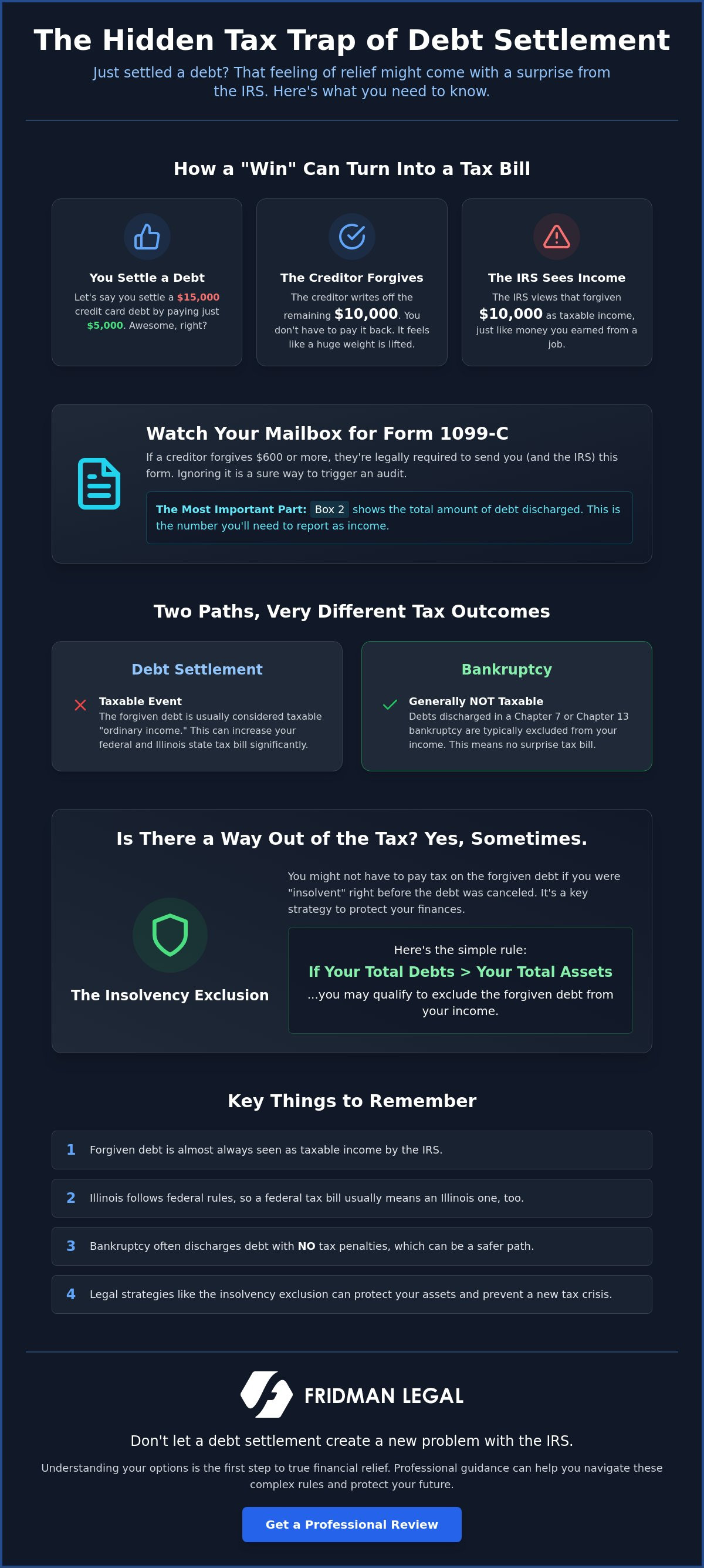
Imagine the relief of finally settling a $15,000 credit card balance for a flat $5,000. You feel like you've finally won a round against the aggressive collectors who've been hounding you. But that feeling of victory can be short-lived. The IRS generally views that "saved" $10,000 as a form of profit. If you didn't have to pay it back, the government decides you effectively earned it as income. It's a frustrating reality that often feels like being kicked while you're trying to stand back up. Understanding the tax implications of debt settlement Illinois residents face is about more than just numbers; it's about avoiding a massive bill when you're already financially vulnerable.
This rule doesn't just apply to credit cards. Whether it's a personal loan, a medical bill, or a private student loan, creditors aren't just going to walk away and forget the balance. They're actually required by law to report that forgiven amount to the government. They do this because they want to write off the loss on their own taxes, which unfortunately puts the tax burden squarely on your shoulders. It's a standard business practice for them, but for you, it's a potential disaster if you aren't prepared for it.
The Psychology of the "Tax Surprise"
Most people experience a "tax surprise" because the settlement happens in one year, but the bill doesn't arrive until the next. If you settle a debt in 2025, you might not see the paperwork until you start your 2026 filings. Any creditor that forgives $600 or more is legally obligated to report it. In simple terms, Cancellation-of-debt (COD) income is the amount of debt you no longer have to pay back, which the IRS then adds to your taxable earnings for the year. This transition from feeling debt-free to feeling tax-burdened can be a heavy psychological blow.
Ordinary Income vs. Capital Gains
One of the biggest misconceptions is that this forgiven debt might be taxed at a lower, "special" rate. Unfortunately, it's treated as ordinary income. This means it's taxed at your standard bracket, just like the money you earn at your job. For a Northbrook family, this extra "income" can easily push you into a higher tax bracket, increasing the percentage you pay on every dollar you earned that year. This amount gets added directly to your W-2 or 1099 earnings, making your total income look much higher on paper than the cash you actually have in your bank account. If you're concerned about how this will hit your specific situation, reaching out for a professional review can help you see the full picture before you sign a settlement agreement.
Understanding Form 1099-C: Your IRS Paperwork Explained
If you've successfully negotiated a lower payment on your balance, the next step isn't just a clean slate. It's a piece of mail. Form 1099-C, officially titled "Cancellation of Debt," is the document creditors use to notify both you and the federal government that a specific amount of money has been forgiven. If you reached a deal in 2025, you should expect this form to land in your mailbox by late January or early February of 2026. It's essential to keep every piece of correspondence from your settlement process to double-check these numbers against the creditor's report.
Ignoring this form is a mistake that usually leads to a direct letter from the IRS. Since the creditor sends a duplicate copy of the 1099-C to the government, their automated matching systems are already looking for that amount on your return. Failing to report it doesn't mean the debt went away; it just means you're inviting an audit. When you're managing the tax implications of debt settlement Illinois residents must be proactive. The state's tax department receives this data as well, so there's no hiding from the paperwork or the potential tax liability.
What Information is on the 1099-C?
When you open the form, focus on Box 2, which shows the total amount of debt discharged. Box 3 is also important because it lists any interest included in that total. You'll also see an "identifiable event" code, which is a single letter explaining why the creditor closed the account. These codes help determine if you qualify for specific exceptions mentioned in IRS Topic No. 431, such as a discharge through bankruptcy or proof of insolvency. Checking these boxes for accuracy is the first step in protecting your financial future.
Dealing with Errors on Your Tax Forms
Creditors make mistakes more often than you'd think. They might report the original balance instead of the forgiven amount or get the date of the settlement wrong. If you spot a discrepancy, you'll need to contact the creditor immediately to request a corrected form. This is where having a clear paper trail from an experienced debt settlement lawyer becomes invaluable. You can't just cross out the number and hope the IRS understands. You need evidence to back up your claim. If you're feeling overwhelmed by the paperwork, you can always request a case evaluation to ensure your rights are being protected during this transition.
Settlement vs. Bankruptcy: Comparing the Tax Consequences
When you're weighing your options for debt relief, it's easy to focus only on the monthly payment. However, the long term ROI of your choice depends heavily on what happens after the debt is gone. The single biggest difference between these two paths is how the government treats the "saved" money. In a standard negotiation, the IRS wants a piece of every dollar a creditor forgives. In contrast, debts discharged through a court order are generally not considered taxable income. This distinction is the primary reason why the tax implications of debt settlement Illinois residents face can often be more expensive than the legal fees of a filing.
Choosing bankruptcy isn't just a way to stop collection calls; it's a strategic tax planning tool. While a settlement company might promise to cut your debt in half, they rarely mention that the Illinois Debt Settlement Consumer Protection Act provides certain safeguards but doesn't shield you from federal tax liability. If you're dealing with a high volume of debt, the "discount" you get from a settlement can be wiped out by a five-figure tax bill the following April. Bankruptcy provides a legal shield that settlement simply cannot match.
The Bankruptcy Advantage in Illinois
For many, a Chapter 7 bankruptcy in Illinois offers the cleanest financial break possible. Under Section 108 of the federal tax code, any debt that is discharged in a bankruptcy case is excluded from your gross income. You don't have to worry about 1099-C forms or "Cancellation of Debt" income. When you look at the total cost of your debt relief, you have to include the potential tax hit. With the 2026 increase in Illinois homestead exemptions to $50,000 per person, more residents can protect their homes while enjoying a completely tax-free discharge of their unsecured debts.
Proving Insolvency to the IRS
If you choose to settle rather than file for bankruptcy, your only hope to avoid a tax bill is the "insolvency exclusion." This requires filing IRS Form 982. To qualify, you must prove that your total liabilities were greater than the fair market value of all your assets immediately before the debt was canceled. It's a complex, document-heavy process. It's important to remember that being "broke" in your head or having a tight monthly budget is different from being "insolvent" on an IRS worksheet. Proving this status usually requires an expert to ensure your assets are valued correctly and your liabilities are fully accounted for.
Illinois State Tax Nuances and Cook County Collection Actions
If you're dealing with the IRS, you're almost certainly going to deal with the Illinois Department of Revenue (IDOR) too. Illinois is what's known as a "piggyback" state, meaning it uses your federal adjusted gross income as the starting point for your state tax return. If the IRS considers your forgiven debt as income, the state will follow suit. When calculating the tax implications of debt settlement Illinois residents must account for the state's flat income tax rate on top of whatever the federal government demands. While the state rate might seem small compared to federal brackets, it's an additional bill that many people simply don't budget for during their negotiations.
The state doesn't just wait for you to pay. Illinois is notoriously aggressive about collecting unpaid tax debt. They have a 10-year statute of limitations to come after you, which is a long time to have a debt hanging over your head. During that decade, they can use tools like wage garnishment or even the suspension of your professional licenses to force a payment. It's a high-stakes game where the state holds most of the cards, especially if you haven't planned for the aftermath of a settlement.
IDOR Collection Tactics to Watch For
A tax deficiency isn't just a number on a screen; it can become a physical reality very quickly. One of the most common moves the state makes is placing a lien on your property. For a family in Northbrook, this means you can't sell or refinance your home without satisfying the tax debt first. Beyond real estate, the state can also initiate bank account levies. While a 2026 rule in Illinois protects up to $1,000 in your bank account from being frozen, the rest of your balance is fair game for the state. Reviewing the Illinois Department of Revenue collection process shows just how quickly they can move once a debt is finalized. They don't need a court order in the same way a private creditor does, making them a far more dangerous entity to ignore.
The Impact on Local Professionals
If you're a business owner or a licensed professional, the risks are even higher. Illinois has the power to withhold or revoke business certificates and professional licenses if you have outstanding state tax liabilities. There's also the "hold personally responsible" rule. In some cases, the state can look past a corporate structure and hold individual officers or owners personally liable for unpaid taxes. This is why having local, strategic representation is so important. You need someone who understands the specific hurdles in Cook County and can help you navigate these state-level threats before they derail your career. If you're facing these pressures, consulting with a debt negotiation expert can help you find a path that protects both your assets and your livelihood.
Protecting Your Future: Why Professional Legal Guidance Matters
Dealing with debt is exhausting enough without having to become an amateur tax expert. You shouldn't have to spend your nights worrying about whether your settlement will trigger an IRS audit or a state tax lien. This is where professional guidance changes the equation. By working with a Northbrook expert like O. Allan Fridman, you stop guessing and start planning. A lawyer doesn't just look at the immediate savings; they look at the long term tax implications of debt settlement Illinois residents often overlook. Whether it’s negotiating a settlement that limits your tax exposure or identifying that bankruptcy is actually the more profitable path, having an advocate ensures you aren't trading one debt for another.
One of the biggest hurdles is the uncertainty of the cost. Many people avoid legal help because they fear billable hours will eat up their savings. At our firm, we prioritize a transparent, flat-fee approach for bankruptcy filings. This gives you the peace of mind to focus on your recovery instead of watching the clock. You get a partner who understands how to navigate the 2026 exemption changes and the aggressive collection tactics of Cook County, allowing you to move forward with a strategy that actually works.
The Fridman Legal Approach to Debt Relief
With nearly 20 years of experience in bankruptcy law and debt negotiation, Fridman Legal doesn't just process paperwork. We look at your entire financial landscape. This includes your residential real estate, your business interests, and your future tax liabilities. Our philosophy is results-driven but human-centric. We know that every case represents a family or a professional trying to regain their footing. We provide a clear, strategic path forward so you know exactly what your options are from day one. There are no hidden surprises, just a focused plan to get you back to zero.
Your Next Steps in Northbrook
The path to financial freedom starts with a simple, direct conversation. We'll sit down and look at your unique situation without the typical legal jargon. Every day you wait is another day that interest accumulates and the risk of a tax surprise grows. We'll help you decide if a Chapter 7 filing is the right way to protect your assets or if a negotiated settlement is truly in your best interest. Don't let the fear of the IRS keep you in a cycle of instability. Schedule a consultation with Fridman Legal today and take the first step toward a future where you own your finances again.
Take Control of Your Financial Recovery
Settling your debt for a fraction of what you owe is a major milestone, but it's only half the battle. The IRS and the Illinois Department of Revenue are often waiting for their share of that forgiven balance. Understanding the tax implications of debt settlement Illinois residents face in 2026 is the best way to prevent a financial relief measure from turning into a long term tax crisis. Whether you're navigating the complexities of a 1099-C form or deciding if bankruptcy offers a cleaner, tax-free discharge, you don't have to make these decisions in the dark.
With over 20 years of local legal experience, O. Allan Fridman provides the personalized representation you need to evaluate your options under Chapters 7, 11, or 13. You deserve a strategy that protects your home and your bank account from aggressive state collection actions while maximizing your financial recovery. Contact Fridman Legal to discuss your debt relief options and tax strategy today. You've worked hard to address your debt; now let's make sure you keep the relief you've earned and start your next chapter with confidence.
Frequently Asked Questions
Is debt settlement always considered taxable income in Illinois?
Most forgiven debt is treated as taxable income unless you qualify for a specific exclusion like insolvency or a bankruptcy discharge. Since Illinois uses your federal adjusted gross income as a baseline, any amount the IRS taxes will likely show up on your state return too. It's a common trap for residents who don't realize that a savings on a credit card balance is viewed as a financial gain by the government.
What happens if I settle a debt but don’t receive a 1099-C form?
You are still legally responsible for reporting the canceled debt even if the creditor fails to mail you a form. The IRS receives a digital copy of every 1099-C issued for debts of $600 or more, so their automated systems will eventually flag the discrepancy on your return. It's best to use your own settlement records to report the income accurately and avoid late filing penalties that can reach $340 per form.
Can I avoid taxes on settled debt if I am insolvent?
Yes, you can exclude canceled debt from your income if your total liabilities were greater than the fair market value of all your assets at the time of the settlement. This is known as the insolvency exclusion. Proving this status requires filing IRS Form 982 and providing a detailed snapshot of your finances. It's a precise calculation where even your retirement accounts and household furniture are counted toward your total asset value.
How does filing for Chapter 7 bankruptcy change my tax obligations?
Filing for Chapter 7 bankruptcy provides a legal shield that standard debt settlement simply doesn't offer. Under federal law, debts discharged through the court are not considered taxable income, so you won't owe the IRS or the state a penny on that forgiven balance. This is often the most effective way to handle the tax implications of debt settlement Illinois residents face, especially with 2026 rules protecting more of your home's value.
Will the Illinois Department of Revenue come after me for taxes on forgiven debt?
Yes, the Illinois Department of Revenue is very active in collecting taxes on reported forgiven debt. Because Illinois is a piggyback state, they automatically see the income reported to the federal government. If you don't pay the state portion, they can use aggressive tactics like wage garnishment or placing a lien on your property. They have a ten year window to collect, making it a long term risk for your financial stability.
Can a debt settlement lawyer help reduce my tax liability?
An experienced lawyer can help by reviewing your total financial picture to see if you qualify for the insolvency exclusion or if bankruptcy is a smarter path. They also ensure that your settlement letters are drafted correctly to reflect the actual amount forgiven. Having a professional negotiator can prevent creditors from reporting incorrect data that could lead to a much higher tax bill than you actually owe.
What is the "identifiable event" code on my 1099-C?
The identifiable event code is a single letter in Box 6 of your 1099-C that explains why the creditor stopped trying to collect. For example, Code A refers to a bankruptcy discharge, while Code G refers to a formal agreement like a settlement. These codes are vital because they tell the IRS which tax rules apply to your specific situation and whether you might be eligible for a particular exclusion.
Are there any debts that are excluded from being taxed when forgiven?
Bankruptcy discharges are the most common exclusion, but the rules for other debts have become stricter. Starting January 1, 2026, many federal student loan forgiveness programs are once again treated as taxable income because the temporary pandemic era exclusions have expired. This return to pre-pandemic tax regulations makes it essential to verify the current status of any debt you're planning to settle before you sign a final agreement.

Article by
O. Allan Fridman
O. Allan Fridman has been practicing law since 2001. His practice is unique in that he does not view himself as a litigation attorney or transactional attorney. Rather, he views each area of law as a tool to pursue the best results for his clients. By practicing in both areas of law, he is able to take a 360-degree view of law. This enables the firm to catch potential drawbacks that are readily identifiable.
By practicing in litigation and transactional law and taking a holistic approach in dealing with our clients, he doesn’t put clients in box — rather, as we are all individuals, so too are the legal services we may require.
Whether it is bankruptcy or litigation or transactional, each client brings challenges and does not fit in any one box. Often times, bankruptcy clients end up not filing bankruptcy because we can achieve a better result through litigation or through an out-of-court resolution with the lender, or through a real estate sale. On the other end of the spectrum, a litigation client with multiple issues and lawsuit may fare better in a bankruptcy.
Since 2001, Allan has practiced in states and federal court, and he is a member of the trial bar of the Northern District of Illinois and admitted in the Northern District of Indiana.
We are a debt relief agency. We help people file for bankruptcy relief under the Bankruptcy Code
The materials on this site are for informational purposes only and do not constitute legal advice. Viewing this site or contacting us does not create an attorney–client relationship, and you should not act or refrain from acting based on any information here without seeking professional legal counsel.