

Did you know that Illinois currently holds the fifth-highest foreclosure rate in the nation, with one in every 833 homes facing a filing in early 2026? If you're one of the many homeowners feeling the weight of these statistics, you aren't alone. It's easy to feel like the bank has all the power when you're struggling with understanding the Illinois foreclosure process and the confusing legal jargon that comes with it.
We understand that the fear of a sudden eviction can be paralyzing. However, Illinois is a judicial foreclosure state, which means the law provides you with specific protections and a timeline that is often longer than you might expect. This guide breaks down that complex timeline into simple steps so you can find the right legal exit ramp for your family.
You'll learn exactly how much time you have to reinstate your mortgage, when the redemption period actually ends, and how filing for bankruptcy can serve as a powerful tool to stop the clock entirely. By the end of this guide, you'll have a clear roadmap of the specific deadlines you need to hit to keep your front door keys in your pocket.
Key Takeaways
- Since Illinois is a judicial foreclosure state, the bank can't just take your home overnight; they have to go through a court process that gives you time to react.
- Gaining a firm understanding of the Illinois foreclosure process helps you spot the 90-day reinstatement window and the seven-month redemption period before it's too late.
- You'll discover how filing for Chapter 13 bankruptcy triggers an "automatic stay," which acts as an immediate legal wall to stop a foreclosure sale in its tracks.
- We'll help you navigate the confusing legal jargon and thick stacks of court papers so you can find the specific deadlines that protect your family's future.
The Pre-Foreclosure Phase: What Happens Before the Lawsuit
Missing that first mortgage payment feels like a punch to the gut. You might expect a sheriff at your door the next morning, but that isn't how it works. Foreclosure is a legal process that moves through specific, regulated stages. In Illinois, the period before a lawsuit is filed is actually your most valuable window for saving your home. While the bank might seem silent, they're following a strict script. Gaining a clear understanding the Illinois foreclosure process starts here, in these early months when you still have the most leverage to negotiate.
The bank doesn't want your house; they want the interest on your loan. This is why they don't sue you immediately. They'll typically start with friendly reminders, then move to more formal late notices. However, once you receive the "Breach Letter," the situation changes. This document is essentially a final demand. It warns you that if you don't pay the past-due amount by a specific date, they'll "accelerate" the loan, meaning they'll demand the entire balance at once. This is the point of no return for informal phone calls, making it the best time to consult a Northbrook lawyer to discuss foreclosure defense strategies.
The Magic Number: 120 Days of Delinquency
Federal law is actually on your side during the first few months. Under most circumstances, your mortgage servicer can't officially start the foreclosure in court until you're more than 120 days behind on your payments. This four month buffer is designed to give you time to explore options like loan modifications or repayment plans. Instead of hiding from the mail, use this time to get your financial house in order. You'll need to gather tax returns, pay stubs, and bank statements. The bank tracks every time they try to reach you. Showing you're proactive can make a big difference later.
The Grace Period Notice and Housing Counselors
In Illinois, you'll likely receive a very specific document called a Grace Period Notice. This isn't just another bill. It's a mandatory legal step that gives you an extra 30 days to seek help before the bank can move forward. It will often list HUD-approved housing counselors who can help you look at your budget. While these counselors are great for financial advice, they aren't lawyers. They can't file legal motions or defend you in a courtroom. This is why having a legal advocate is vital even if you're already speaking with a counselor. You need someone to ensure the bank is following the rules while you're trying to fix the problem.
The Judicial Process: When the Bank Files a Complaint
If you've received a thick stack of legal papers, the "pre-foreclosure" phase has officially ended. In many states, a bank can sell your home without ever seeing a courtroom. Fortunately, Illinois's judicial foreclosure process is much more protective of homeowners. Here, a lender must file a formal lawsuit and prove their case to a judge before they can even think about an auction. Understanding the Illinois foreclosure process at this stage is about realizing you have a seat at the table. You aren't just a bystander; you're a defendant with specific legal rights.
The most critical document in that stack is the Summons. It tells you that you have exactly 30 days from the date you were served to file a formal "Answer" with the court. If you ignore this deadline, the bank will likely ask for a Default Judgment. This is essentially a win by forfeit. It allows the bank to move straight toward a sale without you ever getting to tell your side of the story. If you're feeling overwhelmed by the paperwork, reaching out for civil litigation representation can help you meet these deadlines and protect your interests.
Service of Summons: Being "Served" in Cook County
In places like Cook County, a Sheriff’s deputy or a private process server will deliver these papers to you. Some people think that if they don't answer the door, the case can't start. This is a dangerous mistake. Lenders can eventually ask the judge for "special service," which might involve leaving the papers with a family member or even publishing a notice in a local newspaper. Once you're served, look closely at the Complaint. Banks make mistakes too. They might have the wrong loan balance or fail to attach the correct mortgage documents. These errors can become the foundation of your defense.
The Difference Between a Default and a Contested Case
When you file an Answer, the case becomes "contested." This simple act can buy you months of additional time. A contested case requires the bank to go through the discovery process and prove they have the legal "standing" to sue you. If your goal is understanding the Illinois foreclosure process, you'll see that contesting the case allows your lawyer to negotiate for a better outcome, like a short sale or a loan modification, while the clock is slowed down. In a year like 2026, where foreclosure rates are climbing, using every legal tool available is the best way to keep your home.
Reinstatement vs. Redemption: Your Two Last-Chance Windows
Once the legal machine starts moving, many homeowners feel a sense of hopelessness. They assume that because they've been served with a summons, the house is already gone. That simply isn't true. Under the law, you have two specific "last-chance" windows to halt the proceedings. One allows you to catch up on what you owe, while the other allows you to buy back the property entirely. Gaining a clear understanding the Illinois foreclosure process means knowing exactly which window is still open for you and how much it will cost to climb through it.
The first and most accessible option is reinstatement. This is your right to "cure" the default by paying only the past-due amounts, late fees, and the bank's legal costs. If you can pull this off, the lawsuit is dismissed, and you go back to your regular monthly payment schedule as if the default never happened. However, if you can't reinstate, you still have the right of redemption. This is a longer window, but it requires paying off the entire loan balance, plus interest and fees. While this is a taller mountain to climb, it's often the stage where homeowners look into refinancing or selling the property themselves to preserve their equity.
The 90-Day Reinstatement Clock
The law gives you exactly 90 days from the date you were served with the summons to reinstate your mortgage. It's vital to calculate this date correctly because once those three months pass, the bank isn't legally required to accept a partial payment. You'll need to request a "reinstatement quote" from the bank’s attorneys. This quote will include your missed principal and interest, but it also includes the 9% statutory interest rate on judgments and any filing fees the bank paid to start the case. Once you pay this total, the Illinois foreclosure process stops immediately.
The Redemption Period: 7 Months or 3 Months?
The redemption period is much more generous but also more expensive. Generally, you have seven months from the date you were served or three months after a judgment is entered, whichever is later, to pay off the full loan. This is the "financial reality" phase. If you're still in the home and it hasn't been abandoned, you have this time to find a new lender or a buyer. Be careful, though; if a judge finds that you've abandoned the property, this window can shrink to just 30 days. Don't pack your bags too early, but don't leave the house empty either, as staying present is your best defense for keeping this timeline intact.
The Judicial Sale and the Final Move-Out Date
If the redemption period expires and you haven't been able to refinance or sell the property, the case moves toward the judicial sale. This begins with a Notice of Sale, which is a public announcement of the auction date. The bank must publish this notice in a local newspaper for three consecutive weeks. While this feels like the end, the sale itself is just another step in understanding the Illinois foreclosure process. You still have rights during this transition, and the house isn't legally transferred to a new owner the moment the gavel falls.
In Illinois, the sale isn't final until a judge confirms it. This usually happens at a "Motion to Confirm Sale" hearing held a few weeks after the auction. At this hearing, the judge ensures the sale was conducted fairly and that all legal notices were sent correctly. If the judge signs the order, they will also issue an Order of Possession. This order typically includes a 30-day "stay," which gives you one final month to live in the home and arrange your move. It's a vital buffer that prevents you from being forced out onto the street without warning.
What Happens at a Foreclosure Auction?
Most auctions in Cook County and the surrounding suburbs don't actually result in a third-party buyer. In many cases, the bank is the only bidder. They "credit bid" the amount of the debt they're owed. If an outside investor does buy the home for less than what you owe, the bank might seek a "deficiency judgment" against you for the difference. On the flip side, if the house sells for more than the total debt, you're actually entitled to that "surplus cash." It's rare, but it happens, and you should always have a professional check the sale results to see if money was left on the table.
The Final 30 Days: Planning Your Exit
Once the 30-day stay of possession expires, the new owner can place the Order of Possession with the Sheriff. The Sheriff is the only person with the legal authority to physically remove you from the property. You should never wait for a knock on the door from a deputy. Instead, use this time to negotiate. Sometimes, a bank or investor would rather pay you a small "Cash for Keys" settlement to leave the property in good condition than deal with the cost and delay of a Sheriff's eviction. If you're facing this final stage, reaching out for foreclosure defense can help you negotiate a more dignified exit or explore last-minute options to stay.
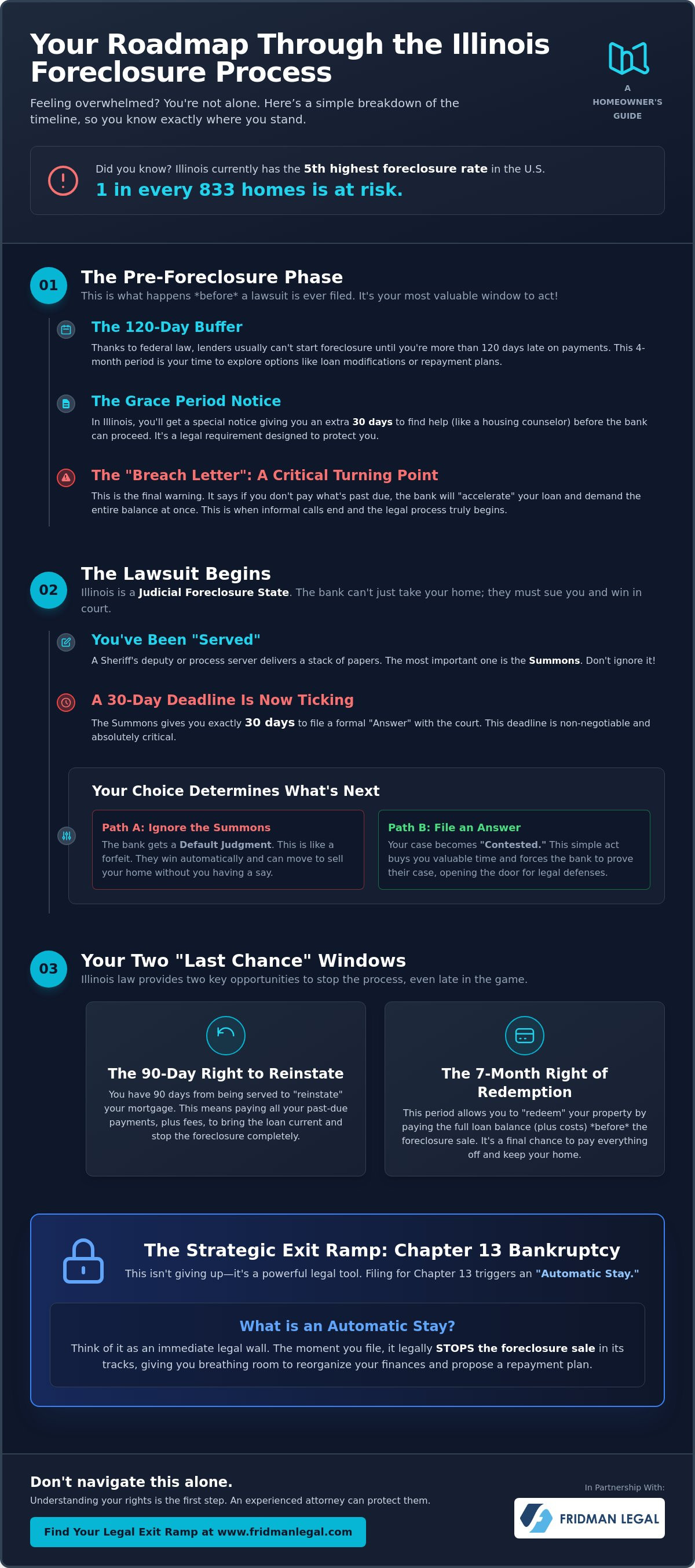
Strategic Exit Ramps: How Bankruptcy Stops Foreclosure
Many homeowners view bankruptcy as a last resort, but in reality, it's often the most powerful tool for understanding the Illinois foreclosure process and taking back control. When you file for bankruptcy, the court issues what's called an "Automatic Stay." This is a legal shield that immediately stops almost all collection actions, including foreclosure sales. If the bank has scheduled an auction for tomorrow morning, a filing today puts up a legal wall they aren't allowed to cross without specific permission from a judge.
The choice between different bankruptcy chapters depends entirely on your ultimate goal. Do you want to keep the house at all costs, or do you just need a graceful way to walk away without a mountain of debt? Timing your filing is the most important decision you'll make because it determines how much of the timeline you can actually reset. By integrating bankruptcy into your strategy, you move from a desperate defense to a calculated, strategic plan that puts you back in the driver's seat.
Saving the House with Chapter 13
If you have a steady income but fell behind due to a temporary hardship, Chapter 13 is likely your best bet. It allows you to take all those missed payments, interest, and fees and roll them into a 3-to-5-year repayment plan. As long as you make your new monthly payments and stay current on the plan, the bank can't touch your home. You can even stop a sale that is literally hours away. To see if this fits your situation, you can read more about Chapter 13 vs. Chapter 7: Which is Right For You?
The Chapter 7 "Delay and Discharge" Strategy
Sometimes, the math simply doesn't work to keep the home, and that's okay. In these cases, Chapter 7 can be a brilliant strategic move. While it doesn't provide a long-term catch-up plan, it usually buys you an extra 3 to 4 months of living in the home without making payments. Most importantly, it wipes out your personal liability for the mortgage. This means if the house eventually sells for less than you owe, the bank can't come after your paycheck for the difference. Consulting with a Chapter 7 bankruptcy lawyer in Northbrook can help you determine if you qualify based on your current income.
Taking Control of Your Future
A "Strategic Bankruptcy" isn't about giving up; it's about using federal law to fix a problem that the state court process couldn't solve. Understanding the Illinois foreclosure process requires knowing when to stop fighting the bank in state court and when to move the battle to a venue that offers more protection. O. Allan Fridman has spent years helping Northbrook families navigate these heavy choices with precision and discretion. You don't have to wait for a knock on the door to start building your exit ramp. Contact Fridman Legal for a free foreclosure strategy session to see which path protects your family's future best.
Securing Your Home’s Future and Your Peace of Mind
The legal path ahead might look intimidating, but you now have the roadmap to navigate it. Remember that because Illinois is a judicial foreclosure state, you have time to explore every exit ramp, from reinstatement to a strategic bankruptcy filing. Truly understanding the Illinois foreclosure process is the first step toward reclaiming your peace of mind and protecting your family's stability. You don't have to face the bank's attorneys alone or guess which deadline matters most.
With nearly 20 years of experience in Illinois debt relief, O. Allan Fridman provides the personalized representation you need to find a way forward. Our Northbrook office serves families across Chicago and the surrounding suburbs with the professional integrity your case deserves. Whether you're looking to save your home through a Chapter 13 plan or need a clean start, we're here to guide you through the complexities of the law.
Take the next step and Talk to a Northbrook Foreclosure Defense Lawyer Today. There's always a solution when you have the right advocate in your corner.
Frequently Asked Questions
How long can I live in my house after a foreclosure is filed in Illinois?
You can typically stay in your home for 12 to 15 months, and sometimes even longer, after the initial filing. Because Illinois is a judicial state, the bank has to move through several court stages before a sale occurs. Even after the auction is confirmed, a judge will usually grant you a final 30-day stay of possession. This timeline gives you substantial breathing room to plan your next move or fight the case.
Can the bank still sue me if the house sells for less than I owe?
Yes, the lender can seek a deficiency judgment if the auction price doesn't cover your total loan balance. This judgment allows them to pursue your other assets or garnish wages to recover the remaining debt. However, this isn't automatic in every case. Filing for Chapter 7 bankruptcy is a common strategy to discharge this personal liability, ensuring you walk away from the property without a lingering financial burden following the sale.
Will filing for bankruptcy stop a foreclosure sale that is already scheduled?
Filing for bankruptcy triggers an immediate "automatic stay" that halts a scheduled foreclosure sale right in its tracks. This legal protection applies even if the auction is set for the very next morning. While it's a powerful tool for understanding the Illinois foreclosure process, the timing is critical. You must file the petition before the gavel falls at the auction to ensure the property remains under your control and the court's protection.
Do I have to move out as soon as I get the foreclosure summons?
No, you don't need to pack your bags when you receive a summons. The summons is simply the formal notice that a lawsuit has begun, not an eviction order. You have a right to defend the case and remain in the home throughout the entire judicial process. Moving out too early can actually hurt your case, as an "abandoned" property can lead to a much shorter redemption period for the lender.
What is the difference between reinstatement and redemption in Illinois?
Reinstatement allows you to "cure" the default by paying only the past-due amounts and fees within 90 days of being served. Redemption is a longer window, usually seven months, but it requires you to pay off the entire loan balance to keep the home. Reinstatement is the more affordable "catch-up" option, while redemption often requires a full refinance or a private sale to a third party to satisfy the debt.
Can I sell my house myself while it is in the foreclosure process?
You absolutely have the right to sell your house privately at any point before the judicial sale is confirmed by a judge. If the home is worth less than the debt, you'll need the bank's permission for a "short sale." If you have equity, a traditional sale can help you pay off the lender and keep the remaining cash. Selling the property yourself is often the best way to preserve your credit score and avoid an eviction.
How much does a foreclosure defense attorney cost in Chicago?
Legal fees for foreclosure defense in the Chicago area vary depending on whether the case is contested or uncontested. Most firms use either a flat fee for specific stages or a monthly retainer to manage the ongoing litigation. While it's difficult to cite a universal price, most homeowners find that the cost of professional representation is significantly lower than the financial loss of an undefended foreclosure or a future deficiency judgment.
What is a "Consent Foreclosure" and should I consider it?
A consent foreclosure is an agreement where you waive your right to defend the case in exchange for the bank waiving their right to a deficiency judgment. It's a strategic way to walk away from a property without the risk of future wage garnishments. You should consider this option if you have no equity and no desire to keep the home, as it provides a predictable and clean exit from the mortgage debt while understanding the Illinois foreclosure process.

Article by
O. Allan Fridman
O. Allan Fridman has been practicing law since 2001. His practice is unique in that he does not view himself as a litigation attorney or transactional attorney. Rather, he views each area of law as a tool to pursue the best results for his clients. By practicing in both areas of law, he is able to take a 360-degree view of law. This enables the firm to catch potential drawbacks that are readily identifiable.
By practicing in litigation and transactional law and taking a holistic approach in dealing with our clients, he doesn’t put clients in box — rather, as we are all individuals, so too are the legal services we may require.
Whether it is bankruptcy or litigation or transactional, each client brings challenges and does not fit in any one box. Often times, bankruptcy clients end up not filing bankruptcy because we can achieve a better result through litigation or through an out-of-court resolution with the lender, or through a real estate sale. On the other end of the spectrum, a litigation client with multiple issues and lawsuit may fare better in a bankruptcy.
Since 2001, Allan has practiced in states and federal court, and he is a member of the trial bar of the Northern District of Illinois and admitted in the Northern District of Indiana.
We are a debt relief agency. We help people file for bankruptcy relief under the Bankruptcy Code
The materials on this site are for informational purposes only and do not constitute legal advice. Viewing this site or contacting us does not create an attorney–client relationship, and you should not act or refrain from acting based on any information here without seeking professional legal counsel.