

Imagine checking your mobile banking app only to see a "frozen" status or a balance that's suddenly been wiped out. It's a gut-punch moment that usually happens without any warning, leaving you wondering how you'll pay for gas or groceries this afternoon. If you're dealing with this right now, you're likely looking for immediate ways for stopping a bank levy in Cook County before your checks start bouncing and your bills pile up. It feels like the system is rigged against you, but the law actually provides specific windows of time to get your money back.
You're probably feeling overwhelmed and confused about how a creditor could do this without a direct heads-up. We understand that frustration; nobody should be left without access to their own survival funds. This guide is here to show you exactly how to unfreeze your bank account and use the latest Illinois legal protections to shield your cash. We'll break down the new 2026 exemption rules, including the $1,000 automatic protection, and explain the steps you need to take during the critical 20-day hold period to keep your money where it belongs.
Key Takeaways
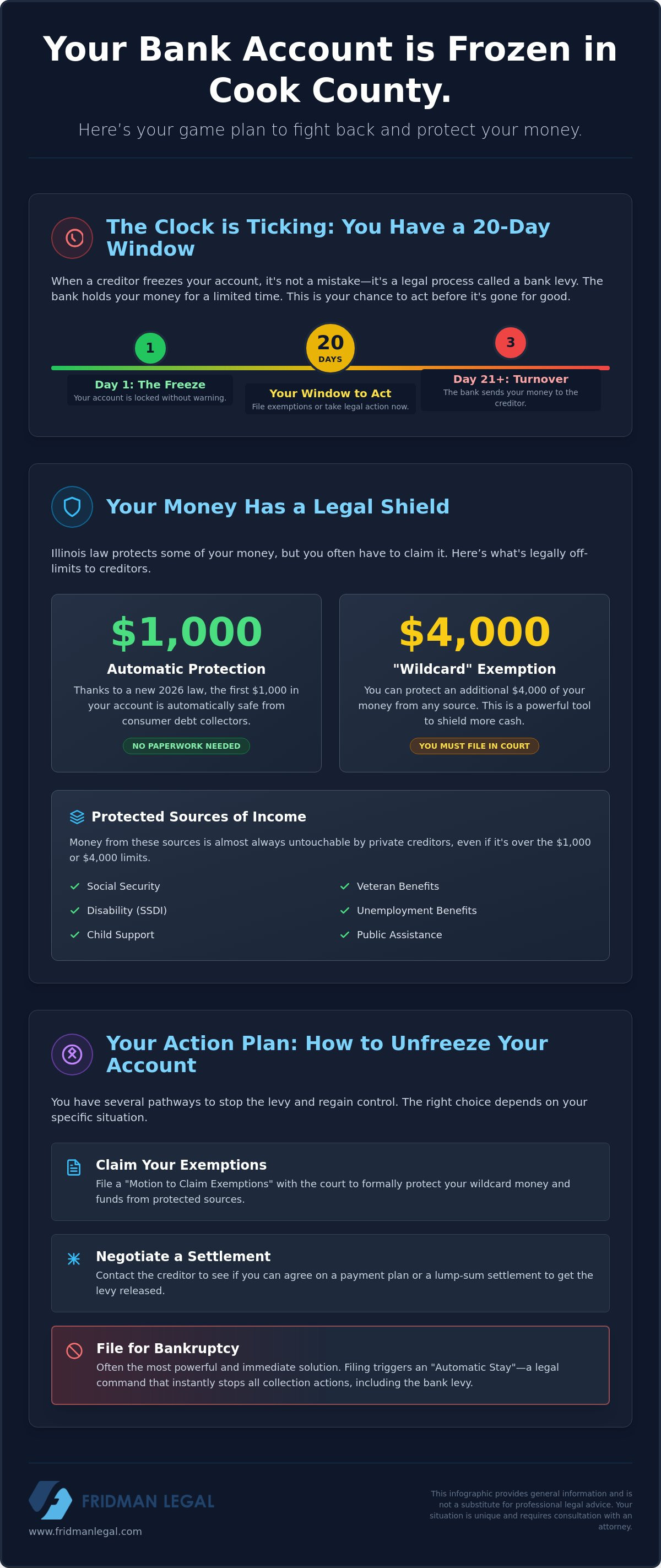
- You have a critical 20-day window to act once your bank freezes your funds, so moving quickly is the only way to prevent a permanent loss of cash.
- Under the 2026 Illinois law, the first $1,000 in your account is automatically protected from consumer debt collectors without you needing to file a single piece of paperwork.
- You can use the $4,000 "wildcard exemption" to shield additional money in your account, but you must formally claim this protection in court to get your funds released.
- Filing for bankruptcy is often the most reliable method for stopping a bank levy in Cook County because it creates an immediate legal wall that freezes all collection efforts.
- Negotiating a settlement or challenging the underlying judgment are viable paths if you have the right timing and a strategic approach to dealing with the creditor.
What Exactly is a Bank Levy and Why is Your Cook County Account Frozen?
If you've just discovered your bank account is inaccessible, you're likely experiencing the reality of a bank levy. Essentially, What Exactly is a Bank Levy is a legal process where a creditor, after winning a lawsuit against you, gets a court order to take money directly from your checking or savings account. In Cook County, this process moves with cold efficiency. Once your bank receives the legal summons, they're legally required to freeze your funds immediately. This isn't a mistake or a bank error; it's a aggressive collection tactic designed to ensure the creditor gets paid before you have a chance to move your money.
The most frustrating part for many people is that there's no requirement for the creditor or the bank to warn you before the freeze happens. You usually find out at the checkout line or when an auto-pay bill fails. This lack of notice is intentional. It prevents people from withdrawing their balance before the freeze takes effect. If you're looking for ways of stopping a bank levy in Cook County, understanding this timeline is your first step to regaining control of your financial life.
The Difference Between a Freeze and a Turnover
A freeze doesn't mean your money is gone yet. It just means it's in a state of legal limbo. During a freeze, the bank holds the funds so you can't spend them, but they haven't sent them to the creditor. In Illinois, banks are generally required to hold these funds for 20 days. This is your window of opportunity. A turnover, on the other hand, is the final stage. This is when the court signs an order telling the bank to actually mail your money to the creditor. Once that turnover order is signed and the money leaves the bank, getting it back becomes significantly more difficult. You have a very narrow window, usually those 20 days, to file exemptions or take legal action to stop the process.
How the Creditor Found Your Bank
You might wonder how a creditor even knew where you banked. They have several tools at their disposal. The most common is a "citation to discover assets," which is a legal document that requires you or third parties to disclose where your assets are held. Sometimes, it's even simpler. If you've ever written a check to the creditor or used a bank account to make a payment on the debt in the past, they already have your routing and account numbers on file. Once a judgment is active, your financial privacy becomes legally limited as creditors gain the right to track your assets through public records and subpoenas. If you're currently in this situation, stopping a bank levy in Cook County requires acting before that 20-day clock runs out.
What Funds Are Safe? Illinois Exemptions You Need to Know
Just because your account is frozen doesn't mean the creditor has a right to every penny. Illinois law provides specific safeguards to ensure you aren't left completely destitute. However, there's a catch. The court won't step in and protect your money on its own. You have to be the one to stand up and say, "This money is legally mine to keep." In the Cook County Circuit Court, this usually involves filing a "Motion to Claim Exemptions." If you're currently focused on stopping a bank levy in Cook County, knowing which laws are on your side is your strongest defense.
Protected Sources of Income
Certain types of money are almost always off-limits to private creditors. This includes Social Security, Disability (SSDI), and veteran benefits. If your account contains public assistance funds, unemployment benefits, or child support payments you receive for your children, these are also protected. The key is to show that the frozen funds came from these specific sources. It's much easier to prove this if you keep these funds in a separate account; but even if they're mixed with other money, you can still fight to get them released. You'll need to provide bank statements that trace the money back to the exempt source.
The $4,000 Wildcard Rule and New 2026 Protections
Beyond specific income types, you have access to what's called a "wildcard" exemption. As of January 1, 2026, Illinois law has become even more protective of your daily survival funds. Under Public Act 104-0297, the first $1,000 in your bank account is now automatically exempt from levies related to consumer debt. This means the bank shouldn't even touch that first thousand. For anything above that, you can apply the broader $4,000 Illinois personal property exemptions.
You get to choose how to use this $4,000 limit. If you have a car with equity or expensive tools for your trade, you might split the exemption between those items and your cash. It's a strategic decision. Keep in mind that these exemptions are per person. If you and your spouse have a joint account, you might be able to protect up to $8,000 in total wildcard value plus any automatic exemptions. Navigating these filings can be complex; so having a professional review your specific situation can help ensure you don't leave money on the table. You only get one chance to assert these rights before the turnover order is signed and the money is gone for good.
Your Options for Thawing a Frozen Bank Account
Once you've identified which funds are legally protected, you need a strategy to address the rest of the balance. The clock is ticking toward that turnover order we discussed earlier. Generally, you have three primary paths to consider: you can try to negotiate a settlement, you can fight the validity of the original judgment in court, or you can seek the immediate protection of a bankruptcy filing. Each path has its own set of hurdles, and the right choice depends on how much you owe and how quickly you need access to your cash.
Negotiating with the Creditor
It might seem counterintuitive to talk to the person who just froze your account, but negotiation is a common way of stopping a bank levy in Cook County. Creditors are often willing to release a levy if you can offer a lump-sum payment that settles a significant portion of the debt. They might also agree to a voluntary payment plan in exchange for unfreezing the account. However, you must realize that the creditor currently holds the upper hand. They've already successfully "caught" your money, so they have little incentive to be generous. If you do reach a deal, don't rely on a phone promise. Ensure you get the agreement in writing before you expect the bank to lift the freeze.
Contesting the Levy in Cook County Court
If there was a major mistake in how the creditor handled your case, you can fight back in court. This usually happens at the Richard J. Daley Center in downtown Chicago or one of the suburban courthouses like Skokie or Bridgeview. You can file a "motion to quash" if you were never properly served with the original lawsuit. If a judge agrees that the creditor skipped legal steps, they can vacate the judgment and force the bank to release the funds. This isn't a DIY project for most people; it requires a formal written motion and a scheduled court appearance where you'll have to argue your case before a judge. It's a high-stakes environment where procedural errors can end your chances of recovery.
While these options can work, they often take time that you don't have. If you need an immediate solution that stops the creditor in their tracks, exploring bankruptcy options might be the most effective route. It provides a legal shield that negotiation simply can't match, especially when dealing with aggressive debt collectors who refuse to budge. Bankruptcy is the most powerful "nuclear option" available, as it doesn't just pause the levy; it can often eliminate the debt entirely.
Why Bankruptcy is Often the Fastest Way to Stop a Levy
While negotiation and court motions have their place, they often feel like trying to plug a dam with your thumb. If you're looking for the most immediate and legally binding method for stopping a bank levy in Cook County, bankruptcy is usually the answer. It doesn't matter if the creditor is a major credit card company or a local collection agency; the moment you file for bankruptcy, a powerful legal shield goes into effect. This isn't just a request for the creditor to be nice. It's a federal court order that they're legally required to obey.
In many cases, bankruptcy can even force a creditor to return money that was recently seized from your account. If the levy happened within the 90 days before your filing and the amount was over a certain threshold, it might be classified as a "preferential transfer." This allows your attorney to demand the funds back so they can be protected under your exemptions. It's a way to not just stop the bleeding, but to actually recover what was lost.
How the Automatic Stay Works
The core of this protection is called the Automatic Stay. To put it simply, the Automatic Stay is a legal injunction that starts the very second you receive a case number from the court. Once it's active, it creates a total freeze on all collection activities. The bankruptcy court sends a formal notice to your creditors and your bank, informing them that they must stop the levy immediately. This applies to almost all types of consumer debt, including medical bills, credit cards, and personal loans. If a creditor ignores this stay and continues to try and take your money, they can face severe penalties from the federal court.
Chapter 7 vs. Chapter 13 for Bank Levies
The type of bankruptcy you choose depends on your long-term goals and your income level. If you're looking to wipe the slate clean and eliminate the debt entirely, Chapter 7 Bankruptcy in Northbrook might be the most efficient path. It usually resolves within a few months and is highly effective at stopping a bank levy in Cook County. However, if you're also struggling with a mortgage and want to save your home from foreclosure, Chapter 13 might be a better fit. It allows you to consolidate your debts into a manageable payment plan while keeping your assets safe from future levies.
Choosing bankruptcy isn't just about unfreezing one account today. It's about building a permanent wall between you and your creditors so you don't have to wake up to a zero balance ever again. If you're tired of living in fear of the next freeze, you should reach out to our team to see which filing option fits your specific financial situation. We can help you navigate the Cook County requirements and get your cash back where it belongs.
Taking Control: How Fridman Legal Helps You Reclaim Your Finances
When your bank account is frozen, you aren't just dealing with a legal technicality; you're facing a genuine household emergency. We understand that every hour your funds are inaccessible is another hour of stress for your family. At Fridman Legal, we don't treat these cases as simple paperwork. We treat them as urgent matters that require immediate, strategic action. Our goal is to move as quickly as the Cook County court system allows to protect what's yours.
O. Allan Fridman brings twenty years of local experience to every case, which is vital when you're navigating the specific quirks of the Cook County Circuit Court. Whether your situation calls for a calculated debt settlement or a full bankruptcy filing, we look at your entire financial landscape. We don't just want to unfreeze one account today; we want to ensure you have a sustainable path forward that prevents creditors from ever catching you off guard again. Stopping a bank levy in Cook County requires a deep understanding of how local judges and banks interact, and that's exactly what we provide.
What to Expect During Your Consultation
We believe in transparency, especially when you're already feeling the weight of financial uncertainty. During our initial talk, we'll dive straight into the details of the judgment against you. We'll identify exactly which Illinois exemptions apply to your situation so we can maximize the amount of money you keep. We'll also discuss your ultimate goals. Some clients need a quick settlement to move on, while others require the total "fresh start" that bankruptcy offers. To keep things simple, we use a clear, flat-fee plan. You'll know exactly what the costs are upfront, so there are no hidden surprises during an already stressful time.
Ready to Unfreeze Your Account?
The most important thing you can do right now is act before that 20-day window closes. If you wait until the turnover order is signed, the bank is legally required to send your money to the creditor, and getting it back at that point is nearly impossible. You have rights under the new 2026 Illinois laws, but those rights only work if you assert them in court. Don't let a creditor dictate your financial future through silence and delay. Reach out to us today, and let's start the process of putting the law back on your side. You can get a free consultation with Fridman Legal to discuss the best way of stopping a bank levy in Cook County and securing your cash.
Secure Your Financial Future Today
Dealing with a frozen account is incredibly stressful, but you don't have to navigate the Cook County courts alone. We've explored how the 20-day window is your most critical asset and how the 2026 Illinois exemptions provide a path to reclaiming your hard-earned cash. Whether you're asserting your wildcard rights or looking for a permanent shield through a bankruptcy filing, taking immediate action is the only way to prevent your funds from being turned over for good. If you're focused on stopping a bank levy in Cook County, the right strategy can be the difference between a zero balance and a full recovery.
O. Allan Fridman brings nearly 20 years of Illinois bankruptcy experience to your specific case, ensuring you receive personalized representation that actually fits your goals. We provide flat-fee services for complete transparency; you can focus on your finances without worrying about mounting legal costs. Don't let a creditor's aggressive tactics define your life. Talk to a Cook County Bankruptcy Lawyer Today and start moving toward the stability you deserve. You have the power to fix this, and we're here to help you do it.
Frequently Asked Questions
Can a creditor freeze my bank account without telling me first?
Yes, creditors are legally permitted to freeze your account without prior notification. They do this to ensure that you don't withdraw or transfer the funds before the bank can secure them. While you should've received notice of the original lawsuit, the actual levy summons is served directly to your bank first. You typically only discover the freeze when a debit card transaction is declined or a check bounces.
How much money is protected from a bank levy in Illinois?
Under the 2026 Illinois laws, the first $1,000 in your account is automatically protected from consumer debt levies. Beyond that, you can apply a $4,000 wildcard exemption to protect additional cash. This brings the potential total to $5,000 per person, provided you file the necessary paperwork in court. If you're married and have a joint account, these amounts can effectively double to protect your household cash.
Can I still use my debit card if my account is levied?
You generally cannot use your debit card once a levy is in place. When the bank receives the summons, they freeze all funds up to the amount of the judgment. If the judgment is larger than your current balance, your entire account becomes inaccessible. Any attempt to use your card or withdraw cash will be declined until the legal hold is resolved through a court order or a signed settlement agreement.
How long does it take to unfreeze a bank account after filing for bankruptcy?
Unfreezing an account after filing for bankruptcy typically takes between 24 and 48 hours. Once we file your case and get a case number, we immediately notify your bank's legal department. The Automatic Stay requires them to release the hold. While the legal protection is technically instant, it takes a short amount of time for the bank's internal processing systems to update your account status and restore access.
What happens if the money in my account is from Social Security?
Money from Social Security or Disability payments is legally exempt from being taken by private creditors. Even if your account is frozen, the bank cannot turn this money over to the creditor if you can prove its source. You'll need to file a motion to claim these exemptions in the Cook County Circuit Court. It's helpful to keep these funds in a separate account to make the tracing process much simpler for the judge.
Can a bank levy be stopped without filing for bankruptcy?
Yes, stopping a bank levy in Cook County is possible through negotiation or by contesting the original judgment. You might reach a settlement where the creditor agrees to release the levy in exchange for a lump sum payment or a voluntary payment plan. Alternatively, if you weren't properly served with the lawsuit, a lawyer can file a motion to vacate the judgment. This effectively cancels the levy and forces the bank to release the funds.
Will my bank charge me a fee for the levy?
Most banks charge a significant administrative fee for processing a levy summons. This fee is separate from the money the creditor is trying to take and is usually deducted directly from your account balance. You should check your bank's fee schedule for "legal processing" or "levy" charges. This cost is added to your financial burden, which is why it's so important to act quickly before the bank processes the final turnover.
What is the "Wildcard Exemption" in Illinois and how does it work?
The Wildcard Exemption allows you to protect up to $4,000 of any personal property you choose, including cash in a bank account. It's a flexible tool that helps in stopping a bank levy in Cook County by legally shielding your money from creditors. You must proactively claim this exemption in court. If you don't file the right paperwork, the judge will assume you've waived your right to protect that specific portion of your assets.

Article by
O. Allan Fridman
O. Allan Fridman has been practicing law since 2001. His practice is unique in that he does not view himself as a litigation attorney or transactional attorney. Rather, he views each area of law as a tool to pursue the best results for his clients. By practicing in both areas of law, he is able to take a 360-degree view of law. This enables the firm to catch potential drawbacks that are readily identifiable.
By practicing in litigation and transactional law and taking a holistic approach in dealing with our clients, he doesn’t put clients in box — rather, as we are all individuals, so too are the legal services we may require.
Whether it is bankruptcy or litigation or transactional, each client brings challenges and does not fit in any one box. Often times, bankruptcy clients end up not filing bankruptcy because we can achieve a better result through litigation or through an out-of-court resolution with the lender, or through a real estate sale. On the other end of the spectrum, a litigation client with multiple issues and lawsuit may fare better in a bankruptcy.
Since 2001, Allan has practiced in states and federal court, and he is a member of the trial bar of the Northern District of Illinois and admitted in the Northern District of Indiana.
We are a debt relief agency. We help people file for bankruptcy relief under the Bankruptcy Code
The materials on this site are for informational purposes only and do not constitute legal advice. Viewing this site or contacting us does not create an attorney–client relationship, and you should not act or refrain from acting based on any information here without seeking professional legal counsel.